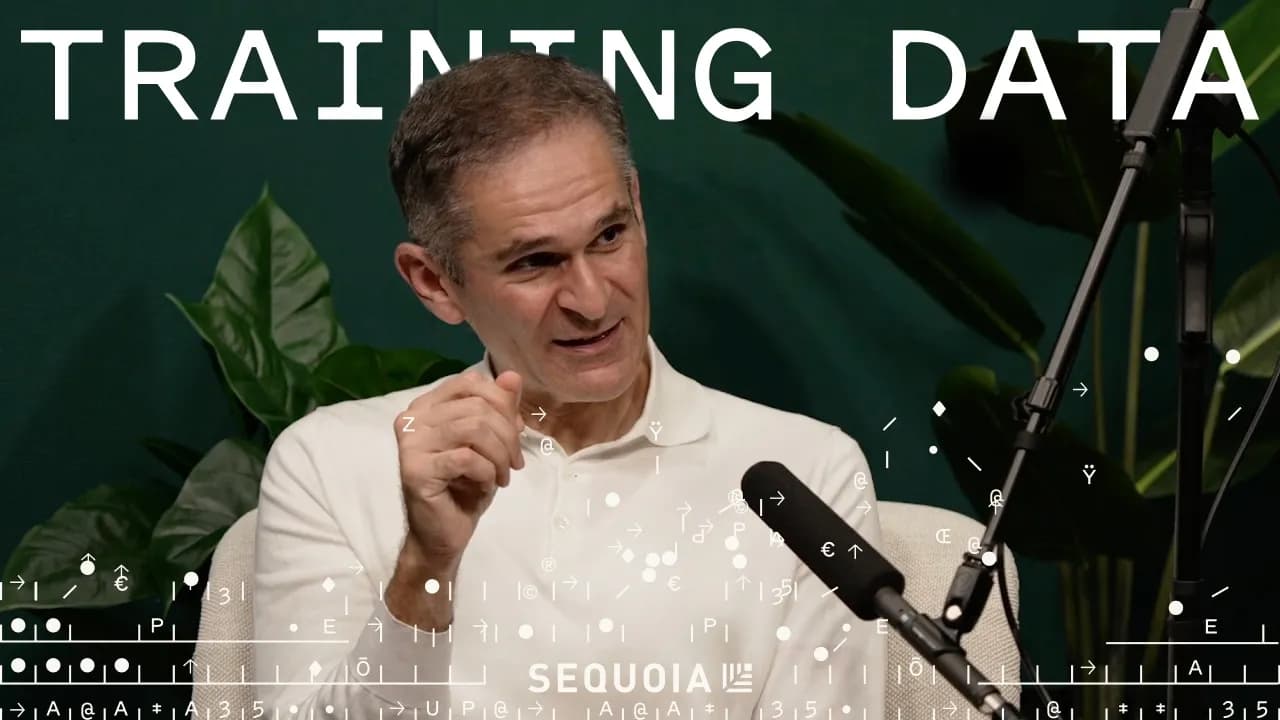
Starcloud's Philip Johnston: Why the Cheapest Compute Will Be in Space
In a Nutshell
Starcloud's CEO Philip Johnston demonstrates that space-based data centers, powered by 24/7 solar (8x more efficient than Earth, no land or battery costs), will deliver the cheapest compute once launch prices hit $500/kg via Starship ($10-20/kg target). Starcloud 1 already runs NVIDIA H100 GPUs in orbit, training nanoGPT and inference on Gemini/SAR data, with plans for an 88,000-satellite constellation adding 20 GW for inference workloads at $100B capex. Challenges like heat (solved via radiators and hotter Rubin chips), radiation (ground-tested), and orbits (low-risk dawn-dusk) are addressed, predicting space compute cheaper than Earth in 5-10 years.
These notes were generated by AI and may contain inaccuracies.
Philip Johnston, co-founder and CEO of Starcloud, builds data centers in space for energy advantages. Previous company also abused GPUs in unintended ways. Plans 5 minutes to explain why building data centers in space will soon make more sense than on Earth, followed by 5 minutes of questions.
Shows deployment video of Starcloud 1 with five NVIDIA GPUs, most significant being NVIDIA H100 chip. Separation confirmed. First to prove state-of-the-art terrestrial data center GPUs can run in space, overcoming thermal dissipation and radiation tolerance challenges (bit flips). Trained nanoGPT from Andrej Karpathy, ran version of Gemini, performed high-powered inference on SAR data (satellite data).
Compares solar project on Earth (cheapest Earth energy) to power data center vs. space:
- Earth costs: permitted land (largest in North America), battery storage/backup (for ~4 hours peak/day), solar cells.
- Space advantages:
- No permitted land cost.
- No battery storage (24/7 sun exposure).
- 8x less solar cells needed (1 sqm space panel = 8x energy of 1 sqm Earth panel). Main space cost: launch. Break-even at ~$500/kg (10x reduction from today). Starship targets $10-20/kg.
Filed with SEC for constellation of 88,000 satellites, each ~200 kW, enabling 20 GW new compute capacity (for inference workloads: 3D video generation, back-office agents, code generation). Dawn-dusk sun-synchronous orbit: always in sun, 24/7 power, sub-50 ms latency to Earth, all optically linked. $100 billion capex (lower than terrestrial). Start of largest infrastructure project, Kardashev Type 2/3 (Dyson sphere) civilization.
Space vacuum (3°K ambient) requires large surface area for infrared emission. Solar panels: ~200 W/sqm. Radiator at 50°C: ~800 W/sqm (need ~1/4 more radiator area than solar, e.g., 400 sqm solar needs 100 sqm radiator). Stefan-Boltzmann equation: dissipation ∝ T^4. 50°C to 80°C halves radiator area. Collaborating with NVIDIA on space Rubin 1 chip (run hotter, lower failure; shown at GTC with Jensen demo).
Take seriously for sustainable space use. Low altitude (~400 km) for first satellite: natural deorbit in months, low collision risk. Higher orbits unpopulated (Van Allen belts). SpaceX operates 10,000 satellites in LEO without collisions via sophisticated avoidance. Space maps exaggerate congestion (dots width of California represent tiny objects). Can fit terawatts of compute in dawn-dusk orbit.
Dawn-dusk orbit finite but viable.
Solved via extensive ground testing: 4 rounds at Knoxville cyclotron (proton accelerator), Brookhaven National Lab (heavy ions: 24 hours = 5 years radiation). Informs shielding and software choices.
Exclusively inference (99% of future compute market). Training rare (small % in 5-10 years), requires docking 5 GW structure.
4 km x 4 km structure: Starship launches 40 MW each, connect to central spine + enormous solar panel + 1 km x 4 km radiator. 15+ years away.
Options: next 5 years, 5-10 years, after 10 years, never. Audience votes mixed.
Keep Sequoia Capital in your library
Save the videos and channels worth coming back to, and find them again in one place.