Ground zero responders recount their haunting 9/11 experiences | 60 Minutes Archive
In a Nutshell
Dr. Benjamin Luft launched the World Trade Center Oral History Project to preserve the raw, personal stories of 9/11 responders, rejecting their reduction to mere medical cases. These accounts reveal the toxic exposure that left nearly a third with asthma, 42% with sinusitis, and many with chronic diseases, alongside the persistent post-traumatic stress that responders carry as "luggage" for life. The interviews, now a book and documentary, stand as a permanent record of the responders' sacrifices, their enduring health struggles, and the therapeutic value of telling their stories.
These notes were generated by AI and may contain inaccuracies.
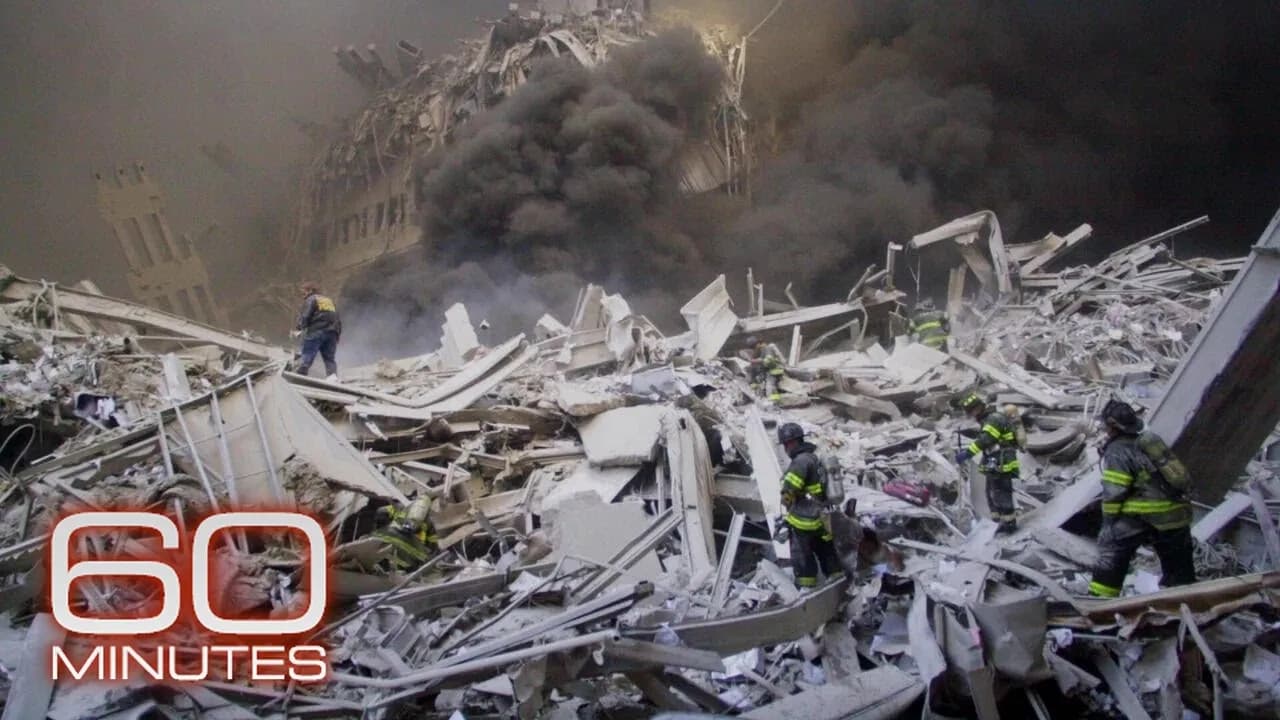
On September 11, Dr. Benjamin Luft prepared Stony Brook University Medical Center on Long Island for the massive number of casualties he expected to overwhelm the emergency room, but none came through the door that day. So few had survived. Dr. Luft's casualties were coming, but they would arrive much later. Although nearly 3,000 people were killed at the World Trade Center, 70,000 others responded to ground zero and worked for months amid toxic smoke and dust. Dr. Luft helped start a clinic to treat the chronic illnesses and psychological trauma suffered by the 9/11 responders.
Over time, Dr. Luft discovered something that he never expected. He began to hear their stories, honest, raw, irreplaceable stories. And almost two years ago, he began to record the definitive history of ground zero, remembering 9/11 in the words of the people who lived it.
The problem that came up was that our society began to look at the responders in terms of their disease. They became an issue in terms of their liability. And my feeling was that that's not who the responders were. Let's find out who they are as human beings, what their motivation was, what values they had, what sacrifices they made, how they were able to renew themselves. It was almost like taking a civics class as to what is important about being a citizen. What is important about being a human being? What is important to being an American?
Stacy Goodman, a police detective, is one of the voices Dr. Luft recorded in what is now called the World Trade Center Oral History Project.
I worked at the makeshift morg. We took in all the bodies. You know, saying I'm sorry for your loss was very difficult because it almost got to be like rote, you know.
At one point, this senior, I think he was a retired fireman. He comes in, his hands are cupped, and he's got bones in his hands. And he goes over to the medical examiner. He puts the bones in front of him. He goes, "This is my son." What do you say to that?
Carol was a cop on the scene before the towers fell.
This big brawny FBI guy had his shield around his neck and uh I looked up at him and he's telling there was about six officers there with me and he's like uh if you want to live you might as well leave now. He said uh we're all going to die. I'm like I can't we can't leave. I'm not leaving. And the officers that I were there with were not leaving either. And we continued to evacuate and do our jobs, but you know, we were all like, "Wow, we're gonna die."
Paulner was trapped when the first tower collapsed. That's her on the left after she pulled herself out of the wreckage. She's with a fellow cop and a woman that they rescued.
I was one of the guys that was able to pull somebody out alive.
So few were saved, but police sergeant Richard Doer helped pull out one rare survivor, a fellow cop named John McLaughlin.
They were given John was uh given John McLaughlin uh morphine because the uh the plan was that if we couldn't extricate him, they were going to cut his legs off. John screamed in pain when we pulled him initially. So, uh, we let him rest and, uh, we simultaneously pulled again and we broke him free and we pulled him out.
Benjamin Luft is a medical doctor who volunteered to help create a clinic for the 9/11 responders at Stony Brook University Medical Center, part of the State University of New York. More than 6,000 responders enrolled in his World Trade Center Health Program. One study shows that nearly a third of those who worked at ground zero have asthma. 42% suffer with sinusitis. Nearly 40% have gastroesophageal reflux disease known as GERD and many have reactive airways dysfunction syndrome that the patients just call RADS.
When you're a physician and you see patients you tend to reduce them to their symptoms and signs to their medical conditions and that's how you think of them.
Dr. Luft listened to their stories in the examining room for eight years when he realized that his patients were the authors of one of the most dramatic chapters of American history.
With his own money, a few donations, and a small mostly volunteer staff, Dr. Luft started his interviews. So far, he's recorded 137.
When the building imploded down, it blew me out of the building, and I was able to hold on to the doorway with my left arm.
The first thing I found was an entire body burned into rebar.
They uh they put a line around our waist. I'm like, "Well, I'm going in this way. I'm snaking around on my belly around." Says, "There's no way you can pull me out." And the guy just looked at me. It wasn't to pull us out. It was just to find us if we died.
Where we expected to see two tall buildings, we just saw a skeleton, the most powerful nation in the world. How could this happen?
There's no clearer rendition of what happened at 9/11 than are in these histories. Who are these people? So, of course, we have the firemen and the policemen and the EMS workers, and then we have the volunteer firemen, and then you have the iron workers and the construction workers and the laborers. On 9/11, all Americans responded from all walks of life.
I was a senior in high school. Uh realized that I have to go down there. I'm not I don't know how I'm going to help. I don't know what it can do.
My whole family's cops. I'm the 13th in my family to be a New York City police officer.
I am a licensed massage therapist. I just felt like I had to be down there helping these people, knowing what I do for a living can help these people.
I work for New York Highway Department. I um you know, road work, construction, stuff like that. Never trained for anything like this. And I learned quick, though.
We spent a few hours with some of the responders at Stony Brook University. And as we listened, we realized that for them, today, Sunday, isn't the 10th anniversary of something that happened. It's the 10th year of something that never ends. In a sense, it's always 9/11.
John Gallagher is a former New York City fire captain suffering with pulmonary fibrosis, scarring of the lungs that only gets worse.
The World Trade Center is still claiming lives. People have had their lives shortened. People have lost their fathers, their mothers to cancers to lung diseases, anything that you can imagine. Bloodborne diseases, people are still dying.
Show of hands, how many of you have been living through medical problems as a result of the work that you did in those days? Almost all of you.
Bill Fischer was a New York City cop, now retired.
I have asthma. I have uh nodules on both lungs. Sinusitis, rhinitis.
I never smoke. I don't drink. I'm I go to the gym as often as I can, and it's not as much as I would like to anymore. I literally have a bucket of about 20 medicines, a plastic bucket that I have to take something during the day.
This is Bill Fischer. He worked at ground zero for 4 months and like thousands of others, he was covered in dust that contained carcinogens, asbestos, and toxins too numerous to list.
Ken George was there, too. He helped recover human remains.
Oh, I got a list. Everybody's got a list. It started with uh the 9/11 cough I had which led me to have RADS restricted airway disease which means I can't get enough oxygen in or out. Like these people said the sinuses I have all that. So it's just snowballing out of control. You know what I mean? And who knows in 5 years down the line if I'm going to wind up with cancer, you know? I just want to make sure my family's taken care of if anything happens. You know, I don't want them out in the street.
Any pain? Paying their medical bills has been a struggle. Funding for the World Trade Center Health Program was never certain until this year when Congress guaranteed coverage, but that guarantee lasts only the next 5 years. The illnesses and the mental trauma are likely to last a lifetime.
One thing nobody's mentioned, but we all have it. It's like luggage and we have it forever, is the post-traumatic stress.
Tyrie Bacon was a senior court officer who worked 10 blocks from the World Trade Center. He reached the towers before they collapsed.
Um, those of us who wear uniforms make a living out of the worst 10 minutes of everybody's lives. 911 was a hell of a lot longer than 10 minutes long. Um, post-traumatic stress is something that I have a issue with. Spent a month after being caught in the collapse, waking up on the floor trying to feel my my way out of my own bedroom. That went on for over a month.
This is Tyrie Bacon in the Oral History Project, remembering a woman who grabbed him by the shirt as one of the towers fell.
And I told her, I said, "Sweetheart, don't worry. I promise we're getting out of here." I flat out lied to her. I thought we were going to die where we were. Um, if I didn't have her, I probably would have curled up in a fetal position and just waited to die.
When that responder went down to ground zero, they were experiencing traumatic events in rapid succession. Buildings falling, girders falling, tripping, you know, people jumping out of buildings, seeing tremendous amounts of carnage, the fires. Now, it's not occurring over a 10-second period of time. It's occurring over weeks and months, and the same person is experiencing it over and over and over again.
The jumpers, I think, were the worst. You know, to actually see them jump and and pulverize just in front of you, you know, that was just horrible.
There was a sound. That that made. That was first. I'm like, I didn't know what that sound was at first and then you go to see what that sound was and you realize that it was a person that had just jumped. If it's that bad up there that you have to jump, you know, a lot we couldn't see.
Almost invariably, people come to us afterwards and say, you know, doc, this is the first time that I've been able to talk about this. This is the first time that I can tell others what really happened on 9/11.
In the three months that I was there, we found very very few uh victims found pieces but not bodies. That was the first time I ever spoke of uh my experiences at 911. I found it uh therapeutic.
How many years was it that you didn't talk about 9/11? Seven years. Why? I didn't want to replay it. I didn't want to, you know, I lived it. I didn't want to relive it.
I didn't think it was such a great idea because I think a lot of us buried that day.
Christine Fameleti was a New York City cop, now retired.
And to to really bring it up and hash it up again and really discuss in depth was uh was a little fe, you know, I was a little fearful of that. In the long run, I I I was glad I did it.
That's how I've gotten through my PTSD is by talking about it. And sometimes it's difficult, sometimes it's not, but it it's helped me a great deal talking about it, you know, helps me sleep at night.
I think a lot of folks at home would like to know after 10 years, would you consider in terms of their mental health? Would you consider a lot of these patients to be better? I do believe that they are better from the point of view of moving on with their lives and having become much more adaptable. But I don't think they ever leave it behind. It's a constant part of their life. I think that that's true for any great event that occurs, but especially true for this event which was etched into their consciousness.
Dr. Luft's interviews are now a documentary and also a book called "We're Not Leaving," the memorable quote from Officer Carol Paulner to that FBI agent who had urged her to run. The profits will go to scholarships and job training for the responders and their families.
John Field was a demolition expert who helped move the wreckage.
These men and women to the left and right of me and behind me did the best of the best of what America offered 10 years ago. We can't change history. And through their eyes, they're telling America what they've seen, what they did, and what they're going through 10 years later. And that is priceless.
Now, the Library of Congress is looking into adding the interviews to its permanent collection to be kept for all time so that generations can hear the unedited, unvarnished reality as experienced by the people who were there.
One thing I want to say, the real heroes out of this stuff are dead. They're not here. Nobody here is a hero. We just did what everybody else did. The true heroes are people went into those buildings and they never made it out.
Keep 60 Minutes in your library
Save the videos and channels worth coming back to, and find them again in one place.