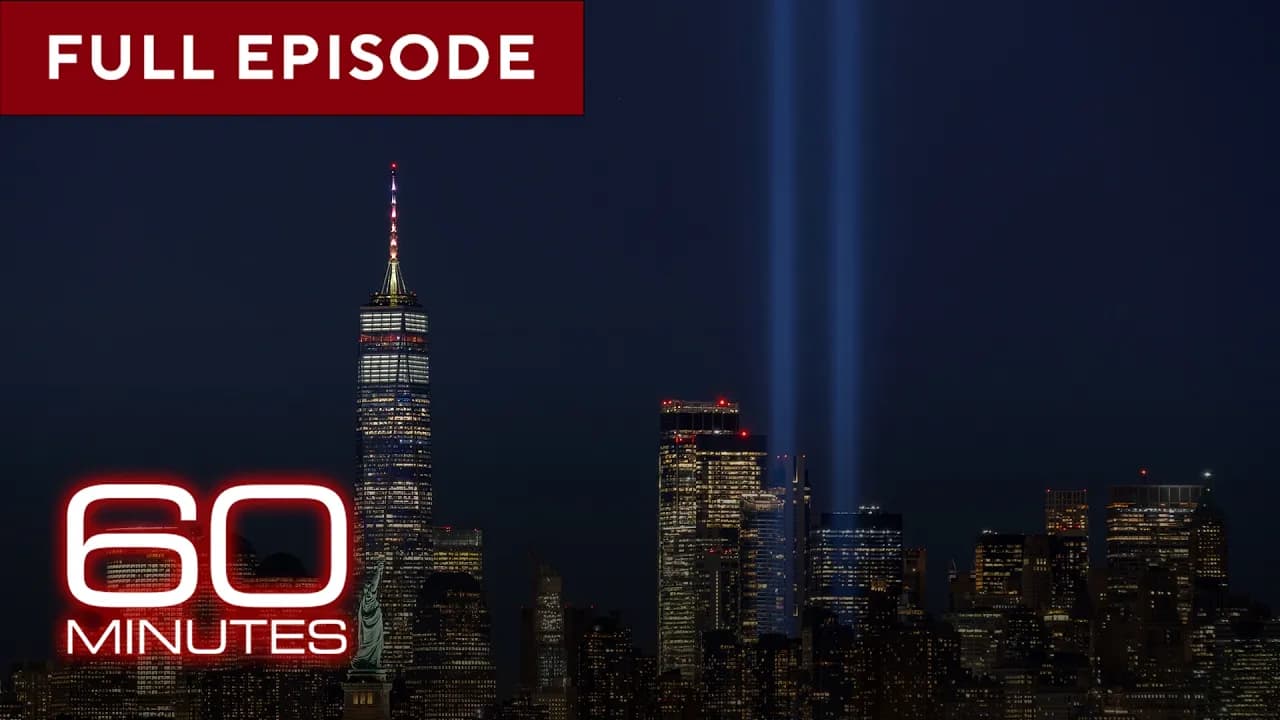
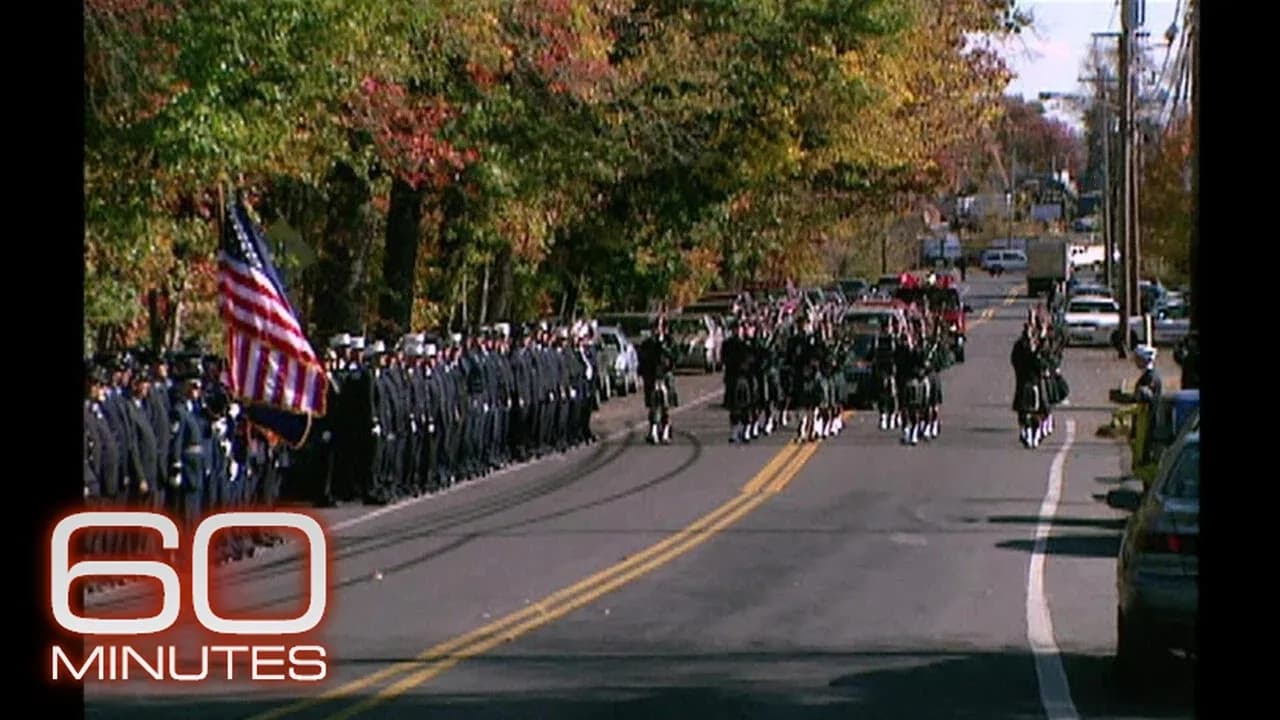
Recalling the heroism of FDNY firefighters at ground zero on 9/11 | 60 Minutes Archive
In a Nutshell
On 9/11, FDNY firefighters climbed into the burning towers knowing they might not come home, saving 17,000 lives while 343 of their own perished. Chief Peter Gansy, Orio Palmer, and others led the response with extraordinary courage, refusing to abandon trapped civilians and fellow firefighters even as collapse warnings came. Two decades later, more than 60 children of the fallen have joined the department, carrying forward their fathers' legacy of selfless service.
These notes were generated by AI and may contain inaccuracies.
In the neighborhoods of New York, there are 217 firehouses. Each holds a memorial to firefighters who answered the call 20 years ago and never returned. 343 members of the fire department of the city of New York perished on 9/11 in the greatest act of gallantry ever bestowed on an American city.
A plane raced past Battalion Chief Joe Feifer along the Hudson River at such a low altitude that he could read American on the fuselage. At 8:46 that morning, Feifer was blocks away searching for a routine gas leak when he saw the plane aim and crash into the north tower of the World Trade Center. From that moment, the firefighters of the FDNY would have about an hour and a half to save 17,000 lives.
They knew that they might not come home, but they knew there were people trapped. That's our job.
There's no way we were going to stand back and say, "We're not going in."
Our aim was to get above that fire and get those poor people out that were calling us.
We're on the floor and we can't breathe and it's very very very hot.
And all the dispatcher could say is um we're coming for you. So we like to keep our promises. You know, we told them we're coming.
Filmmakers Jules and Gideon Node were making a documentary about the FDNY. Engine 69, Engine 6, Engine 10, Engine 211, Ladder 11, Engine 44, Engine 22, Engine 53 all responded. Dispatch launched an armada: 121 engines, 62 ladder companies, 100 ambulances, 750 members of the FDNY.
At FDNY headquarters in Brooklyn, 54-year-old Chief of Department Peter Gansy Jr. raced to his car. He was the boss leading the second largest fire department in the world after Tokyo. Dan Nigro was his number two.
So, we went downstairs quickly, got in the car, and headed over the Brooklyn Bridge where we could see the damage, see the smoke, see the fire. That's when I said to Pete, "Uh, Pete, this will be the worst day of our lives." And you know, that was before I knew the half of it.
Gansy's voice was recorded in route: "Transmit a fifth alarm for this box. Get us a staging area somewhere on West Street." A box is a location. K signals the end of a message. A throwback to the 19th century telegraph, which on this day was punctuating the greatest crisis in the department's 136 years.
Division 1 Commander Peter Hayden met Battalion Chief Joe Feifer in the lobby of the burning tower. The fire was 93 floors above. Elevators were out, so firefighters climbed tight stairwells shouldering 75 pounds and more.
Well, I knew that we weren't going to be able to put out the fire. So, the order of the day was to search and evacuate as many people as we could.
And I thought we would have enough time to get the people out. And uh everybody that was above the impact of the plane um we were pretty much sure were uh either dead already or going to die. There was a lot of people jumping out already.
1,355 people were trapped above the fire. The Boeing 767 had severed all three stairwells, leaving one way out. The first firefighter killed was hit by a fellow human being.
Tour Commander Sal Casano had arrived precisely 17 minutes after the North Tower was hit. At 9:03, the second plane hit the south tower. The second 767 exploded into floors 77 through 85. Now 2,000 people were trapped a quarter mile high.
Casano ran into the department chaplain, Michael Judge.
And I just told him, father, we're going to be for a bad day. You're going to need a lot more chaplain here.
The more and more firefighters, they kept coming in and they took their assignments with no question.
But it's also hard to give them those assignments.
I could see the look in their eyes. I remember seeing firefighters hugging each other and heading up.
Nobody refused to go in.
Gansy joined the FDNY in 1968. He had a chest full of medals. He was a down-to-earth, honest, hardworking guy. He was a paratrooper in the army. Worked his way up to be chief of department in the FDNY over his 33-year career. He won the department's medal of valor, crawling into a burning apartment on his hands and knees, grabbing a child who was certainly going to die and dragging that child out and saving her life.
That's the kind of person Pete was. He would put people before himself without a doubt.
Three months before 9/11, Gansy responded from home to a call of firefighters trapped in a burning store. He went in wearing shorts and boat shoes. He once said his 11,000 firefighters were his children. On that day in Queens, he lost three.
Chief Al Tur asked Pete Hayden if he had considered the threat of a partial localized collapse on the burning floors.
I said yes. Uh but we needed to get the people out. There were hundreds upon hundreds of people coming down the interior stairs.
I thought we had a couple of hours.
The chiefs knew no steel high-rise in history had ever completely collapsed due to fire. None of them expected the building to come down.
Orio Palmer was receiving orders to go to the south tower to try to clear a path to the trapped souls calling 911. 32-year-old Melissa Doy was saying the Hail Mary prayer when 911 answered. She was a manager in a financial firm on the 83rd floor, one of the burning floors in the South Tower.
Is are they going to be able to get somebody up here? Are we coming up?
Well, there's no one here yet. And the floor is completely engulfed. We're on the floor and we can't breathe and it's very, very, very hot.
Orio Palmer ran marathons as a hobby. He found fire marshal Ron Bua on the 75th floor evacuating civilians. Palmer had discovered the only intact stairway to the top of the south tower. Unlike the north tower, the second plane had missed stairway A. If Palmer could clear this stairwell, 619 souls would have a way out. He was five floors below Melissa Doy and rising.
Palmer took the only working elevator as high as it would go. Then he led the men of ladder 15 on a climb from the 40th floor. Palmer was trying to clear a path to 619 people trapped by fire.
We got two pockets of fire. We should be able to knock it down with two lines.
1045 code ones were fatalities, more than he could count. Palmer pressed towards 79, climbing at about one floor a minute.
Wait, wait, wait. [screaming] Help.
Hello, ma'am.
Oh my god. They coming through for you now. Find out if there's anybody here on the 83rd floor.
Ma'am, don't worry. You stay on the phone with me and I already know.
Find out if there's anyone on the 83rd floor because.
Ma'am, I already heard somebody.
The planes had blasted away the spray-on fireproof foam insulating the structural steel. The burning floors were sagging, slowly, pulling the exterior inward. EMS Division Chief John Peru received a warning from an official he believes was an engineer.
The buildings are severely compromised. You can see slight lean. They're in danger of collapse.
Rich Zerillo delivered the warning to Pete Gansy. Zerillo hardly got the words out when Gansy's attention was drawn to a roar from the south tower above him.
Loud noise. Had no idea what it was. All we saw was this plume of dust and smoke and debris.
In the moment before, Melissa Doy had given the 911 operator her mother's phone number and the message that her daughter loved her. Then there was silence. Palmer's last radio transmission was battalion 7 to ladder 15 and there's nothing after that. That's when the tower collapses.
He must have known that with every step he ascended, his chance of survival dropped. Didn't deter him one bit. The only thing that was in his mind was, "Let me get up there. Let me get as many people out as I can as quickly as I can."
Joe Feifer was given the order to evacuate the north tower. In the darkness after the south tower collapse, he wondered if he was dead or alive.
Command to all units in tower one. Evacuate the building.
Chief, we have somebody down.
I felt somebody at my feet. And I saw this was our fire department chaplain, Father Michael Judge. I removed his white collar. I checked for his pulse and breathing and he had none and I knew he was gone.
Several of them picked him up and carried him out. The EMTs took him not to the morgue, but to St. Peter Claver, a Catholic church a little bit north of the trade center, and they laid him on the altar.
Gansy's streetside command post had been set up next to an underground garage in case shelter was needed. Captain John Sudnik, Gansy and the chiefs dove into the entrance.
I just remember the dust that day feeling like it was searing your lungs. Like it felt like you were swallowing glass.
Pitch black. But they heard voices. When they made their way back up to where the command post was, Pete's mind went into rescue mode. Gansy heard on the radio the cries of trapped and wounded firefighters.
I need truck companies. I need rescue company. Tell them to come with me.
As he had before, Gansy went into the debris to save his men himself. In the still standing North Tower, many firefighters refused the order to evacuate while they were still carrying the wounded and disabled.
Gansy sent Sal Casano to set up a new command post. 28 minutes later, Casano was on his way back.
And then I look up and all I could see was the antenna from the north tower imploding.
The other tower just collapsed.
I in my mind had to be resolved with death.
Regina Wilson was on the street below the tower with engine 219 in her second year as a firefighter.
And I prayed and then I just asked God to just protect me. And then if he couldn't, I knew that I would die doing what I love.
Inside the collapsing North Tower, the men of Engine 39 were caught in a stairwell. Jeff Caniglio and Jamie Epamiottis were on the stairs near the ground floor with 110 floors above them.
It took 10 seconds for it to come down, but it felt like 10 minutes. I saw I was in the background of a funeral. I saw my casket. I saw my parents, my wife sitting in the front. And as I'm watching this, I'm like, "All right, it's going to be quick." I'm just waiting for something to tap my shoulder and figure I'll feel a tap and that'll be it. We'll be gone. You know, we're not going to suffer.
James McGlin and Bob Bacon were in the same stairwell.
You know, the wind actually came up the stairwell. Blew me into the air and the landing that I was on just disintegrated underneath me and I kind of bounced, you know, back and forth and hanging from like a pipe.
I think I said a couple of prayers and said, "God, please get us out of here."
Their fragment of an intact stairwell lay upon a mountain of misery. 16 acres of wreckage, 91 crushed FDNY vehicles, and quiet like the first heavy snow of winter. Every once in a while, you'd hear the radio, the dispatcher on the radio trying to contact somebody.
I'm an adding any division or any staff chief at the scene of the World Trade Center.
Silence spoke of unimaginable loss.
Any division chief or any staff chief at the scene of any of the World Trade Center.
That day, 23 battalion chiefs responded. Only four of them survived.
Joe Feifer thought of the lieutenant of engine 33, his brother Kevin, who Feifer sent up the north tower.
Battalion one to engine 33.
Kevin Feifer was gone and so was the crew of ladder 105 which rolled from Regina Wilson's firehouse.
We found the truck. We didn't find the members.
They all died.
Among them was John Chapura, her mentor and her savior. Regina Wilson was assigned to the doomed ladder 105. But early that morning before the attack, John Chapura asked to switch jobs, which put her among the survivors of engine 219.
I tried to honor him by talking his name. And that's how it is in the African-American culture. When you speak the name of an ancestor or you speak the name of a loved one, then they live. And so every time I say John name, he lives. And it gives me comfort.
The men of Engine 39 were trapped in the wreckage near the north tower lobby. They could hear only a few feet away Battalion Chief Richard Prunty who was pinned and calling for help.
We couldn't get to him and he was passing out at times.
Did you hear his radio transmissions? The last thing that he said was of course about his wife and saying that tell my wife and children I love them.
That they were the most of my wife that she was the most important thing in the world to me.
Those words were among Richard Prunty's last. The men of engine 39 were rescued but 343 members of the FDNY were gone. In a tradition where the job is handed down in families, many lost fathers, sons and brothers.
Guys I had worked with both retired and active saying to me, you know, have you seen my son? And uh firefighter, young firefighter coming up, you know, chief, have you seen my father? I knew him. And I just said no. I didn't have the courage to tell him what I knew to be true.
Among the fallen were Peter Gansy and 71-year-old Deputy Fire Commissioner William Fen, who had gone with Gansy to rescue the trapped.
Pete Hayden climbed atop an engine to address the living.
I yelled out, um, you know, we just lost a lot of guys here today. Let's have a moment of silence. And uh well I took my helmet off and um I reheld it. I held it and uh after a while I put my helmet back on. They put their helmets back on. I said, "Okay, we got a job to do. Let's do it."
Do you look back and wonder how did I survive? And 343 members did not.
Um, I didn't think about it as much. We were crazy busy. I was working 18 hours a day. And then it hit me. I says, "I'm here." You know, I mean, I get home and I'm tired. And there was always food on the table waiting for me when I came home. That no matter what time I came home. And um I'm laying in bed and I asked my wife, "Why me?" And she said, "Did you ever think there was a job for you to do?"
Volunteers started fighting fire in Manhattan in 1648. Nearly 200 years later, during the Civil War, an entire New York regiment was manned by firefighters. Their commander is quoted, "I want New York firemen, for there are no more effective men in the country." As those veterans returned home in 1865, the modern FDNY was created. The department's traditions are handed down in families and so it remains, especially for the children of 9/11's fallen.
The late Chief of Department Peter Gansy had three children. His daughter married a firefighter. Captain Peter Gansy III was 27 on 9/11. Battalion Chief Chris Gansy was 25.
I ran home and I'd gotten in the door right when Steve Mosciello was my dad's driver. Uh Al Tory, who was the chief of safety, I just remember them telling my mom that he's gone. And she said, "Gone where?" Like that like an innocently. And they're like, "He's dead." And I remember the scream that she that she let out. It's I could still hear it in my ears. And it pains me to hear it.
He loved being around family, but his family was also the fire department.
Absolutely. Had 9/11 not happened, I would not have been a New York City firefighter.
You'll always be happy. That's hard to explain to people how like you can get injured or you could get killed, but yet somehow you come home with a smile on your face. Like I enjoy being part of the organization. And it makes me gives me a sense of pride that I'd never felt anywhere else. And and and maybe that's what had driven my father for for so many years.
Josephine Smith's late father, 47-year-old Kevin Smith, was with Hazmat 1 on 9/11. She works in engine 39.
I always wanted to be like my father. You know, I always wanted to be brave like him and strong and and willing. It really just runs through our blood generation to generation. I just think it's just who we are. It's our passion. It's our upbringing.
It's not the job that took my father. It was an act of terrorism that took my father. And that made me want to fight even more to protect the city of New York and the citizens. You may have taken my father from me, but the passion in the blood is still there.
John Palumbo works in 92 Engine in the South Bronx. Tommy Palumbo works in 69 Engine in Harlem. John was a week away from being 8 years old on 9/11 and Tommy was nine. There are 10 kids in the Palumbo family: eight boys and two girls. Their dad, Frank Palumbo, was 46 when he died. He was with Ladder 105.
My dad's brothers and sisters in the fire house, they cooked for us. They drove us places. They took us to Six Flags. I remember going on their shoulders and, you know, they take us by the arms and spin us in circles.
The stands were filled at the hockey games. You know, it wasn't the same cuz you're missing the one person that you want there. But they do everything they can to fill it. You know, they never will, but they did everything they could to fill.
The firehouse cooked dinner for the 10 Palumbos and their mother every Monday for five years until the family moved away.
Michael Florio is a firefighter in Engine 214, Ladder 11 in Bedstey, Brooklyn. Mike Florio's dad, John Florio, was 33 years old on 9/11. Engine 214 is the same house where his son works today. Every day he walks in, his father's pictures are on the walls. There are a lot of memorials of him and the other four guys that passed on 9/11. He has a lot of memories from the firehouse being a young boy and just walking in there every day and seeing his pictures, it brings back those memories. It makes him feel closer to his father being there every day.
More than 60 children of 9/11's fallen have been through the training academy on Randall's Island in the East River and are now on the job. They took a written exam that's given only once every four years. About 60,000 applicants take it and only those in the top 10% earn a place in the rank and file.
Dan Nigro feels very proud of them. He feels that their fathers would have been very proud of them. Dan Nigro, Peter Gansy's number two on 9/11, was promoted to chief of department and is now the city fire commissioner.
John Sudnnik, a captain on 9/11, rose to chief of department. Peter Hayden also rose to chief of department. Sal Casano became fire commissioner. Battalion chief Joe Feifer became chief of counterterrorism and now teaches crisis leadership. Regina Wilson is studying for the lieutenants exam. Oreo Palmer's name lives on the FDNY Wise Award for the most physically fit firefighters.
A lot of bravery was displayed that day, followed by a lot of sadness. The sadness has stayed with everybody that was there that day. For those who survived, there are plenty of good days and plenty to be thankful for, but it's a day that never leaves you. Sadness becomes part of your life.
The father survived the collapse of the first tower and instead of moving to safety, he went to answer the mayday calls from his trapped firefighters. Receiving reports of firefighters trapped down below. He knew that the other building was in imminent danger of collapsing. He had decided in that moment that he was not going home. He chose his guys. When the smoke clears and you think about it, it was the only decision. He knew the way his father felt about his men and his job and the FDNY and he was going to stay and see the job through and he wouldn't have been able to live with himself if he left and one more guy was killed. It was just the way he was. He had to be there until the last guy was out.
Today's recruits were children then. They secure their gear and muster before memories. Open R three columns of the World Trade Center and 343 lives which are here indelible in time.
So many sacrificed so much that this story can't get lost because the world is changing fast. It shouldn't be something that's in a history book that a page is turned and we're forgotten. The sacrifices of the FDNY, the New York City Police Department, the Port Authority Police, and those who fought to save lives at the Pentagon and on Flight 93 in Pennsylvania cannot be fully honored in any number of hours.
At the trade center, 2,753 people perished, but there were more than 17,000 in the towers, and 99% of those below the fires survived. That morning, a witness watched firefighters rush to the stairwells and wondered how they found the courage. After 20 years of reflection, it's clear they climbed to rise. To rise to the cries 1,000 ft above them. To rise to the defense of the firefighter beside them. To rise beyond duty. To a place of selfless devotion.
Keep 60 Minutes in your library
Save the videos and channels worth coming back to, and find them again in one place.