Groww: If Your Customers Don't Love It or Hate It, You've Already Lost
In a Nutshell
Groww succeeded by building full transparency, seamless onboarding, and frictionless payments—features customers never explicitly requested but deeply valued—leading to explosive organic growth and near-perfect retention from day one. The team reduced risk to a single question mark (monetization) while obsessing over strong customer reactions, rejecting neutral feedback, and operating with zero revenue for four years before unlocking it through stocks. Key principles include writing down non-negotiable values upfront, maintaining clear ownership among co-founders, and prioritizing genuine enjoyment of the work over external advice.
These notes were generated by AI and may contain inaccuracies.
Most of the time founders would not build exactly what customers directly ask for but instead read between the lines. Customers did not explicitly say to show all products, display full transparency, and make payments frictionless, yet those were the actual needs.
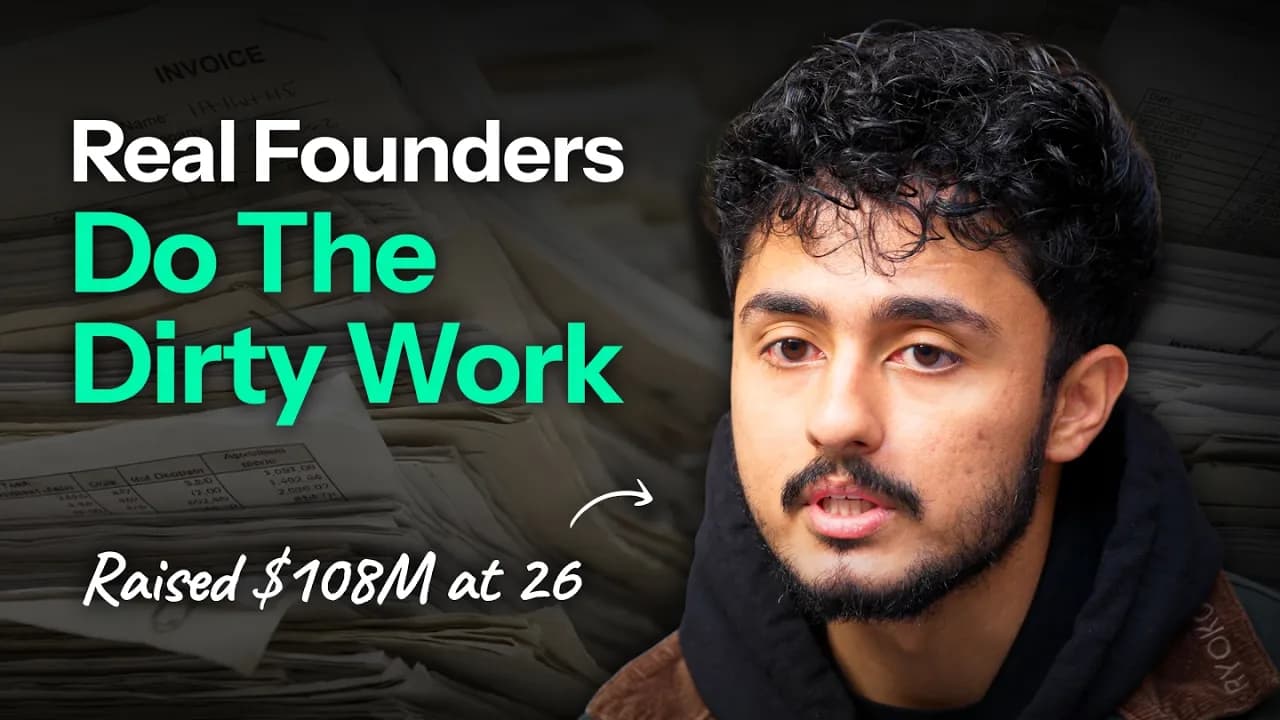
Lalit Keshre joined the Y Combinator Winter 2018 batch. The original vision was to enable everyone in India to invest. Groww went public in November.
Lalit grew up in a small city in central India. His grandmother wanted him to become an IAS officer and coined the blessing "IAS bhava." Exposure to Steve Jobs and Apple in 1997-98 rewired his thinking. He attended IIT Bombay during the 1999-2000 dot-com boom when everyone around him was starting companies, which made the idea of being independent exciting.
Groww is Lalit's second startup and third if counting his student startup. All previous attempts failed. The first idea tried at Groww was a robo-advisor in 2016, inspired by Wealthfront and Betterment. At that time India had over a billion people and hundreds of millions shopping online at Flipkart, yet fewer than 20 million investors. The robo-advisor approach did not work.
Customers kept asking "why this product and not that one." This led to the insight that Indian customers value choice and transparency, similar to the Flipkart model. The current Groww product launched in May 2017, one year after starting in May 2016. The hypothesis was to open everything with full transparency, seamless payments, and seamless onboarding.
The team expected 100 customers in the first month but acquired 600. This created strong conviction around product-market fit. Customer acquisition cost decreased, engagement increased, retention increased, and NPS scores became extremely high. Word-of-mouth growth began immediately. Monetization remained the only open question mark.
In a startup there will always be multiple question marks. Reducing them to one question mark significantly lowers risk. This advice is specific to consumer businesses: if there are zero question marks, it may not be a real consumer bet.
With only 20 users it is difficult to extract insights, so the team expanded their horizon. They created many WhatsApp groups. Lalit and co-founders visited movie theaters before screenings to talk to customers. As soon as a customer signed up they were added to a personal WhatsApp group for direct access. Most insights came from reading between the lines rather than taking requests literally.
It took one year from starting in May 2016 to launching the product in May 2017. Within 10-15 days of launch the team experienced the "aha" moment. Organic growth, where customers acquire themselves without paid marketing, is the clearest signal of product-market fit. Retention day-over-day and increasing engagement confirmed the signal.
Early growth was almost 100% organic through word of mouth. Even today most growth remains organic. When asked how customers discovered Groww, most say a friend, cousin, or their children recommended it.
A key early strategic choice was to operate only in regulated zones, obtaining proper licenses rather than operating in gray or unregulated areas (which represent roughly 40% of opportunities). Strong early choices reduce variables and simplify decision-making and execution.
Started with regular mutual funds earning commissions. Power users on WhatsApp groups demanded direct mutual funds with zero commission. The team bet that products with near-zero CAC, high retention, high engagement, and high customer love that move significant capital will eventually monetize. They operated as a zero-revenue company for the first four years. Adding stocks unlocked monetization.
One of the company's ten commandments is to obsess over design. Founders follow Paul Graham's advice to build for yourself. Lalit personally uses the product more than two hours per day and spends another two hours daily talking to customers. When launching any feature the team looks for two kinds of reactions: "this is awesome" or "this is terrible." Neutral "don't care" reactions are the real problem.
The team stays paranoid by surrounding themselves with younger people who understand their generation better. In consumer businesses, worrying about competition pulls focus away from customers. The best defense is focusing on evolving customer preferences, trends, and how AI will impact experience and productivity.
Lalit has become a power user of coding tools such as Cursor. Getting hands dirty with new technology creates the same kind of intuition as talking directly to customers. After returning to coding after many years, he realized many housekeeping tasks are now automated, making previously difficult things possible, and began promoting these tools internally.
Understanding customer needs remains unchanged, though AI tools can help surface those needs. Once the "what" is clear, the "how" becomes dramatically easier. Previously building a product required hiring engineers, product managers, designers, operations staff, and business people. Now one person with free credits can handle design, product management, coding, and automation tasks, significantly lowering the barrier to entry.
Groww now has millions of customers and is the largest platform in India. Many early customers who joined at age 25 are now 35 and have accumulated significant wealth. Customer needs evolve with wealth, so the product must continue evolving. Wealth management is a major focus area. For younger users (investing age starts at 18), the goal is to remain the most exciting choice.
Before starting, the four founders wrote a detailed document outlining their value system—what they stand for, what they will do, and what compromises they will or will not make. The first line stated they will always be customer-first and customer-obsessed. Value systems are written in pen while strategy changes like pencil. Clear ownership was defined early even though everyone did everything in the beginning. Ownership means accountability for specific areas.
If there is a macro decision and there is a conflict, then who is the owner needs to be clearly defined. When these kinds of responsibilities are well aligned, the co-founder relationship has worked great. Another critical element is enjoying each other's company. Even on weekends, when there is no in-person interaction, continuous WhatsApp communication about what is happening creates connection. On Monday, there should still be genuine excitement about going to the office.
In the founders' journey, there are ups and downs, but if on Monday there is still motivation to work with someone you love collaborating with, that represents the ideal co-founder relationship.
The advice given is to not listen to older founders when starting a startup because the world is changing so fast. All advice is given from the context of what was seen before, and younger founders have much better context now.
Despite that warning, one key piece of advice is to do something where work does not feel like work. Time should become a blur because of genuine enjoyment. When asked about sacrifices made while building Groww, the reflection was that everything was enjoyable. There are low times, but the overall experience of building was fun.
The most important thing is having fun.
Keep Y Combinator in your library
Save the videos and channels worth coming back to, and find them again in one place.