How I Survive Market Crashes (And Find Opportunity)
In a Nutshell
Markets look healthy only because mega-caps dominate indices; underneath, thousands of stocks are down 20-40% from highs, and speculative AI names are still wildly overvalued. The biggest mistake is over-sizing positions or using leverage to "buy the dip," then being forced to sell if the decline continues. Success comes from knowing exactly why you own a name, sizing at half (or less) of what you could afford, and keeping dry powder so you can buy more—not less—if the market falls further.
These notes were generated by AI and may contain inaccuracies.
Ricky from Tech Solutions addresses the misconception that he benefits from market sell-offs. He does not carry positions overnight, and much of the recent selling occurred during non-trading hours. Markets remain structurally more bullish than bearish, with more money historically made by going long over time.
A critical error many investors made previously was buying the dip too aggressively, positioning themselves with leverage or oversized positions they could not tolerate when volatility increased. This forced them to sell at the worst possible time. The core issue is placing oneself in a position to fail by not being able to withstand additional stress and price declines.
Despite NASDAQ and S&P 500 experiencing pullbacks from all-time highs, the broader market tells a different story. 5,000 publicly traded companies are down 20% from their 52-week highs (correction territory), and nearly 4,000 of those are down 40%. This represents a massive disconnect between major indices and the average stock.
The market is not representative of how the average American or average business is performing. While AI is very real and demand is genuine, thousands of stocks have been destroyed while indices remain near highs due to concentration in mega-cap names.
The recent significant sell-off was driven by fear injection, but nothing has broken yet. Current concerns include:
- CoreWeave financing issues
- Oracle concerns
- Anthropic valuation adjustment from $2 trillion to $1.5 trillion
- Federal Reserve concerns
- CPI and PPI reports coming in higher than expected
- Bond yield concerns
- Oil price concerns
There always needs to be a trigger for a market fall, and none exists yet. Markets can recover, but the key is not ruining the opportunity through poor positioning.
The S&P 500 is market-cap weighted, meaning the top 10 names (Nvidia, Microsoft, Apple, etc.) can represent roughly a third of the entire index. When these giants remain flat or up, the index sits near highs while thousands of smaller companies bleed. The 4,000+ stocks down 40% are mostly small and mid-caps with negligible weight in the indices. This creates a narrow rally where indices appear healthy but breadth is deteriorating underneath.
Liupold, who had one of the most successful funds for a period, rebuilt his AI bet after July's forced liquidation only to face another sharp sell-off. Since September 8th, six of seven stocks in his AI bets have seen significant declines:
- CoreWeave: 37% sell-off
- Skhy: 25%
- Sandisk: 23%
- DRAM: 22%
- Bloom Energy: 18%
- Intel: down 9%
- AMD: up 9.1%
Average decline approximately 18.4%. Unlike his previous liquidation, he is not aggressively leveraged this time.
CoreWeave loses $1.9 billion and trades at a negative almost 20 P/E ratio - fundamentally a terrible business but speculative due to AI exposure. NBIS trades at a 169 P/E ratio with $1.35 billion in revenue and $42 million in net profit, yet holds a $45 billion market cap (after significant sell-off). These valuations reflect speculation rather than fundamentals.
Shorting at current oversold levels carries significant risk. Recovery potential is substantial - 44-50% for NBIS or CoreWeave, 20% for Micron. The risk-to-reward tradeoff for shorting at these levels is unfavorable, particularly for beginners who may not manage position size or risk effectively.
Micron represents a fundamentally sound opportunity with a 21% pullback from recent levels. The company shows 42% upside to fair value, an 11.7 P/E ratio, $133 billion in revenue, and nearly $85 billion in net profit. US companies cannot buy Chinese memory chips, providing a competitive advantage despite concerns about Chinese manufacturers.
Fund managers managing billions of dollars can still get liquidated by being too leveraged at overbought levels. The same mistakes apply to retail investors who position themselves without the ability to tolerate volatility. The goal is not to repeat these errors.
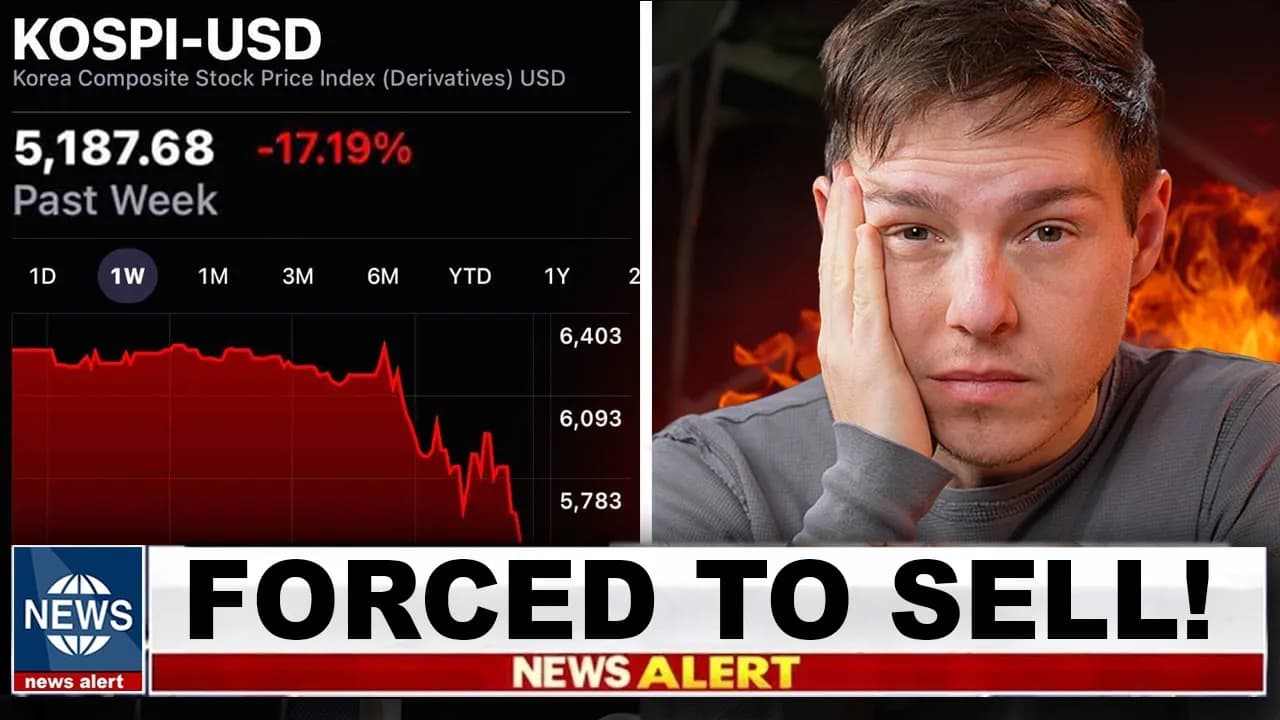
The KOSPI index, highly influential in memory and chip space affecting AI, is down 35% from recent all-time highs. These concerns are not new but have been ignored until now.
Let fear get factored in and allow the market to sell off. The more it sells off, the better the deal becomes. Beginners should avoid continuing to short at oversold levels due to the high upside potential if direction reverses.
Know your why: Identify one company you want to buy, understand where you would buy it, where you would sell it, and how you would manage risk. Understand the company fundamentally enough to explain why it is your number one pick.
Position sizing: Whatever dollar amount you are considering investing, cut it in half or split it into fifths. This preserves capital and maintains the ability to buy more if prices decline further.
Buying the dip too aggressively and then being forced to sell if markets continue declining means missing the recovery entirely. The goal is positioning to succeed, not to fail. Overexposure prevents tolerating additional downside before recovery occurs.
Using 10x leverage or triple-leveraged ETFs on speculative names like CoreWeave leads to liquidation rather than wealth. Making smaller profits is preferable to being liquidated. The focus should be on preserving capital rather than maximizing returns, especially early in one's trading career.
When markets are uncertain and the extent of potential downside is unknown, the priority is preserving capital over maximizing gains. Overexposure prevents tolerating the time required for recovery, potentially leading to forced liquidation and later regret.
- Identify specific stock names
- Understand the company fundamentally
- Have a clear plan for entry, exit, and risk management
- Buy less than maximum to tolerate more volatility
The principle: "Buy less to tolerate more."
Keep Ricky Gutierrez in your library
Save the videos and channels worth coming back to, and find them again in one place.