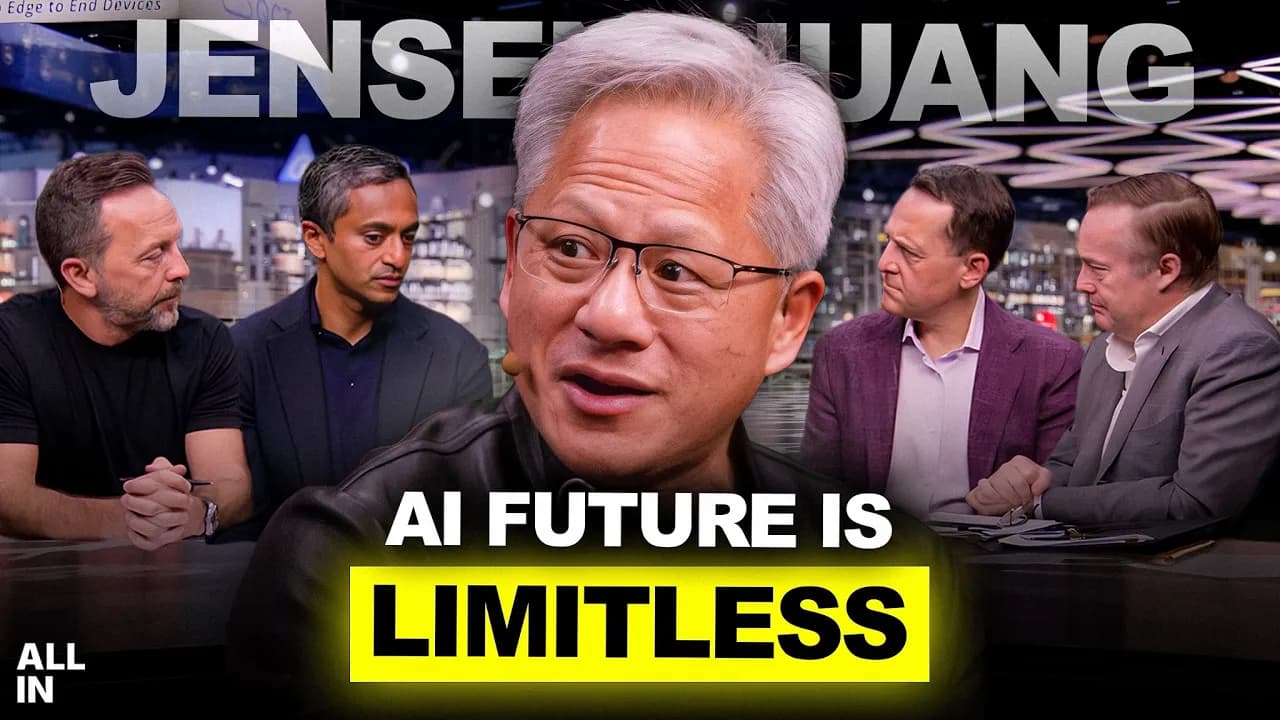
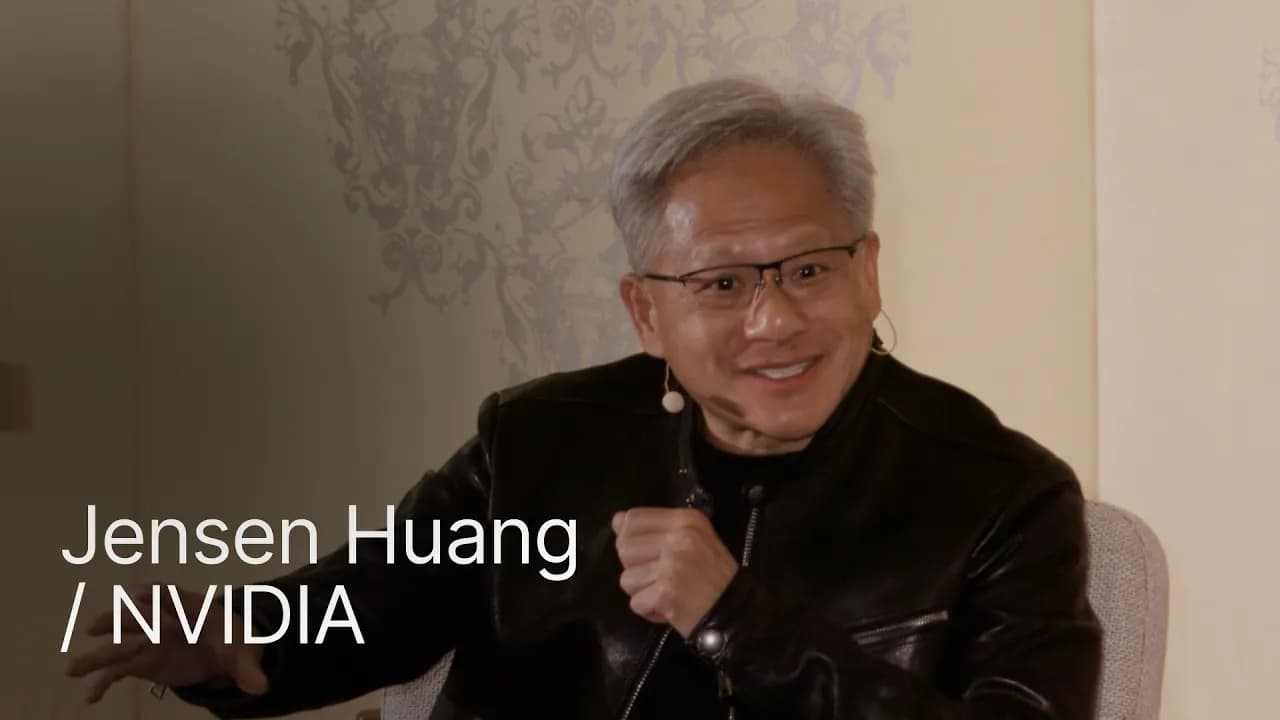
Jensen Huang: NVIDIA - The $4 Trillion Company & the AI Revolution | Lex Fridman Podcast #494
In a Nutshell
NVIDIA, under Jensen Huang's leadership, dominates the AI revolution through extreme co-design of rack-scale systems (GPU, CPU, networking, cooling), evolving from gaming GPUs to AI factories via bold bets like CUDA on GeForce, which built a massive developer install base despite short-term profit losses. Scaling laws persist—pre-training, post-training, test-time inference, and agentic scaling—with no major blockers as synthetic data, power efficiency, and supply chain orchestration (e.g., TSMC, HBM) enable exponential growth toward $3T revenue and planetary AI factories. Huang emphasizes first-principles "speed of light" engineering, CUDA's moat, open-source AI like Nemotron, human-AI job elevation, and optimism for AGI (already here per his $1B company definition), humanoids in space, and ending disease.
These notes were generated by AI and may contain inaccuracies.
NVIDIA is the engine powering the AI revolution, with much of its success attributed to Jensen Huang's force of will, brilliant bets, and decisions as leader, engineer, and innovator.
NVIDIA has moved from chip-scale design to rack-scale design. Winning used to be about building the best GPU, now expanded to extreme co-design of GPU, CPU, memory, networking, storage, power, cooling, software, the rack, the pod, and the data center.
Hardest Part of Extreme Co-Design
Extreme co-design is necessary because problems no longer fit inside one computer accelerated by one GPU. To go faster than the number of computers added (e.g., add 10,000 computers but want a million times faster), algorithms must be broken up, refactored, sharded across pipeline, data, and model.
Amdahl's Law: Speedup depends on the fraction of workload accelerated. If computation is 50% of the problem, infinite computation speedup only doubles total workload speed.
Distributing the problem makes everything an issue: CPU, GPU, networking, switching, workload distribution across computers. It's a massively complex computer science problem requiring every technology. Otherwise, scaling is linear or limited by slowed Moore's Law due to slowed Dennard scaling.
Trade-offs involve disparate disciplines with world experts in high bandwidth memory, NVLink, NICs, optics, copper, power delivery, cooling.
Process of Extreme Co-Design
Extreme co-design optimizes across entire stack: software, architectures, chips, systems, system software, algorithms, applications. Includes CPUs, GPUs, networking chips, scale-up switches, scale-out switches, power, cooling (computers are power-hungry despite energy efficiency).
Reason: Exceed benefits of just adding computers by distributing workload.
How: Company organization reflects what it produces (product) and environment. Organization charts should not look the same across industries (e.g., hamburger, software, car companies).
Jensen Huang's direct staff: 60 people (more reports), almost all with engineering foot: experts in memory, CPUs, optical, GPUs, architecture, algorithms, design.
No one-on-ones; present problems for group attack. Company does extreme co-design constantly. Even discussing one component (e.g., cooling, networking), everyone listens and contributes (e.g., impacts power distribution, memory). People tune out if not relevant, but staff knows when to pay attention or get called out.
NVIDIA adapts to environment: from GPU for gaming, early deep learning to AI factory (produces AI, build factory for it).
Started as accelerator company, but narrow domain limits market, R&D capacity, and computing impact.
Always planned to become accelerated computing, but general-purpose computing dilutes specialization. Tension: better computing company worsens specialization; more specialist limits computing capacity. Narrow path to expand computing aperture without losing key specialization.
Steps:
- Invented programmable pixel shader (first step to programmability).
- Added FP32 (IEEE-compatible) to shaders, huge computing step. Attracted stream processors, data flow researchers; enabled porting CPU software to GPU.
- Created Cg (C on FP32), led to CUDA.
CUDA on GeForce: Strategic, cost enormous profits (couldn't afford), but done to become computing company. Computing architecture must be compatible across all chips.
CUDA on GeForce Decision
Existential threat-level decision, one of most brilliant ever (foundation for AI infrastructure computation).
CUDA expanded applications. To attract developers: install base most important for computing platform (developers want reach). x86 survived despite criticism (not elegant) over elegant RISC architectures due to install base.
Competitors: OpenCL, others. Best way: Put CUDA on GeForce (selling millions/year), into every PC to cultivate install base. Attracted developers via universities, books, classes. PC was primary computing vehicle (no cloud); put supercomputer in every researcher/scientist/student hand.
Cost: Increased GeForce GPU cost 50%, consumed all gross profit (35% margin company). Market cap dropped from ~$6-8B to $1.5B, stayed low for a while. NVIDIA is the house that GeForce built; researchers/scientists (many gamers, built own PCs/clusters) discovered CUDA.
Became platform/foundation for deep learning revolution.
Meetings: Clear to board/management gross margins crushed. Gamers wouldn't pay more. Took decade to recover margins in workstations/supercomputers.
Leadership in Bold Bets
Informed by curiosity, reasoning system convinces outcome will happen, manifests future despite suffering.
Envisions future, reasons how/why it must exist (management team reasons too).
Leadership style: Shares insights immediately, step-by-step, shapes belief systems daily (board, management, employees) using external info, insights, milestones. No surprise manifestos/layoffs/reorgs.
Examples: Buy Mellanox, all-in on deep learning obvious by announcement day. Shapes via GTC keynotes (partners, employees). Employees think "what took so long?"
GTC effect: Shapes industry partners' beliefs; by product readiness, they think "what took so long?"
NVIDIA is computing platform company: Vertically designs/integrates/optimizes, but opens entire platform for integration into others' products/services/clouds/supercomputers/OEMs. Can't succeed without convincing them first.
Believer in scaling laws: Now more (pre-training, post-training, test-time, agentic scaling).
Past perceived blockers:
- Pre-training: Data limits intelligence. Larger model + more data = smarter AI. Ilya Sutskever: "out of data, pre-training over." Industry panicked, but false; continue scaling data (much synthetic).
Most human data exchange is synthetic (created, not from nature; modified/augmented/regenerated). AI takes ground truth, augments/enhances/synthetically generates enormous data. Human-generated data shrinks; training limited by compute, not data.
- Test-time scaling (inference): People thought easy (tiny chips, commoditize); illogical. Inference = thinking (harder than pre-training = reading/memorization/generalization/patterns). Involves reasoning, planning, search, first-principles, prior experiences, exploration. Intensely compute-intensive.
Beyond: Created one agentic person with large language model that we've now
During test time, agentic systems perform research, access databases, use tools, and spawn sub-agents, creating large teams. Scaling NVIDIA by hiring more employees is easier than scaling oneself. The next scaling law is the agentic scaling law, multiplying AI by spinning off agents as needed. There are four scaling laws. Agentic systems create more data and experiences, some memorized and generalized in pre-training, refined in post-training, enhanced at test time, and deployed to industry in a continuous loop. Intelligence scales by compute.
Hardware must anticipate AI innovations like mixture of experts (MoE) with sparsity, as pivoting takes time. AI model architectures evolve every six months, system and hardware architectures every three years. Anticipation involves internal basic and applied research, creating models for hands-on experience (co-design), and working with every AI company to understand challenges. CUDA balances specialization for acceleration and generalization for adapting to changing algorithms, explaining its resilience and evolution to CUDA 13.2. For MoE, NVLink 72 enables a 4 trillion or 10 trillion parameter model in one computing domain as if on one GPU.
Grace Blackwell racks focus on processing LLMs. One year later, Vera Rubin rack includes storage accelerators, new CPU called Vera, Vera Rubin with NVLink 72 for LLMs, and additional Rock rack. Previous design ran MoE LLMs for inference; new one runs agents that bang on tools. Design anticipated future like Claude Code, Codex, OpenClaw through reasoning: LLMs as digital workers need ground truth (file system), research, and tools. AI won't destroy software or tools; agents use existing tools like a humanoid robot using household microwave after reading manual online.
Properties described match OpenClaw: uses tools, accesses files, does research, has I/O subsystem. This reinvents the computer. OpenClaw schematic shown at GTC two years ago for agentic systems. Required model capabilities (Claude, GPT) and robust open source project. OpenClaw did for agentic systems what ChatGPT did for generative systems.
OpenClaw captured attention more than Claude Code or Codex because consumers could reach it, plus vibes, memes, and Peter (wonderful human). Serious security concerns with handing over data. NVIDIA sent security experts, created OpenShell integrated into OpenClaw, and NemoClaw (easy install, secure). For agentic systems accessing sensitive info, executing code, communicating externally: two out of three rights max, with enterprise access control and policy engine.
Power is a concern, addressed by extreme co-design improving tokens per second per watt orders of magnitude yearly. Last 10 years: Moore's Law 100x computing; NVIDIA scaled 1,000,000x. Energy efficiency affects revenues. Computer price rises, but token effectiveness rises faster, dropping token cost an order of magnitude yearly.
NVIDIA grows at unprecedented accelerating scale, increasing AI computing share. Informs CEOs upstream (IT) and downstream (infrastructure); several hundred attended keynote. Convinced DRAM CEOs three years ago HBM (then scarce for supercomputers) would be mainstream; also low-power LPDDR5 for cellphones adapted for data centers. All three (LPDDR5, HBM4? HBM) had record years; 45-year companies.
Manifests supply chain future: conversations with TSMC, ASML upstream; GEV, Caterpillar downstream. Semiconductor industry involves deep science, engineering, robotics manufacturing. Vera Rubin rack: 1.3-1.5 million components from 200 suppliers.
Moved from data center assembly to supply chain supercomputer manufacturing (NVLink-72 dense racks ship 2-3 tons). For 50 gigawatts simultaneous supercomputers, if manufactured in one week, supply chain needs 1 gigawatt power weekly for build/test.
Explains to partners: shifting DGX build for inference market inflection. Asks for billions in capital investments; they trust due to respect, questioning, first principles reasoning, pictures.
No worry about bottlenecks (ASML EUV, TSMC CoWoS, SK Hynix HBM) because informed needs; they committed.
Power grid designed for worst-case with margin; 99% time at ~60% peak with excess idle for rare extremes (winter/summer days, weather). Propose contracts/data centers where data centers yield max power to society (hospitals, airports) rarely; use backup generators, shift workloads, or run slower/degrade performance for longer latency.
Instead of 100% uptime contracts pressuring grid, use excess. Three-way problem:
- End customers demand perfection (never unavailable).
- Data centers need backup generators + grid for six nines.
- Utilities need to offer segmented power guarantees (e.g., available next month at price, not 5 years for max).
CEOs unaware of ops team contracts; negotiators push for best terms down chain. Build data centers that gracefully degrade: at 80% power, move workloads, ensure no data loss, reduce compute rate, shift critical workloads.
Engineering smart dynamic power allocation possible if specified, obeys physics first principles.
Elon deep in topics, systems thinker across disciplines, pushes: questions necessity, method, timeline. Minimalist at system scale: removes all non-essential while preserving capabilities. Present at point of action: goes to site, sees problems directly. Overcomes 'this is how we do it' inertia.
When you act personally with so much urgency it causes everybody else to act with urgency. Every supplier has a lot of customers and projects going on, and he makes it his business that he's the top priority of everybody else's projects by demonstrating it.
Not enough people ask the question like, "Okay, so, can this be done a lot faster, and how? Why does it have to take this long?"
That becomes an engineering question. Getting the ground truth of the actual process, like going through how to plug in cables into a rack with an engineer on the ground to understand what the process looks like so it can be less error-prone. Building up intuition from every single task involved in putting together a data center immediately reveals inefficiencies at both detailed and broad systems scales. Then you can say, "Let's do it totally different and remove all possible blockers."
Co-design is the ultimate systems engineering problem. NVIDIA approaches work from that perspective first.
A philosophy started 30 years ago called the speed of light, shorthand for the limit of what physics can do. Everything is compared against the speed of light: memory speed, math speed, power, cost, time, effort, number of people, manufacturing cycle time, latency versus throughput, cost versus throughput, cost versus capacity. Test against the speed of light to achieve constraints separately, then make compromises together since systems for extremely low latency versus very high throughput are architected fundamentally differently. Force first principles and physical limits before doing anything, and test everything against that.
I don't love continuous improvement. Engineer from first principles with speed of light thinking, limited only by physical limits and physics. After that, improve over time.
Don't accept "it takes 74 days today, we can do 72." Strip it back to zero: explain why 74 days, what's possible from scratch? It might be six days. The rest are reasoned compromises, but now the conversation from 74 to six is much more effective.
In incredibly complex systems, simplicity is a good heuristic. The Vera Rubin pod: seven chips, seven chip types, five purpose-built rack types, 40 racks, 1.2 quadrillion transistors, nearly 20,000 NVIDIA dies, over 1,100 Rubin GPUs, 60 exaflops, 10 petabytes per second scale bandwidth—that's just one pod. NVL 72 rack alone: 1.3 million components, 1300 chips, 4,000 pods in a single 19-inch wide rack. Need to crank out about 200 pods a week.
We need things to be as complex as necessary, but as simple as possible. Test if all that complexity is necessary, challenge it—everything else above is gratuitous.
Semiconductor industry, especially NVIDIA, represents some of the greatest engineering in history. The most complex computer the world has ever made. Engineering teams like NVIDIA, TSMC, ASML are gold medalists in every sport, working together.
50% of the world's AI researchers are Chinese, mostly still in China. Tech industry showed up at the right time during mobile cloud era, contributing via software. Incredible science and math education. China has provinces and cities with mayors competing, leading to many EV companies, AI companies—insane internal competition, so what remains is incredible.
Social culture: family first, friends second, company third. Constant conversation, essentially open source all the time. Contribute more to open source because engineers' brothers, friends, schoolmates are everywhere—schoolmates are brothers for life. Share knowledge quickly, no point hiding technology. Open source amplifies and accelerates innovation. Rapid innovation from great talent, open source, friends, insane competition. Fastest innovating country today, due to education, parental emphasis on school, culture, timing with technology exponential. It's a builder nation—cool to be an engineer. Leaders are incredible engineers, built from poverty.
NVIDIA loves Perplexity. Released open source Nemotron 3 Super (120 billion parameter open weight MoE model), usable in Perplexity.
To be a great AI computing company, understand AI models' evolution. Nemotron 3 is transformer and SSMs, not pure transformer. Early in conditional GANs, progressive GANs leading to diffusion. Basic research in model architecture gives visibility into computing systems for future models—part of extreme co-design.
Want world-class proprietary models as products, but also AI to diffuse into every industry, country, researcher, student. Proprietary makes research and innovation hard. Open source necessary for industries to join AI revolution. NVIDIA has scale, skills, motivation to build models forever and activate everyone.
AI is not just language—uses tools, models, sub-agents trained on biology, chemistry, laws of physics, fluids, thermodynamics. Need to push weather prediction, biology AI, physical AI to frontiers. Don't build cars but ensure car companies have great models; don't discover drugs but ensure Lilly has best biology AI.
Open sourced Nemotron 3 models, weights, data, creation process.
Deepest misunderstanding: TSMC success is not just technology (transistor, metallization, packaging, 3D packaging, silicon photonics). Technology makes them special, but ability to orchestrate dynamic demands of hundreds of companies—shifting volumes, wafer starts/stops, emergencies—with high throughput, yields, costs, customer service is miraculous. Wafers promised show up on time to help run companies.
Culture: technology-focused and customer-service oriented, world-class at both. Created intangible trust—trust them to put company on top of them.
Close relationship, three decades, tens/hundreds of billions in business, no contract.
In 2013, TSMC founder Morris Chang offered Jensen Huang chance to become TSMC chief executive. Declined—deeply honored, Morris is highly regarded executive, business/personal friend, TSMC consequential company. But NVIDIA work is important, envisioned NVIDIA's impact, sole responsibility to make it happen.
NVIDIA and TSMC two greatest companies in history. Everybody all in at every scale.
Single most important property: install base of computing platform, specifically CUDA. 20 years ago no install base, but now dedicated company, 43,000 people, several million developers ported mountain of software, trusting continued CUDA evolution.
Install base amplified by velocity of execution at this scale—no company built systems of this complexity once a year. Developers: support CUDA, in six months 10x better; reach hundreds of millions computers, every cloud (Google Cloud, Amazon, Azure, AWS ramping, CoreWeave, Nscale), supercomputers (Lilly), enterprise, edge (radio base stations), cars, robots, satellites, space. One architecture covers every industry.
Trust NVIDIA will maintain/improve CUDA forever.
Second: ecosystem—vertically integrated complex system, horizontally into every company's computers.
Unit of computing evolved: GPU → computer → cluster → entire AI factory. Mental model shifted from picking up chip (adorable but outdated) to gigawatt factory with power generation, grid connection, cooling, monstrous networking, 10,000 installers, hundreds networking engineers, thousands powering it up—takes thousands of people.
Now thinking pods, entire infrastructure; next click: planetary scale.
Space angle for compute: cooling not easy, many engineering complexities. NVIDIA GPUs first in space (for high-res imaging satellites sweeping Earth continuously—centimeter scale real-time telemetry; do AI at edge, discard unneeded data, avoid beaming petabytes to Earth). 24/7 solar at polars, but no conduction/convection—radiation cooling with giant radiators.
Practical: pursue next bucket of opportunities first, cultivate space—send engineers to work on radiation, degrading performance, continuous testing/attestation of defects, redundancy, graceful degradation.
Make software so the computer never breaks, it just gets slower. Do engineer exploration upfront. Eliminate waste from idle power as fast as possible. There's low-hanging fruit on Earth for AI scaling.
NVIDIA's growth is extremely likely and inevitable. NVIDIA is the largest computer company in history.
Computing shifted from retrieval-based, file retrieval systems (pre-written, pre-recorded files retrieved by recommender systems) to contextually aware AI computers that process and generate tokens in real time. Old world needed storage; new world needs computation. This computation-intensive generative computing only reverts if ineffective. Last 5 years of deep learning give more confidence than previous 10 years.
Computers were storage warehouses (low profit); now they are factories directly correlating with company revenues. Factories generate valuable commodities (tokens) that segment like iPhones: free tokens, premium tokens, middle tiers. Intelligence is a scalable product. People will pay $1000 per million tokens soon.
World needs many factories, many tokens. Society will pay substantially as productivity improves, discovering new drugs, products, services. World's GDP will accelerate; percentage of GDP for computation will be 100x more (product generation unit, not storage). NVIDIA will benefit greatly from this new economics.
Possible for NVIDIA to be $3 trillion revenue company. No physical limits. Supply chain shared by 200 companies; scales with ecosystem partnerships. Energy will be available. Past skepticism: impossible for fabless semiconductor to exceed $1B; never more than $25B. NVIDIA not in market share business—creating new markets.
Token factories: tokens per second per watt, each token brings value (different kinds, amounts). Exponential need for more factories given AI's potential.
Agents are the iPhone of tokens—fastest-growing application in history, went straight up. OpenClaw is the iPhone of tokens.
From December, people woke up to power of Claude, Code, Codex, OpenClaw. Lex programmed by talking to laptop at airport, pretending to talk to human colleague. Future: everyone talking to AI; AI will bother you by reporting completions fast.
Attributes success to working harder, withstanding more suffering: failure, engineering problems, human problems, uncertainty, responsibility, exhaustion, embarrassment, near-death moments, pressure. Nations/economies plan around NVIDIA.
NVIDIA success vital to US: tax revenues, technology leadership for national security (all aspects), prosperity for domestic policies/social benefits, re-industrialization, jobs, building chips/computers/AI factories in US. Benefits mainstream investors (teachers, policemen now millionaires via stock). Central to ecosystem partners.
Reason about circumstances, impacts (positive/negative), changes, hardness. Decompose into manageable parts. Assign or do actions. If reasoned need but didn't act, stop complaining. Tough on self. List things to protect company/partners/industry, assign to capable people. Then sleep.
Hits low points all the time. Break down problems, act. Systematic forgetting like AI learning—don't carry everything. Share burden: decompose, assign, inspire. Be tough: stop crying, get going. Attracted to next opportunity like athletes to next point. Does job publicly, so reflects on past statements.
If knew how hard building NVIDIA would be (million times harder), wouldn't do it. True of everything worth doing. Superpower: mind of a child—"How hard can it be?" Enter experiences fresh, expecting fun. Have endurance/grit for setbacks. Forget, move on. Stay true to beliefs if assumptions hold; constantly reevaluate.
- Fresh-minded entry
- Forgetting setbacks
- Self-belief
- Constant reevaluation Always curious, learning, humble, emulating others empathetically.
Surprisingly no harder; doing work publicly humbles (everyone sees wrongs). Certain about public statements due to impact. Reasons publicly in meetings, shows steps so others can intercept/disagree on reasoning (collective path searching).
Tolerance for embarrassment from years of public wrongs. First job: cleaning toilets at Denny's.
Thank NVIDIA for incredible graphics. GeForce still #1 marketing strategy: teens learn NVIDIA via gaming (Call of Duty, Fortnite), then college (CUDA), then pro tools (Blender, Dassault, Autodesk).
Gamers concerned DLSS 5 makes games look like AI slop. Understandable—AI content looks similar/beautiful. DLSS 5 is 3D conditioned/guided: truthful to artist geometry/textures per frame, enhances without changing. Open system: train custom models, future prompts (toon shader, style examples). Integrated with artists for more beauty in their style, not post-processing.
People sensitive to human faces, AI slop. Beautiful moment: realize we seek imperfections over perfect graphics.
Generative models are tools that help create worlds, including non-photorealistic styles. Gamers appreciate skin shaders introduced in recent years, featuring subsurface scattering to make skin look more realistic. Game developers seek more tools to express their art and decide what to use.
Most influential game: Doom—started 3D era, turned PC into a gaming device from office automation tool, had massive cultural and industry impact. Flight simulators preceded it but lacked popularity. From game technology perspective, Virtua Fighter.
Cyberpunk 2077 features fully ray-traced, GPU-accelerated graphics. Skyrim (Elder Scrolls) from long ago remains replayable via mods that transform it into a different game, allowing re-experiencing loved worlds. RTX Mod is NVIDIA's modding tool injecting latest technology into old games. Great games combine graphics, story, and character development; beautiful graphics enhance immersion.
AGI defined as AI system able to start, grow, and run a successful tech company worth >$1B (innovate, find customers, sell, manage teams of agents/humans).
I think it's now. We've achieved AGI.
Possible because definition is $1B (not forever). Example: AI could create viral web service/app used by billions briefly (like internet era companies), then go out of business. Many such sites were simple, within current models like OpenClaw capabilities. Achieve virality and monetize it. Unpredictable, like past companies. In China, people teach AIs to seek jobs, do work, make money; possible digital influencers, social apps, Tamagotchi-like hits that succeed briefly then fade. Odds of 100,000 agents building NVIDIA: zero.
Purpose of job and tasks/tools related, not the same. Jensen's job unchanged 34 years (longest-running tech CEO), but tools changed dramatically.
Radiology example: AI researchers predicted radiologists obsolete due to superhuman computer vision (achieved ~2019-2020). Every radiology platform now AI-driven, yet radiologist numbers grew—now shortage. Why? Purpose is diagnosing disease/helping patients/doctors. AI enables faster/better diagnosis, more scans/patients, more hospital revenue → need more radiologists. Alarmism scared people from profession, causing harm. Obvious outcome.
NVIDIA software engineers will grow, not decline: purpose is solving problems (not lines of code). Tasks like coding related but distinct from team work, diagnosing, evaluating, innovating, connecting dots.
Coding now specification (or directive architecture). Pool expands from 30M to ~1B people. Future carpenter is coder + architect via AI, elevating value/artistry. Accountants become financial analysts/advisors. All professions elevated (plumbers, farmers, pharmacists).
Current programmers intuitively communicate with agents via natural language for best software. Value in learning programming languages, design principles for large systems. Artistry of specification depends on problem/level of team: specific enough to act, under-specified to enable improvement/creativity. Spectrum from prescriptive to exploratory; future of coding.
Compassion for pain/suffering in white-collar jobs during automation. Hopefully creates more opportunities, automates boring parts, enhances creative/fun aspects (e.g., programming more fun now).
Advice: Break down anxiety: focus on actionable parts. Hire experts in using AI over non-experts (college grads, accountants, marketers, supply chain, customer service, salespeople, BD, lawyers). Every student/teacher/worker (carpenters, electricians, farmers, pharmacists) should become AI expert to transform/elevate job, innovate industry.
If job = tasks, high disruption risk. If purpose includes tasks, learn AI to automate them.
AI as life coach: Chatbots break down problems (e.g., job worries → skills/steps/AI plan). Removes beginner friction: ask first steps for anything (unlike Excel). Meta: AI teaches AI use.
Chips unlikely to get nervous/anxious/emotional. AI can recognize/understand them, but chips won't feel them. Human performance spectrum (amazing to poor) from same circumstances differs individually—not replicable computationally (same context → statistically different but not feeling-based outcomes).
Subjective experience special: nervousness, hope/fear/anxiety, love/heartbreak, death/pain of loss. Open to surprises from scaling miracles in intelligence.
Intelligence defined: Perception, understanding, reasoning, planning loop. Not equal to humanity. Intelligence is commodity (surrounded by smarter people). Jensen orchestrates 60 superhumans despite being "dishwasher" (less intelligent/educated). Humanity > intelligence: tolerance for pain, determination, character, compassion, generosity—superhuman powers.
Democratization/commoditization of intelligence inspiring, not anxiety-inducing. AI helps celebrate humans/humanity; tool making humans more powerful.
Doesn't want to die: great life/family/important work. NVIDIA consequential in history; once-in-humanity experience. Practical: succession planning.
I don't believe in succession planning.
Reason: Worry → pass knowledge/insight/skills/experience continuously. Every meeting reasoning/knowledge-sharing. Shares before fully learning. Goal: die on job, instantaneously, no suffering.
Confidence in human kindness, generosity, compassion, capacity—sometimes overly so, gets taken advantage of, but unwavering.
People want to do good and help others. Vastly proven right, often exceeding expectations. Complete confidence in human capacity.
Incredible hope comes from extrapolating current possibilities: so many problems to solve, things to build, good things now within reach in our lifetime. Impossible not to be romantic about that.
What an exciting time to be alive. Truly so. How can you not be romantic about that?
Reasonable to expect the end of disease, drastic reduction in pollution, traveling at the speed of light for short distances.
Soon, putting a humanoid on a spaceship—NVIDIA's humanoid—sent out as soon as possible. It will keep improving and enhancing along the flight.
Much of life already uploaded to the internet: inbox, everything done and said, collected into an AI. When the time comes, send that at the speed of light to catch up with the robot.
Oh, that's brilliant.
Application-focused, but also curiosity-maximizing perspective: all those mysteries, fascinating scientific questions.
Understanding the biological machine is right around the corner—not 10 years, probably 5 years.
Cracking the human mind, theoretical physics, explaining consciousness—all within reach.
Thank you for everything done over the years, for the world, for being a great human being. Wish incredible success this year. Can't wait to see what's next, hopefully see you in Taiwan.
Thank you, Lex. I had a great time.
Thank you for all the interviews: the depth, respect, research to reveal amazing people. Enjoyed them immensely. As an innovator, created this long-form, captivating format.
It means the world. Thank you, Jensen.
Thank you for listening to this conversation with Jensen Huang.
To support this podcast, check out sponsors in the description, links to contact, ask questions, give feedback.
The best way to predict the future is to invent it. — Alan Kay
Thank you for listening, hope to see you next time.
Keep Lex Fridman in your library
Save the videos and channels worth coming back to, and find them again in one place.