How to ACTUALLY Lose Belly Fat in 2026 (Using Science)
These notes were generated by AI and may contain inaccuracies.
Namesh, at age 35, had the most belly fat ever in his life. Less than a year later, his belly fat is lower than 98% of men. Nobody approaches losing belly fat in three layers, each requiring a slightly different strategy, working for both men and women. Most people are stuck in the outermost layer 1, where Nesh started with 29.5% body fat.
DEXA scans split the body into regions: arms, legs, hips, belly. Nesh's belly was 34.4%, higher than anywhere else.
You said that belly fat's like one of the areas where you struggle and you feel like genetically you're kind of like >> cursed. Yeah.
Almost every guy has more belly fat on day one DEXA scan, a serious health risk. Large population studies show every few centimeters around the waist increases risk of metabolic disease and death, even if weight stays the same.
Team analyzed 8 years of DEXA scans from nearly 18,000 American men and women.
For men under 25% body fat, belly fat levels match the rest of the body. Above 25%, belly becomes preferred fat storage, harder to lose.
Data plotted shows rate of fat loss from body parts as you get leaner (belly in red). Flatter line means slower fat loss. At higher body fat, fat drops quickly from arms, legs, hips; belly stays higher. Around 30% body fat, belly fat nose-dives, others flatline. By 25%, belly no longer fatter, progresses faster.
Body burns fat from easier areas first, then pulls more from stomach.
Women's Fat Distribution
Women store less in belly, more in hips, legs, arms. Example: Nicole at 33% total body fat, belly 33.7%, legs/hips higher.
DEXA data predicts: When Nicole and Nesh drop similar total body fat, Nicole loses more from belly than Nesh in layer 1.
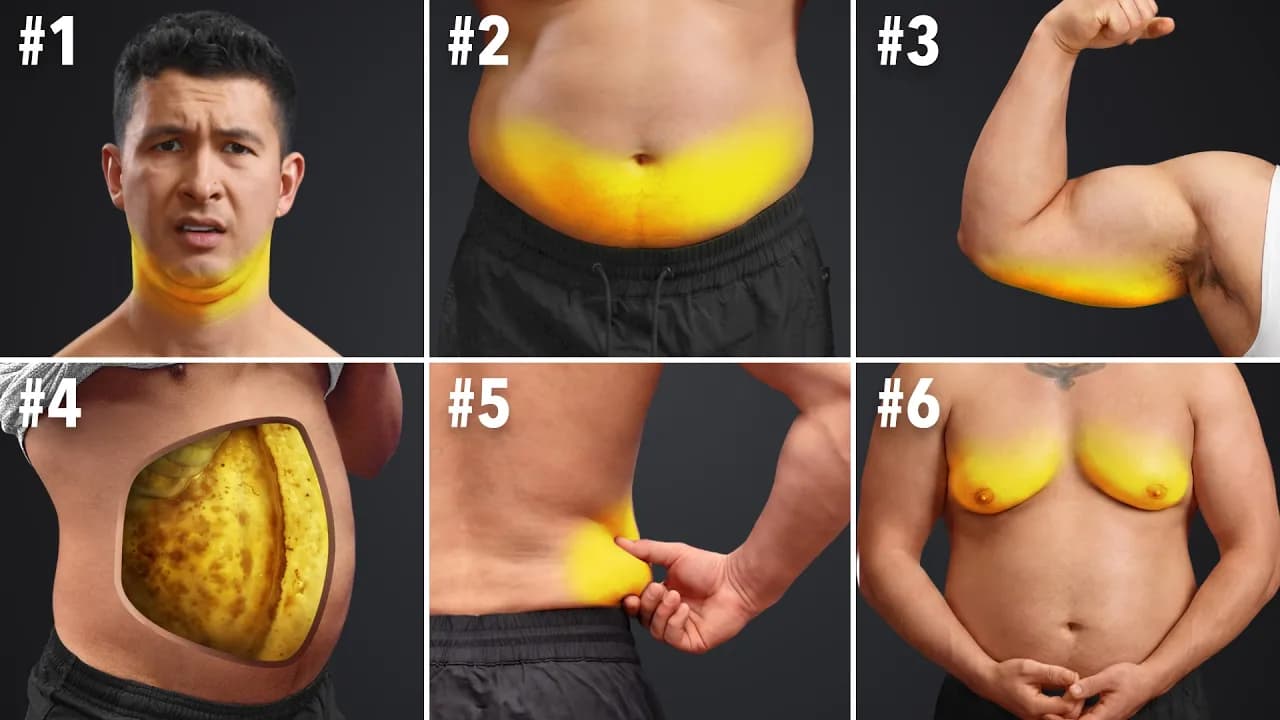
Layer 1 is soft outer belly fat preventing ab definition. Men: upper abs poke through, shape in rest. Women: waist tightens, rolls smooth out, no clear ab definition yet.
End of layer 1: 20% body fat (men), 28% (women). Requires least physical effort.
For Nesh: 4 core habits + 1 bonus.
- Workout plan: 3 workouts/week to ensure fat loss, possible muscle gains.
- Diet rules: Palm-sized lean protein per meal; prepare most meals at home; build around core foods. No calorie counting needed.
- 8,000 steps/day.
- Scale for morning weight; 1 lb/week loss goal.
Used Built with Science Plus app for tracking weight, weekly workout coaching, healthy recipes.
Layer 1 hardest mentally. Day 30: Nesh down 7 lbs, texted doubting plan despite waist down 3 cm. Chin, chest, arms leaned down, but belly lagged (as DEXA data predicted: easy areas first).
Day 60: Another 3 cm waist loss, chest/arms progressed more (new veins), belly slower.
Nicole (similar fat loss): down 8 cm waist, ab definition poking through.
Abs are small, flat muscles; more fat to lose vs. arms/shoulders.
Bonus habit: Morning progress photos after weighing. Review to see chest/shoulders/arms progress, not just belly. Helped Nesh notice progress. Below 25% body fat, belly progress accelerated.
Day 90: Lost 12 lbs fat, layer 1 burned off, clear upper ab definition. Leaner than 84% of men.
Most give up in layer 2 (15% men, 23% women). Fat loss slows/stops as body fights back; layer 1 strategies fail.
So 2 weeks, the weight hasn't changed. Uh the progress photos I'm taking daily, they look identical. And the weird thing is like I'm recording most of the meals and been um pretty consistent I feel. So yeah, I don't know what's happening.
Reasons: Less body weight = lower calorie burn (like removing weighted backpack). Body conserves energy (subtle: less walking/sitting more).
Avoid: Ramping cardio (works short-term, then stalls/burnout).
For Nesh:
- Steps: 8,000 to 10,000/day (insurance for consistent burn, no hunger spike/burnout).
- Strength training: From 3-day to 4-day split, more volume on shoulders/arms (test muscle gain in deficit; 2-3 full-body workouts/week, 4-6 hard sets/muscle prevents loss).
Calorie intake key: Track calories. App calculated 2100-2300/day for Nesh. Alternative: body weight (lbs) x 10-12.
Chipotle order: 900+ calories. Gave 2100 calorie meal plan:
- Breakfast: apple cinnamon overnight oats.
- Lunch: butter chicken.
- Snacks pre-workout.
- Dinner: homemade freezable burrito.
- Save room for daily treat (e.g., ninja creamy ice cream with science protein; Nesh: sugar-free Jell-O, Greek yogurt, caffeine-free Coke Zero, Smart Sweets).
Free PDF of Nesh's full meal plan in description.
Metabolisms: 2019 research - spendthrift (metabolism stays high in deficit) vs. thrifty (adapts, slows burn; easier muscle gain, harder fat loss). May need lower calories/more activity.
Nesh responded well (spendthrift?): Belly fat loss picked up, upper abs/obliques definition.
Layer 2: 10-16 weeks. Men: visible 4-6 pack. Women: tighter stomach, possible upper/middle ab definition in lighting.
Still softness in lower belly/love handles. Layer 3: <1% succeed. Hardest to lose, but fastest visual progress (less fat covering abs; small losses noticeable every few days). Every lb feels like battle.
Not all fat equal: Beta receptors (gas pedal, easy burn: most fat lost so far). Stubborn fat: alpha 2 receptors (brake pedal: lower abs, love handles, hips, glutes). Shredded glutes = elite conditioning.
Body ramps hunger, lowers energy.
So just struggling to fall asleep today a wee bit. Um I'm usually pretty good at falling asleep, but uh the hunger is just setting in a bit more than usual.
Strategies:
- Food selection: Thin margins. No cream in coffee, fewer drinks out. Swap rice for yellow potatoes (most filling per satiety index). (Upcoming potato-based no-count diet project.)
- Diet breaks: Body resistance strengthens; cortisol rises, causes water retention (belly looks worse overnight). Don't panic/add cardio/drop calories (worsens stress/muscle loss).
Instead: Increase calories ~500 higher (add carbs: rice, bread, snacks) for 5-14 days. Lowers cortisol, improves sleep/hunger. Nesh: 5 days; abs sharpened despite more food, energy up.
To 10% body fat: ~8 more weeks. Not for everyone.
Example: Brother-in-law Dayton from 33% to 18% in 5 months. Paused fat loss, maintained, lean bulk. Now ready for future diet.
Most overestimate muscle, underestimate fat to lose; end up skinny. Nesh built muscle.
275 days total. Included 5-week trip (maintain weight + training). Slow/steady best for Nesh.
Final DEXA:
- Total body fat: 29.5% → 16.7%.
- Belly fat: 34.4% → 13% (20 percentage point drop).
- Gained ~7 lbs lean mass (much muscle).
Damn, dude. Look, >> dude. There's no way. Holy. Look at this. One, two, three, four, five, six. I feel you got a eight pack coming in, too. Dude, they're coming slowly, >> dude. And like the size is there. >> Yeah. >> You know what I mean? Yeah. Give her a little double bicep flex for the camera. Holy crap, bro. You look amazing, dude. Holy.
I'm getting there. I'm happy, man. >> What do you mean you're getting there? You're there, bro. Holy crap. >> Cheers, man. I appreciate it. >> That's incred. Look at this. I'm just going to peel it.
App promo: buildwithscience.com or QR code; 2 weeks free. Customizes workouts/nutrition.
Yeah, 100%. Um, and just to Jeremy's point, I mean, without the app would have been really hard. I was tracking everything every day. Um, the app does the foods, does the weights and everything. So, just having everything in a one-stop shop, again, not pushing it, but it genuinely helped a lot.
Without your guidance, it wouldn't have been possible. But yeah, >> man, dude, I'm freaking stoked for you. Holy crap. >> Thank you so much. >> I wish it wasn't so cold, though. I want to just like go to the beach right
Keep Jeremy Ethier in your library
Save the videos and channels worth coming back to, and find them again in one place.