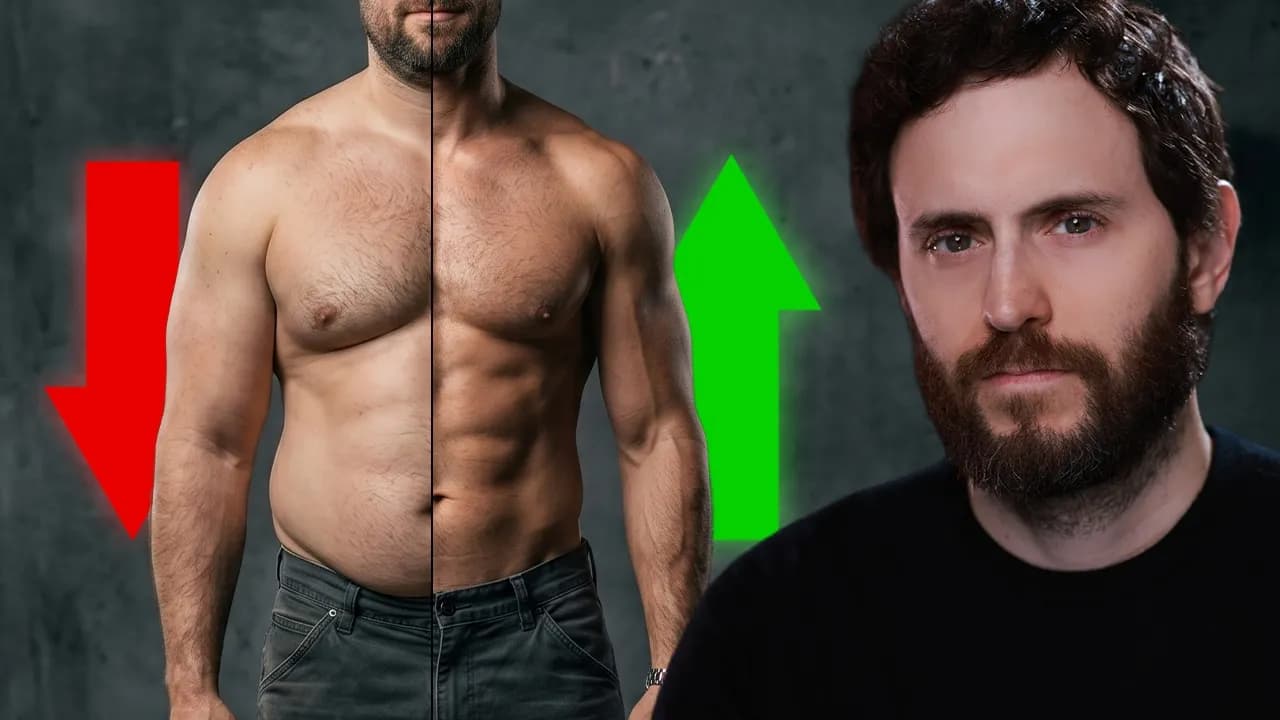
How to Build Muscle & Lose Fat at the Same Time | Dr. Andy Galpin
In a Nutshell
Body recomposition—gaining muscle while losing fat—is feasible if you have excess body fat (men >10-12 %, women >15 %) and are relatively untrained. Once body fat drops below those thresholds or training experience is high, a calorie surplus becomes necessary. A modest 5-10 % calorie deficit is usually enough for fat loss, since muscle is metabolically expensive to build and fat is a high-calorie reserve that can fuel the process.
These notes were generated by AI and may contain inaccuracies.
Can you build muscle and lose fat at the same time? Can you build muscle while in a calorie deficit? If you're trying to gain muscle, can you do that without worrying too much about gaining some fat? The answer depends entirely on your body composition and training experience.
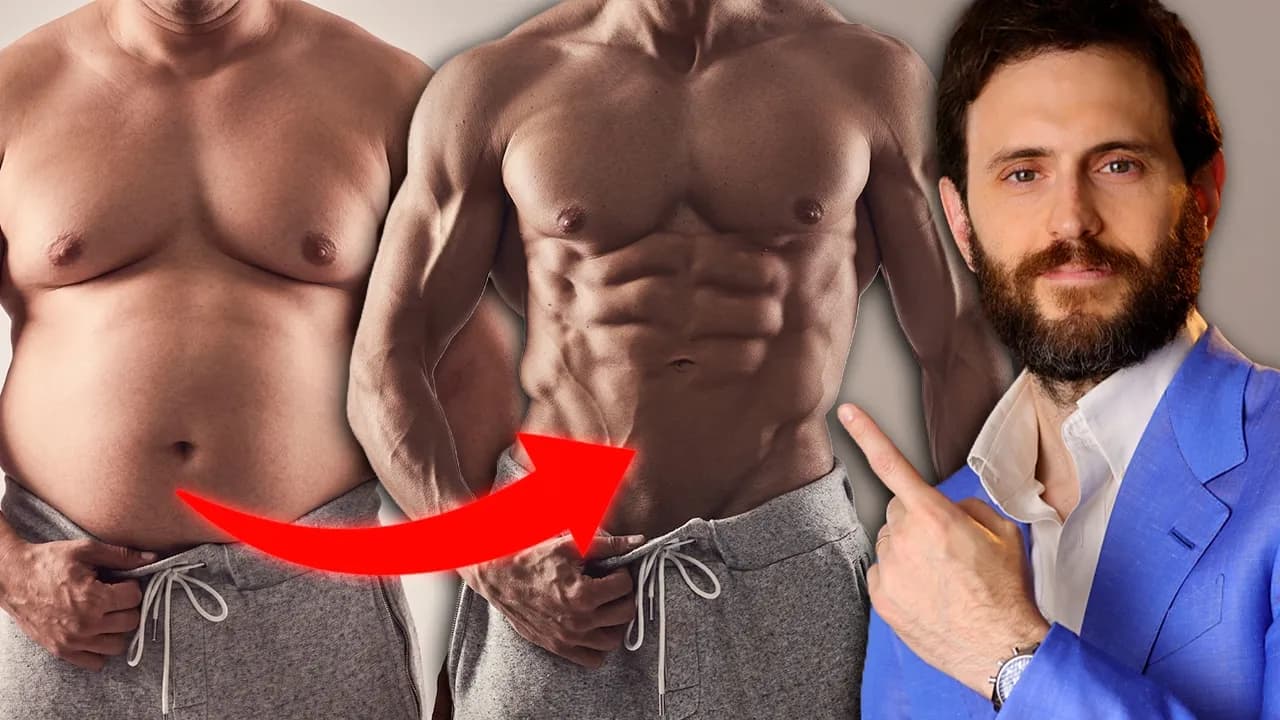
If you have a lot of body fat and a lack of training and exercise experience, it becomes easier to add muscle during a calorie deficit. A calorie deficit is defined as the number of calories you consume compared to what you burn. This process is called body regeneration - you're in a calorie deficit but converting some of your calories from stored fat to stored muscle. This is what most people want: to gain more lean muscle and lose more fat. This is entirely possible.
For this person, yes, you can gain muscle during a calorie deficit if you have enough stored body fat from which you can draw calories.
If you move to the other end of the spectrum - a very experienced person with many years of continuous training who is extremely thin - then these two things become difficult, if not practically impossible. At that stage, you should enter a state of calorie surplus. It's that simple.
If you're somewhere in the middle, we can't be sure. You may have to try things out and adjust them. You may be able to achieve some muscle gains while losing body fat, or you may not be able to do that. It depends entirely on the range in which you fall.
Body recomposition can occur if men are over 10 to 12% body fat, and women are over 15%. When you start to get below that, regardless of the training situation, it becomes extremely difficult. It wouldn't be impossible, but especially in the absence of external hormones, it becomes a big challenge.
For most people, most women will have over 15% body fat, which is a good percentage of thinness. For women, and most men, it will be above 10 or 12% body fat. So most of the time, these things are perfectly possible.
The range we would prefer people to stay in is around 5 to 10%. This will be a calorie surplus or a calorie deficit. I am generally not in favor of going beyond that. I don't really see the need to reach a calorie surplus of 25, 30 or 50%. I rarely see the need for that in order to lose fat as well.
If you have a lot of fat, more than 40% of body fat, which is a very high number, then I may be convinced of the usefulness of a deficit greater than 5 or 10% because you have sufficient reserves. But to be fair, this represents a lot of people. There are a large number of people who fall under this category. But for the average person, the figures we stick to are in the range of 5 to 10% for surplus or deficit.
If asked how many calories it takes to burn a pound of fat, most people know that number. It's not entirely accurate, but within an acceptable range people would say it's around 3500 calories. In other words, if you were following a 500-calorie deficit per day, after a week, 7 times 500 equals 3500. After a week you would have burned one pound of fat. That means 4 pounds a month, 50 pounds a year. That's all it takes with a deficit of 500 calories.
500 calories is a lot for some people. If you eat only 1500 calories a day and you have to reduce it to 1000, it will be extremely difficult. You probably won't be able to achieve it. But if your calorie intake is this low, you don't have 50 pounds to lose anyway.
If you are consuming 4000 calories and reduce them to 3500, this means a few fewer bites at each meal. And frankly, that's what I do. I usually eat literally a few less bites at each meal. And I end up reducing my calorie intake by 200 to 300 calories a day. I barely notice it. This means a few pounds a month. After two or three months, you will have lost 10 pounds, and it's that easy. You can be stricter, but you get the idea.
Ask yourself, how many calories does it take to build a pound of muscle? We know that losing one pound of fat requires about 3500 calories. How much does it take to build a pound of muscle? We don't know that, but it seems to be close to about 1800 calories.
If you took a pound of your body fat and released it completely, you would get approximately 4000 calories of energy, which is why a pound of body fat is such a valuable source of fuel. Approximately 4000 calories. But if you free up a pound of muscle, you'll only get about 800. That's a difference of almost five times.
So muscles are not a storage depot for calories, but fat really is. What this tells you is that the reason you're building muscle is because it's a high-cost investment. It requires a lot of calories to build. It consumes a lot of protein, calories and a lot of adenosine triphosphate (ATP) daily. It is a factory that constantly burns, burns, and burns materials just to maintain its existence. If you get rid of this factory, you will get almost nothing from it. In this sense, it is a high-cost investment with a very low return.
From an energy perspective, fat is the complete opposite. It is very easy to set up. It is also very efficient in terms of ATP consumption, and can be released to obtain a huge number of calories. Structure usually equals function in physiology, which tells you that it is not meant to be your fuel source, which also means the opposite of what we are saying here, which is that it is easy to lose fat, but difficult to gain muscle in terms of energy.
Keep Andy Galpin in your library
Save the videos and channels worth coming back to, and find them again in one place.