How to Build the Reacher Physique
In a Nutshell
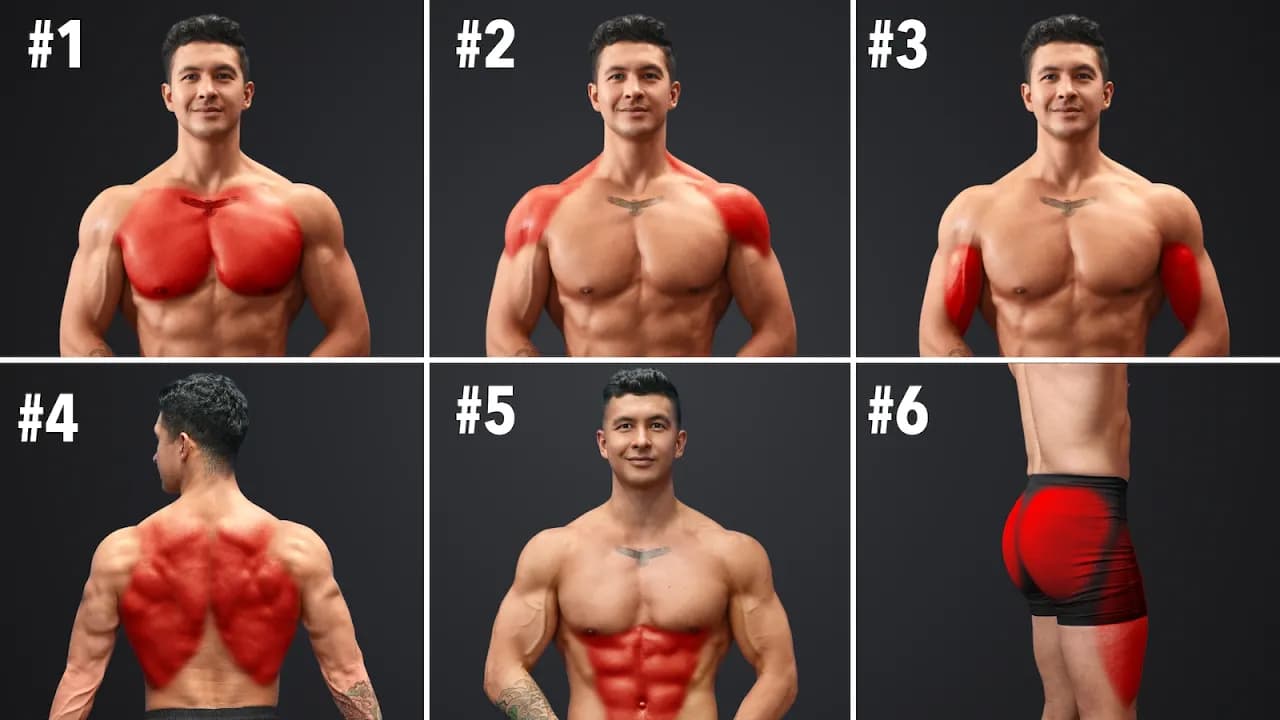
Alan Ritchson's imposing Reacher physique stems from massive chest and shoulder development creating an inverted triangle shape. To replicate this, prioritize heavy low-rep chest presses with a specialized outward dumbbell press variation, while shoulders need high-volume lateral raises with partial reps to failure. The program uses a 5-day full-body split with 12-30 weekly chest sets and 14-35 weekly lateral shoulder sets, following a slow bulk/cut cycle for maximum growth.
These notes were generated by AI and may contain inaccuracies.
Alan Ritchson has gained prominence as an action movie hero, particularly as Jack Reacher. His physique stands out for being muscular and imposing rather than just his fighting skills. The key question is what makes his physique particularly convincing for action roles and how others can develop similar attributes.
Alan Ritchson stands at 6 feet 3 inches tall, with height being primarily genetically determined. He weighs over 200 pounds at this height, indicating significant muscle mass that would require serious training to replicate. While he possesses overall muscularity, his chest and shoulders are particularly prominent and contribute most to his imposing presence.
His chest and shoulder development creates an "armor-like" appearance on top of his frame. The combination of broad shoulders and a thick chest gives him the inverted triangle shape characteristic of action heroes. Without this chest and shoulder development, he would not project the same intimidating character in scenes.
Two major factors limit the value of directly copying Alan's training approach. First, genetics play a significant role in muscle development patterns. Some individuals naturally develop certain muscle groups faster than others, as demonstrated by the speaker's own experience where chest and thigh muscles grew rapidly while biceps required focused effort.
Second, it's not clear that Alan specifically prioritized chest and shoulder training. His workouts appear to emphasize the upper body as a whole rather than targeting these muscles specifically. Prominent muscles don't necessarily indicate focused training on those areas.
The chest is a large, strong muscle that responds well to full range of motion training with heavy weights. Pressing exercises using barbells, dumbbells, or machines at maximum depth for 6-12 repetitions are effective. Due to the significant muscle damage from heavy loading and deep stretching, the chest requires more recovery time between sessions and has limited productive sets per workout.
The recommended approach for chest training involves heavier weights, fewer repetitions, and lower training frequency compared to other muscle groups.
A unique dumbbell press variation involves performing the movement at a low incline while pushing the dumbbells outward at the bottom position. The dumbbells are lowered deeply, allowing the inner sides to reach outward toward the chest. At the lowest point, after pausing, the dumbbells are pushed outward (not down or up) for several inches before returning to the starting position.
This outward push creates maximum tension on the chest muscles while reducing triceps involvement. The increased tension at the deepest stretch position, combined with prolonged time under tension, promotes significant muscle growth. The outward push phase should take approximately 3 seconds total from reaching the bottom position until beginning the upward movement.
Proper warm-up is essential, and lighter weights than usual should be used due to the intense tension at the bottom position.
For optimal visual shoulder development, lateral deltoid training should be prioritized. These muscles create the round, full appearance when viewed from the front. Rear deltoids receive substantial stimulation from back exercises, while front deltoids are worked during chest movements, leaving lateral deltoids requiring specific attention.
Unlike the chest, lateral deltoids cannot achieve deep stretch under load and are more sensitive to heavy movements in the anterior plane. Therefore, lateral shoulder training requires higher repetitions, greater training volume, and more frequent sessions rather than heavy, low-repetition work.
The recommended shoulder workout uses a superset of standing lateral raises with partial repetitions. Starting with dumbbells held while leaning slightly forward (approximately 10 degrees), the weights are raised with arms extended and pinky fingers pointing upward throughout the movement. This hand position increases lateral deltoid stimulation while reducing front deltoid dominance.
Once muscle failure is reached at parallel arm height, partial repetitions continue using the same strict technique. These partial reps progressively reach lower heights until even 45-degree angles cannot be achieved. The set ends at this point. Many individuals can perform as many partial repetitions as they completed full-range repetitions.
All repetitions, both full and partial, count as one set when tracked in training applications.
A 5-day-per-week full-body program has been designed specifically for chest and shoulder development. The program is demanding but manageable, with emphasis on the target muscle groups.
Chest Volume: Six exercise slots per week, with sets progressing from 2 to 5 per exercise, resulting in 12-30 weekly sets for maximum chest development.
Shoulder Volume: Seven total exercise slots distributed across the week, with one exercise on Mondays, Wednesdays, and Fridays, and two exercises on Tuesdays and Thursdays. This distribution yields 14-35 weekly sets specifically targeting lateral shoulders.
The shoulder training schedule includes built-in intensity variation for recovery, with single exercises on alternating days and double exercises on consecutive days. Despite daily shoulder training, the varying intensity prevents overtraining.
Arm and upper back exercises are included for complete upper body development. Leg training is minimal, with 2-3 sets per exercise to maintain rather than build leg muscle mass. This allocation preserves recovery capacity for the prioritized chest and shoulder development.
Forearms and calves are excluded from the program to reduce physical exhaustion and time requirements, though they can be added based on individual preferences.
While specific exercises are pre-selected in the training application, the overall program structure takes precedence over individual exercise choices. Exercises can be substituted based on equipment availability, enjoyment, and motivation-to-fatigue ratio. The program's framework remains effective regardless of specific movement substitutions.
Repetition ranges of 5-30 are acceptable when performed close to muscle failure, though 10-20 repetitions are generally optimal for muscle growth, technique, and joint health.
Set numbers depend on training experience: beginners should start with 1 set per exercise, while those accustomed to high-volume training can begin with 3 sets. Two sets per exercise serves as an appropriate starting point for most individuals.
Progression involves adding 2.5-5 pounds or 1 repetition per week until reaching near failure, typically occurring after 4-8 weeks. Recovery status determines whether to reduce or increase volume throughout the program.
After 4-8 weeks of training to near failure, a complete deload period is recommended. If specific muscle groups show fatigue while others recover well, targeted recovery sessions can be implemented by reducing sets, weights, and repetitions by half for the affected muscles.
Following a recovery session, the subsequent workout uses two-thirds of normal volume before returning to full training load. This approach allows continuation of the program while managing localized fatigue.
A slow bulking approach is recommended, targeting 0.5 pounds of weight gain per week for 12-16 weeks, aligned with the training schedule and including recovery periods as needed. This controlled approach maximizes muscle gain while minimizing fat accumulation.
Following the bulking phase, a cutting period of 4-8 weeks at 1 pound of weight loss per week is recommended to achieve leanness before restarting the cycle. During cutting phases, a full-body split helps preserve muscle mass.
The complete cycle involves prioritizing muscle growth through focused training, then maintaining gains during cutting phases before repeating the process.
Keep Renaissance Periodization in your library
Save the videos and channels worth coming back to, and find them again in one place.