How to Eat for Gut Health & Longevity | Lifespan with Dr. David Sinclair - S2, Ep. 8
In a Nutshell
Eating lots of sugar and inflammatory foods accelerates aging by damaging proteins through glycation, promoting chronic inflammation, and disrupting gut microbiome diversity. A low-inflammation diet centered on plant foods, minimal processed sugars, and limited alcohol can reverse these effects within months, as shown by David Sinclair's own blood markers improving significantly after cutting dairy and alcohol. Maintaining healthy nutrient-sensing pathways through diet, exercise, and avoiding overeating helps preserve metabolic function and insulin sensitivity as we age.
These notes were generated by AI and may contain inaccuracies.
If you eat a lot of sugar, you will have a faster aging process than if you don't. Your body's turning on itself. When there's a lack of inflammation, other aspects of your body come back to life. Our bodies start to have a harder time as we age in recognizing what nutrients are and how to use them. Your microbiome, which is the bacteria and the fungi in the gut, actually control your health and your longevity. You've bought yourself a little more good life.
Welcome to Lifespan, a show where we discuss the cutting edge science of aging and how to live healthier at any stage of life. David Sinclair is a scientist and professor working on understanding why we age and discovering new ways to slow and even reverse the aging process. On this show, he shares an insider look at the latest from his lab, the field, and what's just around the corner.
This is part two of three episodes. Today the discussion focuses on food because what you eat dramatically affects both the signals your cells receive and the microbial community living in the gut. What you eat can also affect the proteins in your body. Too much sugar or carbs that turn into glucose in the bloodstream can attach to proteins in a process called glycation. This attachment can be measured using a surrogate for the other proteins in the body called HbA1c, which is sugar attached or glucose attached to hemoglobin. This is a test many people have probably already had. Today's topics include inflammation, sugar, the gut, and nutrient sensing, which is how cells know whether nutrients are abundant or scarce, and why that matters for living a very long time.
Inflammation is a state that is very helpful when you need to fight infections. We need to be able to detect things that invade us, want to eat us, want to feed off us, and we've got an immune system to address that. The problem is that as we get older, our immune system becomes weaker at addressing and attacking invaders, and it turns on ourselves, and that's called chronic inflammation or inflammaging. This is a process that is a problem because it erodes joints. It causes cells to accelerate in their aging. We get diseases like diabetes, heart disease, even Alzheimer's have a large component that is accelerated, made worse by this inflammatory process that we all get as we get older.
There are ways we now know that you can slow that process down and even reverse it. There are lots of ways to know if you're getting inflammation. The most accurate way is to do a blood test and look for markers like C reactive protein, which is a marker for cardiovascular inflammation, IL-6, IL-1 beta, TNF alpha. Your doctor can test for those or you can order a kit online typically.
If you just want to know daily how you're doing as a human being, the kind of symptoms that you might see would be your skin might feel inflamed, so you're getting itchy, redness. Your eyes might look inflamed. Your joints might start to feel a little bit stiff or even painful. Arthritis being the major downstream effect of that. That's what's really going on is that your body's turning on itself and you're not feeling great. And eventually, if you don't slow it down or stop it, these effects of being lethargic and your joints hurting will actually become diseases.
Inflammation is something that we can do something about pretty easily. Even if you address inflammation, you're not going to stop aging. What you can do is change your diet. There are low inflammatory diets. It's the one that David Sinclair has been on now for two years. It's a fairly unusual diet. It's a vegan diet. He was turned on to it by looking at the amazing health of his partner, Serena Pune. She looks a lot younger and feels a lot younger than she is. He switched after she came to his kitchen and threw out half his food.
The low inflammation diet includes stopping alcohol, which David Sinclair has done. Matthew LaPlante beat him to that one and inspired him. David Sinclair says his mind is so much better and he can remember things. They were talking about this over dinner a couple of nights ago about how they feel like they might have wasted a whole bunch of years with all that alcohol. Matthew LaPlante agrees that they definitely wasted years.
The other thing David Sinclair changed was he got off dairy. It's surprising how quick the effects are. When he got off dairy and was eating cheese every night, his inflammatory markers, which can be measured in blood, within two months had dropped dramatically. He was not an unhealthy person at that point. Matthew LaPlante saw his blood work and it was great. David Sinclair thought he was the healthiest he could possibly be, but this got him to another level. He went back, at least based on some blood tests, a number of years, even younger than he was then. Now he's at least a decade younger, at least based on those tests.
David Sinclair rarely eats meat. He's not really a vegan. He's a struggling vegan, but he rarely eats meat. A lot of people say to him, "How do you do that?" It's helpful if your partner is a chef and a vegan as well, but he no longer craves meat. He used to be one of these people that if he had dinner, there'd be a steak or a piece of fish and then some other green stuff that he didn't really want to eat, but he just ate it for vitamins. He's off that. Because he feels so good now, and other people say, "Wow, you look better. Your skin's better." He's sticking with it. It's not difficult once you make a lifestyle choice like that.
That doesn't mean everyone should go vegan. He knows people love meat, but he would say try to be more focused on plants if you can. Choose dishes that are not just meat and a little bit of veggies on the side most days of the week. You'll find that you'll feel better. Your inflammation will come down. That's a fact. That's not really speculation.
Sugar and its relationship to inflammation is so obvious that David Sinclair forgets to mention it. Think of sugar as poison. It's okay to eat a dessert. Occasionally he eats a dessert. He typically just steals it from people. Just tastes it. But if you're drinking sodas with sugar, pure sugar in them, or just daily life, you've got sauces and stuff that's in coffees, these fancy coffees. It's amazing how much sugar is just in stuff that you don't even think like ketchup. It's tens of grams in these. One bottle of sugar-free ketchup at the store and 47 bottles of stuff that's got high fructose corn syrup in it.
Think of it this way. This is what helps David Sinclair. Sugar tastes good, of course, and it's good for your energy. Your brain needs it. Your muscles, in fact, need it even more. What sugar does to you in part is it actually sticks to your proteins. It's called glycation. Glycation is modifying proteins so that they don't work. This is a process of aging. One of the measures of glycation that doctors use is called HbA1c, which is glycation of hemoglobin. That's a good measure of how high your blood sugar has been over the last 2 to 3 months. If you eat a lot of sugar, then you'll have high levels of sugar attached to these proteins. It's not just hemoglobin that gets attached to sugar. All proteins, pretty much all proteins in your body get caramelized or caramelized if you're Australian or Canadian.
This is a process that is toxic. If you have low carb, low sugar diets, your proteins will be pristine, more pristine. They won't become dysfunctional and you won't be so predisposed to the diseases of aging that come much later. It's actually known that if you eat a lot of sugar, you will have a faster aging process than if you don't. The sugar itself will attach to proteins and modify them with glycation. The ultimate product of that are called advanced glycation end products. These are molecules that are attached to the proteins that cause them to behave badly. What's often forgotten about is that these glycation products are happening to pretty much every protein in every cell.
The problem with that is that there really isn't a way that the body has to get rid of these sugar caramelized proteins except to recycle them completely. But it would be really exciting if we could have a molecule where you could ingest it and clean up those proteins.
Anytime David Sinclair says the words "it would be really exciting if we had," Matthew LaPlante thinks there's somebody in his lab who's working on this or one of his companies is working on this right now. In this case, they have some ideas. They haven't started, but there are other labs. There was a paper that was published that kakans, one of these plant molecules, you can find it in green tea, especially matcha as well as chocolate, that these kakans stimulate the ability of the body to get rid of these modifications on the protein. So you can reduce your glycated hemoglobin. There's another thing that's really interesting. Albumin gets modified by sugar as well. Gets glycated. David Sinclair was looking it up recently. Glycated albumin is toxic to human cells. It could be though not proven, but they're going to investigate this that the sugar that's attached to albumin in your body is toxic. It might be why when you have blood transfusions or what's called plasma pheresis where you replace the albumin component of your blood, why that's so healthy because it's not glycated. It's fresh.
Diet is one of the easiest ways to impact inflammation. Changing your diet is really easy for some people but hard for others. But that's sort of the most straightforward way, the most accessible way to impact inflammation. There are other ways. What you're doing with your diet is you're ingesting anti-inflammatory molecules from plants. Typically, they're made by plants, not by animals. That's why this diet works. You can also take molecules that are purified from plants as supplements such as curcumin and kakans which you can find in whole variety of foods as well as supplements. Resveratrol is one that they've worked on in his lab which is a polyphenol a chemical that's found in grapes and you can take that as a supplement. These are all molecules that are highly anti-inflammatory that he aims to get both from his diet but also he takes them as supplements every day.
Dysbiosis is imbalance in the gut microbial community that is very associated with disease. The microbiome, which is the bacteria and the fungi in the gut, actually control your health and your longevity. We now know this. As we get older, that community changes. We see shifts in the types of bacteria that are in our gut and they become less conducive to health and they become less diverse. A lot of people think more bacteria is bad, lots of different kinds of bacteria is bad. No, actually in our guts, lots of different kinds of bacteria is best. We start to get types of bacteria that cause inflammation, which as mentioned is terrible, but we also start to lose bacteria that make molecules that make us healthy.
There are short chain fatty acids. Short-chain fatty acids we can either take as a supplement, but is one among others. But also these bacteria make them naturally and we start to lose those species as we get older. What we want to do is maintain those communities by having a healthy diet. But we can also take these bugs with a pill and so probiotics which are enhanced by prebiotics. Prebiotics are the food for those bacteria to get back the more youthful communities that we might have lost over time or by being given antibiotics by our physicians.
The main probiotics are lactobacilli that those are in most probiotics, but there are other species as well that are really found in people that are super healthy athletes, people who eat vegetarian diets. These are bacteria that you find in yogurt. These are lactobacilli and that's pretty common. You can eat yogurt and fermented foods that can help with your gut. The more advanced developments in what science is saying is that there are certain bacteria that make these short-chain fatty acids specifically if you're healthy and you lose these as you get older or if you have a bad diet. When you eat certain probiotic strains in food or as a supplement, they will populate your gut. Instead of you having to eat these short-chain fatty acids or SCFAs like acetate and butyrate which often can taste terrible, your bacteria in your gut will actually make them for you.
David Sinclair has yogurt in his refrigerator, but it's a certain kind of yogurt. This yogurt in his fridge is coconut based, so that also has the bacteria in it, the same as these other dairy based yogurts, such as Greek yogurt, but he also gets the benefit without having the inflammation. Matthew LaPlante snuck one of those the other day. It was really good. David Sinclair says they're just as good as dairy, which is what he loves about this diet that he's on, or this new lifestyle, which is he's not feeling like he's missing out at all.
Deregulated nutrient sensing means our bodies start to have a harder time as we age in recognizing what nutrients are and how to use them. That's key because we know that when the body senses that there's a lack of nutrients or a lack of energy, it responds in a positive way to enhance longevity. As we get older, we lose that ability. In reality, when we are fasting and even exercising, our bodies don't recognize that the way it should, and we don't get the benefits. Our job really as individuals here is to reignite, reinstall the ability of the body to recognize when we're eating and living well. And you'll reap the benefit that way.
The kind of nutrients we're talking about are amino acid levels, phytochemicals, so from plants, and sugar is a big one. Sugar is a main source of energy. The way we sense nutrients determines our longevity. It's one of the reasons why if you eat well and you don't overeat, you actually reap these health benefits because there are some main senses in the body that measure how much protein and sugar and fats are coming in. Depending on how well we recognize those things determines how long we live.
The most common form of this, the one everybody knows is type 2 diabetes where the body loses its ability to recognize sugar for what it actually is. What we end up having is that the body doesn't recognize insulin, which is one of these hormones that tells the whole body, now you've just had a meal. Without insulin or at least the ability to sense insulin, our muscles and our brain don't suck glucose out of the bloodstream and instead you get a buildup of sugar which is toxic.
Diabetes is caused in part by dysfunction in a couple of the three main nutrient sensing groups. There are three main nutrient senses in the body that are relevant to longevity. There's mTOR which recognizes the amount of amino acids in your body that you're mostly bringing in from protein. Then there's AMPK which measures energy and controls mitochondrial function. And then there's the sirtuins which respond to a lot of different things. Temperature, exercise, and nutrients that are coming in.
These three main nutrient sensing groups attenuate over time while we age. They're not as effective. We lose the ability to sense. For example, glucose and sugar that we're eating. Our bodies don't sense that. As a result, blood sugar levels rise in the body and you get what we call type 2 diabetes.
There are things we can do to reestablish the presence of these nutrient sensing groups in our bodies in a healthy way. In the case of inability to sense sugar for example, we know that if you live well, so if you exercise, if you eat well and you don't eat too much or you take certain drugs and molecules, you can reestablish the ability to sense sugar. Case in point, you can take the drug metformin, you can go running, do exercise, or you can just eat less often. These are all helpful to reestablish your body's ability to sense sugar. But once our nutrient sensing mechanisms have become deregulated, it does get harder to get it back.
It's true. You want to make sure that you're doing the right things from an early age in your 20s and 30s. Certainly by the time you're David Sinclair's age, in your 50s, you want to be doing the right things. So that's doing a lot of exercise, eating the right things, eating less often. Don't become obese. Otherwise, it becomes just too hard to reverse. Those are the things that can set off nutrient sensing and put them off course. It becomes harder to recover. It's never really too late, but if you're 80 and you're obese and you've got type 2 diabetes, it's a lot harder than if you start working on it in your 30s, 40s, and 50s.
Once our stem cells become exhausted, once our intercellular communication becomes interrupted, once our mitochondria become dysfunctional, once that happens, it is harder. So this is the whole let's stay as healthy as possible. Let's stay as biologically young as possible for as long as possible so that we don't have to worry about these things that are further upstream. Until we've figured out the information theory of aging and can reset the body, we've got to delay the process. The best way to do that is to live well. But there are also molecules that we can take to reestablish the ability of the body to sense what's coming in.
For example, metformin enhances mitochondrial activity. It enhances insulin sensitivity so your body can sense the sugar in the bloodstream and that can reverse some aspects of aging including type 2 diabetes. Metformin has been shown in various studies to act on all three of these pathways: mTOR, AMPK, and sirtuins. If you address one of these pathways, so let's take mTOR. If you make sure mTOR is healthy, your other two will be healthy. Same for AMPK, it affects the other two. Sirtuins, which David Sinclair works on very similarly. If you can boost the sirtuin activity either through exercise, fasting or small molecules, which they're developing, resveratrol was the first example. There are some better ones now. NAD boosters which they've talked about is another class that will also improve mTOR signaling and also boost AMPK as well. So it's not that hard once you know what you're doing to be able to keep the nutrient sensing part of your body youthful. What we don't fully understand right now is which one are the best ones to address and what are the ratios of fasting, exercise and molecules and when to do them. Ultimately, we'll get there.
If somebody has not taken any action in their own life to think about combating aging in this way yet, where's the best and easiest and maybe most effective immediately place for them to start? The easiest one would be to reduce inflammation. David Sinclair just changed his diet and
David Sinclair changed his diet and stopped drinking alcohol, resulting in inflammation levels dropping significantly. Start with inflammation as one of the broad effects achievable through dietary changes. Change diet by avoiding inflammatory foods and consuming molecules that reduce inflammation. Living the proposed lifestyle will definitely reduce inflammation levels.
Overall state of biological aging will not decrease substantially, but this approach provides more good life. Immediate benefits include feeling better without aches and pains. When inflammation is reduced, other bodily functions improve: mitochondria become healthier, fewer senescent cells exist, and nutrient sensing improves. Start by reducing inflammation, then work up from there.
Address inflammation through small concrete actions, though these may not be easy. Stopping alcohol consumption after years of drinking produces concrete effects on inflammation levels. Stopping sugar intake creates similar measurable benefits. After addressing one concrete factor, move on to the next.
Eating a bad diet increases inflammation and blood sugar, alters gut microbiome, and activates nutrient sensing pathways in ways that speed up aging. Focus on minimally processed plant foods when possible, or grow them at home. Avoid building every meal around meat with minimal vegetables. A vegan diet is not required.
Joe Rogan suggested eating mostly meat and offered elk he had killed. Scientific evidence indicates that excessive protein, particularly animal protein with high branched-chain amino acids compared to plants, likely activates mTOR excessively. This activation denies the body's protective mechanisms against aging.
Limit and eliminate alcohol consumption. Cut back on foods and drinks high in added sugars or those easily converted to sugar. This includes sodas, desserts, soups, and sauces. Additional sources include rice, pretzels, oat milk, and breakfast cereals.
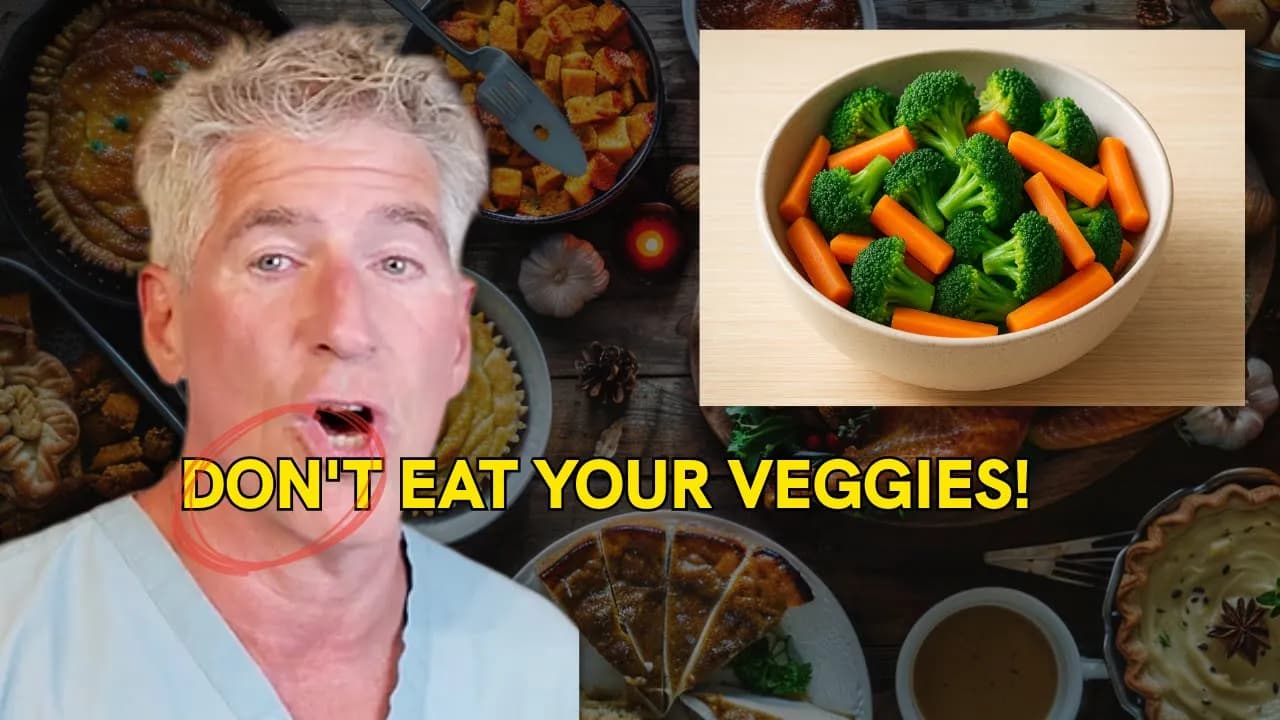
How much and when food is consumed matters as much as what is eaten and how it is prepared. High-temperature cooking like frying and dry heat generate more advanced glycation end products (AGEs), especially when cooking meat. Boiling or steaming produces fewer AGEs due to higher moisture content and lower temperatures. When cooking broccoli, maintain bright green color and slight crunchiness. Reheated russet potatoes can be a significant source of sugar in the system.
As people age, the community of microbes in the gut can change dramatically. In some individuals, particularly those with declining health or frailty, microbial diversity decreases along with bacteria that produce useful molecules like short-chain fatty acids (SCFAs). Feed this ecosystem by eating plenty of whole plant-based foods, especially fiber, and include fermented foods if they work well individually.
Prebiotics serve as food for beneficial gut microbes. Good food sources include onions, garlic, leeks, asparagus, oats, and legumes. Avoid unnecessary antibiotics as they can disrupt microbial communities. These practices become especially important after taking large doses of oral antibiotics.
Chronic periodontal or gum disease involves inflammation of the gums, often indicated by bleeding gums during flossing. This condition associates with greater systemic inflammation and higher risk of cardiometabolic diseases like diabetes. Brush and floss regularly. Coconut oil pulling can be performed by sucking coconut oil through teeth morning or night, or both times, then spitting it out without swallowing.
Cells contain nutrient sensing pathways including mTOR, AMPK, and sirtuins, which play important roles in aging biology. Exercising, avoiding overeating, and maintaining healthy body weight help preserve insulin sensitivity and metabolic health during aging. Episodes 2 and 3 of this season provide more information on meal timing and eating less. Episodes 5 and 6 cover exercise for longevity.
GLP-1 receptor agonist drugs like semaglutide reduce appetite, improve glucose control, and can lower cardiovascular risk in some people. Semaglutide, known as Ozempic, and likely other GLP-1 drugs improve several epigenetic measures of biological aging in specific groups of adults.
Next topics include the body's cleanup crew essential for long life, what happens to cells that become so old they stop dividing but refuse to die, what occurs when these systems fail, and actions to live the longest, healthiest life. Lifespan magazine is now available along with additional resources at lifespan.com including early access to episodes, longevity newsletter, clinical trial updates, AMAs, exclusive interviews, and support for medical research.
Lifespan is produced by Andrew Ying, Rajie Geek, Me Out Romesh, Marissa, Kathleen Fitzgerald, researchers Shivani Sethi, Adiv Johnson, and new producer Daniel Salazar. Partners help support longevity research. The show serves informational purposes only and is not medical advice. Viewers should consult qualified healthcare providers as individual results may vary. Views expressed are those of the host and not Harvard University or Harvard Medical School.
Keep David Sinclair in your library
Save the videos and channels worth coming back to, and find them again in one place.