How To FIX Leash Pulling (in under 15 minutes)
In a Nutshell
Use a non-stretch 6-ft nylon leash and a properly fitted Herm Sprenger 2.25 mm prong collar high on the neck. Stop and brace whenever the dog pulls, rewarding with high-value treats the instant the dog follows pressure; once conditioned, switch to quick U-turns and phase out treats. Teach two clear modes—“go sniff” to ignore the dog and let it explore, “let’s go” to resume attentive walking—and limit walks to five minutes per month of age followed by crate rest.
These notes were generated by AI and may contain inaccuracies.
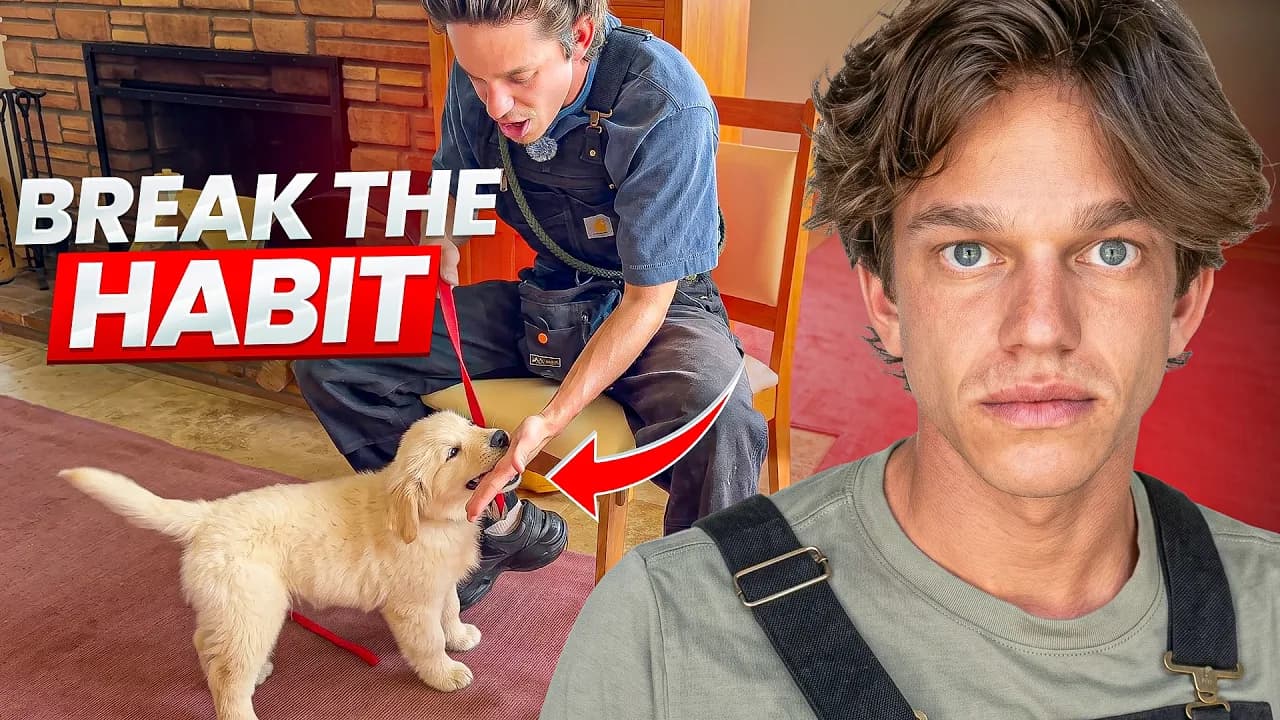
If you have a puppy who is absolutely pulling you on the leash with every single walk, putting tension on that collar non-stop or their harness, coughing, choking, not letting you walk at all, we're going to show you how to fix this leash pulling in less than 15 minutes with any pup of any age. This is Olive. She's a 6-month-old golden retriever and as you can see, this leash is completely tight because she is quite the leash puller.
Before you train your dog to do any sort of leash training, it's very important that your dog goes to the bathroom, gets outside for a couple minutes, and you let them sniff and do their business. Let them pee, let them poop, because trying to leash train a dog who really has to go to the bathroom is not going to go well. If you had to really go to the bathroom and you were trying to run to the bathroom, but someone was telling you to walk slowly to the bathroom, we all know how that's going to go. Make sure your dog goes to the bathroom, play with them inside a little bit, let them burn off a little bit of steam.
Whatever leash you're using, you need to make sure that when you pull on it, there is no stretch to it. Although this leash looks like a rope leash, this is not a typical rope leash that you would find in a pet store. A lot of the leashes in the pet store that have this ropy-like material have this horrible stretch when you pull on them, and that's not going to be great for your training. When your dog pulls on that leash and that leash gets 2 inches longer, your dog's going to feel that, which means they're going to be reinforced, rewarded for pulling because it gives them more freedom. You need a leash that has no stretch. The recommended leash is a 6-ft flat nylon leash that looks just like the one shown. These flat tightly woven leashes don't stretch and they're going to be perfect for your training and they can withstand incredible amounts of weight.
You need to make sure you're using high value food rewards whenever you're training outside. Many people talk about high value treats and what is recommended is really high quality dog food. Typical treats found at the store like Zukes, the crazy dog training me treats, any training treat you find in the Petco, PetSmart section is going to be ineffective for training your dog because they don't use really good ingredients. They're loaded with vegetable glycerin and other different fillers and they're not healthy for your dog. One brand that has been used extensively is called Vital's. They make these patties that are meant to be actual dog food, but they're great for training treats and since it's actual dog food, they're loaded with vitamins, nutrients, minerals and everything your dog needs to have a balanced diet. If you give your dog like a whole pound of these things during training and you feel like you've given them too much treats, you can just cut back on their regular diet and your dog is still going to have a balanced meal. The duck recipe is being used today. This stuff is stinky and gross, but Olive is very interested in it.
The flat collar being used for Olive is not going to be effective for her. A lot of times with dogs, flat collars are not effective because when we pull on them, there's this massively large gap and then all the pressure is being on their trachea. A lot of dogs, especially Goldens who have these thick, blubbery necks, don't even care when pressure is applied. This is what's known as opposition reflex in dogs where when you pull, they pull back and it can be really, really hard to fight this with a flat collar. If you find that you're pulling on your dog's flat collar and they're choking, highly likely you want to upgrade to a prong collar. Not just any prong collar, but a Herm Sprenger 2.25 mm prong collar is going to be the best applications for 99% of dogs who are over the age of 4 to 5 months old. If you're doing this with a 3-month-old puppy and a really young puppy, stick to using a regular flat collar or a slip leash, but since this puppy is 6 months old, the prong collar will be used.
Herm Sprenger 2.25 mm prong collars always have one big ring, the one not being held, and then a little ring, which is the one being held. This needs to be up high on your dog's neck behind their ears and you're going to attach your leash to that ring. The prong collar goes right up behind her ears, clips on, and then the leash clips onto it.
The only reason dogs pull on the leash is because it works. Every time your dog pulls, you go like this and what you're doing is you're rewarding them for pulling by giving them more distance. Start walking with Olive and pay attention to how quickly Olive moves. If Olive moves faster than the handler, stop and use body weight to lean in the opposite direction as her. Since this is day one of leash training, if she comes back, say yes and give her food. The goal is to teach her that when you feel pressure on your collar, don't fight it, follow it.
Randomly stop, pull, and say yes when she follows the pressure. The reason treats are given after she makes a mistake and comes back is because conditioning is happening to follow the pressure on the prong collar. Very gently pulling and showing her food the moment she follows the pressure. The goal is not to have her be afraid of the prong collar, but to teach her that when you feel it tighten up on your neck, that means you need to come back. Already you can see that the response she has to the collar where she's pulling on it and fighting is being eliminated.
Whenever she's feeling that pressure, she's not showing signs of fear, she's not showing signs of pain, she's looking at the handler attentively and waiting for her reward, which is exactly what is wanted. The handler is giving her treats and rewarding her for doing such a good job. Now she's got it. She knows that when she feels pressure, she's meant to come back.
Now that she understands that, the treats will need to be phased out eventually, because the goal is not to have a dog who keeps doing this over and over on the walks, but to have her just stay next to the handler the entire time. What will be introduced is a method known as quick unexpected U-turns. Olive is going to drift ahead, but instead of slowly pulling and then treating her for coming back, a U-turn will be made and walking the other way. Instead of giving her a treat, stop, pop, and turn the other way. Since the prong collar is being used, this can be done very gently without much pressure at all. The handler is not going to give Olive a treat unless she looks at them before the pop comes.
A big thing about U-turns is you can't do it when the leash is already taught. You got to wait for her to drift ahead of you, or you just got to ask yourself, is Olive paying attention to me right now. When the handler stops, Olive stops too. That's a big theme in leash training - you should be the one who is leading the walk, not your dog. It doesn't mean you're dominant over them. It doesn't mean you're better than them. It just means when I stop, I need you to stop, too.
As this is being done, arms are not being yanked and cranked. When stopping, all that's being done is bracing for the impact and lunging into Olive so that if Olive were to make a mistake, she would receive a correction. But if Olive doesn't make a mistake, then she's not going to receive a correction. At any time your dog is next to you paying attention to you, feel free to reward them with food.
Walks are not just about walking next to you. You want your dog to sniff. You want them to check stuff out. You want them to be dogs at the end of the day. When it's believed that it's time for the dog to go enjoy the world, the cue go sniff will be used. The handler will say Olive, go sniff, give her a little leash pressure, and then completely ignore her. If she asks for food, it won't be given. This cue is going to be her time to walk around, check out the grass, go potty, and just be a dog.
Once Olive's sniff time is over, she's got her nose in that bush, she's got her nose in the grass, and the handler wants to keep walking, the cue Olive, let's go will be used. This is going to be the way of telling Olive that we're back to business mode. We're back to working now. I need you to listen to me. Instead of ignoring her, treats will be given, corrections will be given, turns will be given, communicating that you need to pay attention and follow.
Quick recap: if the handler says Olive, go sniff, that means you're free to be a dog. When go sniff is said, then the dog is ignored completely. After saying Olive, let's go, food comes out, leash corrections come out, and all the stuff that was being done earlier comes out. This can be her time to say hi to people. You can give her that go sniff cue whenever she wants to say hi to someone, or you can say go say hi. It doesn't really matter too much the word that you say, it just matters that you say it, and then you ignore your dog.
You do not want your puppy extremely tired before walks. Puppies like Olive do not have long battery lives. Olive is a 6-month-old puppy. What is done is taking the puppy's age and multiplying it by five. So, 6-month-old times 5 is 30, and that means Olive can go on a walk for 30 minutes without becoming what is called out of battery. When a puppy is out of battery, often times they won't just flop in the shade and tell you, but they get distracted, they don't listen, they don't want your treats, they have puppy ADHD on steroids, and you're wondering what's going on and why your puppy won't listen. If you got a 4-month-old puppy and you're trying to go on an hour-long walk, well, yeah, after 20 minutes, your pup ain't going to listen to you.
After going on walks with your puppy, it is very, very important that you put them in the crate, you bring them to the living room, you let them settle down, and you let their little puppy brains recharge because these guys, not only do they need a lot of love, but they also need a lot of sleep, and they need to rest, and they need to relax.
Keep Ethan McMahon Dog Training in your library
Save the videos and channels worth coming back to, and find them again in one place.