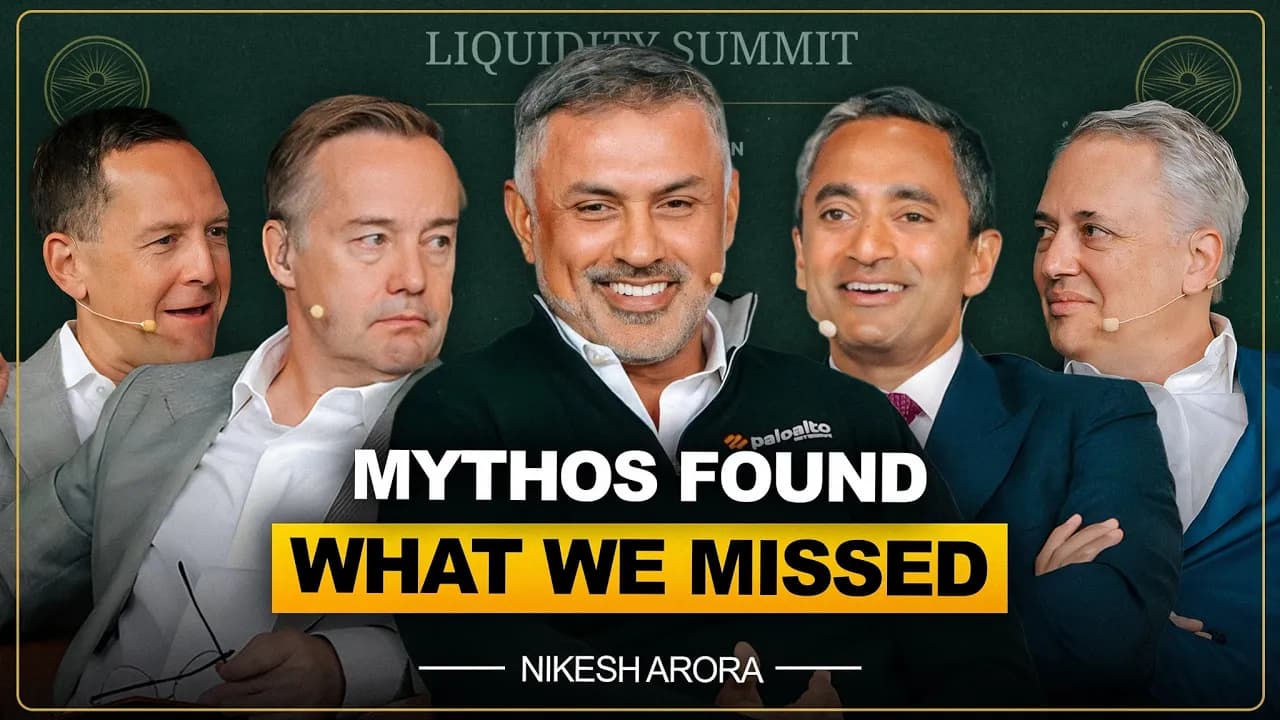
How to Win Deals & Grow a $250B Business | Nikesh Arora, Palo Alto Networks
In a Nutshell
Nikesh Arora grew Palo Alto Networks from a single-product firewall company to a multi-product cybersecurity leader with 70+ offerings by acquiring market-leading startups rather than building internally, recognizing that good products take 4-7 years to develop. He personally vets every acquisition, requires founder alignment on product roadmaps before closing, and retains founders for 3-4 years with revesting to maintain execution continuity. The approach treats M&A as a mechanism to buy cohesive teams with proven strategies, not a strategy itself, while emphasizing that number one and two companies capture disproportionate value and that founder "sheer will" often determines which is which.
These notes were generated by AI and may contain inaccuracies.
Nikesh Arora met Egon Durban when Durban had just arrived in Europe as a Silver Lake partner. A common friend arranged their introduction after Durban expressed interest in understanding the European tech scene and finding potential advisors for Silver Lake. At the time, Arora was in his early 30s running Google Europe. During their initial lunch meeting, Arora expressed reluctance about traditional advisory roles, explaining that companies often use advisors for comfort during two-day offsites where they present PowerPoint decks, and he didn't need more presentations or free coffee in his life. Durban found this perspective resonated with him and asked Arora to provide honest feedback on investment decisions and to collaborate on identifying good and bad investments.
Arora participated in this informal advisory arrangement with Durban for approximately 15 years, which began during Durban's time in Europe. The arrangement involved personal investing, not institutional capital. This group, referenced in Ari Emanuel's book, eventually became the technology advisory board to Willie Morris at the time of its acquisition by Silver Lake.
During a trip back from CES with Mark Andreessen, who rarely travels but attends CES for dinner meetings, Arora was asked if there were any interesting companies he might want to invest in. Andreessen mentioned Palmer Luckey, the founder of Oculus VR. Arora contacted Brendan Reib, who was involved with the company, expressing interest in making an investment. Reib invited Arora to see the technology, requiring a drive an hour outside of Los Angeles to an industrial park.
Upon arrival, the facility had no power. When the lights came back on, Arora and his wife were shown a virtual reality prototype. Arora was impressed by the technology's potential for visualization and gaming applications. When he asked to write a check, he learned that existing investors included Mark Andreessen, Blake Livingston, and Viv Neo, with room for one more investor. Arora indicated that he and Egon Durban would invest together. However, before the deal could be completed, Oculus was sold to Facebook.
The advisory relationships around Egon Durban and Ari Emanuel operate on a transactional basis. Ari Emanuel typically conducts 15-minute phone calls and has been known to end conversations abruptly without saying goodbye. Arora noted that Emanuel's communication style reflects his focus on getting things done efficiently.
When Arora left SoftBank and was figuring out his next steps, Emanuel reached out to discuss potential opportunities. Despite Arora's assistant scheduling only 30 minutes for their meeting based on his expectation of a brief conversation, Emanuel spent an hour and a half discussing Arora's future plans. Arora observed that while Emanuel is generally transactional when he needs something done, he invests significant time when the conversation is genuinely important.
When asked about staying focused on single companies for extended periods compared to founders who frequently switch between ventures, Arora explained that even within one company, the scope of work can be highly varied and challenging. At Google, the company grew from 2,000 to 60,000 employees and from $2 billion to $63 billion in revenue during his tenure. The work involved search, YouTube, DoubleClick, and numerous acquisitions, providing continuous intellectual challenge through exposure to different problems.
At Palo Alto Networks, where Arora has been CEO for eight years, the company has expanded from a single firewall product to over 70 products across all aspects of cybersecurity, including significant AI initiatives. Arora emphasized that maintaining engagement depends on having the right environmental structure and sufficiently large opportunities to keep the brain challenged through problem-solving across multiple areas.
When recruited as CEO of Palo Alto Networks, the company was essentially a single-product firewall business. During his interview process, Arora initially discussed executive security, which he later realized was a small market and more of a consumer business. He approached the opportunity with an enterprise framework rather than a cybersecurity-specific framework.
Arora's primary goal was to grow the company from an $18 billion market cap to north of $100 billion. His analysis of enterprise company financials revealed that most companies spend 15-18% on product development (R&D), with administrative costs at 6-10%. The major difference between operating margins and gross margins comes from sales, marketing, and customer support expenses.
Arora's key insight was that if sales, marketing, and customer support costs—which typically represent 60% of expenses—could be reduced to 20%, the company could achieve 40% operating margins. The biggest expense in enterprise sales is customer acquisition. With only one product to sell, sales efficiency is limited because representatives knock on many doors with limited success rates.
Arora realized that successful large enterprise companies like Microsoft and Salesforce generate significant revenue from the same customers by selling multiple products. This led to the strategy of finding adjacencies that customers would trust buying from Palo Alto Networks, allowing expansion of wallet share with top customers. This approach requires earning customer trust through best-in-class products, as cybersecurity customers specifically want the best solution rather than second-best options.
Arora identified that building good technology products takes four to seven years regardless of the company or industry. Historical examples include Uber, YouTube, Facebook, and Google Search, all of which required extended periods to develop products that customers found valuable. Given that Palo Alto Networks lacked a large product pipeline upon his arrival, Arora recognized that organic development alone would take too long to achieve the growth objectives.
Rather than building products from scratch, Arora pursued an acquisition strategy, but emphasized the importance of careful execution given the history of failed acquisitions. He spent considerable time studying acquisition patterns across companies to identify what makes acquisitions succeed or fail. Common failure reasons include market failure, poor idea selection, bad execution, and inadequate leadership.
One specific example was the acquisition of a company called Opera, which was intended for IP-based segmentation. When the market moved in a different direction, Arora's team cut their losses quickly and moved on, treating acquisitions like a portfolio approach similar to venture capital or pharmaceutical drug development.
Arora noted that internal teams often resist acquisitions by claiming they can build the capability themselves. However, this approach typically fails because successful acquired companies are usually 1.5 years ahead with functioning teams of 50-75 people. By the time internal teams hire and organize, the acquired company would be even further ahead.
Arora argued that M&A failures are rarely due to ego or intentional mistakes, as CEOs generally believe they're making the right decisions. Instead, failures often stem from bad execution, particularly around leadership decisions post-acquisition. A common mistake is assigning acquired companies to existing internal leaders rather than letting the founders run the business.
Arora's philosophy is to make the acquired company's founder the head of that product area, allowing the existing organization to learn from them rather than the reverse. While this may cause some internal employees to leave, Arora believes it's better to risk losing people who haven't succeeded in building the capability than to risk destroying a valuable acquired asset.
Arora emphasized that number one and number two companies in any market capture disproportionate shares of profits, with number three sometimes approaching but never matching their returns. This principle drives the preference for acquiring market leaders rather than number two or three companies.
When acquiring lower-ranked companies, the number one competitor continues to exist and likely maintains advantages. Additionally, large enterprises face challenges maintaining startup momentum due to interference from various corporate functions (finance, HR, etc.) that slow down decision-making and execution.
Palo Alto Networks does not have a formal acquisition team. Instead, a small group of people work directly with Arora on acquisitions, with Arora personally involved in every deal. The evaluation process involves identifying the top one and two companies in target product categories and conducting deep analysis of their differences.
Arora noted that even when both companies appear similar at first glance, deeper examination often reveals strategic and execution differences. Sometimes the number two company overtakes the leader due to execution mistakes by the acquirer. Both companies typically have product-market fit, but their approaches to solving customer problems may differ in ways that become apparent over time.
Arora described a significant evolution in his acquisition approach. Initially, he spent six months post-acquisition debating product direction with founders, which proved problematic. The current process requires founders to agree on a joint product roadmap with Arora and the product team before the deal is finalized.
This alignment happens during a 30-day period after the deal terms are agreed but before the definitive agreement is signed. Arora insists on direct negotiation with founders rather than involving bankers, emphasizing that founders will work with him for the next four years. The final term sheet is not signed until the founder commits to the joint product roadmap, giving founders the option to walk away if they don't want to build according to the agreed vision.
Founders are notably more amenable to aligning their product vision during this pre-close period when a large check is contingent on agreement, compared to after they have received their proceeds.
Nobody backed out. We backed out twice. We backed out because in the process we figured out it would be hard to get consistent alignment of the product. We figured out it would be hard to manage the founding team. They had very strong opinions on where they wanted to go. We could sense that they were playing ball because they knew that they had to play ball to close the deal, and we just didn't feel that was going to be the right outcome.
In one case, as we kept digging deeper in the 30 days and pushing harder, we figured out that the substance was not as strong as we had sensed in our diligence early. As you dig deeper, you start looking at architecture saying I'm going to combine architecture. Oh my god.
Some founders stay on long after acquisition. When you buy something like this, you're buying a team. You're buying the vision. You're buying the execution. It's very hard as a founder says, "I'm out." We don't buy companies where the founder says I'm out. If you're out, you should go. Which means you could kill the company anyway if you're going to be done. So you've got to want to be around.
Typically if there are two or three founders, one will slack off because they're doing biz dev. Maybe we don't need as much biz dev. We do better business. One's doing go to market. We don't need that. So founders fall off depending on the function that they bring in. But it's never the product guys or engineering guys who fall off because that's what we're buying. We need them.
We still have many founders who work at Palo Alto. Some have converted to continuing to work at Palo Alto. Some have left the founding after 3 years they leave. But the other thing which we always do is when we buy a company we revest the founders for 3 years ideally four.
We want continuity. We want the continuity from the execution of vision perspective. Because they build something as I've said it takes four to seven years to build a great product. Typically we buy these product companies 3 years in, 2 years in, four years in. We think there's another 2, 3 years of consistent product development that needs to be done. And we want that consistency and continuity of the founder and the founding team keep driving that. So if they're not there to lead it, then there's disruption. Disruption could cause us to lose the lead as number one in the category. We want them to continue to execute in that direction.
When looking at number one and number two companies, they may look similar from the outside, but the more you dig in, you see why number one is in the position they're in. The hardest thing to put your arms around as a larger company is sometimes number ones also win because of the sheer will of the founder. Some founders are just what you call them alpha killers or whatever they are.
It's one thing to be that as a leader of the entity. It's one thing to have people within your team who are that way. If you acquire a company and the founder is like you described, they're going to break glass and it's okay. But they also have to find a way of coexisting with the larger entity because you know what you get with working with Palo Alto for example and if you're a founder you have 6,000 people in the field you have eight. You've got to find a way of leveraging 6,000 people. They're not all bad. They're amazing right?
Sometimes when you're a founder you take on this point of view that everybody's stupid. I'm smart. I'm going to get this done. Anybody who comes in my way is basically slowing me down is not competent enough. You got to change. You got to need a mental reset. If you're going to survive and succeed in a larger ecosystem, you've got to be able to balance saying, "I get it. I get 6,000 sales people. My job is to motivate 6,000 people to go out there and sell my product because they do. My vision of wanting to make this an amazing product is going to be realized because these 6,000 people are going to be my amplifiers."
Sometimes founders who are used to doing small team stuff and going and being the underdog don't realize you went from being the underdog now you're part of the overdog and that's the only risk that one has to watch out for. The will of the founder running and succeeding in a smaller company largely built due to the will of the founder means they have to modulate their behavior. You have to make sure that they can modulate their behavior and succeed in your environment.
If they can't modulate their behavior and succeed in the environment, then I lose their leadership on the product part because they're going to rub people the wrong way and then they're going to get frustrated. So that's what I have to watch out for. Sometimes the one and two has to be adapted by us for who's going to be a better fit in our environment.
One and two is also a judgment call. It could be one and two. You could have one, you could have this one, A call one, and B call two, and I could have B call one and A call two because I'm looking at a different set of criteria to measure it. There's no obvious criteria who's one and two. They both have 30 customers. They both have same amount of ARR. Which one is one and two?
The criteria depends right like some could have clear company attributes which make them one or two. Somebody's got twice the ARR and the other one yeah we get it they could be deemed as one much easier sometimes they have similar starting grounds or they started from the same place one came at it from a different angle then it becomes on which founder is going to lead this to success or the other and that's where you're getting into the mindset of the founders and the leadership team.
Once we identify one and two remember they also have to be willing to sell. The people we were talking about before we started recording are not selling for any price. So there's also that. You've got to reanalyze that from that vantage point saying well these could be alpha founders they could be winners but dude they're also sending a signal by saying I'm willing to sell.
Hock Tan has a different philosophy. He was advising a younger founder that was also there and he was just like just make sure that on day one of your acquisition that the acquired company knows that you are the conqueror and they are the conquered. I say the opposite. I tell my team when you're starting a negotiation with a company, remember, they're going to be a colleague. Don't treat them with disrespect.
I cannot win if 20 people around me don't feel they're winning. And for them to believe that they're winning, they have to believe they're a first class citizen. They have to believe that they're part of the team and their winning matters and their winning is as much for themselves as for me.
We had just bought a company called Evident.io. Palo Alto bought it before I got there and then we ended up buying a company called Redlock, which was the same space. The difference was one only worked on Amazon, the other one worked on all three clouds. I suspect the one that had been bought early was too early, which was bought by my predecessor, but it didn't matter. The company bought it too early. And then we bought the second one, which was in the same space, just further along. So sometimes you can buy stuff too early.
It becomes a question of price, stage, and conviction. If you marry the three right? Am I convinced this is going to be a big space in the future? Okay, if I'm convinced a big space in the future, I need to have a footprint in that space. Sometimes I can go spin up my own team, have them go charge it down and go make it work or I can go out and acquire something.
M&A is not a strategy. M&A is a mechanism to validate or to amplify your strategy or to execute your strategy. People come always ask me, "What's your M&A strategy?" I don't have one. I buy companies when I believe I need to go win in a category and I don't have my team at the place I'd like them to be at this point in time. I've got to go look for another team that's got it figured out and they have the right people in place. So you go buy it.
If something's worth $200 million, it's worth $800 million because my job is to take the $200 million asset and turn that into a $5 to $10 billion asset. As a $300 billion company, I should be buying things which I believe in the next 5 to 10 years will be worth $5 to $10 billion for us.
Egon Durban reminded that when buying IMG, they wanted to pay nine or 18 and it went to 22, something like that. He goes, "You're never going to remember the 400 million." He's like, "This is an asset we want or not. Like you're going to remember fucking up the deal, but you're not going to remember the 400 million."
Egon and I bought a cricket team together in London. He called me. I was about to go play golf at the AT&T and he called me. He says, "How's the auction going?" It's like 6:00 in the morning because it's in London. I said, "The last auction went for two rounds. We're in round number 24." He goes, "I know you're going to want it cheap because you like value. It's in your upbringing. This is sport. Welcome to sport. Don't stop bidding. I will stay on the phone with you to give you moral courage." We ended up at 29 rounds.
You're buying teams. You're buying their point of view. You're buying their strategy, buying their execution, right? A company is just a construct that is around the team that allows to be held in some legal entity, protect IP and eventually turn that into sort of go to market capability. But effectively, what is a company? When you come up with an idea, your first instinct is not that I'm going to start a company. Your first instinct is I'm going to go build something amazing.
When you go build, you call yourself a builder. You go find like-minded people who have shared the vision and then you're the most charismatic person in the room because you're trying to convince people to get on the bandwagon for your story because you had the idea and it's typically one or two or three people. So you're doing everything. You're a builder. You're building. You're validating your strategy. Every time you hire the next person, you're looking in their eye and telling them, "This is what we're going to build." And the person gets excited. And if you're hiring smart people, they also have to buy into it. So you're basically building a team.
You're building a team of like-minded people. You're bashing out the edges. You're aligning the strategy and getting to a point say, "Okay, now we all agree we're going to build this. Now, let's go warp speed and build the shit because you're going to beat everybody else to the punch." That's what you're doing. The company is just sort of legal entity. If you think about most of these guys, they probably have one administrative person who does HR, finance, facilities, and brings coffee. So a company is a construct in which you organize, but you're actually buying a well functioning cohesive team. That's what you test for. Can this team execute better than other teams out there?
When you think about it like that and say, I'm going to compete with that team that spent a year and a half getting together and training together and they're on the field every day. They live in the same house. They were 80 hours a week and say I'm going to beat them by hiring a bunch of corporate people by going through my HR team going through four interviews and going through internal process like holy shit you're never going to beat them they're far ahead.
Henry Singleton ran this very successful conglomerate called Teledyne in the 1960s. He grew by acquisition just like you did. At one point he owned 130 companies. 129 of them were profitable. So he bought really well. But then he changed his strategy and he stopped acquiring. And then from there he never acquired another company for like another 15 years.
It's possible Palo Alto Networks stops acquiring. As I said, it's not an existential strategy for us. It's a way we can maximize the value for the business. It's a way we can maximize the outcome for our customers. At some point in time, we believe we've reached a point where the marginal value to accrete to the customer is through us making sure all of our stuff works at a customer. We may focus on that. There's no hard and fast rule that we have to keep acquiring.
AI is the most transformative technology we've ever seen in our lifetimes and possibly will be. The impact it's already having is fundamentally changing how everybody works. When I was at Google, we democratized knowledge or information. This is democratizing intelligence, right? We all have in our back pocket something that gets more and more intelligent over time. So we basically have access to intelligence we never had like in I'm pretty sure two three years from now AI will get to a point of reliability where we will trust it as much as a human being who's an expert in the topic.
You talk to your nutritionist you talk to AI and say you know what my nutritionist is not smarter than my phone giving me nutritional advice or my physiotherapist or my physical or my trainer. So you suddenly find that AI is going to get to a point where it's going to have so much data, so much tribal knowledge that it's going to be able to decide you'll be able to torque it saying listen give me advice which is at the frontier which has got a little bit of risk or give me advice down the mainstream you'll be able to talk saying how much intelligence do you want how much differentiation you want in the intelligence that you're going to get.
That's going to be true is going to fundamentally change the way we work. A lot of organizations are structured in work that is being broken down into silos right even the process of product development is split across eight different teams you have documentation people you have testing people you have coding people you have product people you have UI people so you got eight different sets of people who combine together to build a product which makes no sense the only reason we did it because we created specialization because nobody could be great amazing at everything but if you believe that you can harness all this intelligence in a way that one person could master all these eight crafts because they have very abled assistance which will do 90% of the work for them. It fundamentally changes the way we get shit done, the way we build things, the way we do anything in our lives, the way companies are created. So that's going to be true. The shape of a company, the shape of the organization that we run today is going to be fundamentally different 5 years from now.
More technology and interconnectedness makes cybersecurity companies more valuable. Cybersecurity didn't exist 25 years ago because there was no connectivity. The problem is now David can log in from here into his bank account. Now that becomes an attack vector. The more people who can log into Facebook from everywhere just expands the attack surface. Facebook has 3.65 billion daily users getting into their infrastructure every day. Every door into their infrastructure is a potential cyber attack surface. Across the world, between 8 billion people interacting with hundreds of consumer applications, there must be trillions of interactions every day on a line that allows interaction with enterprise infrastructure. The more you do that, the more likely that you need security across all those vectors.
The products that will secure AI don't exist fully yet because AI is so new. The more you connect things, the better for the cybersecurity business.
Nikesh Arora describes himself as a stoic person who doesn't get stressed. Life shouldn't stress you. You should wake up every morning, do the best you can, and then remember if you grew up in India with Hinduism, there's a strong sense of fatalism. All you can do is do your best.
With 1.8 billion people in India, you need to make sure they all understand they can do their best and eventually there is a hand of God which dictates what eventually happens. The notion is uncertainty. You can't create full certainty. Things will happen to you which you can't control. The only thing you can control is what you do. If you do what you do really well, then you should sleep well because you can't get worried about everything that can happen to you from an uncertainty perspective. That sense of fatalism keeps society somewhat orderly.
It's easy to say that and very hard to apply for a lot of humans. It doesn't stop anyone from trying. We try and control every outcome that we can around us. We try and minimize risk around us. We all do that. But at some point in time, we've got to say, "I've done my best."
This philosophy was recently found in the past 5 years. At Google, the search business was the best business. There was pressure that this is a huge opportunity, this could be a once in a lifetime, this will change my life. But it didn't feel like that when working there. It just felt normal, like "Wow, this is this great rocket ship that's working."
At 34, having never worked in any other company of a similar ilk, being at the center of attention of technology, every morning there were more searches, more people wanted to advertise. It was an execution problem. When Nikesh joined Google, people were spending money at Google in Austria with an American credit card. That was the only way you could buy advertising in Europe.
Nikesh Arora was head of sales for Google Europe, selling advertising. The challenge was not knowing how much advertising would cost because it depended on what the last guy bid. You couldn't tell customers what it was going to cost them. It depended on how much they were willing to bid. You didn't know how much they could take a day because it depended on the number of people who search since ads could only be served when somebody searches. Volume was controlled by people who search, and price was controlled by bidders.
When it rained in France, Google used to get a lot more revenue because people sat home and searched. The approach was to work out an ROI with customers. Every search is worth something. If you convert that into an insurance sale or into an e-commerce transaction, you figure out how much you're willing to pay for a lead. The lead becomes conversion. They would sit and do ROI maths with customers so they could understand what their maximum bid should be, then tell customers to give all their money as long as it hits below their bid.
PHP is a vulnerability being used in 22.5 million places right now. AI is changing everything. AI can find holes in your perimeter faster than anybody else in the world. It used to take days to find vulnerabilities. AI can find holes to enter your perimeter. AI is not going to patch the perimeter. You still have to go look through the infrastructure, find where the poorest parts are and patch them.
Everybody's IT stack is made up of tens and thousands of vendors. Vulnerabilities exist in software and software written by customers themselves. The likes of Mythos, OpenAI's new models, GLM 5.3 have immense capability of finding vulnerabilities, and bad actors can rent them cheap and throw them at you to find everything vulnerable.
The call of the hour is to find a way to patch these things swiftly so bad guys can't get in. Palo Alto Networks is building a service called virtual patching. They write signatures, put band-aids around the entire perimeter, and customers can't get in. Over time, customers will patch the underlying systems.
Palo Alto Networks inspects everyone's parameters. They live on a laptop, charge $25 a year, and watch 150 megabytes a day on your laptop to make sure nothing bad's coming in. The marginal cost of inspection of traffic and laptop by them is zero. They don't charge more the more traffic goes through. AI is set up to charge you every time you run traffic through AI in terms of tokens. If AI tried to do Palo Alto's job at your endpoint, it would cost $5,000 a day or $500 a day. AI can't do what Palo Alto does at $25 an endpoint.
If a bad actor gets inside, AI can help analyze all the anomalous behavior quickly, but you still need harnesses, security expertise, data ingestion, and infrastructure. The cybersecurity business is not at risk from AI.
Nikesh spends at least four or five hours a week with AI founders. These founders possibly worked at OpenAI or Google. He learns about open weight models, training, training data, and guardian agents. He talks to five or 10 cyber startups a month, maybe 15, trying to absorb how they're thinking about AI. This is a new and developing science. There are no real experts. People know how to do their own work, but everybody else is trying to imagine the implications to everything else around them and build a mental model so they can build product and win in this category.
There's no concept of data labeling before you started having self-driving cars be able to label data. Now that's turned into reinforcement learning, simulation models, neural networks that are trying to simulate data so we can train AI. You have to stay in the conversation with tons of people to understand and absorb what people are talking about. You spend a lot of time on Twitter, talking to people, reading stuff. Half is understood, half just gets through the other side.
Nikesh started tweeting after Harry gave him advice. Harry said Nikesh gets the right to build his own brand if he wants to. He told Nikesh to tweet every day. Nikesh is now tweeting almost every day, though at lower frequency now. He doesn't feel the pressure to say something all the time because you end up making it a job. He wants to do it when he has something he wants to say.
Nikesh Arora personally writes all of his own communications and content. He was once advised to have someone review his writing for grammatical corrections, but the edits resulted in significant criticism from readers, leading him to conclude that he would never do that again.
The host notes that the conversation moved very quickly and was engaging. He expresses appreciation for the interview and suggests they should conduct similar discussions every few months.
Nikesh agrees that the conversation was valuable. The host closes the episode by encouraging listeners to subscribe wherever they are listening and to leave a review. He also promotes his other podcast, Founders, noting that for almost a decade he has obsessively read over 400 biographies of history's greatest entrepreneurs, searching for ideas that listeners can use in their work. He mentions that most of the guests on the show first found him through Founders.
Keep David Senra in your library
Save the videos and channels worth coming back to, and find them again in one place.