I Tried the Workout That Claims 20 Minutes Replaces the Gym
In a Nutshell
EMS training delivers intense muscle contractions in 20 minutes but cannot replace 2-hour traditional workouts in calorie burn or overall stimulus. The technology excels as a supplement for building mind-muscle connection, aiding injury rehab, and targeting stubborn muscle groups, but only when paired with active effort and proper nutrition. Maximum benefits require combining EMS with heavy lifting, not using it passively.
These notes were generated by AI and may contain inaccuracies.
The video explores whether a 20-minute electrical muscle stimulation (EMS) workout can replace a 2-hour traditional training session. The team visits an EMS gym in Miami, Florida, described as an elite, glamorous, ritzy training facility. The host, Doctor Mike from RP Strength, notes that Miami is a place where everything is extra special.
The session begins with an iCycle bike that provides both warm-up and training in 8 minutes. The bike gives verbal instructions to the user, including a "tiger mode" protocol consisting of two 20-second sprints. The bike provides immersive audio guidance, including phrases like "Imagine you're strolling through grasslands under a beautiful blue prehistoric sky" and "Try to race with the tigers. NO GROUND GIVEN."
The participant was instructed to pedal as fast as possible during the sprint intervals. The bike recorded 153 calories burned with peak power output of 702 watts. The system tracks user progress for future sessions.
The EMS suit contains electrodes covering all major muscle groups. The suit requires wetting for conductivity between the electrodes and the body. The practitioner turns on muscle groups individually first, then activates all muscles simultaneously, which is described as the biggest challenge. The host expressed concern about being electrocuted during the process.
The activation sequence follows a specific order:
- Squats targeting legs and glutes
- Upper back activation
- Middle back
- Biceps
- Chest
- Abdominals
- Deadlifts
- Additional cardio/endurance work
During squats, the participant is instructed to go down with a bicycle motion, feeling the legs coming up, then coming up to feel the glutes. The practitioner emphasizes breathing techniques: breathing in to get ready, then executing the movement.
The EMS training produced several notable physical responses:
- Involuntary contractions of the whole body
- Bicep cramps (predicted by the practitioner)
- Intense sensations described as "trippy"
- Muscle activation described as "intense"
- Post-session muscle contractions occurring every 4 seconds as muscles remained prepared for stimulation
The practitioner noted that the participant would cramp at least once during the session.
After completing the session, the participant reported that muscles were occasionally contracting on their own due to conditioning from the 4-second stimulation intervals. The back tensed up periodically as if preparing for shocks.
The assessment concludes that EMS does not replace 2 hours of workout intensity. The team had completed a 2-hour push workout prior to the EMS session, which was described as pretty intense. Calorie-wise and total muscular stimulus-wise, 20 minutes does not compensate for traditional training duration.
However, EMS offers specific advantages:
- Helps individuals who have trouble feeling specific muscles
- Creates strong mind-muscle connection
- Particularly valuable for injury rehab
- Allows muscle contraction without putting injured areas at risk
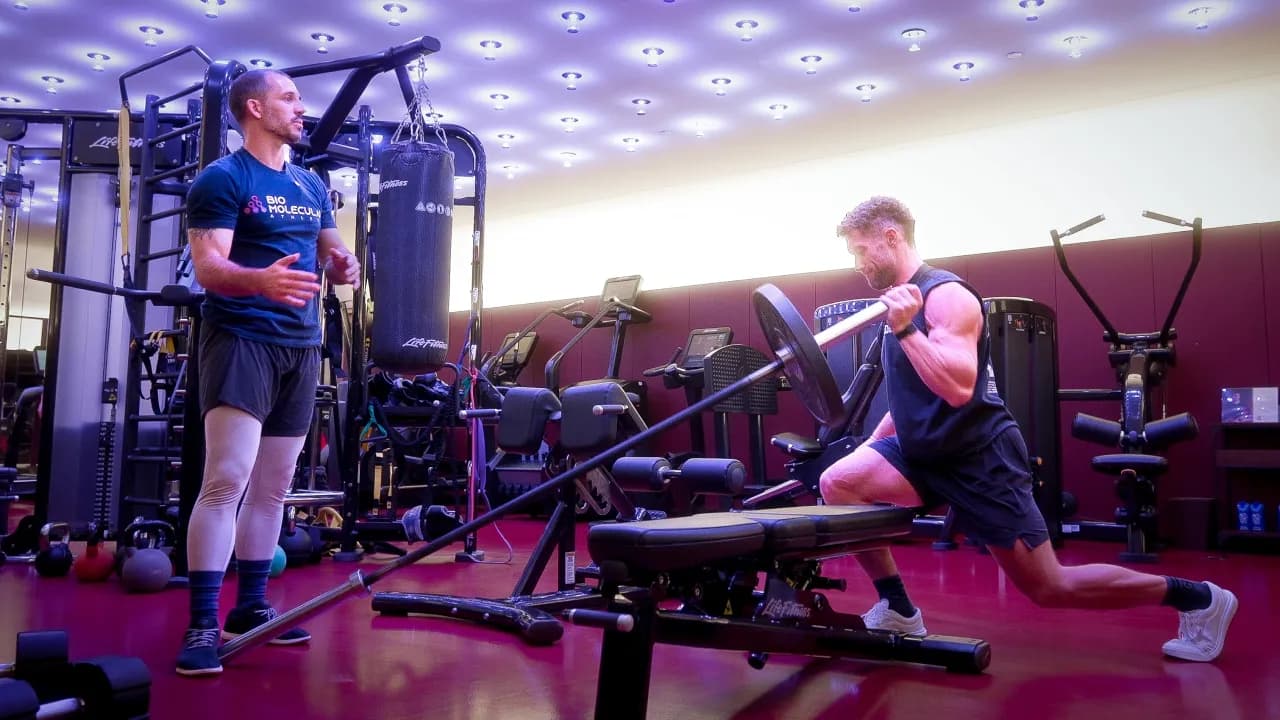
The optimal use case involves combining EMS with traditional gym training. The suggestion is to use the body suit with a skilled practitioner while lifting big weights, applying EMS during each repetition. This combination approach is expected to work effectively.
For home use, the recommendation includes using EMS systems to target specific muscles that are difficult to recruit, such as biceps or rear delts, then transferring the learned mind-muscle connection to regular gym training.
The learned mind-muscle connection from EMS training should be applied to regular gym workouts using the RP Hypertrophy app. Exercises can be labeled as "plus EMS" in training programs. This approach helps users who struggle with muscle recruitment to develop better connection and activation patterns.
Two critical caveats are emphasized:
-
Diet control remains essential - EMS does not magically burn calories or replace proper nutrition. While there is calorie burn, it is not extreme enough to compensate for poor dietary habits.
-
Active participation is required - Maximum benefits come from bringing full effort to the session. Using heavier weights, squeezing muscles intensely, and moving through full range of motion produces significantly better results than passive participation.
The technology is described as "the icing on the cake for a good workout" rather than a replacement for traditional training. Passive use where the machine works independently leads to minimal gains, while active participation combined with EMS can be effective.
EMS training is recommended as an occasional supplement rather than a primary training method. It serves as motivation for fitness engagement and provides unique benefits for muscle activation awareness, but requires active effort and proper nutrition to be effective.
Keep Renaissance Periodization in your library
Save the videos and channels worth coming back to, and find them again in one place.