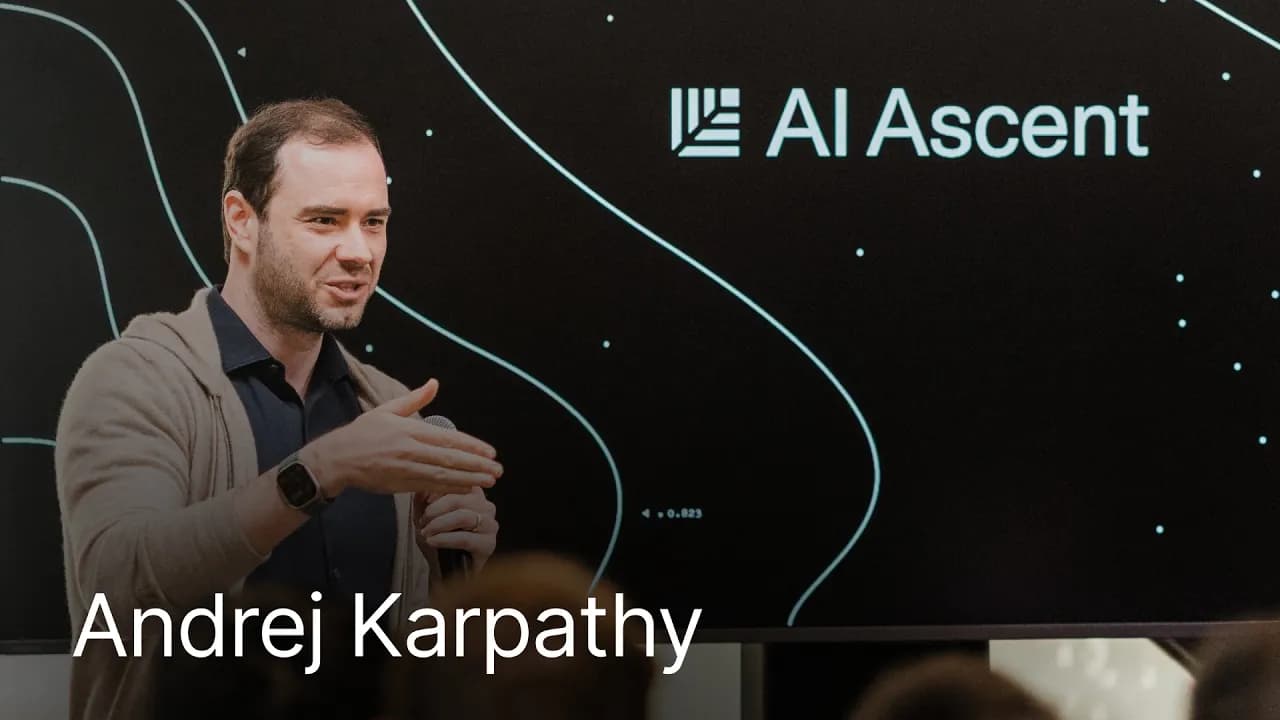
Marc Andreessen: The real AI boom hasn’t even started yet
These notes were generated by AI and may contain inaccuracies.
If we didn't have AI, we'd be in a panic right now about what's going to happen to the economy. We've been in a regime for 50 years of very slow technological change in the face of declining population growth. The timing has worked out miraculously well. We're going to have AI and robots precisely when we need them. The remaining human workers are going to be at a premium, not at a discount.
This is a very, very historic time. AI is the philosopher's stone. Now we have a technology that transfers the most common thing in the world which is sand converted into the most rare thing in the world which is thought.
The most leading edge founders are thinking of entire companies where the founder does everything.
Everybody wants to talk about job loss but really what you want to look at is task loss. The job persists longer than the individual tasks.
There's a Mexican standoff happening between product manager, engineer, and designer. Every coder now believes they can also be a product manager and a designer because they have AI. Every product manager thinks they can be a coder and a designer. Every designer knows they can be a product manager and a coder. They're actually all kind of correct. The additive effect of being good at two things is more than double. The additive effect of being good at three things is more than triple. You become a super relevant specialist in the combination of the domains.
People aren't fully grasping how much this is changing. People who want to improve themselves and develop their careers should spend every spare hour talking to AI, saying "train me up."
Mark Andreessen invented the web browser, built the world's largest venture firm. He's a multi-time founder and investor in every generational tech company. Discussion covers the unique moment we're living through, skills for kids to thrive in AI future, future of product managers, designers, and engineers, moats in AI, what AI-native founders are doing differently.
Thanks to newsletter community and X for suggesting topics. Subscribe and follow podcast. Insider subscribers get a year free of 20+ products: lovable, replet, bold, gamma, nad, linear, superhuman, devon, post hog, dscript, whisperflow, perplexity, warp, granola, magic patterns, raycast, chappd, mob, stripe atlas. Visit lenny'snewsletter.com/product-pass.
Sponsored by DX, developer intelligence platform. Companies like Dropbox, Booking.com, Adion, Intercom use it for AI insights on developer tools, usage, value, engineering productivity. Visit getdx.com/lenny.
Sponsored by Brex, intelligent finance platform for founders. High limit corporate cards, banking, high yield treasury, AI agents handle expenses, waste detection, reports. One in three US startups runs on Brex. Visit brex.com.
2025 was the most interesting year in Mark Andreessen's career and life; expects 2026 to exceed it.
Two things happening: trust in legacy institutions in full-scale collapse, supported by data. National and global conversations liberated with expanded freedom of speech and thought. Massive geopolitical shifts: US, Europe, China, Latin America changing. All assumptions being re-examined.
Three mega things colliding: institutional upheaval, liberated discourse with citizen participation, AI as new technology. Comparable to fall of Berlin Wall in 1989 or end of World War II.
AI is really working. ChatGPT moment was three years ago. Initial question was whether it could harness for reasoning and problem-solving in medicine, science, law. Answer is yes. Last 12 months, especially last three, prove it: AI developing new math theorems, AI coding hit critical mass over holiday break. World's best programmers, including Lisbald, said AI now codes better than they can.
AI will get good at reasoning in any domain with verifiable answers.
Wrong frame: AI sweeps world and changes everything. Incomplete understanding of last 80 years.
Productivity growth measures technological change impact on economy. For last 50 years, very low. In US, running at half the pace of 1940-1970, third of 1870-1940 pace. Little technological progress in economy.
Demographic collapse: reproduction rate under 2 in many countries including US and China, leading to depopulation over next century.
AI enters world with no technological progress and depopulation. Need AI for productivity and economic growth, and machines to fill jobs as population declines. Interplay more complex.
Homeschool 10-year-old. AI impact on individuals: takes good people and makes them very good; raises average. Really great people become spectacularly great, superpowered individuals (10x better, e.g., coders).
Goal: position kids to be deep in their domain to fully leverage AI.
Agency: initiative, willingness to do things, be primary participant (live player). Society teaches follow rules; premium on taking responsibility, leading, creating. Balance with structure: to lead, first learn to obey.
AI as ultimate lever for kids with agency to contribute in physics, code, art, novels.
Give me a lever and I'll move the world.
AI as philosopher's stone: early scientists like Isaac Newton obsessed with alchemy, transmuting lead (common) to gold (rare) via philosopher's stone. AI transmutes sand (most common) into thought (most rare).
Teach kids to leverage AI fully. Counter to meme that Silicon Valley avoids computers for kids; more plugged in, more important kids master it.
Two levels: national/state scale needs large systems like K-12. At n=1 individual kid, ideal is one-on-one tutoring, known for centuries as by far the best way.
Maximizing an individual child's potential is best achieved through one-on-one tutoring. Historical examples include royal families and aristocrats, such as Alexander the Great tutored by Aristotle, who conquered the world. This approach has been used by great kings, queens, and elites over centuries.
Statistical evidence supports this: the Bloom two sigma effect shows one-on-one tutoring raises student outcomes by two standard deviations, moving a student from the 50th percentile to the 99th percentile. In this tight loop, the tutor keeps the child at the leading edge of their capabilities with real-time correction, yielding superior results.
Economically, one-on-one tutoring has only been feasible for the richest. AI now makes it possible for everyone. A child interested in a topic can interact with an LLM, asking infinite questions, getting instant feedback, requesting simplification ("dumb it down"), or quizzing ("quiz me to check understanding"). Parents can augment traditional education with AI tutoring. Startups are building products for this, and nonprofits like Khan Academy are pushing AI integration.
A hybrid approach combines schools with AI one-on-one tutoring. The Alpha private school system embodies this philosophy: in-person teachers plus heavy AI tutoring. Parents should explore these options now.
Concerns about AI replacing young people's jobs are overly simplistic. For 50 years, technological change has been slow—at half the rate of the previous era and a third of 100 years ago—leading to little job turnover.
Even if AI triples productivity growth, it returns job turnover to 1870-1930 levels, when the world was "awash with opportunity." Kids developed new careers, inventing much of the modern world. This translates to higher economic growth, job growth, and hiring booms, swamping task/job substitutions.
Compounding this: declining population growth and shrinkage make human workers a premium. Immigration rates may reverse due to nationalism, further premiumizing workers in places like the US and Europe. Faster productivity, slower population/immigration growth means no dystopian joblessness.
Without AI, depopulation would shrink the economy, leading to stagnation or decline—no new jobs, fields, or demand. AI and robots arrive precisely when needed to substitute for population/immigration shortfalls, preventing economic shrinkage—a fundamentally good news story.
Mass job loss requires 10-50% annual productivity growth, unprecedented in history. In a utopian scenario of radical transformation:
- Massive economic boom and growth.
- Collapse in prices (price deflation) for AI-affected goods/services.
- Cheaper everything equals massive wealth increase (e.g., $100 item drops to $10 then $1, like a giant raise).
- Additional spending power drives growth, new fields; everyone materially better off.
- Unemployment, if any, is easier to address via cheaper safety nets (healthcare, housing, education prices collapse).
This is basic economics: higher productivity = more output, less input → gluts → collapsing prices → wealth boom. Even rapid change is good news, not dystopia.
Incremental change (more likely) is also positive; faster change is positive differently.
Andreessen correctly predicted:
- Web and web browsers' importance.
- Software eating the world.
- 5 billion smartphone users by 2021 (actual: 6 billion).
- Progress continues (vs. Peter Thiel's stagnation view).
He admits errors but highlights these wins. On Thiel debate, he's shifted: more agreement on progress in bits (digital) but stagnation in atoms (physical world).
Last 50 years: little technological innovation in most economy, especially atoms. Built world barely changed vs. 1870-1930 or 1930-1970 transformations.
Today: buildings from 1960s, bridges from 1930s, dams from 1910s, cities from 1880s. No new cities, dams, or California high-speed rail.
AI won't transform overnight due to red tape, bureaucracy, rules, politics, unions, cartels, monopolies blocking change. Example: healthcare—doctors, nurses, hospitals as cartels; nationalization creates government monopolies resisting disruption.
ChatGPT is likely better than many doctors but can't license, prescribe, or perform procedures.
Peter Thiel correctly identified structural impediments slowing change. Optimistically, AI may prompt revisiting assumptions to accelerate to the future. It's time to build.
A great product manager can become a coder and product manager. Talented people in these roles become superpowered, good at all three: coding, product management, and design. These individuals become incredibly valuable as they can build and design new products from scratch.
If you're amazing at any of these three roles you will do well.
Being amazing includes harnessing new technology like AI. A master coder who doesn't use AI to leverage skills will hit limits.
Economists view the atomic unit of work as the task, not the job. A job is a bundle of tasks. Focus on task loss or change, not job loss.
Classic example: In 1970, executives dictated memos to secretaries who typed letters. With email, secretaries handled email between admins, printed for executives to read and dictate replies. Today, executives do their own email; admins handle travel planning and events. Executive tasks expanded to include clerical work; secretary tasks changed. Jobs persist, but tasks evolve.
In coding, product management, and design, tasks will change. Jobs persist longer than tasks; jobs change when tasks shift enough. Adapt by swapping tasks, using new tech like AI coding, adding skills in design and product management. In 10 years, job titles may become "I build products" or "I tell the AI how to build products," orchestrating AI.
Software engineering is changing dramatically; engineers won't write code by hand soon. Historical context:
- Original calculators were people doing math by hand in rooms of hundreds or thousands, parceling equations.
- First computers used machine code (ones and zeros), then punch cards.
- Assembly language added English-like layer.
- Higher-level languages like C compiled to machine code.
- Scripting languages (JavaScript at Netscape, Python, Perl) emerged in 2000s. Debate: Is scripting real programming? (It was dismissed as cheating, no manual memory management.) Now, most coding is scripting, abstracting five layers of detail.
AI coding abstracts writing scripting code. Programmers now orchestrate 10 coding bots in parallel, arguing with them across browsers/terminals to write, debug, and adjust code. To evaluate bots, understand code yourself.
Advice to 10-year-old coding with Claude, ChatGPT, Copilot on Replit: Still learn to write and understand code to check AI output, performance, etc. Need depth like understanding microprocessors for scripting.
Programmers become 10x, 100x, or 1000x more productive overseeing AI. Humans remain essential.
Still learning to code is a valuable skill.
For mediocre coding, let AI generate infinite mediocre code. For top software people building important products, understand full stack: assembly, machine code, chips, networks, and how AI works to maximize value and debug quickly.
AI aids learning: Ask it to teach memory management in 10 minutes, creating synergy.
Perl programmers faced snobbery: "too slow, won't scale." Early limits existed, but it improved, swept the world. Most coding now scripting. Those understanding lower levels made scripting work well, leading to more coders overall. AI will be more dramatic.
Perl designed by linguist, making it nice to code with, though notorious for being hard to read.
AI excels at tasks like generating 1000 icon designs. Capital D Design—purpose, human fit, happiness, life integration—remains human. Designers focus more on higher-level questions.
Young designers aspiring to Jony Ive level can use AI to surpass, focusing on what great designers do without pixel tasks.
T-shaped strategy: Deep in one role (product, engineering, design), good enough in other two using AI.
Scott Adams' advice: Good at two things > double value; three > triple. Additive effect creates super relevant specialists.
- Adams: Pretty good cartoonist + business = spectacular Dilbert success.
Examples across economy:
- Hollywood: Writers who direct (auteurs) are superstars.
Hollywood AI standoff: Director (AI writes/acts), writer (AI directs/acts), actor (AI writes/directs). All correct; each expands skills. More writer-directors, etc.
T-shape generalized:
- Top of T: Breadth in domains to use AI well.
- Stem: Depth in at least one.
Deep coder using AI for design/product = triple threat. Superpowered individuals perform magic, building unimagined products.
Marc Andreessen proposes a framework like a sideways F or E with multiple downward parts, emphasizing getting good at least two skills to become non-fungible—irreplaceable in the economy. Larry Summers advised: don't be fungible, meaning don't be a replaceable cog by being just one thing like a designer, product manager, or coder. A rare combination of skills makes you massively important as one of the only people who can do that unique mix. AI titanically enhances the ability to develop such combinations.
People with dual skills like coding and design were called unicorns at companies. Silos between roles like PM, engineer, and design are disappearing; get good at least two.
The thing about AI that people are not getting enough benefit out of yet is it will teach you. There's never been a technology where you can ask it "teach me how to do this thing."
Spend every spare hour talking to AI: "Train me up, supermpower me, train me how to be a coder turned product manager." AI makes problems, assignments, evaluates results—just as happily as doing work for you.
Learning Tricks
- Watch the AI agent's output, thinking, and decisions to learn architecture, even if not an engineer.
- When unstuck, ask: "What could I have done differently? What could I have said to avoid this error?"
Watch AI code to understand mistakes, intervene effectively: "I see where it went sideways, do this instead." This requires grounding in at least one skill for synergy. Same as working with humans: need theory of mind to give feedback, understand their thinking. AI explains why it's doing things, critiques itself. Have one AI critique another, or one write code and another debug—play AIs off each other (LLM councils).
Design feels hardest to learn via watching/talking due to exposure hours needed, but remains valuable. Marc confesses wanting to be a cartoonist despite no art skills; AI makes it time to try.
Leading AI founders operate on three layers:
- Redefine products: AI as additive feature (e.g., flash storage) or category-killer (e.g., internet killed on-prem software, replaced by web). Example: Photoshop's 40-year franchise—AI image editing as feature, or generate new images via Nano Banana (easier than editing)? VCs bet on reinvention across domains.
- Change jobs: Super-empower coders with AI. With budget for 100 coders, now need 10 doing 10x more, or still 100 but 10x productive?
- Redefine companies: Superpowered individual oversees army of AI bots. Holy grail: one-person billion-dollar company (e.g., Bitcoin/Satoshi, Ethereum small team, Instagram/WhatsApp). Most software companies grow huge, but leading founders explore AI-only companies (feasible for software). Ultimate: autonomous AI economy—AI bots on blockchain functioning as businesses, issuing dividends.
One-person billion-dollar outcomes face edge cases (support tickets, bugs, forms), even with AI/contractors. Bitcoin used open-source community. Smartest people think hard about this.
Big tech transformations (e.g., internet) take long to play out with cascading structural implications. Early predictions (1993-2010 internet coverage) were almost all wrong—people state with enormous self-assurance what products/companies/jobs/industries/nations win, saturating media.
AI involves 5-6 layers: products, companies, jobs, industries, national/global levels, politics, unions, war, China.
Are AI models defensible moats? Arguments for: billions in cost, compute/data critical mass, elite engineers (NBA-star paid), political/regulatory hurdles → oligopoly/monopoly (common in software).
Against: 1.5 years post-ChatGPT Christmas, 5 US companies (Google, Anthropic, xAI, Meta), 5 Chinese (DeepSeek, Kimi), open-source match capability. Post-GPT-3, open-source equivalents on fraction of hardware for free.
Apps: Models commoditize so apps die? Or apps adapt models to domains (medical, legal, coding) where fit-for-purpose matters, value accrues to apps?
Process of discovery in complex adaptive system: tech, legal/regulatory, entrepreneur choices, economics, capital availability. Be open to surprises; VCs bet across strategies. No one has it all figured out.
Don't over-obsess moats now—we have no idea. "GPT wrapper" derogatory a year ago; now fastest-growing companies.
Claude (great), Claude Code (app/agent harness), Co-work (Claude Code built it in a week and a half)—impressive speed, but questions complexity.
How much complexity could there be? How much of a barrier to entry can there be in something developed in a week and a half? It's incredibly valuable and functional, with people all over the world calling it the most magical product ever. Yet it took only a week and a half to build. Every other model company will build similar features like an Asian artist or co-working tool for regular people.
How defensible is that? In six months, will it get lapped like GitHub Copilot? History in the last three years shows fundamental breakthroughs get replicated and lapped quickly. Smart people in the field say there are no secrets among big labs; they all have the same information and knowledge, lapping each other regularly with little proprietary advantage. Evidence: DeepSeek came out of left field as a re-implementation of American big lab ideas with some originals, done by a Chinese hedge fund.
Big labs pay individual engineers like rock stars. Maybe a dozen key ideas in each lab will be huge breakthroughs hard to replicate. Views require a big discount on forecasting. Less interesting to predict industry structure in five years, big winner company, or killer app. Better to be flexible and adaptable.
So with all this in mind, do you feel like there's something you're paying attention to more to help you decide okay this is where we want to place our bet or is the answer essentially the strategy you guys have which is place a lot of bets. You guys raised the largest fund in history. Is that the way you win in this world?
Yeah. For us, we have a deliberate strategy. Peter Thiel's 2x2: optimism/pessimism and determinate/indeterminate. Silicon Valley has too much indeterminate optimism: world will be better but can't explain how—wishful thinking. World needs determinate optimists: world better because I'm doing this specific thing. Elon is determinate optimist (electric car, solar, Mars). VCs are indeterminate optimists.
There's merit to Thiel's framework, but indeterminate optimism is stronger. A16Z strategy is indeterminate optimism: extremely bright founders like Elon are determinate optimists with strong views. Capitalist system, American economy, Silicon Valley virtue: not one or ten, but hundreds, thousands, 10,000s running hard. Optimize by running as many experiments as possible with smart people doing interesting things. Firmly indeterminate optimist.
I'm wondering if the answer to the question of what you look for now more and more is this determinate optimistic founder. Yeah. That has this massive ambition and is actually working on achieving it.
Founders need to be determinate optimists with specific plans. Founders critique VCs: you don't commit, place multiple bets, operate portfolio; we make one bet. Counter: founders run companies, we don't steer. Virtue of determinate optimist: single-minded execution. History remembers Henry Ford, not seed investor in Ford and ten failed car companies. Founders, company builders, engineers do the thing, deserve 99.99999% credit. Role for indeterminate optimists in background helping cycle.
Struggle with AGI concept: prosaic vs. cosmic definitions. Cosmic: singularity, world fundamentally changes, old rules gone, self-improvement loop, takeoff where AI improves itself faster than humans, human judgment irrelevant (utopian/dystopian). Don't think we live in that world.
Prosaic AGI (industry convergence): AI does every economically relevant task as good as human, or Anthropic co-founder's basket of 10-15 most valuable economic tasks. We're clearly getting close if not there.
Cosmic overstates; prosaic understates. No reason human skill is cap. AGI definitions relative to humans, but humans capped by biology. Human fluid intelligence/IQ tops at ~160 (Einstein/Feynman level, new physics). Impressive humans: 140 (best-selling author, top research scientist, best doctor); 130 (really good lawyer); 110 (good line manager); 105 (good small business accountant). Spectrum 110-160.
No theoretical limit without biology. Existing AI models test at 131-140 IQ, approaching 160. Soon: 160, 180, 200, 250, 300 IQ machines. World better with more Einsteins; better with super-Einstein machines. Performance improves too: AI coders better than best humans (Line of Stars example), AI doctors/lawyers better than best humans.
Used to world capped by biology; now experience superhuman capability. Human equivalent a footnote (e.g., Tuesday in 2026). Exploratory process exceeding humans, not singularity at threshold.
200 IQ. I uh just like that frame of reference is such a mindexpanding way to think about just how fast and how smart these things are going to get and quickly.
Experience: ought to do something but can't (takes too long, not enough knowledge, can't do math in head, imperfect memory, forget books). Endless frustration; smarter would be better. Also, know smarter people: first half conversation taking notes, second half outthought.
Exciting: machines without limitations working for us.
Reads three categories: up-to-the-minute news (X) or old books that stood test of time (timeless). Skeptical of middle. Read old newspapers (even last week's): none of it happened as predicted, irrelevant. Magazines worse: long cycle, outdated by publication.
Practitioners underrated (Substack, newsletters, podcasts): direct exposure to field experts. Mass media filtered; now direct from principals. Podcasts open access to leading experts (e.g., Lex Fridman). People talk their book a bit, but love explaining, contributing knowledge, ego gratification. Tremendous alpha. World washed in it now vs. 10 years ago.
Silicon Valley culture of sharing (LinkedIn: how is this free?). Silicon Valley is a company town where company is Silicon Valley. N=1 running company: secrets/employees walk out, sucks. But benefit from that.
CEOs benefit from hiring people with diverse skills and experiences in adapting ecosystems that channel talent, knowledge, and people into new fields. This creates a push and pull dynamic at the individual CEO level and within the broader ecosystem. AI represents the ninth major technology platform in Silicon Valley's history. Silicon Valley retains its name despite not manufacturing silicon chips for decades; it originated from chip fabrication and design in the 1950s. The ecosystem's indeterminate optimism enables it to morph into successive waves: internet in the 1990s, smartphones in the 2000s, cloud in the 2010s, and AI in the 2020s—without centralized planning. This flexibility is a testimony to the ecosystem's adaptability, likened to a company town where the industry is the company.
This reminds me of the meme of how we're all just rappers over sand. Everything we're building is just wrapper.
The rapper thing is hysterical. I'm a software company now. I'm a chip rapper. I'm a business application. I'm a database rapper. We're all sand rappers.
Marc Andreessen recommends Edington as the best movie of the decade, possibly the last 15 years. Set in Edington, a small New Mexico town of 600 people, it features a crusty right-wing sheriff played by Joaquin Phoenix and a young hip progressive mayor played by Pedro Pascal. The story begins in March 2020 with COVID, extends into summer 2020 covering the George Floyd moment, protests, riots, and BLM events. A third element is a company resembling Meta building an AI data center on the town's outskirts. The film captures how townspeople experience these events primarily through the internet, smartphones, and social media. It grapples directly with 2020 dynamics and the experience of real-world events filtered online—a challenge movies rarely handle well. The director fearlessly engages third-rail topics, portraying human life in 2020s America, even if Andreessen disagrees with some perspectives.
Andreessen's 10-year-old son is obsessed with Replit, discovering it independently and spending hours on vibe coding games—demonstrating how kids view peer-discovered tools as cool, unlike parental suggestions. AI voice technologies excite him: Grok with Bad Rudy (foul-mouthed raccoon avatar) as a dinner party trick; Sesame for intimate, emotional voice experiences that went viral. Voice input wearables like pendants and Meta glasses signal a coming revolution. Whisper Flow app provides staggeringly accurate voice transcription where users can instruct the AI model conversationally (e.g., "I want bullet points" without typing it), understanding context. His son builds Star Trek simulators on Replit, leveraging the LCARS UI design language from Next Generation for authentic interfaces and games. They watch all Star Trek series, including the new Starfleet Academy, which is quite good.
Read Piyush McCormack's piece, the best explanation of a16z's work and thinking. Check a16z's YouTube channel for great video content, with more excitement ahead.
Keep Lenny's Podcast in your library
Save the videos and channels worth coming back to, and find them again in one place.