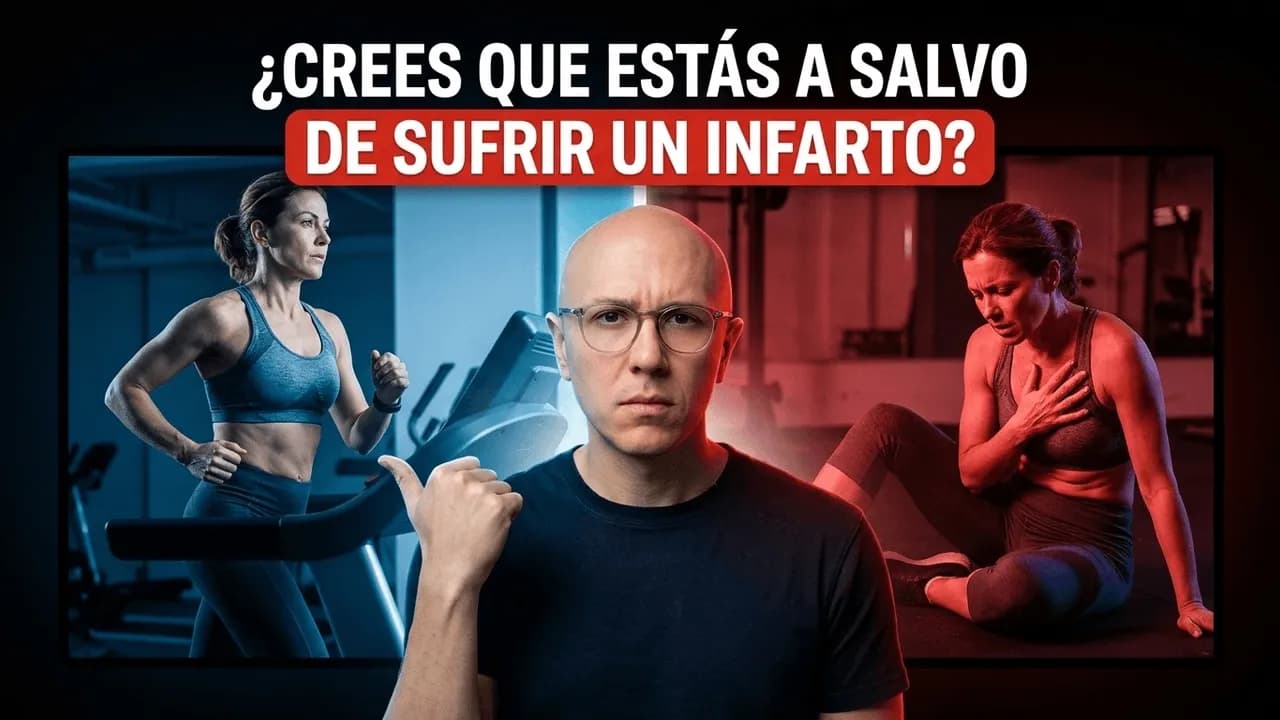
Intense Exercise & Potential Heart Damage (aka Athlete's Heart)
In a Nutshell
Intense endurance exercise induces **athlete's heart**—beneficial left ventricular hypertrophy, eccentric remodeling, increased stroke volume, and bradycardia that boost VO2 max and longevity (runners gain 20% life expectancy up to 20 miles/week, with no upper harm limit in population data)—but risks arrhythmias (e.g., 5x AFib), coronary calcification, and rare myocardial fibrosis in genetically predisposed elites. Sudden cardiac deaths (e.g., Micah True, young athletes) stem from genetic conditions like HCM (1/500 prevalence) or undetected blockages, not exercise itself; distinguish via **Three I's**: imaging (CT angiogram/CAC), interpretation (eccentric vs. concentric), intervention (de-training tests, hedge to 5 hours/week). Screen high-risk groups (family history, extreme volume >1 hour/day) proactively; net benefits vastly outweigh rare risks—prioritize aerobic training, monitor, and study elites to advance science.
These notes were generated by AI and may contain inaccuracies.
The science and practice of enhancing human performance for sport, play, and life. Welcome to Perform. Dr. Andy Galpin, professor, scientist, and executive director of the human performance center at Parker University.
Start with a ghost story about Cabayo Blanco (Spanish for 'the white horse', also called Cabayo or Micah True, not his real name). Terrorized and mystified the Copper Canyon range of the Sierra Madres in northern Mexico for 20 years. Story unraveled years later. Lived running 30-60 miles between villages, gathering resources, returning to his hut. Ran 160-170 miles per week for nearly two decades in an area with no running shoes, medical care, advanced technology, nutrition, or hydration strategies—simply surviving by running large amounts daily.
Micah's story famous from best-selling book Born to Run. Central legendary figure in ultramarathon circles, launched generation of ultra runners.
Micah died at age 58 during a routine 12-mile jog. Common story in running community: highly cardiovascularly fit individuals, often runners, dying paradoxically young from cardiovascular disease. This is the phenomenon of elite physiological performers at extremely high risk.
Took several days to find him, lost in canyon; too difficult for proper autopsy. Likely died of left ventricular cardiomyopathy.
Story as old as cardiovascular physiology understanding. Cardiologists created confusion about extreme exercise and cardiovascular health. Split into two categories:
- Classic case like Cabayo: 30-50 years old, generally men (occasionally women), extreme cardiovascular fitness, sudden death mid-race/activity from cardiovascular disease.
- Young athlete: 12-20 years old, no apparent signs/symptoms, passes during physical activity.
Personal experience: friend Mike Osuna lost 15-year-old son Lucas to similar event. Important to cover for prevention, reduce unnecessary confusion.
Cover: what we know about athlete's heart, why it happens, causes, prevention, what to look for. Separate fact from fiction. Don't know everything, but actionable info available. Understand preventable aspects, hedge against unnecessary risk (overconfidence) and unnecessary fear of exercise.
Term athlete's heart coined in 1899 by Swedish physician noticing enlarged hearts in cross-country skiers—unclear if congenital or exercise-induced. Decade later, mostly in runners (not special to running, just common events), became runner's heart (interchangeable terms in pop culture).
1910: Clarence DeMar (won Boston Marathon 7-8 times) at Olympic start line, physicians begged him not to run due to irregular heartbeat/heart murmur, fearing death. He ran, lived to 70, died of cancer. Autopsy: exceptionally large coronary arteries, large heart. First longitudinal description confirming enlarged areas not detrimental.
Heart has four chambers: two atria (top), two ventricles (bottom). Blood flow: right atrium → right ventricle → lungs (oxygenates) → left atrium → left ventricle → body via aorta.
Left ventricle key (80-90% of athlete's heart discussion): pumps against pressure (e.g., high blood pressure, exercise). Difficult to distinguish positive vs. maladaptive adaptations from morphology (structure/anatomy) alone—cause matters.
Arteries (away from heart), veins (back to heart), capillaries (exchange). Aorta major artery; coronary arteries supply heart muscle itself (needs oxygen, ATP, etc., like skeletal muscle). Equivalent veins: inferior/superior vena cava.
Left ventricle supplies entire body against gravity, needs more force than right side (lungs close). Heart often tilted right due to larger left ventricle from exercise adaptations (hypertrophy = muscle growth, from chronic/acute stress; confusable with heart disease).
Enlarged heart/hypertrophy positive in skeletal muscle (e.g., quads), but different connotation in heart.
Paul Dudley White (Harvard, pioneer in preventative cardiology 100 years ago) advocated exercise to prevent cardiac disease. Athletes experienced bradycardia (low resting heart rate; vs. tachycardia high). 100 years ago, abnormal rates signaled pathology; White showed bradycardia not pathological in exercisers.
With Lewis Wolf, John Parkinson: named Wolff-Parkinson-White Syndrome (WPW).
1960s-70s: marathoning/running exploded (Olympics reintroduced, running boom—fascinating critical period in exercise science/physiology/modern health).
Italian data: elite athletes with left ventricular hypertrophy, enlarged chamber size, no disease. Also sudden cardiac death in young athletes from hypertrophic cardiomyopathy (HCM) (enlarged heart muscle disease).
Controversy: same morphology labeled HCM if early disease, exercise-induced adaptation if not. Exercise mimics disease without pathology.
2012 American College of Sports Medicine conference (San Francisco): South Carolina epidemiologists presented unpublished Cooper Clinic (Dallas) data, 1970-2000 (30 years), 50,000 cardiovascular tests; 14,000 runners (self-identified exercisers), average 15-year follow-up (pre/post).
Runners had 20% increased life expectancy vs. non-runners. Protective effect up to 20 miles/week (increased lifespan); >20 miles/week: no increased survival vs. non-exercisers (inverted U: benefits plateau/plateau to disadvantageous).
Media explosion: 'is too much exercise bad/dangerous?' Waves every 3-4 years, latest articles in last month—same outdated story.
Momentous: highest quality supplements, third-party tested, many NSF certified for sport. New Fiber Plus prebiotic: 95% Americans miss daily fiber. Powers gut health (nutrient absorption, energy stability, recovery, inflammation). Mix scoop cinnamon flavor in water nightly.
You can cover the entire thing in one set. In the next few years, barring new information, the same story will likely be repeated. Famous cardiologists published in reputable journals like Mayo Clinic Proceedings claiming exercise is inflammatory to the heart, causes fibrosis and scar tissue, and is deleterious and dangerous. However, when they published the paper a couple years later in the Journal of the American College of Cardiology, they did not conclude running was dangerous. They concluded most, if not all, running exercise is excellent for health. Past 20 miles per week doesn't seem more advantageous, but it didn't hurt anybody.
This differs greatly from how the data were portrayed two years ago, especially by attendees at the meeting and later writers. Share data as best interpreted, then decide if the risk is worth it. Scientists must ensure data are portrayed accurately, conclusions match results. In this case, the interpretation was not appropriate. Be careful jumping to conclusions.
Eight Sleep makes smart mattress covers with cooling, heating, sleep tracking, and more. Used an Eight Sleep mattress for over 3 years; hates traveling without the Pod 5. Nothing impacts health and performance more than great sleep, which requires body temperature dropping a couple degrees at night. Eight Sleep helps cool down; runs hot at night. Pod 5 fits any mattress, heats or cools each side from 55 to 110°F, provides high-fidelity sleep tracking. Try at eightsleep.com/perform, code PERFORM saves up to $350 off Pod 5 Ultra. 30-day trial, ships to US, Canada, UK, select EU countries, Australia.
If cardiovascular disease exists, identify the failing heart part and why. First: coronary arteries. Blocked or damaged vessels cause myocardial infarction (heart attack). Heart becomes hypoxic without oxygen/nutrients, stops contracting, leads to necrosis or death.
Second category: firing issues (electrical signal for contraction).
- Cardiac arrest: heart stops firing/contracting, not due to oxygen block.
- Ventricular fibrillation (VFib): ventricles (bottom, do most work) misfire/flutter instead of strong beats. Deadly; left ventricle doesn't pump effectively. Valves don't close properly, blood shoots wrong direction. Requires surgical intervention; uncommon but nasty.
Atrial fibrillation (AFib): upper chambers; more common, less dangerous. Can be cleared by cardiologist; athletes often sidelined briefly then return. Not benign but manageable; full athletic life possible.
AFib danger: blood pools in atria, clots, can cause stroke if pushed to ventricle and system (e.g., brain).
Genetics cause firing issues like Wolff-Parkinson-White (WPW) syndrome (genetic, causes AFib). In 1990s, terrifying; now known as manageable, though deadly in some cases.
Loeys-Dietz syndrome (LDS): connective tissue issues in heart blood vessels, leads to premature atrial aneurysms. Example: Mike's son Lucas passed while swimming cooldown; aneurysm fatal despite CPR. Link in show notes for fundraiser; personally donating.
Hypertrophic cardiomyopathy (HCM): enlarged heart, most common cause of sudden cardiac death in young. Thick walls reduce chamber size (inward hypertrophy). During exertion, ventricle can't refill, leads to sudden death. Prevalence: 1 in 500; few die, most unaware.
Screening possible; medications for HCM exist.
Differentiate from chronic heart disease (maladaptations from lifetime, not genetic), e.g., chronic high blood pressure mimics exercise but constantly stresses aorta.
High blood pressure: aorta stiffens, less compliant, rigid. Left ventricle squeezes harder; vessels damaged like brittle concrete hose. Turbulence causes issues or rupture. Induces fibrosis (scar tissue equivalent) in left ventricle.
Problems:
- Lack of vascular compliance.
- Increased fibrosis.
- Left ventricular hypertrophy (inward growth, reduced chamber size).
- Reduced contractile strength (weaker muscle fibers).
Cycle reduces blood flow.
Athlete's heart/runner's heart often asymptomatic in lean, active, non-smoking, non-drinking people who manage stress—"silent killer."
Term: EICR (exercise-induced cardiovascular remodeling)—exercise-induced changes potentially advantageous, not pathological.
Hard to identify via imaging/ECG (misses 50% issues); can't distinguish maladaptive from adaptive easily.
Three I's: Investigate (measure), Interpret (results), Intervene (action). Cover interpret first.
EICR components:
- Structural (focus left ventricle): size/mass, dilation/chamber size, supernormal diastolic (excessive relaxation/filling ability, like skeletal muscle).
- Functional: Greater stroke volume (blood per pump) = positive; reduced = negative. Major VO2 max determinant; increases via ventricular filling, lower end-diastolic volume, higher ejection fraction. Stroke volume plastic, increases with any exercise (60+ years research).
- Electrical: Increased vagal tone lowers heart rate (less pumping needed), relaxes heart for more filling. Can cause exercise-induced AFib (relaxed valves leak slightly, murmur).
In this case, the ventricle dilates more, resulting in extra fluttering and flickering. It is not necessarily known how dangerous exercise-induced ectopy is. It may be noticed more in exercisers because they are often more in tune with their bodies. This can be blamed on the heart being too relaxed due to high vagal tone. It may not be pathological.
Up to 80-90% of endurance athletes show increased left ventricle chamber size. About 50% have left ventricle diameter >55 mm; 10-20% >60 mm. This occurs mostly in endurance/aerobic training, not strength training. Wall thickness increases to 12-14 mm; >15 mm warrants additional testing.
Concerning findings include asymmetrical hypertrophy, excessive left ventricular size relative to right, fibrosis, poor contractile reserve, or poor ejection fraction. Left ventricular size alone cannot differentiate exercise-induced cardiac remodeling (EICR) from cardiomyopathy, but provides clues.
Concentric remodeling (bad): Seen in chronic high blood pressure; left ventricle contracts against high pressure, reducing chamber size.
Eccentric remodeling (from exercise): Arteries/veins dilate, increasing blood flow and preload (venous return). Blood pushes outward on chambers like water expanding a balloon, lengthening/widening them without fiber contraction.
This follows the principle of specific adaptation to imposed demand.
Isotonic exercise (endurance: running, cycling, swimming): High sustained blood volume, low peripheral resistance (dilated vessels). Results in balanced hypertrophy across all four chambers. Rowers show more eccentric left ventricular hypertrophy; distance runners show eccentric hypertrophy with normal mass.
Isometric exercise (strength: lifting, wrestling): High peripheral resistance (e.g., maximal deadlift blood pressure 450/300 mmHg, near full occlusion). Causes mid-left ventricular wall thickening without chamber dilation.
To maximize cardiovascular health and chamber size increases, prioritize sustained aerobic effort over strength/speed/power training.
- Sex differences: Less remodeling in females than males (studies on elite athletes).
- Ancestry/genetics: Early research; no single nucleotide polymorphism reliably predicts issues. Ancestry studies (e.g., white vs. black) lack precision due to broad categorizations.
- Training exposure: Initial concentric remodeling, then eccentric. Minimal threshold ~5 hours/week (4-8 hours range) consistently for months/years for structural changes. Functional changes (e.g., VO2 max, stroke volume, bradycardia) occur quickly, even with exercise snacks (e.g., push-ups, sit-ups). Higher threshold in older individuals, but adaptations still possible.
Limited normative data for right ventricle; similar to left.
Endurance athletes consistently have larger left atria and right atria (studies on 500-600 athletes vs. controls).
90% of endurance athletes have normal/elevated ejection fraction (>50%, more blood per pump). ~10% have reduced (<50%). May warrant investigation, but contextualize with overall fitness. Possibly genetically driven (early signal from polymorphisms).
Proheart studies: 280 elite endurance athletes (18-19 years old, mostly male, VO2 max 63-64 ml/kg/min, 15-16 hours/week exercise). 15-16% had reduced ejection fraction in left/right ventricles or both.
Three main risks:
- Arrhythmia (e.g., AFib): Prevalent in high-intensity + high-volume over years/decades. Swedish study (50,000 cross-country skiers): Top performers had 1.3x higher risk; >5 races added another 1.3x. Experts estimate up to 5x higher risk. Often no other risk factors (e.g., no hypertension, apnea). Linked to high vagal tone and adaptations boosting stroke volume.
- Coronary artery calcification.
- Myocardial fibrosis (scarring).
Atrial fibrillation (AFib) is seen very commonly in endurance athletes. Detractors claiming too much exercise is bad focus heavily on this data, and they are not wrong—it happens consistently. However, it is more a function of risk predisposition versus too much high-intensity exercise. Emerging evidence suggests it is the combination of that exercise in a subset of genetically predisposed people we are not yet aware of. Future research may identify this predisposition, leading to screeners. While there is a slight bump in AFib in endurance athletes, it comes with a massive drop in mortality risk, heart disease risk, and almost everything else. Aerobic and endurance exercise is on net very positive. Focus on AFib alone can twist the story accurately but ignores that people are not dying from aerobic exercise—research shows the opposite. Be clear in describing this risk.
Most AFib research is in men; it is less common in women based on available data, but female athlete research is insufficient for a complete picture.
Recommended paper: Athletes Heart or Heart at Risk: Cardiac Remodeling and Exercise-Induced Ventricular Arrhythmias in Elite Athletes. This distinguishes AFib from ventricular arrhythmia (VA). VA in athletes is probably not good and not exercise-induced. A recent study of over 200 athletes, including Olympic-level, found VA does not seem to be an exercise adaptation and is not detrimental in high-level athletes.
Athletes frequently have elevated coronary artery calcification (CAC) scores. Typically, calcification or plaque in coronary arteries is problematic, but in athletes, it is unclear if it is detrimental. Pathology is unknown: could be inflammation, hemodynamics (blood smashing into arteries causing vascular tears), or benign vascular remodeling. Radiologists and cardiologists seeing many athletes are confused. Calcification is scary, so treatment (e.g., statins) is often recommended until proven benign.
Cooper Clinic study: 26,000 people followed for decades. Higher CAC scores associated with more heart attacks and revascularization, but those with higher fitness had lower all-cause mortality. Interpretation: higher fitness leads to higher CAC but lower risk of dying from heart attack. Fitness offsets anatomical changes, allowing tolerance of otherwise problematic changes. This is a risk tolerance issue.
Ben Levine's work: >3,000 minutes/week physical activity associated with increased CAC prevalence but no increased all-cause or CVD risk after a decade, even with clinically significant CAC scores. Example: 30 miles/week running at 10-minute pace—not harmed or dying.
More prevalent in men than women; female athletes show no additional coronary issues versus controls.
New evidence suggests myocardial fibrosis (scarring) happens more with high-intensity than lower-intensity exercise, especially high volume + high intensity. Causes: mechanical stress, inflammation, ischemia, oxidative injury, stiffer chambers. Occurs in atria, right ventricle, septum.
Data is most unclear here. Study of veteran endurance athletes >50 years old with fibrosis: 5x risk of non-benign ventricular arrhythmia. They averaged 12 hours/week for 20+ years, competing 20 times/year (e.g., 2 hours/day, 6 days/week for 20 years)—rare even among chronic runners.
Contrast: substantial exercise survival benefits in extreme endurance athletes, e.g., Scandinavian cohorts, 80-90-year-old cross-country skiers competing 50-60 years (started 1930s-50s), VO2 max ~40, independent living despite imaging issues.
Runners doing 40 miles/week: 25% less likely to develop coronary heart disease vs. 13 miles/week (equivalent to normal guidelines). Doubling/tripling from 13-15 miles/week drops heart disease risk by 20+%.
No upper limit for VO2 max; higher VO2 max correlates with higher survival (e.g., Cleveland Clinic studies, 125,000 people, 10-20 years; JAMA papers). Top 98th percentile fitness: 20% mortality reduction; top 25%: 20-30% reduction. No bodies piling up.
Study: 2,000 people, early 50s average age, exercising 35 hours/week for 28 years. Of 66 extreme exercisers, 10-year follow-up: 2 deaths, neither from heart disease.
"Intellectually interesting. It is clinically worth knowing but it is not worth worrying about." —Dr. Paul Thompson
Start with affordable targeted screening for highest-risk groups: rowing, running, cycling, swimming, skiing. Increased sudden cardiac death risk in basketball (e.g., Reggie Lewis, Hank Gathers 1992-93). Rates: black male college athletes 1/16,000; male basketball 1/9,000; black male basketball 1/4,000.
Criteria: family history of early heart disease (<55 years in immediate/secondary family)—strongly recommend screening; silent, no symptoms/comorbidities.
Example: Joel Jameson (VO2 max >55, lean, no smoking/drinking/partying, good sleep/stress management). At 40, screening found 50% widowmaker blockage. Family: mom stroke ~60, dad/uncle/brother early deaths/triple bypass.
Speaker's experience: multiple uncles/great uncles died early; screened after wife's urging despite being young/healthy.
Free: American Heart Association 12-step questionnaire (e.g., fainting, chest discomfort exercising, childhood "asthma" mimicking heart issues like murmurs).
Personal screening: coronary CT angiogram (~20-30 min, includes CAC score, ~$1,200 out-of-pocket).
Cleerly: FDA-cleared AI for atherosclerosis, plaque, stenosis, ischemia (~$2,000-2,500).
De-training: Stop exercising 3 months if imaging shows abnormal size (establishes cause/effect). Reduction indicates exercise-induced; no change likely genetic/pathological. ~20% athletes show no size reduction even after 5 years.
Hedge to ~5 hours/week (~1 hour/day)—safe zone unless severe genetics.
Proactive monitoring essential; don't assume leanness/high VO2 max/good bloodwork (e.g., Joel's cholesterol fine) means okay. Silent killers require multiple analyses.
Misguided message that too much exercise is inherently bad irritates; sends wrong public health signal.
Unfortunately, somebody dies of high-profile incidents, making headlines, leading to case studies published in medical journals that get recycled. Recommended reading includes David Epstein's work, Alex Hutchinson, and Mike Joyner, renowned in this field, who have all written extensively. Their articles are easy to read and will be in the show notes. These voices center the discussion on what we truly know and what we do not.
The same mechanisms that confer benefit can also confer risk: cardiac enlargement (particularly the left ventricle), vascular compliance (ability to expand and contract without damage), and enhanced metabolic flexibility. Risks include arrhythmias (AFib in particular, VFib being very dangerous), potential coronary calcium increases, and myocardial fibrosis (scarring). These occur.
Is it worth the risk? The speaker believes it is, but ultimately it's up to you.
On aggregate, longevity is associated with cardiovascular fitness markers from classic studies like the London bus studies and others: high VO2 max, low resting heart rate, high stroke volume. These correlate with longer healthspan and lifespan quality.
VO2 max makes humans special—we have five times higher VO2 max than our closest primate relatives, a defining characteristic. In Born to Run, the argument is that humans are born to run, built for endurance rather than strength. Dissuading people from running or exercise is misguided.
Cardiac rehab programs get people exercising a few days after cardiovascular events, which is the predominant approach—you want to get the heart back to work. In one of the best programs in the country, high-intensity exercise was used as much as possible soon after events, yielding better outcomes.
Do not negate the profound physiological and psychological benefits of exercise—they are pronounced and robust. For extreme exercise (tons of volume for long periods), pay more attention:
- Get imaging done, testing done, multiple types.
- Do not rely solely on ECG or blood work; need a robust set to understand true risk.
- If exercising more than an hour per day on average, consider it.
- Factor in family history.
There is very limited reason to think this is bad for you—do not interpret data that way. Do not cut back for no reason if you have no risk factors. Acknowledge it could be risky for you; it's possible, though rare. No promise you can exercise unlimited without risk, as that's inconsistent with literature.
Testing is not simple; genetic testing is not yet a cure-all solution.
We must study elite performers—we wouldn't know basic heart physiology without studying people like Kilian Jornet or Eliud Kipchoge (contextually Cabayo likely refers to such figures), who push human limits. That comes with risk, as in Kipchoge's case, but it's not for us to judge.
The exercise science field is critical, not just for sports but for human health and understanding. > If you have a body, you are an athlete, like it or not.
Thank you for joining. Goal is to share exciting scientific insights to help you perform at your best.
To support (keeping information free and accessible):
- Subscribe on YouTube, Spotify, Apple.
- Leave up to five-star review on Apple and Spotify.
- Check out sponsors.
- Share with a friend.
Content questions/suggestions: YouTube comments (tries to read them all). Follow on Instagram and X (@DrAndyGalpin) for scientific communication.
Email newsletter at performpodcast.com/newsletter (free, no sharing): distills episodes into actionable takeaways (e.g., improve fitness and VO2 max, build muscle and strength).
In the famous words of Bill Bowerman, if you have a body, you are an athlete.
Keep Andy Galpin in your library
Save the videos and channels worth coming back to, and find them again in one place.