It’s Starting: The Fall of Europe
In a Nutshell
Europe is collapsing under unsustainable welfare systems, demographic decline, and failed immigration that created parallel societies instead of integration. The unrest serves elite interests—cheaper labor for corporations, new voters for politicians, surveillance expansion, and eventual asset transfers during engineered chaos. The ultimate endgame is replacing rights-conscious populations with compliant ones before AI and robots make ordinary people economically unnecessary.
These notes were generated by AI and may contain inaccuracies.
Something seems to be happening, and Europe may be on the verge of collapse. The day will come when we will see extremists and terrorists leaving Europe in much larger numbers, due to a lack of decision-making, an attempt to adhere to political correctness, or the assumption that they know the Middle East, Islam, and others much better than we do.
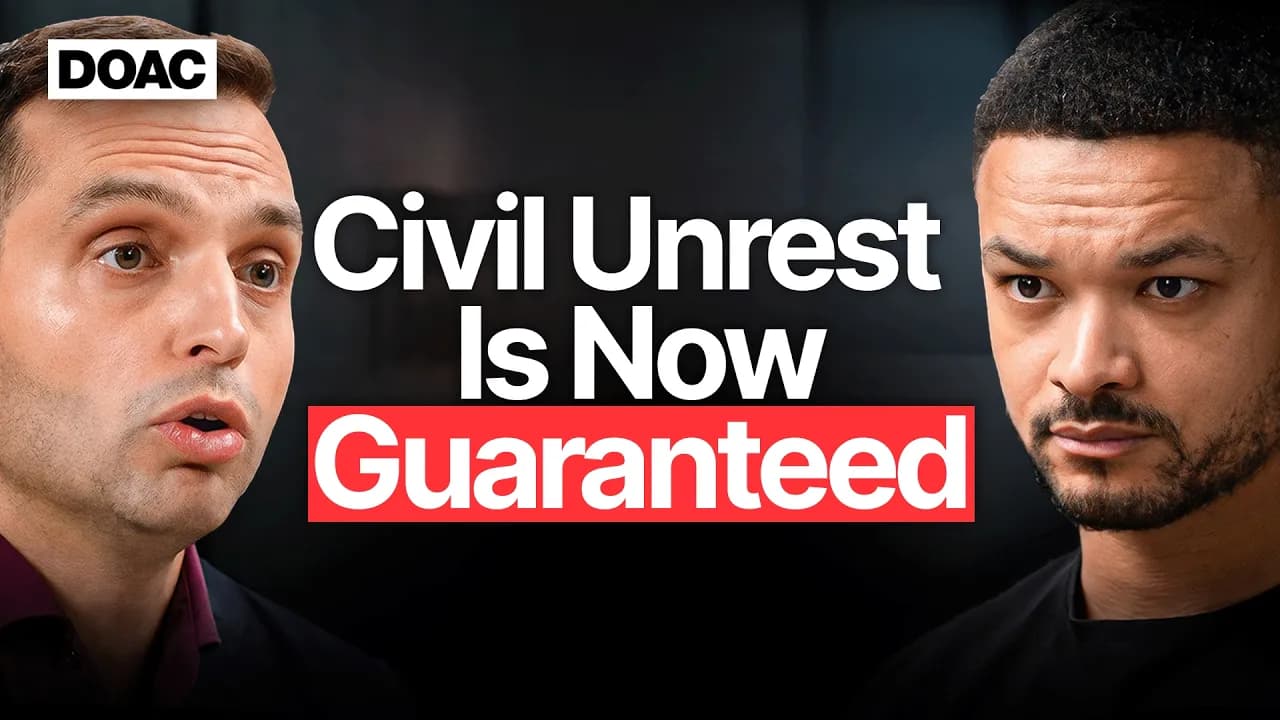
Protests are erupting across Europe. More than half a million people demonstrated in France. Their shops were looted, luxury goods stores were smashed, and public buildings were set on fire. Thousands were arrested, and in Milan, rioters emptied one of Europe's most famous squares. Belgium and Portugal saw marches on the same weekend, and a week earlier, a 400-year-old market in Paris burned to the ground.
The official narrative says the protests are about a lack of funding for schools. Students are protesting about things like leaking roofs and a shortage of teachers, but this narrative doesn't seem logical at all. Something much bigger is happening in Europe.
The first theory is entirely based on mathematics and numbers, stating that what happens in Europe ultimately comes down to capital. For the economy to grow, it needs more productive people who work for the system than people who take from it. Imagine a restaurant where every retiree eats for free, and the bill is paid by everyone who eats there. This technically works when you have 10 people for every one retiree. But when everyone stops having children, retirees live longer, and now you have just two people trying to cover the entire room of retirees expecting to receive their money. This is essentially the European welfare state.
France is the most extreme example of this. It spends almost a third of its entire economy on social programs, which is far more than any other developed country. Pensions alone represent about 14% of GDP, second only to Italy. France has not managed to balance its budget since 1974. The last time France had a surplus was when Nixon had just resigned. Today, its debt is around 3.6 trillion euros, which represents about 119% of its GDP. Interest payments are expected to cost around 65 billion euros this year.
The replacement level needed to keep the population stable is 2.1 children per woman. The European Union is only at 1.34, which is the lowest level ever recorded.
Immigration was supposed to solve the problem. If the population isn't having enough children, workers are imported from elsewhere. In 2000, the United Nations published a report whose title was literally "Replacement Migration." That report calculated the number of immigrants Europe would need to prevent its workforce from shrinking. Today, about one in four babies born in Europe has a mother who was born in another country.
Many young Europeans who were born there spent the first decade of the second millennium collecting useless degrees that the economy does not actually reward them for. The economy is now undergoing a transformation. Artificial intelligence is coming for entry-level jobs. Therefore, the government is forced to reduce spending. Their pensions were reduced, their ministries were downsized, and public spending was restricted. The only category that was not reduced is defense.
If you are a 17-year-old in France sitting in a classroom, you see that your government doesn't have money for you, but it has all the money in the world for weapons. This is part of why underfunded schools are part of the ongoing debate.
Zocdoc is a free website where you can search for local doctors within your network, with over 150,000 providers in more than 200 specialties across all 50 states. You get genuine patient reviews and detailed profiles, so you decide who is right for your needs. You see the available dates on the calendar and click to book immediately. Most appointments take place within 24 to 72 hours, and sometimes you can get an appointment on the same day.
The second theory says that what is happening in Europe is a failure of immigration policies. Not only was it a failure, but it was predicted by the UAE Foreign Minister in 2017. Abdullah bin Zayed said: "The day will come when we will see far more extremists and terrorists coming out of Europe, due to a lack of decision-making, trying to be politically correct, or assuming that they know the Middle East, Islam and others far better than we do. I apologize, but this is complete ignorance." He reposted his message and said: "I told you so."
Integration means not just living in that country. Instead, you learn the language, work, follow the laws, and know the basic values of the place you have moved to. The thing about integration is that it doesn't happen because people want it to. Rather, it happens because they have no other option. When my parents came to the United States, we didn't know anyone. I didn't even speak English, but nobody around us actually spoke Russian. So, I had to learn the language because I had no other way to make friends. But if we moved to a completely different place, would I have learned the language at the same speed? For example, there is a neighborhood in New York called Brighton Beach where you could spend your whole life speaking only Russian, with Russian shops, Russian restaurants and everything Russian.
This is what happened in many of these European cities. They began to form what are called enclaves, sometimes known as parallel societies, where the culture of origin grows stronger, meaning that the next generation grew up somewhat stuck between two worlds. Sometimes, when these cultures live side by side, they may find it very difficult to integrate. This is why resentment, competition, and ultimately conflict arise.
The United States has these pockets too. Places like Little Italy, Chinatown, and Brighton Beach, but the reason the United States has been able to integrate its immigrants is that here in America you have to work to survive. Work forces you to integrate because you need the language to get the job, and you need the job to get the money. But in a country with a generous social welfare system, this pressure to integrate is much weaker. If you can move to a certain enclave and apply for social welfare, you may not need a job. You're just getting paid to live there.
Denmark enacted what was originally called the "Ghetto Law," which requires young children in certain neighborhoods to attend foster homes where they must learn the Danish language and values. Italy has just imposed a cap on the number of foreign students per class, which, ironically, is one of the things students in Milan have been protesting against.
All of this was predicted a long time ago. Karl Popper has explained this problem since 1945. He called it the "paradox of tolerance," where if a society is infinitely tolerant, it ends up being dominated by people who are not tolerant at all.
The third theory states that what is happening in Europe is not a coincidence, and that all of this is proceeding according to a plan. If immigration was supposed to save Europe's economy, the evidence clearly shows that it has not worked as promised. So why does it continue? Why doesn't anyone simply change course? This theory states that the reason is that it works perfectly for those at the top. They get the benefits and everyone else pays the price.
After World War II, Germany's economy was booming and it ran out of workers. So, in the 1950s, she began inviting what she called guest workers from Italy and Greece, and eventually from Türkiye. The plan was for them to work for a few years and then return home. But many of them stayed. They brought their families with them. Today, Germany has one of the largest Turkish communities in the world.
In 2015, Germany received approximately one million asylum seekers. The strange thing is that one of the loudest voices in favor of this was the CEO of Mercedes-Benz, who said that refugees could boost Germany's next economic miracle. Why would a car company be interested in immigration? Well, because more workers mean cheaper labor, i.e., lower input costs. More people competing for the same jobs keeps wages low.
New citizens become new voters, and voters allow politicians to remain in power. In France, opinion polls showed Muslim voters supporting the far-left party by large margins. Therefore, it is not surprising that the party itself also supports these protests.
There is a concept called "wellness beliefs," which is when you believe in something that looks and sounds good, but doesn't cost you anything because someone else is paying for it. A politician in Paris can advocate for open borders, and it costs him nothing. They do not face any of the consequences because they do not live in the neighborhoods that are changing. They do not send their children to overcrowded schools. They are not competing for those low-paying jobs. Therefore, the people who end up paying the price for these luxury beliefs are the children of the working class.
The central planners benefit because chaos is always beneficial. Every riot is a reason to expand their powers, add more surveillance, and ultimately restrict what people can say. Once these authorities are in place, it becomes really difficult to get rid of them.
This is a K-shaped economy. Benefits flow upwards, and costs flow downwards to affect everyone. Thus, the gains are privatized and the losses are generalized. It is cheap labor for employers, but it puts pressure on workers' wages. There is a moral credit to the elite, but there are consequences for residential neighborhoods. There are electoral votes for the political class and parties, but it means crime for the people who live there.
The fourth theory states that what we are witnessing is a late stage of capitalism. All the control systems that have mastered the extraction processes are now in their ideal form. Companies have perfected the art of extracting your health, your time, your money, your attention, and everything else. There are three largest groups of forces that make money in different ways: the financial-industrial complex, the military-industrial complex, and the technological-industrial complex.
For decades, the military-industrial complex has made huge profits from the model of perpetual wars in the Middle East. This model is nearing its end because we will soon have artificial intelligence and robots. In 2025, NATO countries agreed to increase defense spending from 2% of GDP to 5% by 2035. France is cutting pensions, schools and all these different government aspects. All categories are under pressure except for defense spending.
Rheinmetall, Germany's largest arms manufacturer, saw its stock trading at around $100 the day before Russia invaded Ukraine, and three years later, it was around $1,000. A 10x return.
Prior to the 2024 Olympics, France was the first country in the European Union to legalize AI-powered video surveillance. There are cameras that analyze people's movements and suspicious behavior. It was supposed to be temporary, just for the Olympics, but it was extended, and now the French government wants to continue it until 2030.
During the Cold War, NATO secretly created so-called Survival Armies throughout Western Europe. The idea was that if the Soviet Union invaded, these secret groups would resist from behind enemy lines. The Italian Prime Minister publicly acknowledged this in 1990, and the European Parliament condemned it in the same year. In Italy, investigations have linked some people in that world to far-right terrorists who were behind bombings that were blamed on the left. This was during a period known as the strategy of tension.
Those networks have not truly returned home. There is no public evidence of this, but history shows that Western governments have used manufactured chaos before. The reason they want chaos is that we are in the middle of this transition from a US-led world to a world led by different regional powers. Such shifts require massive repricing events. Essentially, a collapse. When asset prices collapse, the average person is forced to sell what they own at a loss. They are losing their stock portfolios, they are losing their savings, and those who are buying them are the people at the top.
This removes the average person from the realm of ownership and moves them into a rent-based economy, where you rent everything and own nothing. While all assets are concentrated in fewer and fewer hands. Hermes Street and the civil unrest are pivotal to how all of this happened.
It is a controlled and profitable destruction as a business model: war generates money for arms manufacturers, financed by banks; fear justifies surveillance of technology companies; the collapse transfers assets to the big players and losses to governments, i.e., you, the taxpayer.
The fifth theory is what people call the "endgame of the 2030 Agenda." Evolutionary biologist Brett Weinstein recently explained where he thinks it's all headed. From the point of view of our masters, we are "useless mouths." If we are necessary because they cannot fix their home's plumbing, then they have a reason to keep us. Currently, the immigration crisis in the West looks like a replacement of a people who are attached to the idea of having rights, with a group of people who do not have a long history of enjoying rights. They are moving, if they haven't already, towards settling on the idea that we are unnecessary and that they are morally justified in dealing with this issue in some way.
The people at the top just need us for the next 5 minutes. They need people to drive their trucks, grow their food, and fix their plumbing. But what will happen when artificial intelligence and humanoid robots are able to perform all these tasks better and cheaper? Once ordinary people are no longer needed, there will be nothing to stop the people at the top from deciding that they will be better off without us.
Douglas Rushkoff studies technology and the future. He was once paid to give a talk in front of a small group of billionaires. He thought the conversation would be about investment. But instead, they spent all their time asking him about their shelters. The discussion turned into a debate about how I maintain control over my Navy SEAL security force after Bitcoin loses value. What's interesting is that I'm using that story as a starting point to examine the mindset of Silicon Valley's tech-rich elite.
There is truth in each of these theories. When you look around the world, you can already see "herd clearance" being implemented. We have food that makes us sicker, because sick people are profitable. This leads to a steady stream of customers for the pharmaceutical industry. Regular customers are very profitable. We have an education system that is failing us. There is division on every conceivable front, fueled by algorithms that coordinate our perfect little worlds. Civil war is also the easiest
Civil war is the easiest way to make money while the herd liquidates itself. This mechanism makes people fight with each other instead of seeing the real problem. Financial repression and inflation are eating away at everyone's savings while those with real resources are getting richer.
This situation naturally leads to lower birth rates. All of this can be proven and is not a conspiracy theory. There is a dark room full of elites where these decisions are made at the World Economic Forum in Davos, Switzerland.
Even if decisions aren't made at Davos, this represents a late stage of capitalism driven entirely by interests. As Charlie Munger once said, "Show me the motivation, and I'll show you the result." The incentive is profit in a total game of thrones.
Human nature inclines people to enslave and subjugate themselves systematically. At the end of this game of capitalism and exploitation, a handful of winners will control most of the world's resources while the rest own nothing. This is simply a game of incentives that leads to its logical conclusion.
You are a player in this game. Almost everything they profit from is something you can take back. In healthcare, where the incentive is to profit from your health, take responsibility for your health by cooking your own food, moving your body, and reading labels. None of them can sell lifetime prescriptions if you don't need them.
They profit from a failing education system, so educate yourself and don't let them indoctrinate you and your family with their ideas. Everything you need to learn is available for free. They profit from your attention, as the algorithm wants people to be scared, angry, and divided.
Each time you notice the algorithm's manipulation and close the application, you regain some control. They profit from division, so don't be swayed by superficial narratives. Don't spend your life and energy trying to profit from them.
If the plan is to own nothing and be happy, then the most rebellious thing to do is own something, such as assets that cannot be printed, reduced in value by inflation, or frozen.
You are a player in this game. You just need to know that there is a game, and you need to know how to play it.
Keep Andrei Jikh in your library
Save the videos and channels worth coming back to, and find them again in one place.