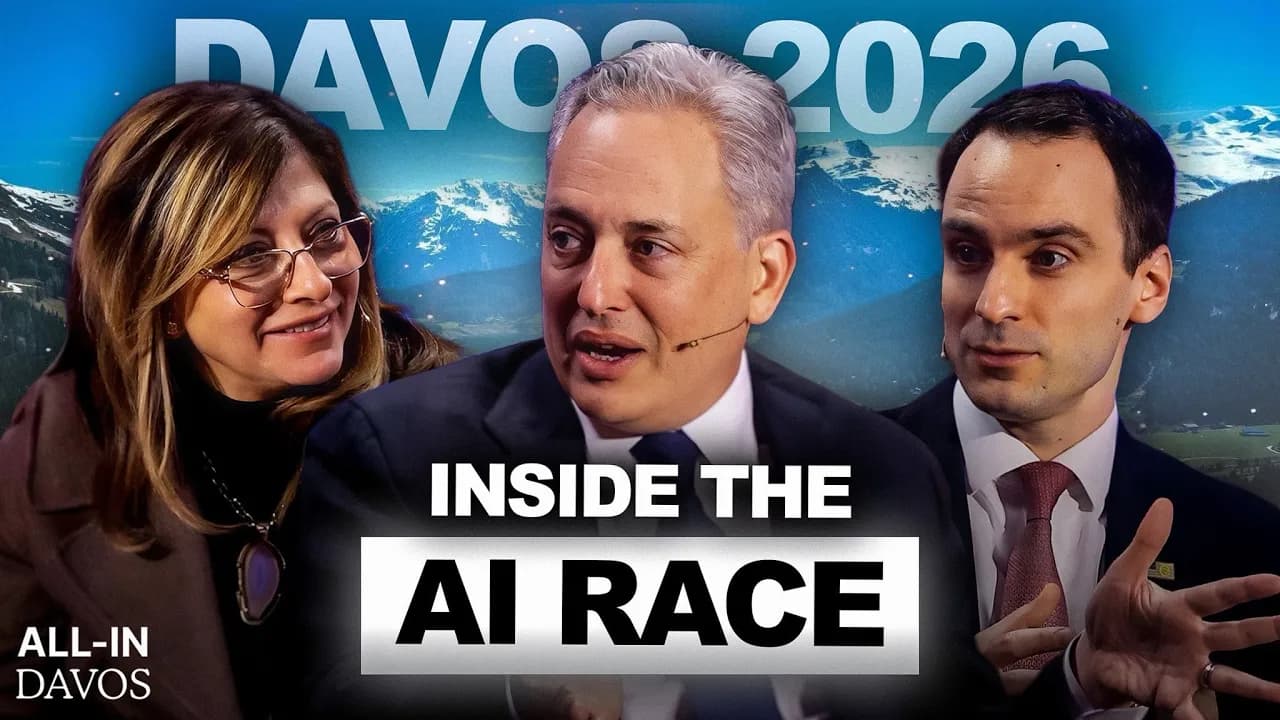
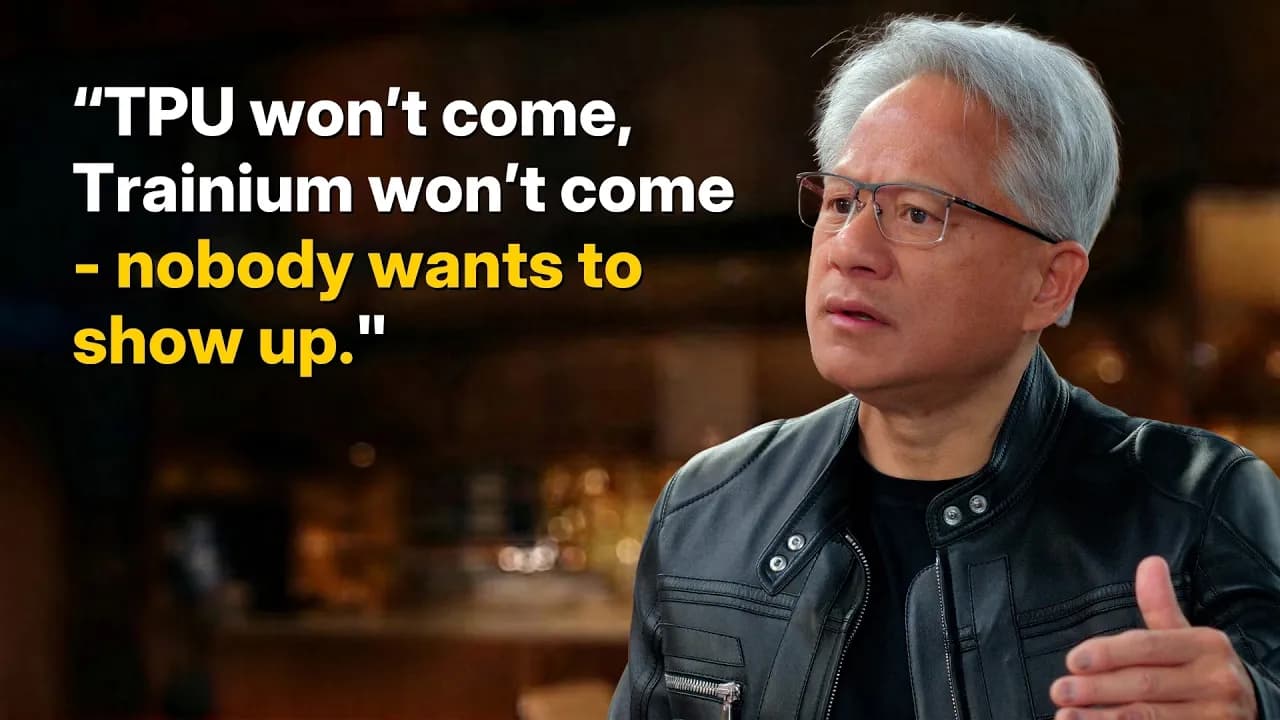
Jensen Huang: The Doomer Hoax, Superintelligence is Here, and The Future of AI (ft. President Trump)
In a Nutshell
Jensen Huang argues AI doomer predictions are fabricated, pointing to multiple failed forecasts—from radiology replacement to mass job elimination—that proved false, while safety concerns should be handled through internal engineering controls rather than public alarmism. He emphasizes that superintelligence already exists in narrow domains like autonomous driving and protein synthesis, and America wins the AI race by exploiting technology through open models and rapid deployment, not by restricting development. President Trump reinforced this by calling AI takeover fears a hoax and stating America must lead in what he called "the oil of the next 20-25 years."
These notes were generated by AI and may contain inaccuracies.
Jensen Huang is the founder, president, and CEO of Nvidia. Nvidia is described as the most important stock in the market, with revenue exploding 97% year-over-year. The company is positioned as the only computing platform that is a full stack AI factory. A GPU functions like a time machine because it lets you see the future sooner, enabling better prediction and planning for the future.
The conversation begins with an essay by Dario. There is discussion about how much of it may have been AI-assisted. The frontier labs coalesced around the essay itself. Jensen unpacks the essay, noting there was substantial content within it.
Safety is paramount and must be taken very seriously. Safety and leadership are not false choices - it is possible to innovate quickly, execute quickly, and maintain American leadership while doing it safely. The essay addresses internal control matters, specifically referencing the Coxin whistleblower situation, which Jensen considers very serious. Coxin demonstrated great courage in raising concerns. However, some issues were conflated within the whistleblower statement.
Jensen distinguishes between the whistleblowing aspect, which he considers appropriate, and the scientific predictions about the future, which he believes are not grounded in science despite being expressed by a scientist.
Pausing and pacing are voluntary measures companies can implement if they feel their operations are out of control. The labs are transitioning from research to engineering, and this transition may be clumsy. Engineering differs from research, though both involve extraordinary talent and engineering capabilities. If there was a matter of lack of control, that represents a different topic than the predictions being made.
When asked how to explain concepts like "civilizational death" or "10% extinction" to average people, Jensen states these predictions are made up. He argues that well-educated researchers working in labs are using language that creates alarming and troubling predictions that shouldn't be made - describing this as irresponsible.
Jensen reviews multiple failed predictions:
- A prediction that in 5 years, radiology would be completely taken over by AI with no radiologists remaining in the world - this proved exactly opposite, as more radiologists are needed than ever, though AI has automated scan reading
- A prediction from last year that within 6-12 months, 90% of code would be generated by AI - this has proven wrong
- A prediction from last year that within 6-9 months, 50% of entry jobs would be wiped out - this has proven wrong
- Predictions that GPT-2 would be too unsafe to release
- Predictions that Llama 3 would be too unsafe to release
- Predictions that half of white collar jobs would be gone the following year
Jensen emphasizes that accountability must be taken for all these incorrect predictions, noting they are inconsistent with America winning the AI race.
There is an ongoing tension between trusting experts and examining the actual history of predictions. The question arises about psychological makeup and real incentives behind making these predictions - whether business or political incentives are driving this behavior.
These are described as some of the most consequential companies in history with extraordinary engineers and researchers doing fantastic work. Jensen works closely with them as companies, but believes conversations like this need to happen in public. He advocates for companies to be built the way companies used to be built - in silence.
Nvidia does not allow anyone in the organization to speak for the entire organization, especially when having a bad weekend or after rage quitting. Employees are informed about expected behavior when joining the company. Nvidia's culture attracts people because the company is consistent, stable, with core values focused on taking care of families and creating conditions for employees to do their life's work. The company does meaningful work quietly and contributes to everyone else's success.
Nvidia is an a-political, bipartisan company. Political discourse about race, religion, and politics is to be conducted outside the company. Employees are told to take political discussions home. The company wants whatever government is in place to succeed and will do everything possible to help America succeed.
Satya's position is referenced: before discussing regulation that could stifle innovation, basics should be addressed - getting measurement right and standardization right. Jensen emphasizes getting engineering right and translating research in more predictable ways rather than fear-mongering. Research should be kept internal until ready for exposure.
Demis proposed a more FINRA-like organization for oversight. Dario's position involves some sort of transnational control mechanism. Jensen's perspective is that regulation should solve actual problems, and all actual problems so far have come from the labs because they have the most compute and are trying to solve frontier problems.
It is unlikely that high school students or startups will cause problems because they won't have enough compute. Only frontier labs have sufficient compute to potentially create issues. The labs are doing pioneering work that is very hard while simultaneously building their companies, cultures, technology, engineering, and products.
The first step after incidents is to root cause problems from an engineering perspective - determining what happened, what could have been done differently, and what technology, methods, or processes should be implemented and institutionalized. Jensen believes all incidents are within the labs' control to prevent in the future. He is certain the labs have implemented sandboxes, runtimes, monitors, and continuous monitoring systems.
The alternative - that labs would conclude they have no idea how to control what happened and need society for help - is considered unlikely. If that were the case, companies with engineers should send engineers to advise, though Jensen doubts this scenario given the extraordinary people at these labs.
A Chinese lab, the makers of GLM, announced they will put three billion dollars toward a recursive self-improvement run. Zpoo.com's founder raised 5 billion and stated one priority is getting to AI that trains the next AI and automating as much of that process as possible.
RSI combines a system of ideas starting with in-context learning, skills, reflection, reinforcement learning, and synthetic data generation. These are sensible ideas that cause AI to get better at solving problems over time. Low rank adaptation (LoRA) can improve weights without training the base model itself, and over time the base model can be trained with accumulated experience.
Jensen considers this a logical idea that everybody is using to some degree. The phrase is being weaponized to create impressions of spiraling out of control.
Even with RSI occurring inside companies, products must be evaluated and tested before release to ensure no regression. The basic process of control means labs will have much better control as they transition from labs to engineering. Control comes from methods, knowledge, practice, tools, and technology, enabling RSI to be done internally while releasing good products externally.
The world needs both closed and open models. Closed models are compared to bottled water - water is free, but you use the right water in the right places. This is analogous to electricity and other commodities used in the world.
Open models are needed for sovereignty reasons, privacy reasons, and proprietary technology reasons. In the last 6 months, $400 billion of venture funding went into AI native companies, with 80% using open models. Without open models, these companies could not build their dreams, which may differ from frontier labs' objectives.
Open models enable every company, industry, researcher, teacher, student, and startup in America to participate in winning the AI race. Some will use closed models, many will use open models. There are 10 million open models available.
The vast majority of the world's contribution to open source today comes from China due to their larger population of engineers and production of science and math students in volume. Chinese universities like Chinua University manufacture talent in high volume. When downloading Chinese models, they become yours to do whatever you want with them, similar to how Linux and Kubernetes are used regardless of Chinese contributions.
The race is about who exploits technology best, not who invents it. During the last industrial revolution, all inventors were European (Maxwell, Volta, Ampere), but America exploited the technology socially better than anyone else. The goal is ensuring America exploits this next generation of technology similarly.
China's narrative is more practical - they see AI as technology to advance their economy and society without groups claiming it will end civilization. If predictions of doom were true, time should be spent addressing them rather than worrying people who cannot do anything about them. The job is to build AI.
There has never been a point in history where so many people have so vehemently said something so untrue, and these claims are measurably and demonstrably untrue. They make sense as untrue because they are not based on science or research, while everything based on science and research proves otherwise.
When Jensen first graduated, he was an engineer who didn't do much typing because his generation built computers before software became popular. Today's engineers spend all their time typing - they receive laptops and type from waking until sleeping. There was engineering before typing, and there will be great engineering after typing. At Nvidia, Jensen tells software engineers they are just typing, and his favorite key is backspace because the best software is the smallest software.
During the conversation, President Trump calls in. Jensen notes that if not for the call, he would be on stage with the besties - Sachs, Jason, Chamath, and David. The President mentions they were talking about him. Trump states that Jensen can develop the most complex computer chip that nobody can copy for 10 years, but cannot figure out how to put him on speaker. Trump notes that the happiest group about AI developments is China, and many states that weren't going to get data centers are now happy because companies are building there. Google wants to build a big data center in Finland, which Trump is unhappy about due to permitting issues. Trump states that data centers are great, make people and states wealthy, and represent the oil of the next 20-25 years - bigger than
President Trump stated that AI represents the oil of the next 20-25 years, describing it as bigger than the internet and emphasizing that certain political people and China are actively working against its development. He explicitly called AI takeover fears a hoax, stating that robots will not be taking over the world and that AI will not take over the rest of the world. He referenced his uncle, a top MIT professor for 41-42 years, as providing genetic strength in understanding AI, while emphasizing he also possesses common sense about the technology.
Trump acknowledged that while AI development must proceed carefully, this does not mean stopping industry development. He expressed concern about communities that were previously dying now becoming wealthy through data centers. He emphasized that America must lead in AI, stating that whoever wins AI wins, and that this is bigger than the internet.
Trump highlighted that the country has 20 trillion dollars of investment coming in, compared to much less than 1 trillion under the previous administration over four years. He noted that thousands of people were clapping during the call and emphasized staying with the future.
Jensen Huang was on vacation when the call came through, having postponed his vacation for 5 years. The President had asked about Huang's attendance at a dinner, and when told he was on vacation, responded with "Get him on the phone."
The discussion addressed how AI doomerism polls at minus 80, representing the popular position. Despite this, the President called it a hoax. The narrative was initially anchored on national security concerns, which were later disproven, and has now shifted to safety concerns.
Huang emphasized that the first priority for safe AI is ensuring that the labs building it maintain control with proper testing protocols. He suggested third-party evaluators similar to financial auditors, noting that multiple independent evaluators prevent any single company from becoming compromised. He stressed that extraordinary technology requires holding companies to extraordinary standards.
Huang explained that AI is creating enormous numbers of jobs, with President Trump prioritizing job creation and re-industrialization of the United States from their first conversation. The focus includes ensuring America has energy to support the next industrial revolution, with $400 billion in venture financing going into the AI industry in the past 6 months.
Huang discussed his conversation with Texas Governor Abbott about being empathetic to small communities when building data centers across America. He emphasized the need to be better listeners when developing infrastructure.
Huang described Nvidia's approach to becoming the "bank of AI" to get the ecosystem going, including the Cloverleaf deal involving land, power, and shell infrastructure, and partnerships with BlackRock and Goldman Sachs to create financing capability. He explained that this new industrial revolution requires manufacturing across electricity, internet, and now AI, where AI enables asking and knowing anything.
Huang outlined looking across the entire ecosystem for bottlenecks, identifying where extraordinary companies need scaling in supply chains. He mentioned working with Corning, TSMC, and memory companies long before growth came, ensuring supply chain readiness. The strategy involves solving problems upstream and now moving downstream.
The discussion addressed how earnings tend to move up the stack toward the application layer over time. Huang explained Nvidia's strategy of going up as far as needed but as low as possible, creating technology like CUDA and Megatron Core so that frameworks and large-scale training could exist, then letting a thousand flowers bloom.
Huang noted that Nvidia now runs every single model in the world, having expanded from only running OpenAI a year and a half ago to now running Meta's Llama, Grok, Gemini, and Anthropic's models. Multiple frontier AI labs including Inevitable, Reflection, Physical Intelligence, and others are building on Nvidia's platform.
The discussion emphasized needing 50, 100, or 1,000 regional clouds rather than just a few hyperscalers. Huang explained that hyperscalers plan once a year but market dynamics are volatile, while regional clouds are agile, know their regions, and secure land, power, and shell infrastructure more effectively. Countries are now recognizing AI as strategic and restricting power access to their own companies.
Huang mentioned recent work in Australia bringing on two more gigawatts, and Southeast Asia expansion with IOH and others. The strategy involves building gigawatts of capacity and helping regional clouds grow in countries where Nvidia operates.
Huang confirmed Nvidia is building open source models because customers need them and Nvidia has the capability. The company is the frontier model in five domains, including self-driving with ALMA, which reasons about driving situations rather than requiring billions of hours of road data. Nvidia also built ESM2 protein language models, ESM Fold, Open Fold, AlphaFold 2, and Proteinix Complex for synthesizing next-generation proteins.
Regarding Elon Musk's announced 100 million square foot facility, Huang noted that Musk's superpower is being difficult to discourage once he decides to pursue something. Huang explained that Nvidia could potentially have chips fabricated there, given their deep knowledge of process technology and being the world's best systems company.
Huang stated that China will achieve advanced lithography systems by 2030, noting this is just around the corner. He emphasized thinking in decades, with two or three years being insignificant in long-term planning. China excels at high-volume production, and once the capability exists, manufacturing will move to mainland fabs almost immediately.
Huang stated that superintelligence has already arrived in narrow domains. Self-driving cars demonstrate superintelligence with one-tenth the accident rate of humans. Protein synthesis and virtual screening of proteins represent other areas where superintelligence is already achieved. He emphasized that slowing down is definitely the wrong strategy and that humanity needs to ride the bike toward this future.
Keep All-In Podcast in your library
Save the videos and channels worth coming back to, and find them again in one place.