Jim Collins — What to Make of a Life
In a Nutshell
Jim Collins shares insights from *What to Make of a Life*, studying lives through "cliff events" (major disruptions) to uncover self-renewal, revealing peak productivity often occurs after 50 via discovering and trusting "encodings"—innate capacities activated by circumstance, not systematic search. Key practices include maximizing return on luck (seizing who/what/zeitgeist opportunities with 10x intensity in "Natalie moments"), allocating time via a punch-card system to protect creative hours, and placing right people in encoding-matched roles for sustained energy. At 68, Collins has more fire than at 37 by extending prior builds, embracing fog phases without panic, and prioritizing spouse's respect as true success.
These notes were generated by AI and may contain inaccuracies.
Joanne gasps, "I feel like I'm dying." Her identity as a world champion athlete, something she was encoded for and loved, was being taken away. One way to study self-renewal is to look at people who go through cliff events—times in life where life in some significant way changes under your feet.
Jim Collins has more energy at 67 than at 37; now 68. Looking back at prior conversations to spot gaps, including mundane routines like food, caffeine, rock climbing.
You have more energy at 67 than 37.
Not rock climbing much; cycling with Joanne in Italy and Dolomites, huge mountain passes they share. Intense aerobic aspect: heart rate above 160 for 1-2 hours, spiking to 170s. Energy has only increased; needs less sleep, higher clarity. Looks forward to 4:00 a.m. to leap into the day with childlike anticipation. Always a morning person; gets two mornings a day via napping anywhere, anytime.
Example: Before talk to 3,000 people, napped on couch backstage, woke immediately, performed.
Tells team, "I'm going to go get ready for second morning" (take a nap).
First Morning Routine (4:00-7:00 a.m. Ideal)
Up at 4:00 a.m., one cup coffee (no caffeine after), travels with own setup except Italy. Intense creative work in 3-4 hours as light changes; fully into it within 15 minutes. With coffee, has Kind bar or yogurt for brain calories. Breakfast with Joanne: makes her latte (coffee elf), she curates and reads Wall Street Journal stories aloud, they discuss.
Marcelo Garcia (9-time world champion BJJ, greatest ever) sleeps under bleachers before finals, goes from 1 to 10 intensity, avoids "simmering six." Gear shift to shared activities like biking with Joanne mirrors successful relationships, e.g., Kelly Starrett shifted to mountain biking with wife Juliet.
Packs Pete's ground coffee (Arabian Mocha Java), cone filter, filters, water boiler. Ritualistic bootup sequence replicates morning bubble anywhere, any time (4:00 a.m. East Coast or 7:00 a.m. California). Adapt if needed, but controls variables.
Idiosyncratic encodings.
In What to Make of a Life, people did best work after 50, 60, even 70. Host (48) reassured: still warming up. Example: Alan Page (NFL player) ran, woke at exactly 5:19 a.m.
Side passions list: 80% had intense ones outside primary focus (monomaniacal on big thing for years/decades), e.g., disco dancing, studying the occult, teaching Sunday school, running, mountain climbing, hosting dinner parties.
Inspired by John W. Gardner's book on self-renewal (Stanford sage). Question: Why continuous self-renewal vs. peak then decline? Seed from 30s, activated later.
Joanne: World-class athlete, Ironman world champion (1985 Hawaii), first female in original Nike "Just Do It" campaigns (1980s with Bo Jackson, Howie Long). Encoded to compete, needed to win; gave up opportunities for Ironman.
Joanne's 1985 Ironman Win
2.4-mile swim, 112-mile bike, 26.2-mile marathon in 90°F, 80+% humidity on lava fields. Good swim/great bike, 10-minute lead with 10 miles left in marathon. Chronic hamstring injury caught up (limited training); lost 1 minute/mile. Stopped in lava fields, massaged/pounded quads, looked to sky pleading, fixed gaze on horizon with stoic countenance, ran, won 10+ hour race by 90 seconds.
Hamstring didn't heal post-race (tried surgery, PT, rest, stretching). Athletic career ended at peak. At kitchen table: gasps, "I feel like I'm dying"—identity dying.
Fused with Gardner: Study cliff events (chosen or imposed, before/after reorientation). Method: Pairs at same cliff, similar lives up to cliff, compare through/after for renewal process.
Project massive: Studied full lives (most deceased, records intact; few in 80s). None aimed for self-renewal as objective; they led lives through cliffs. Method answered bigger question: What to make of a life.
Cliffs force re-answering: young (out of youth fog), mid-life (big cliff like Joanne's), later decades (make 50s-90s biggest/creative years, not inferior to youth).
Pattern across works (Built to Last, Good to Great): Start with narrow question (e.g., corporate vision), method leads to bigger (enduring great companies). Here: Self-renewal artifact of leading life through cliffs.
Jim Collins framed the whole book around a central question he gave himself over to. The seeds go back to a shattered kid trying to figure out life, representing the creative journey. The book feels clearly linear for conceptual cohesion, but the creative process is dynamic.
Tim is in a fog with an 850-page draft that feels denser and harder to chip away at. Jim's completion provides light at the end of the tunnel and moral support. Tim has clarity on specific projects like books, podcasts, business in the past, but now less clarity on broad life direction. He has a wonderful partner with clear shared direction as the Archimedes lever. Feels little to prove professionally, but wants more energy and fire at 67 like Jim has at 37. Less clarity on Tim 3.0 or 4.0. Loves podcast but it's saturated and noise-filled; anticipates a cliff. Fog around writing: chip away at draining 850-page behemoth (now on back burner) or focus on exciting new project. Questions if it's leaning into encodings or novelty allure; still pays taxes in the mud.
Fog: periods of being lost, confused, befuddled, disoriented, uncertain—either in part or overall life. Alternates with clarity phases. Everyone in the study had fog phases, sometimes losing a decade. Fog prevalent, especially after cliffs (unexpected big cliffs lead to thick fog).
Jim in clarity phase now; was in fog 2013-2014 and in 20s.
Tim asks if book illuminated navigating fog: Don't freak out—everyone ends up in fog. Return on luck and types of luck compelling; luck not just having it or not—widen aperture, take advantage. Simplex stepping for fog navigation (to discuss later).
Questions from book: energy as core currency of life (not verbatim but fundamental). Energy required for execution; without it, best plans fail. Cessation of energy is death.
Loved Katherine Graham piece. Profiles show unprepared for cliffs vs. prepped 10-20 years. Methodically find encodings (distinguish from strengths). Overlap of circumstances with inner workings finds stride (e.g., Michael Jordan in basketball prison camp).
Tim asks how Joanne would answer why Jim has more energy now than at 37. Might involve honing encodings as energy wellspring, but Jim good at that post-Stanford.
Profile reporter asked Joanne one word for living with Jim: after pause, "exhausting." Jim has high energy set point; variation possible around it. Lead life on positive side of variation to sustain until out of breath. Many drop below set point, losing 20-30 years.
Joanne: Jim expends energy on things with tremendous intrinsic pleasure in doing. Compelled, not disciplined—can't stop preparing because loves it. Loves big projects; 12 years on book (from 2013 noodling)—clear 4 a.m. purpose, energizing.
Extending out and circling back: not radical reinvention, but organic extension into new modes/activities, circling back to prior builds as fuel. Robert Plant: extends to bluegrass, desert trans musicians, blending voice with Alison Krauss (e.g., bluegrass Black Dog), circles back to Led Zeppelin songs. Jim's study: new question/unit but circles back to methodology on messy questions.
Fire shift: younger painful red molten lava (channeled rage/ferocity)—worried losing it would lose drive. Now green/yellow sustained warming glow, constantly generative. No insecurity/proof needs; best work from it.
Not byproduct of age/CV alone (though nice no safety net terror). Data point: life without raging coals wonderful, more energy. Happened via studying lives in book (2013+). Living alongside them transformed Jim—softened to rapturous joy (Robert Plant/Alison Krauss; Grace Hopper on Letterman at 79 sparkling; Barbara McClintock fearing death before solving genetics puzzle). Their reinforcing engagement rubbed off.
Finding power zone with encodings (differentiate from strengths) top/base domino/prerequisite. Avoids decision fatigue/paradox of choice draining chi. Practical advice request: how find encodings if no Yo-Yo Ma cello at 4 or Tiger Woods dad.
Encodings: durable capacities awaiting discovery through life experiences. Most die with vast swaths undiscovered. Constellation of encodings like vast galaxy; life looks through window frame capturing bright set or not (in/out of frame).
Example: John Glenn not capturing as youth (family business/doctor; chemistry/physics flop). Happenstance government pilot training: click—wears aircraft like glove, heart rate drops under danger/speed (Korean War supersonic jet). Later astronaut with Gordon Cooper. Career end: Kennedy pulled from rotation (too valuable national hero, couldn't go to moon).
Kennedy felt John Glenn was too valuable as a national hero to be an astronaut anymore, which became his cliff. Ten years later, he went to Royal Crown Cola. In his memoir, his time at Royal Crown Cola is almost 10% of his life but 0.2% of the memoir. Not much to report. He was still John Glenn, but the window frame shifted. It shifted again when he returned to the Senate. He was an adequate executive, but not like when flying fighter jets or orbiting Earth—he was out of frame.
Encodings are there to be discovered by life's experiences. When they click into frame, trust them, even if you don't know where they'll go. People didn't always know. Turn encodings into strengths through training and discipline. John Glenn could have done 10 MBAs and never been encoded for business executive like he was for senator, fighter pilot, and astronaut. Key is discovering them and letting them go—empirical observations.
Jim Collins notes the interviewer has encodings for this type of work, curiosity, etc. Asks what encodings occurred while making notes, distinct from turning discovered encodings into strengths, especially thinking about what's next.
Interviewer responds roundabout: Tried ferreting this out with varying success, assuming imperfect self-awareness. Benefited from asking close people—coaches, agents, friends, collaborators—like 360-degree analysis. Questions include: When have you seen me at my best and worst? What do you think I find easier than others?
Fascinated by Soviet and Chinese athlete sourcing. China scouts elementary schools with simple tests: broad jump, hold broomstick overhead and squat—to source Olympic weightlifting candidates. Fun, not coercive. As N=1, no infinite time to try everything.
Experimented with dumb questions—good at asking seemingly dumb questions that often aren't. Puts on beginner's glasses, persistent like dog with bone. Leads interesting places. Novelty seeker (blessing and curse)—avoids doom cycles. Does angel investing across industries, interviews diverse people, borrows practices, copies principles across areas.
Friend suggested recording founder conversations—invested in 100+ companies over ~20 years. Good at pinpointing terms, positioning. Experiments with recording; listens back, thinks nothing special because easy for him, but not for others.
Still wondering how to facilitate finding encodings.
Jim rewound lives of studied people—process organic, messy. Light spun them into situations where encodings lit up. People get clues from experiences and others all the time. What stood out: they trusted glimpses of encodings despite opposition (e.g., John Glenn's parents wanted family business/doctor; Robert Plant's wanted accountant). Didn't question or let others talk them out.
Allocate 100 points: 70 on trusting discovered encodings, 30 on discovering (we get clues constantly).
Shifted view: Not what you do better than others, but doubling down on what you do better than other ways to expend yourself. In frame vs. out of frame.
Book not about business/leadership/management, but affected Jim's prior work. 'Right people on the bus' still true, but now about seats matching encodings, feeding fire.
Studied people gravitated to arenas hitting big bright encodings, feeding fire, then clicked in. Used to frustrate turning people into what they're not. Study softened him: attune to team encodings, shift responsibilities incrementally to click into frame.
Emotional shift: awe/gratitude for what they are, not frustration for what not. Lives improved. Helps discover via experiments—test, observe flash, shift responsibility.
Marvelous seeing people in frame. If frustrated with what not: wrong seat. Bus issue? Off bus. Else, wrong seat for encodings/fire. Trying to turn into what not: misery.
Others help see encodings. Friends running companies use Enneagram as heuristic.
Interviewer: self-preservation six (married to one—resonates). Caveats, but helpful for post-mortems on organization fits. Irrefutable patterns in types that work/don't. No right/wrong, but for his style.
Shopify, Dropbox use Enneagram. Good for conflict resolution. Caveat: in Silicon Valley, sometimes acceptable horoscope for tech guys. Needs experienced typer or good tools.
Incredibly helpful for dating—ended with great match.
Don't go down rabbit hole turning everything into Enneagram—losing forest for trees. One input of many.
Jim at Stanford: invisible, did deep work, long reflection cycles for 6 years. Worried visibility would make books half as good, no quiet solitude.
Commonality in Jim's +2 days: intense solitude or highly socialized, little in between.
Respected faculty: 50/30/20 time split—50% new intellectual/creative work, 30% teaching, 20% other (committees).
Jim organizes life that way still.
Novelty seeker penalty: pulled into good-at things not aligning with encodings—choppy days (management, regretted speaking, too many startups, Zoom vs. book).
Question: Succumbed to gravitational pull managing > making? How corrected?
Early: pulled toward not encoded for. Good events/choices got in frame; glittering opportunities could have led successful but out-of-frame life.
Not prepared for success (was for failure). Success fog: opportunities/noise pulled out of encodings. Said yes to travel/etc., later never would.
Realized life could be sucked by accepting opportunities. Fought back systematically.
-
1000+ creative hours every 365-day cycle, every year for 50 years—no miss.
-
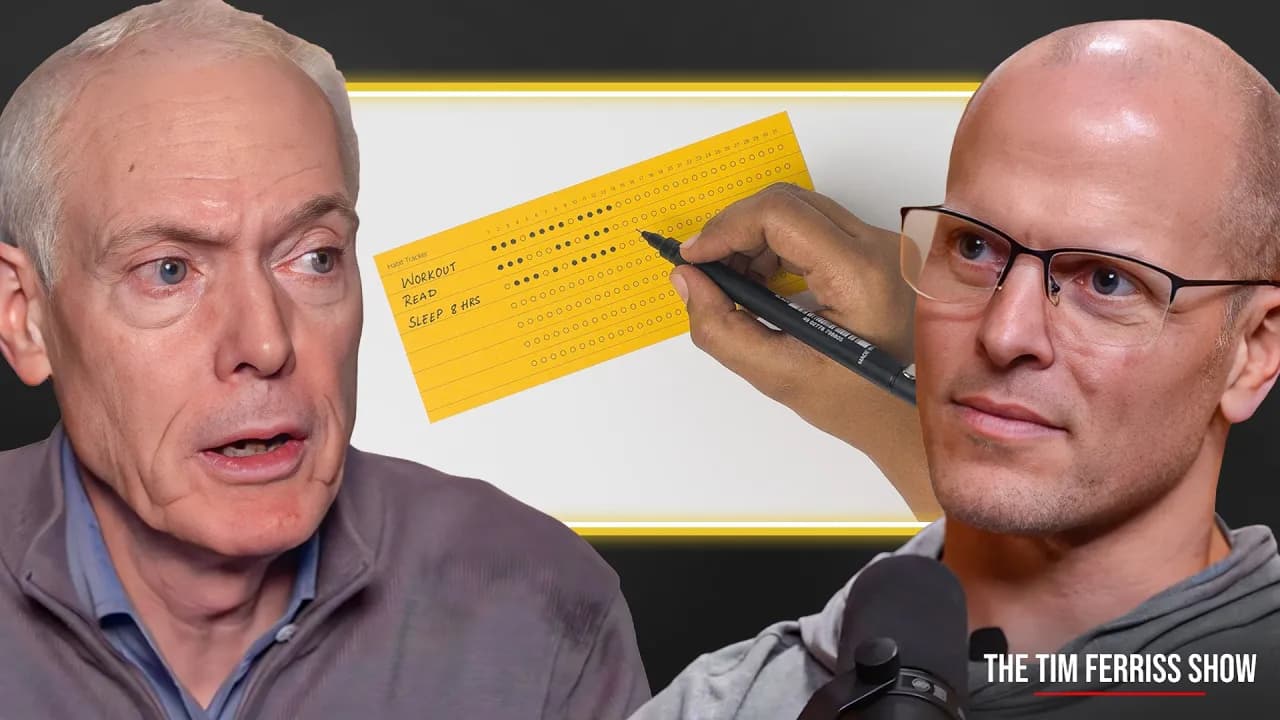
Disciplined yes: punch card system (inspired by Warren Buffett—any use of you is investment, punch gone).
Yearly: lay out punches. Not 'free on Oct 17?' but 'punches left?'
Life ultimate punch card. At 48, ~5-year projects = many punches left; at 68, fewer.
Can't get 5-10 years pulled away back.
Iterated: weekly calculate. Point system:
- Airplane engagement: more points.
- Virtual: fewer.
- Intense 2-day Boulder lab (exec team grilled): many points despite local, due to intensity.
- London: ~3 punches.
Reverse frequent flyer—points subtracted. Running total; ok underspend, not overspend.
Turning down: team in frame, encoded for relationships. Builds friendship first, sets low odds expectations upfront.
Explains punch card for research/writing focus, limited spots. Then discuss event; mostly no, some yes: 'unable for Jim to be able to'
Jim Collins' team is prepared for punch card constraints preventing Jim from joining events. They ensure people walk away feeling better about the organization than before reaching out, even with disappointing answers. In some cases, Jim personally records a voice memo expressing appreciation for the person's work and invitation, aiming for "the most wonderful disappointing answer I've ever received."
The 850-page book is entirely about how to say no, likened to a pet monster from Monsters Inc. rather than a Kraken. Saying no relates to saying yes, decisions, and everything in life, as isolating one thing reveals it's hitched to everything else in the universe.
Staying on track involves right people in key seats encoded for their roles. When in frame, be grateful for what they are. Getting good at placing people encoded for their seats reduces management energy and angst, replaced by joy of working with them. This traces back to Good to Great: first who, then what, especially for key seats.
For small teams (3-4 full-time), trial and error is feasible but limited by fewer players. At larger scales (100, 1,000, 10,000), systematizing is harder. Never confuse scale of impact with scale of enterprise—a small special operations team of six can have immense impact.
Growing a company provides more seats, expanding opportunities to shift people into encoded roles. Good unit leadership involves sensing when people are in or out of frame and shifting them iteratively through observation.
Jim observes behaviors, like a team member who stays calm in crises (not Jim, who has some Enneagram 4 tendencies and can be overly dramatic). During COVID chaos, this person was the calm balance. Jim notices snippets, then adjusts their frame to capture more of that strength iteratively—no magic dust, just observation.
For crisis-encoded people, simply acknowledge: "I'm really glad you're encoded for this. Let me know how it goes." Trust them (70 points on trusting), get out of the way—don't second-guess their encodings. Let them do what's natural.
Team members are not underutilized like firefighters playing cards; Jim overutilizes them. People are not encoded for just one thing. The crisis handler is also an instinctive coach for young research team members (2-year stints) and others, providing constant inflection. Crises are sporadic, but coaching is ongoing—like special ops not always on patrol but activating different encodings.
Uplifting study finding: you're not encoded for just one thing. Maslow's self-actualization: discovering what you're made to do and pursuing it with excellence. Study shows vast range of potential encodings—all you need is one, found randomly.
Examples:
- Alan Page: NFL defensive MVP, then Minnesota Supreme Court justice—no overlap, encoded for both.
- Benjamin Franklin: media empire, scientist, diplomat, nation founder—radically different frames.
Some stay in one frame lifelong; others shift due to cliff endings or interests. Implications for founders: how you think about life cycles intersecting company building depends on in/out of frame.
Return on luck (ROL): from Great by Choice with Mortality Hansen, studying chaotic environments and successful startups.
Luck event definition:
- You didn't cause it (not "make your own luck"—bad luck like cancer exists).
- Potentially significant consequence (good or bad).
- Came as a surprise (form, timing unknown).
Luck events happen constantly. In study, 10x winners vs. comparisons had equal good/bad luck, spikes, timing—luck evenly distributed. Differentiator: return on luck—making more of luck when it hits.
In this study, whole chapter on luck permutations, including roulette luck (unexpected encoding activation, e.g., Grace Hopper pulled from Vassar professorship to Harvard's Mark I computer during WWII, diving her life).
- What luck: good/bad events (e.g., cancer).
- Who luck: key people (Jim's life full of it, starting with Joanne; bad: father's loss).
- Zeit luck: fitting zeitgeist you didn't cause (Benjamin Franklin for Revolution; Alice Paul for 19th Amendment; Jimmy Page for blues rock; Led Zeppelin's founding as chain of luck events; Robert Plant quote: "What was that? The gods roared and lightning crackled and Blake wrote a poem from under the ground and all England was reunited" during first song Train Kept A-Rollin').
Natalie moments: Not all time in life is equal—requires unequal (10x) response.
Tim: Good at ROL via connecting disparate worlds from dozens of weekly conversations (scientists, founders); picks right ball from 600 tennis balls/machines. 80% misses, occasional home runs (personal/external rewards). Relates to recognizing Natalie moments, 10x intensity.
Examples of Tim's: angel investing 2008-2010; 2015 10x-30x on psychedelic therapies, bioelectric/brain stimulation, biologic medicine.
Surface area of luck: Increase exposure for luck to stick (Tim's who-luck via Silicon Valley move for startups/book success).
Jim: ROL operates anywhere, not just large spheres. Example: Grandmother (Oklahoma farm girl) meets dashing test pilot grandfather Jimmy Collins at Wichita airport on Memorial Day weekend—married 4 days later; both seize who-luck Natalie moment. One reason to be in certain
In high-quality environments, there are more tennis balls coming at you and more who-luck events. Jim Collins describes his greatest wealth as a vast set of who-luck events from being in environments with high surface area for encountering such people. Examples include John Gardner down the hall at Stanford.
In second year at Stanford Business School, the entrepreneurship small business course filled up, and the course sorting machine randomly placed him in a section with unproven instructor Bill Lazier (first time teaching, no one knew him). Bill became the first father figure for Jim, who recognized Bill's caring, invested in the relationship despite challenges, yielding a return on who-luck.
At 28-30 years old, shortly before fall 1988 term, one section of entrepreneurship and small business lost its professor due to a family tragedy (bad luck for that person, luck event for Jim). Bill Lazier, teaching the other section, recommended Jim (not then teaching there) to the deans, taking responsibility despite skepticism. This opened the door to teach at Stanford—a who-luck following prior who-luck. Bill framed it as unexpectedly pitching in Yankee Stadium: one shot, like a no-hitter to get another chance. This is a Natalie moment (referencing Eminem's "Lose Yourself": one shot to seize everything or let it slip). Not all time in life is equal.
After writing an article for San Jose Mercury News, faculty member Jerry Porras (previous professor) emailed about shared interest in corporate vision. This conversation started the project leading to Built to Last—another who-luck.
On pub date (October 17-ish) of Built to Last, Jim woke in a Half Moon Bay, California hotel for a Stanford Alumni Association talk. Picked up USA Today: top mentioned "Built to Last author" in money section. Full front-page money section feature with large photo of Jerry and Jim, book picture, spanning three pages—zero prior knowledge. Thought it was a hoax (called Joanne, checked multiple copies), but real: 50,000 copies backordered overnight. Following year was intense "Natalie year," ending with shingles from immune system crash.
Each event (often who-luck, sometimes what-luck) followed by return on luck: e.g., five years of research inventing matched-pair method after Jerry's email. Jim's life: who-luck after who-luck. Key: sometimes avoid return on luck if it doesn't fit encodings. A once-in-a-lifetime opportunity is a fact, not a reason.
Everything's kind of a once-in-a-lifetime event if you sit down and really think about it. Each and every day.
The great challenge in life is to separate an opportunity to be seized from a temptation to be resisted. — Late Lord Rabbi Jonathan Sacks
Return on luck applies to good and bad. In matched pairs studies (Good to Great, Built to Last, Great by Choice, How the Mighty Fall), luck distribution roughly equivalent, but return on luck differs. Question: patterns where high return on good luck also handles bad luck?
Jerry Porras invented historical matched-pair method for corporate research (similar circumstances, contrast outcomes). For life study, Joanne noted "people are not stock returns"—no objective "better life." Pairs hit similar cliffs, diverge differently (not better/worse); e.g., one has more trouble reframing. Pairs essential but applied differently for humans vs. companies.
In Great by Choice with Mortality Saloner: learn only from bad luck survived. Manage bad luck (COVID, financial crisis, disruption) by staying above death line via discipline, financial reserves, buffers, relationships. Productive paranoia ensures survival through triple bad-luck hits—sets up return as others wiped out.
Pair of women whose congressman husbands died tragically (plane crash, heart attack). Cardiss Collins felt husband wanted her to try for his seat (mandate opened opportunity). Unprepared, life shattered, went to Washington DC. Served on committee, discovered encodings for legislation: chaired Congressional Black Caucus, 25 years in 7th District Chicago, flourished. Not "good she lost husband" (awful tragedy), but cliff event knocked life sideways, exposed unknown encodings, recognized/trusted them, new life vector.
Bad luck cliff events (disease, etc.) shatter frame, expose hidden encodings. Return: recognize, trust, new vector. Not Pollyannaish—terrible pain remains (e.g., Katharine Graham: no idea she had encodings for greatest corporate leadership; frame shift revealed them, ultimate return for Washington Post Company, her, journalism).
Founders often lose company control (shock like death, cast into fog) or sell and lose decades without reframing. Hope book helps: military veterans (e.g., special ops reframing), founders not building till death (unlike Sam Walton, Steve Jobs). Ask: builder till out of breath, or one frame then different second frame? Many lose/sell company, fail to reframe; years pass (55-70 best years expire unused).
Very few founders have a plan. They have scripts they can copy, but it's not reasoning from first principles or from seeking encodings. Typically ends in identity crisis (like post-athletic career, special ops).
Mentor Irv Grubb: "an option to come back has negative value on a creative path because it will change your behavior."
When contemplating leaving Stanford for own path (post-Built to Last), considered bridges for return option if failed. Irv: options can have negative value—knowing return possible reduces commitment. No return option forces all-in Natalie time, changes behavior. In low-odds games, <100% commitment = 0% odds (2% vs. 0%; take 2%). Study subjects: once clear/framed, total commitment, no looking back.
Benjamin Franklin: dressed down by Privy Council, walked in Englishman, out American. Declaration of Independence (pair: Roger Sherman, Franklin): signing = death warrant if lose (separating from king vs. Parliament).
Putting a signature on the Declaration of Independence, knowing it would result in death if they didn't win, focused the mind to win. No options.
Choosing who to include in the book acted as a forcing function for filtering. Matched pairs required constraints, which are often positive. Even with many potential matched pairs, they winnowed down to a coherent set. Learned from both who was included and omitted, beyond the matched pair criterion.
Journey involved finding a range of people to shine light on key questions. Many omitted for various reasons. Primary filter: must find the opposite side of the pair.
Originally framed Franklin under renewal, fascinated as poster child for great achievements late in life (70+). Most in the study did great stuff late—one of the most uplifting findings.
To match Franklin: started with signers of Declaration of Independence also at Constitutional Convention. Criteria for match:
- From leather apron class (working class).
- Self-educated to successful business person through hard work.
- Second life in interesting way.
- Significant role in U.S. founding documents.
- Comparable age cohort to Franklin.
Discovered Roger Sherman, who met all tests—one of the great finds. Almost no one knows him. Saved the Constitution twice. Both oldest at Constitutional Convention, played seminal roles. Without Sherman, no Franklin.
Throughout study: constant process of "that'd be interesting, but is there a match?" Example: Wanted Lennon and McCartney, but Lennon's life truncated. Instead, Plant and Page from Led Zeppelin—phenomenal match.
Wanted diversity: different walks of life (scientists, writers, etc.), eras (suffrage, founding, 1920s/40s/60s). Lives largely in record books—not too young with much left to live. Glad stuck to this, showed what happens after 50, 60, 70+.
Dangerous to assume, but many scientists produce compelling work in startup years (18-30). What separates book subjects—consistently productive later—from others?
Where does mythology come from that creativity/innovation/breakthroughs/best work is province of the young?
Studies publicly traded companies for comparable metrics. Startups as laboratory (e.g., analyzing last 20 years of investing by founder age). Belief situational: intensity constrained by energy/responsibilities. Early 20s advantages: futon living, ramen, competitive edge, possible mitochondrial/physical advantage. Home runs in professional sports peak years (energetic intensity/endurance).
Collins: Not about energy—it's about being in frame with your encodings. Energy/creativity goes up, not down (absent physical health issues like autoimmune disease). Evidence from lives studied and company builders (Sam Walton, Walt Disney, Steve Jobs)—intensity didn't wane until death.
- Sam Walton: bone cancer, simple life, still expanded stores/culture.
- Walt Disney: planning next at Epcot.
- Steve Jobs: next iterations, setting up Apple beyond him.
Lives didn't change much despite wealth. Peak young? No—peak and then up/up/up (e.g., founded media empire, nation).
In science/creative: Toni Morrison—didn't become writer until 40s; Beloved at 56, Jazz at 61—no slowdown.
- Barbara McClintock: breakthrough on transposable genetic elements after midpoint (late 40s).
- Grace Hopper: huge computer science contributions as second career.
Company builders in frame: encoded for it (Sam Walton for Walmart, etc.). Startup just first step—would still eat ramen.
Post-success: invitations overwhelm (Nobel syndrome—productivity plummets). Founders post-exit: boards, charities eat time pie chart, below 50% on new intellectual/creative work aligned with encodings.
Steve Jobs had fog periods (fired—cliff). How preserve majority pie chart for encodings?
Collins: Challenging. Advantage: belligerently reclusive temperament—always selective, even without options. Independent of circumstance.
Phases (not common stages): clarity phases (click into frame with big thing) vs. fog phases.
- Some: big thing till death (Toni Morrison writing, Barbara McClintock genetics, Robert Plant music).
- Others: fog, then re-click.
Hedgehog mode: clear on big thing (science, company, nation). Tributaries, but big river (Mississippi) organizes allocation. Subpoints ok, but big theme.
Flipping the arrow of money: Money as fuel for encodings (flywheel), not goal. Purpose: never stop. Different relationship to success.
If money-driven, run out of steam post-success. Great builders: never about money, so endless steam.
Distinguish fuel for journey vs. journey itself.
Tim O'Reilly quote: Imagine life as road trip—need fuel, but not tour of gas stations.
Seth Godin reframing: Not "What would you do if you knew you could not fail?" but "What would you do if you knew you would fail?"—focuses on process.
Risk-takers like Richard Branson: expert risk mitigators, rarely near death line.
April 9th, Commonwealth Club, San Francisco: conversation on book ideas. Public signup. Search "Jim Collins Commonwealth Club April 9 San Francisco What to Make of a Life".
From Good to Great acknowledgments: "success... is that my spouse likes and respects me ever more as the years go by."
Still ultimate definition. Joanne (wife): engaged 4 days after first date (45 years—return on luck; 46th this year). Spouse knows you like no one. Depth of love + respect for intellect, integrity, direct/sharp feedback.
Marriage works for multiple reasons...
Our marriage works for multiple reasons, one being that Joanne is incredibly good at seeing what needs attention, and I'm encoded to hear it. This combination is great for us. She's the strategic guidance mechanism, while I'm the creative propulsion.
Over the years, I realized Joanne can see me for who and what I am—what my real motivations are, why I'm doing things, my weaknesses, flaws, fracture points, unlikable tendencies. When I wrote that sentence, it's as true today as ever.
The measure for me is that Joanne will love me unless I do something really stupid. She will love me regardless, but will she like me more as the years go by? Will she respect me more? The truest, most searing test is if Joanne likes and respects what she sees—I'm not too far off the mark.
Other kinds of success have come, and I want my work to be read, but if I had all kinds of external success but lost Joanne's respect, or she woke up one day and said, "I actually don't really like you anymore," that would be the worst possible kind of failure.
That'd be a bummer of a day.
Jim, that's deeply inspiring. I find your life and your examination of your life and the lives of others deeply inspiring.
People can find you at jimcollins.com. The new book: What to Make of a Life, subtitle Cliff's Fog, Fire, and the Self-Knowledge Imperative. I read every page—encourage people to check it out; it's available everywhere.
Is there anything else you'd like to add before we wind to a close?
It is truly a great joy to connect with you in conversation. The range of things we get to talk about, the quality of your questions—it makes today absolutely a plus two day for me. I would converse with you anytime.
Thanks, Jim, that makes my day. Always a pleasure to connect. Hopefully we'll have a chance to break bread in person in the not too distant future, or get into the mountains.
For everybody listening, we'll link to everything, including the new book What to Make of a Life, jimcollins.com, and the Commonwealth Club in the show notes at tim.blog/podcast—just search Jim Collins and go to the most recent episode.
Until next time, be just a bit kinder than is necessary, not only to others, but also to yourself.
Oh, I love that.
Thank you, Jim.
You're welcome.
And thanks to everybody for tuning in. Till next time, take care.
Keep Tim Ferriss in your library
Save the videos and channels worth coming back to, and find them again in one place.