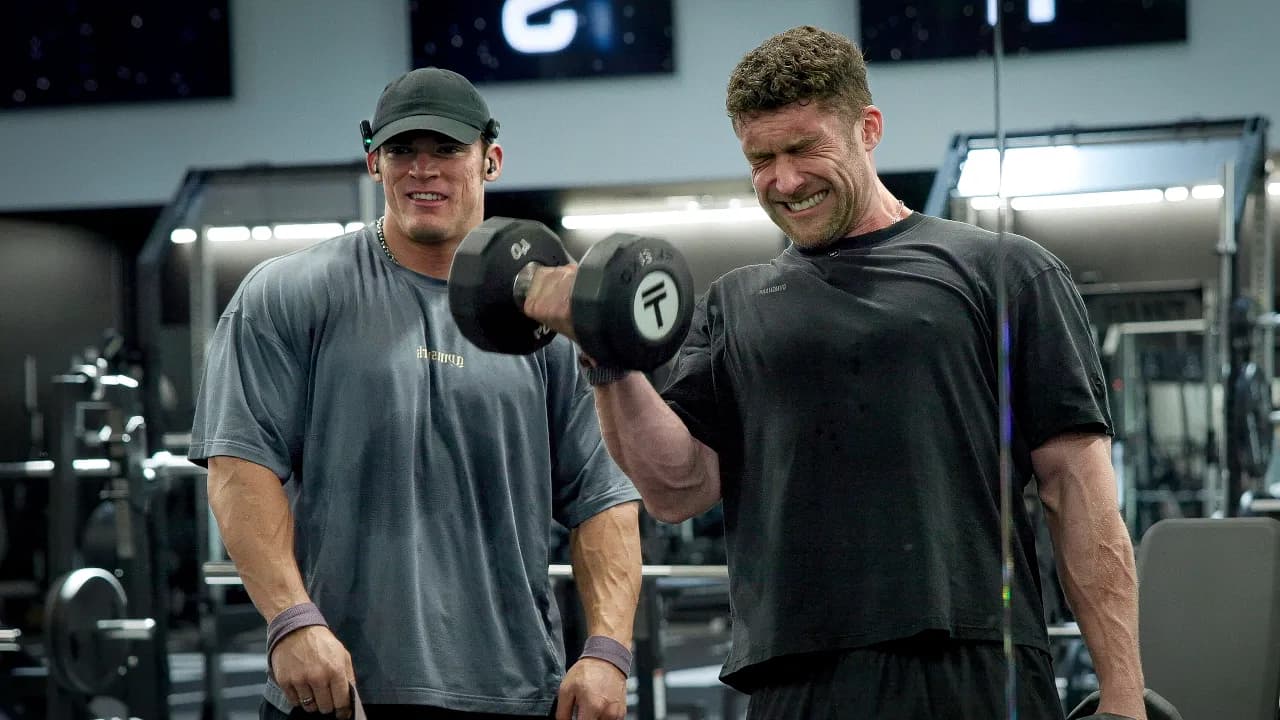
Joe Rogan Experience #2510 - Devon Larratt
In a Nutshell
Devon Larratt, 51, is still the top-ranked arm wrestler in his division despite being bone-on-bone in both elbows for 20 years and having three surgeries to remove bone growth. His longevity comes from extreme specialization—85-90% of training focused on one arm—combined with high daily volume, blood-flow work, and lifestyle discipline rather than heavy lifting or general strength training. He argues that at the elite level, small technical details in grip, wrist angles, and positioning beat raw strength, and that pushing athletic age limits will continue through peptides, TRT, and specialization.
These notes were generated by AI and may contain inaccuracies.
Joe Rogan welcomes Devon Larratt as his first arm wrestler guest, calling him the GOAT of the sport. Larratt expresses honor at appearing on the podcast, noting Rogan has interviewed nearly everyone on the planet.
Larratt's arms do not fully straighten due to his arm wrestling career. This condition limited his range during a fight against Thor. He first noticed the issue in his late 20s after starting club arm wrestling around age 18. The range of motion has progressively decreased over time.
The condition stems from constant pressure on the elbow joint, potentially leading to osteophytes. Not all arm wrestlers develop this issue. Larratt has undergone three surgeries to remove bone and scar tissue. Dr. Pollock at Ottawa Hospital performed the procedures, extending his competitive career.
When bone growth becomes severe, it can constrict nerves or blood flow. Larratt experienced this around 2013, approximately 13 years prior to the recording. He describes the condition as "weaponized arthritis" because the loss of range can sometimes be leveraged strategically in competition.
The issue results from pressure combined with genetic predisposition and occasionally a single bad match. Continuing to train when rest is needed exacerbates the problem. Larratt acknowledges he has been guilty of this approach.
The reduced range creates a higher arm bar threshold due to ligament and tendon resistance plus muscular protection at end range. However, a skilled jiu-jitsu practitioner can still arm bar him, and the bones would snap at a higher point. Larratt has tried numerous methods to restore extension, including hanging from chin-up bars, without success.
A video with Juji Mufu showed Larratt in significant pain while attempting to roll out muscles with metal bars, highlighting the severity of his restricted extension. He has largely accepted the condition.
As a 20-year-old, Larratt admired champion Crazy George, who could not straighten his elbows, and wished to develop the same trait. He later realized the root cause involves the joint capsule, likely composed of fascia and connective tissue that encapsulates the joint.
Larratt references David Goggins' knees, which are bone-on-bone. Goggins' bones adapted according to Wolff's Law, growing thicker and denser under stress, causing the bone to mushroom outward. Surgeons sawed his tibia, repositioned the knee, and screwed it into place to create a flat surface. Goggins then used a stationary bike intensively before resuming running.
Larratt has been bone-on-bone in his elbows for approximately two decades with no cartilage remaining. During surgery 15 years ago, the doctor stated he could potentially give Larratt only a couple more years of career. Despite this prognosis, Larratt achieved one of his best performances six weeks prior to the recording.
Larratt is 51 years old and remains ranked number one in his division with another opportunity at the world title. He emphasizes that doctors' statements are not always definitive and that individuals can exceed expectations through determination.
Pain serves as information and a guide for improvement. The tendons and connective structures of the elbow experience extreme stress in arm wrestling. Rehabilitation requires significant time and monotonous work that many people avoid.
Joe Rogan reports reaching a maximum of 164 on grip strength devices and aims for 200. He notes difficulty progressing because his hands remain sore from other lifting. Larratt states he performs grip training every day.
Grip strength is critical but not everything in arm wrestling. The primary technical goal is making the opponent hold onto you rather than gripping them. The opening move is called "rising," an upward spinning slipping motion designed to improve grip position and force the opponent to hold with their fingertips, the weakest part of their grip.
The objective is to create unfair pressure interactions. Instead of thinking solely about pinning, competitors should focus on pulling the match into advantageous positions. A strong grip provides both defensive and offensive value, but attacking the opponent's weakness is prioritized.
Larratt dedicates one of approximately 21 working sets per workout purely to grip training. He structures his week around two hard club sessions where he trains at maximum capacity. The remaining days focus on high-repetition, low-weight movements for blood flow and recovery.
Larratt trains in his basement using a 40-year-old arm wrestling table with a cable system originally from champion Leanne Drain (Johnny Roberts). The setup allows work at various angles replicating competition pressures. He uses a fat grip PVC tube on a single-point attachment system similar to a Swiss ball for wrist instability training.
The fundamental movements include top rolling, hooking, and pressing. During tapering periods, Larratt performs high-repetition (around 100 reps) movements with very light weight (approximately 20 pounds) to increase circulation through connective tissues.
Larratt prioritizes movements that enhance his ability to perform on the table without detracting from recovery. Heavy lifting can consume energy and resources needed for sport-specific training. High-repetition work provides healing through blood flow, metabolic conditioning, and adaptation without interfering with peak performance days.
Larratt competed in judo, basketball, and military service. He participated in military Iron Man events involving backpack carrying, canoe portaging, paddling, and running. These races typically last 5 to 6 hours. He has always returned to arm wrestling as his primary passion.
Larratt began arm wrestling at age four with his grandmother Leavonne as a reward system after completing chores. He never defeated her. The current super heavyweight world champion shares the same name, creating a notable coincidence.
Arm wrestling represents a low-cost fight sport with minimal risk to the head, spine, or overall mobility. World champions in the open division have competed near age 70. The hand's high connective tissue density allows for continued improvement with age, as more time permits greater structural development.
Arm wrestling clubs foster tight family-like bonds in a blue-collar environment. Training often occurs in garages and homes with low membership costs. Larratt considers his training club his family.
Peak performance typically occurs in the low 30s. Larratt notes his continued high-level competition at 51 is atypical for the sport.
Crazy George employs a move called the king's move or outside top roll, where the opponent's wrist is bent back. At approximately 160 lbs, he has defeated much larger competitors including Pork Chop, a 230 lb professional arm wrestler who competes at East versus West, the highest league. Matt Smith from the same club may have beaten Crazy George during the period shown, which coincided with Crazy George's decline.
Crazy George was likely in his late 60s in the footage. He is considered an absolute legend in the sport for his technical mastery. He spent his first 20 years in the sport competing in double elimination tournaments and became the Canadian champion. He mastered a style of arm wrestling with very few practitioners at the time, developing the outside top roll or king's move to a high degree of effectiveness.
The four main strengths in arm wrestling are rising strength, pronational strength, and cupping strength. Pronation is demonstrated through a specific forearm muscle that turns the thumb down and pops the wrist back. This muscle is essential for the king's move top rolling style, which depends heavily on pronation and twisting movements.
The hand is complex with multiple angles and capabilities. The two primary drivers are cupping (flexion) and pronation, which interact dynamically. When one pronates, it attacks the other's cup, creating a balancing relationship between these strengths. Crazy George mastered pronational styles, and Devon Larratt considers his open top roll or king's move his best current technique after changing techniques throughout his career.
Devon studied this style for 30 years. One of his first coaches, Troy Eaton, could never beat Crazy George despite repeated attempts. Arm wrestling movements happen very quickly, requiring a balancing act of different strengths involving locks, giveaways, and positioning.
Devon attributes his ability to compete at a high level into his 50s to his extremely high training volume. He performs arm wrestling movements all day long, constantly forcing muscles to work and maintaining blood flow without losing strength. This approach keeps tendons and ligaments functional from a metabolic and health perspective. He describes himself as a simple and obsessed person who arm wrestles at every opportunity.
Geneticist Ryan Rosner has described Devon's genes as highly unusual. Devon believes he is genetically predisposed to endurance and has favorable mutations overall. He advocates for genetic screening at birth to accompany health records as an informational tool, noting that mastery of genetics represents a top priority for humanity.
Recent research from Beth Israel Deaconess Medical Center and Harvard Medical School, published in Proceedings of the National Academy of Sciences, demonstrated a method using CRISPR to silence much of the extra chromosome 21 activity responsible for Down syndrome. Devon notes that some genes have natural stop codes that prevent expression.
Brian Shaw's genetics are estimated at one in every 500 million people. Ryan Rosner has scanned Shaw and found mutations never previously observed. Shaw possesses a different type of growth hormone than typical, possibly molecularly different due to a mutation. His exceptional traits include freakish bone density, mindset, and overall genetic factors that contribute to championship performance.
Some world record holders in deadlift lack fast twitch muscle genetics according to their DNA, having natural stop codes on fast twitch genes. Eddie Hall is cited as an example of someone with a stop code on fast twitch muscle despite moving explosively and hitting with tremendous force. This suggests current understanding of fast twitch muscle function may be incomplete.
Myostatin is a protein that stops muscles from growing too large. Myostatin inhibitors allow excessive muscle growth, as seen in certain whippets that develop extremely muscular physiques despite being a naturally lean, fast breed. Belgian Blue cows also carry this genetic mutation.
Follistatin acts as the key that turns on cell growth, while myostatin signals cells to stop growing. Genetic therapies already exist that increase follistatin levels, originally developed for longevity purposes since follistatin drops with age, causing muscle shrinkage. These therapies are also relevant for performance enhancement.
New injectable therapies for disc degeneration can inflate damaged discs between spinal vertebrae. This development could eliminate the need for artificial disc replacements and spinal fusions, which carry significant complications. Devon strongly recommends avoiding back surgery when possible.
Louis Simmons invented the reverse hyper machine, which Devon considers one of the greatest inventions for lower back problems. The machine decompresses the spine during the lowering phase and strengthens muscles during the lifting phase. Devon keeps one at his studio and one at home.
Devon predicts that athletic ages will continue to be pushed higher, potentially making 60 the typical age for champions in arm wrestling. Performance-enhancing drugs including peptides, stem cells, testosterone, and steroids enable older athletes to maintain young bodies while retaining the experience and intelligence of age. Victor Belfort on TRT is cited as the prime example of a 37-year-old fighter with a lifetime of experience combined with superhuman speed and strength.
The Enhanced Games concept would allow performance-enhancing substances, creating a separate category from tested sport. Devon supports both tested sport and open competition categories. However, significant strength, speed, and endurance gains require years or decades of training rather than months, meaning freakish performances would not appear immediately even with enhanced protocols.
Juji Mufu began with tricking, a form of acrobatics and gymnastics involving flips. He demonstrates exceptional flexibility combined with massive muscle mass, performing overhead presses while in a side split position on chairs. Devon considers Juji among the most positive people he has met.
Juji's visit approximately a year and a half ago influenced Devon to change his training approach. During their session, Devon normally avoided heavy lifting on table work days to preserve energy. However, he demonstrated his heavy training circuit to Juji, then performed two-arm work that evening. Devon felt the earlier heavy lifting slightly diminished his table training performance.
In Devon's club, the senior holds while the junior works, allowing the junior to control intensity. The senior typically performs two-arm work to flip the script and reach redline intensity. Training with Juji demonstrated the priority of this sport-specific table work over heavy lifting, leading Devon to eliminate heavy weights from his protocol.
Devon creates his own training protocols and adjusts them based on competition results. If performance meets expectations, the protocol remains stable. If results fall short, modifications are made for subsequent events. The session with Juji served as the tipping point for removing heavy lifting to maximize energy for table training.
Two-arm work is highly effective when performed correctly but can cause injury and setbacks if done improperly. Devon does not limit himself exclusively to arm wrestling-specific exercises and incorporates walking for overall conditioning.
Devon has faced criticism for not engaging in broader cross-training. He previously maintained a well-rounded fitness background but made a deliberate choice to specialize in arm wrestling to pursue world title contention rather than maintaining general health through squats, deadlifts, and running. He acknowledges the common argument that overall body strengthening through compound movements would enhance his foundation and core stability.
Leavonne Sag Philly represents the pinnacle of modern arm wrestling. He weighs approximately 420 pounds and has remained undefeated since 2017. Devon describes him as having a primitive, science-project-like appearance with exceptional size and hairiness. Leavonne resides in Georgia (the country) and grew up competing through the trenches of arm wrestling rather than entering via world championships.
Leavonne incorporates heavy pull-ups and extremely heavy curls into his training. While all top competitors perform similar exercises, they employ different formulas and emphases. Devon notes that he cannot replicate Leavonne's raw strength approach due to physical limitations from multiple elbow surgeries and age-related changes since turning 25.
Devon's primary limiting factor is elbow stability resulting from multiple surgeries. He transitioned from a hook-style arm wrestling approach, which emphasizes wrist flexion and shoulder drive, to a more precise, technical style. He believes his training is more precise than Leavonne's sledgehammer approach, focusing on fine wrist angles, pronation, hand control, and table time skill work.
Devon acknowledges he will never match Leavonne's size or strength output, such as Leavonne's 180-kilogram two-handed curls. Instead, Devon aims to compete through smaller, more precise advantages—using a pitbull-like grip on fingertips to maintain control. He weighs approximately 265 pounds currently and plans to reach 300-320 pounds for future matchups.
Devon attempts to gain size for every super heavyweight preparation through increased eating while staying in his basement rather than adding weightlifting movements. He has tried incorporating chin-ups and other exercises Leavonne performs but remains committed to his specialization approach after 32 years of competitive experience.
Devon argues that victory in arm wrestling typically comes down to small details in the hand and wrist rather than overall body strength. He has observed sore legs at tournaments but maintains focus on the most valuable components that determine match outcomes. He has come close to defeating Leavonne multiple times.
In their first match, Leavonne tore Devon's bicep in the second round. Devon has a tattoo commemorating this with "415" and "Leavonne was here." In their second match, Devon stopped Leavonne in round one. Their most recent 2024 match went to straps, representing Devon's closest contest, though Devon received two fouls including a decline humerus violation when his shoulder went below the table.
Devon believes he can still win in the 115-kilogram and 105-kilogram divisions. The open division, regardless of weight, continues to motivate him despite giving up approximately 135 pounds to competitors like Leavonne.
Leavonne's dominance forces Devon to maintain rigorous training. Without this challenge, Devon would be satisfied as a weight-class champion, but the pursuit of being the absolute best drives continued improvement.
John Bzen, considered the greatest of all time, competed undefeated for approximately 25 years across a 40-year span from age 18 to nearly 60. He weighed around 195-210 pounds during his prime and won the real tournament depicted in the movie Over the Top. Bzen started arm wrestling with his father as a child and became one of the first athletes to emphasize arm wrestling-specific practice over general weightlifting.
Bzen silently ruled the arm wrestling world for decades before internet documentation existed. Devon obtained his world title from Bzen in 2008. Bzen's technique was considered superior to all competitors, and he served as a model for specialization and the value of table time over weight training.
Bzen trained exclusively through arm wrestling rather than weightlifting. He practiced with his father from childhood and competed against predecessors like Iceman (Johnny Walker). Arm wrestling training produces extreme soreness that can prevent walking for days due to the body's design favoring resistance over force production.
Bzen's last competition was in Dallas against Yoshi Kana, Japan's number one competitor. Bzen is approximately 60-61 years old and considered well past his prime, though he remains connected to the sport.
Government recognition of arm wrestling as a legitimate sport began around the turn of the millennium, providing financial support and raising competitive levels in countries like Georgia, Turkey, and Kazakhstan. Sweden received recognition within the past year. This professionalization enabled top athletes to potentially quit side jobs.
Early tournaments offered $500 prizes. By 2010, the PLA offered thousands of dollars, and WA provided $20,000 prizes. ESPN coverage brought sponsorship opportunities. COVID disrupted existing leagues including the European PL and North American WA, but led to increased visibility through TikTok and YouTube.
East vs West emerged as the premier arm wrestling organization, hosting international events every seven weeks featuring all top competitors worldwide. Top arm wrestlers now earn healthy six-figure incomes without requiring side jobs.
East vs West does not conduct drug testing, operating under an "everything goes" policy comparable to F1 racing innovation. The World Arm Wrestling Federation (WAF) conducts tested world championships annually in different global locations, with state, provincial, and national levels feeding into international competition.
At the highest levels, Devon continues to learn technical subtleties, but his biggest gains now come from vague lifestyle principles. The sport cleans up his entire life because the drive to perform well forces dedication to nutrition, sleep, and every other factor. Perfect performance exists in the balance between chaos and order.
Devon explains that becoming great requires embracing chaos. He has met only about two people he considers completely pure (like a Jesus Christ figure) and only a couple he considers genuinely pure evil, with most people falling somewhere in the middle. For single-date performance, the balance of who you are needs structure.
In the actual fight, many people perform best in chaos — completely wild, no rules, unhinged. Leading up to competition, however, maximum order is required. The more order brought into life beforehand, the better the performance.
After hearing a geneticist named Mack speak about life existing only in the balance between chaos and order, Devon created sticker charts for training. Blue stickers represent chaos (not quite making it), white stickers represent order. After competing, he deliberately moves into chaos to gather data and form new plans before returning to structure.
Devon's life moves in structured blocks between major events. He is currently at the beginning of his longest block yet — facing Leavonne in roughly 16 months. This period allows travel and openness while gathering information for the next structured training phase.
Devon needs a finish line to stay disciplined. Knowing he only has to maintain extreme structure for four or five months makes it sustainable; the idea of living that way forever causes everything to fall apart. The chaos phase satisfies him as a human being and allows fun outside his normal box.
The most difficult aspect is the psychological dedication required to perform ten hours of wrist curls in a day. Devon gets up in the morning with help from his wife Jod, who prepares food while he trains.
Devon is returning to "pumpkin training" — right-hand only work. The name comes from giant pumpkin growing contests where all flowers except one are pinched off the vine to produce a single massive pumpkin. He applies the same principle by putting all energy into his right arm.
Devon believes humans have a finite amount of energy. Directing that energy to one area causes more development there. He rejects the idea that he has limitless energy to become a proportionate bodybuilder while remaining world champion; top performance requires extreme specialization and focus.
Many junior players criticize his specialization, but most senior arm wrestlers at his level understand it and practice similar approaches to varying degrees. Devon considers himself simply an extreme example.
When one side is injured, remarkable compensation often occurs on the other. The sport also attracts genetic freaks such as Oleg Zach and Matias Schliti, whose one arm is dramatically larger and stronger than the other.
Oleg Zach is a world champion who competed at 165 pounds yet nearly beat the then-current world champion Devon. His left arm is massively developed — the size of a 300-pound man's arm — while his right arm appears normal. The difference extends beyond hypertrophy to insertion points and muscular angles.
Devon theorizes that Oleg has an arterial spread disorder causing heavy blood flow to one side. He believes the expression of human physical traits is largely determined by circulation reaching the genetic material. Matias Schliti, another athlete with the same extreme asymmetry, helped lead Devon to this conclusion.
Devon believes blood flow is central to healing and strengthening. The heart alone cannot adequately feed all structures, which is why movement and training increase circulation. He has personally noticed that years of right-arm emphasis have created completely different endurance capabilities between his right and left arms.
For his final preparation, Devon has returned to heavy right-arm prioritization. At the club he arm wrestles everyone right-handed until people lose interest, then does some left-hand work. In basement homework sessions he allocates 85-90% of work to the right arm and roughly 10% to the left for timing and maintenance.
Devon was initially worried about developing back or imbalance issues but reports none ever occurred. He argues balance is overrated — a concept suited to an imaginary world. When the goal is winning a right-handed world title, the body should receive a clear, unconfused signal about what is being prepared for.
Similar specialization exists in jiu-jitsu. Eddie Bravo concentrates almost all attacking energy on the right side of the body. At the world level, taking an attribute from 99 to 100 even if it costs 15 points on the opposite side is a trade many elite athletes willingly make.
Devon has been studying rock climbers' grip strength, particularly Magnus Midtbø and climber Eve Grall. Eve trains with Devon and possesses forearms the size of most people's legs despite weighing only 150 pounds. Within six weeks of starting arm wrestling, Eve won the Ottawa Open against the region's strongest competitors.
Eve performs extreme grip work including hanging from two-millimeter holes and pinching extremely small surfaces. He also competes in grip sports and is considered among the best in the world at those events. Devon notes that while Eve has an extraordinary ability to hold onto opponents, the next evolution will be learning to become "the wall" — the immovable object that is difficult for others to hold.
Despite entering arm wrestling later in life (starting around November of the previous year), Devon believes Eve has legitimate world championship potential. Within one to three years he expects Eve to reach North American top-pro level. Eve's climbing background provides highly transferable strength qualities.
Eve is extremely detailed and science-based. Before each workout he performs grip tests and rates difficulty. If a movement does not feel right, he aborts the session and continues resting rather than training through poor conditions. Devon contrasts this with his own philosophy of training regardless of how he feels.
Eve measures static wrist strength by testing maximum output against weights. These pushing isometrics develop the locked isometric and negative strength that arm wrestlers rely on most. All of his squeezing work is similarly documented with detailed charts.
Devon Larratt discusses how certain athletes demonstrate enormous forearm strength and power despite small body sizes. Magnus, a climber, performs 180 lb single-arm rows at 150-160 lbs bodyweight, raising questions about the source of this force—whether tendon strength or specialized tissue development. Unlike massive athletes like Eddie Hall, these individuals do not appear physically imposing in a t-shirt and could be mistaken for runners.
Larratt explains that arm wrestlers, climbers, and fighters recognize the value of hand strength, whereas many strongman and powerlifting athletes develop massive body strength but lose much of that force through the chain to the fingers. He notes he never used straps in training because grip is critical in jiu-jitsu and functional activities.
Nick Kersonen, a strength and conditioning trainer, identified foot strength as the number one deficiency in fighters. Once foot strength breaks down, movement, power, and defensive capabilities all deteriorate. Grip strength scores are referenced: one individual scored 160, while Derrick Lewis casually achieved 218. Vitali Lettin previously held a world record in grip strength.
Michael Eert (Instagram: michael_eert_fitit), a marine, recorded 351 on grip and 262 on another device. He performs crazy one-arm pull-ups and has massive forearms despite not being a very large individual. Eert provides grip strength tutorials and recommends knurled metal devices with minimal play for accurate readings. Larratt notes his own grip at approximately 70 lbs but claims to have beaten stronger individuals in arm wrestling contexts.
Larratt mentions he could previously perform eight or nine reps on the number three Captains of Crush grippers when younger. A 200 lb gripper on the table proves too difficult for Joe Rogan to close.
Larratt discusses a massive Russian athlete nicknamed "Smay" who is described as the freakiest individual in strength sports. The athlete is open about using performance enhancing substances. Speculation arises about growth hormone intake levels, with some reports suggesting 10 units daily or even 100 units, though the athlete has publicly addressed and potentially debunked certain claims. At age 17, the athlete already displayed exceptional development.
The athlete trains specifically for arm wrestling with pronation lifts and explosive movements. His Instagram was taken down, possibly due to the extreme nature of the content. Weight estimates place him around 340-350 lbs.
Leonitis Arona, a young German champion weighing approximately 285 lbs, defeated Brian Shaw in arm wrestling. Shaw is roughly 100 lbs heavier. Larratt notes that Shaw has only been arm wrestling for less than two years, while Leonitis has more experience in the sport. This outcome demonstrates that technique and repetition create advantages beyond raw strength.
Larratt positions himself as number two in the world in the open division despite acknowledging that the top 50 competitors are all stronger than him physically. He emphasizes that arm wrestling functions as a miniature martial art requiring understanding of positions, leverage, and adaptation.
Tom Havlin from Australia is described as another strength giant who trains in his backyard wearing work boots and jeans. Most images show only his back. Havlin weighs nearly 400 lbs at 6'8" and appears shredded and athletic rather than purely massive. Larratt has messaged him about competing at East vs West. Speculation exists that Havlin may belong to an organization requiring discretion, though photos of his face exist.
Eric Spoto, former world record holder in the bench press from Vegas, is mentioned as another individual who avoided competition until he could break records. He reportedly set the record in his basement before competing publicly and is considered an extremely strong arm wrestler who does not compete often.
Larratt classifies arm wrestling as a combat sport due to the interplay, decision-making, adaptation, and technique involved between two competitors. He compares it to football in that both involve direct opposition and fighting dynamics. While guns and weapons dominate modern warfare, arm wrestling represents pure physical combat between bodies.
Larratt argues that technical skill developed over four to five years of practice allows smaller, trained individuals to dominate larger untrained opponents, similar to jiu-jitsu dynamics. Repetition under resistance refines positions and energy transfer, creating efficiency that pure strength cannot overcome. He attempts to incorporate psychological elements into his arm wrestling approach.
Larratt served 20 years in the Canadian military, with 16 years in JTF2. He states he would have remained if circumstances had not become too complicated, partly due to the growing visibility of his arm wrestling career beginning around 2000.
In 2014, Devon was on ESPN and had not publicly declared his military background, maintaining operational security by presenting himself as a farmer. As an active JTF2 member, he faced concerns about the growing exposure from arm wrestling conflicting with the requirement for operators to remain anonymous. Command gave him an ultimatum to choose between his military career and the sport.
They offered him a year off without pay. He accepted and spent that year gathering apples and eating sardines, with his children attending school with dried apples. He and his wife questioned whether they were making the right decision. At that point, he had completed seven tours.
Devon explained that after multiple tours, things began to "gray out." Everything in military life revolves around mission, and without a strong mission, life can deteriorate. He described how initial patriotism and desire to help country and comrades keep people undeterred, but prolonged exposure can create doubt about whether the mission is the right thing to do.
Issues with OBSC outside his own career affected unit policy, leading to a shutdown of all extracurricular activities. Command told him he could no longer arm wrestle despite being the current open world champion.
Devon described the stress of taking the year off without pay at age 39. He had to win because losing would mean financial consequences including potentially selling the house. He competed in the W finals in the 225 lb division for a $20,000 first-place prize in both right and left hand. A sponsor matched his winnings.
Before facing Ron Bath in the finals, his longtime mentor Mike Gould reminded him that he used to run to practice at 18 simply because he loved it. Devon went out and competed with that mindset, ultimately winning.
After taking the leave, command wanted him to publicly declare his special forces background for recruiting purposes. When he returned and asked for his old job back, they asked if he planned to continue arm wrestling. Upon learning he would, they assigned him to recruiting.
At that point he was on his 19th year. After completing his 20th year of continuous service in the Canadian Forces, he received a base pension. He spent that final year traveling across Canada promoting JTF. He has now been a full-time arm wrestler for the last 10 years.
Devon described feeling selfish and irresponsible for leaving a career he genuinely believed in. He worried about the impact on his children's education and future. Despite these concerns, he and his wife committed to the decision and it ultimately worked out.
He noted that many special forces personnel complete 30-year careers. Some of his former colleagues now hold senior positions. He described his current life as simple and beautiful compared to the complexity of special forces life, where he is home every day unless traveling for tournaments.
Devon stated that the discipline from his military career continues to inform his approach to arm wrestling. He is still integrating experiences and lessons from his service into his current life. He views soldiering as one of the highest callings alongside motherhood, describing special forces operators as among the highest order of fighters.
He does not frequently discuss his tours publicly but acknowledges the military chapter as a significant part of his life, particularly his work in Kandahar conducting counterterrorism operations alongside American and Afghan forces.
Devon described himself as someone who was "scared shitless" before missions but went anyway. He learned to create a psychological separation, becoming a different person when operating than in daily life. He developed a persona that loved the violence and aggression required for optimal performance.
He explained the process of accepting worst-case scenarios, including death, and finding a way to love the work. He desensitized himself to fear by repeatedly watching parachute failures before his own jumps. He noted that this ability to transform psychologically transferred into his arm wrestling.
Devon expressed skepticism about sports psychologists teaching preparation techniques without having experienced real combat. He emphasized the vast difference between theoretical knowledge and the actual experience of parachuting into combat and taking lives. He later reframed his perspective around the broader concept of excellence and mastery in any field, whether soldiering, farming, business, or art.
Devon was asked about the Kandahar giant legend. During a mobility exercise north of the Pangway region, he observed a massive warlord from approximately 200 meters away. The individual appeared roughly 8 feet tall and was significantly broader than his companions. The warlord met with Devon's officer while Devon served as a gunner.
He confirmed seeing the individual clearly through optics and described him as far outside normal human proportions. Devon also recounted seeing another extremely tall individual in a Cree community in northern Canada whose father was reportedly 8 feet 11 inches tall.
Devon stated he believes in the existence of such anomalies and noted that many large individuals in remote regions go unstudied. He mentioned the Kandahar giant story involving a 12-foot-tall figure with six fingers and six toes. He suggested these individuals may represent genetic throwbacks or recessive traits.
He described Afghanistan as a beautiful country with perfect climate and fertile land, noting it would be an ideal location for early human settlement.
Devon mentioned there are many fascinating stories from that region beyond the well-known Kandahar giant account. He referenced one particularly strange incident involving demonic possession that he witnessed involving a colleague.
A soldier Devon worked with closely was possessed by a demon during a military tour. The man began speaking in tongues and demonstrated supernatural knowledge about everyone in the unit, including their personal lives and sins from childhood. He also spoke different languages he had no prior knowledge of.
The soldier was initially taken through the medical system but was removed and placed under the care of the military padre. An exorcism was performed on him. After the exorcism, he was sent back to Canada where he remains under church supervision and must check in weekly.
The priest who performed the exorcism stated he already knew the demon because he had performed exorcisms on three or four other soldiers previously. The same demon had been appearing in different men within the unit.
Devon confirmed he was not present during the tour when the possession occurred, but the military unit was small and he maintains close personal relationships with all the men involved. He specifically knew the possessed soldier well as his stall partner and continues to see him regularly.
The soldier who was possessed remembers the entire experience. He described being aware of everything happening but feeling like a visitor in his own body, essentially along for the ride. The episode began with him freezing and locking up, followed by speaking in tongues.
The possession lasted approximately one to two weeks. The soldier was medically retired afterward and has not returned to work. Devon noted the diagnosis was not schizophrenia or a psychological break, but rather required ongoing church involvement. The soldier was scared by the experience and does not like discussing it much.
The incident occurred in Iraq in the ancient city of Urbil. Devon reflected that war zones may be places where such phenomena occur, noting the long and misunderstood history of the region.
Devon offered to connect Joe with the soldier who was possessed, stating he would be willing to come on the podcast and share his story. Joe expressed nervousness about hearing the account directly.
Devon described his life as full of experiences and expressed gratitude for being on the show. Joe mentioned knowing Devon's brother before meeting Devon and revealed that a candle made by Devon's brother, who has passed away, will remain in the studio as a memorial.
Keep PowerfulJRE in your library
Save the videos and channels worth coming back to, and find them again in one place.