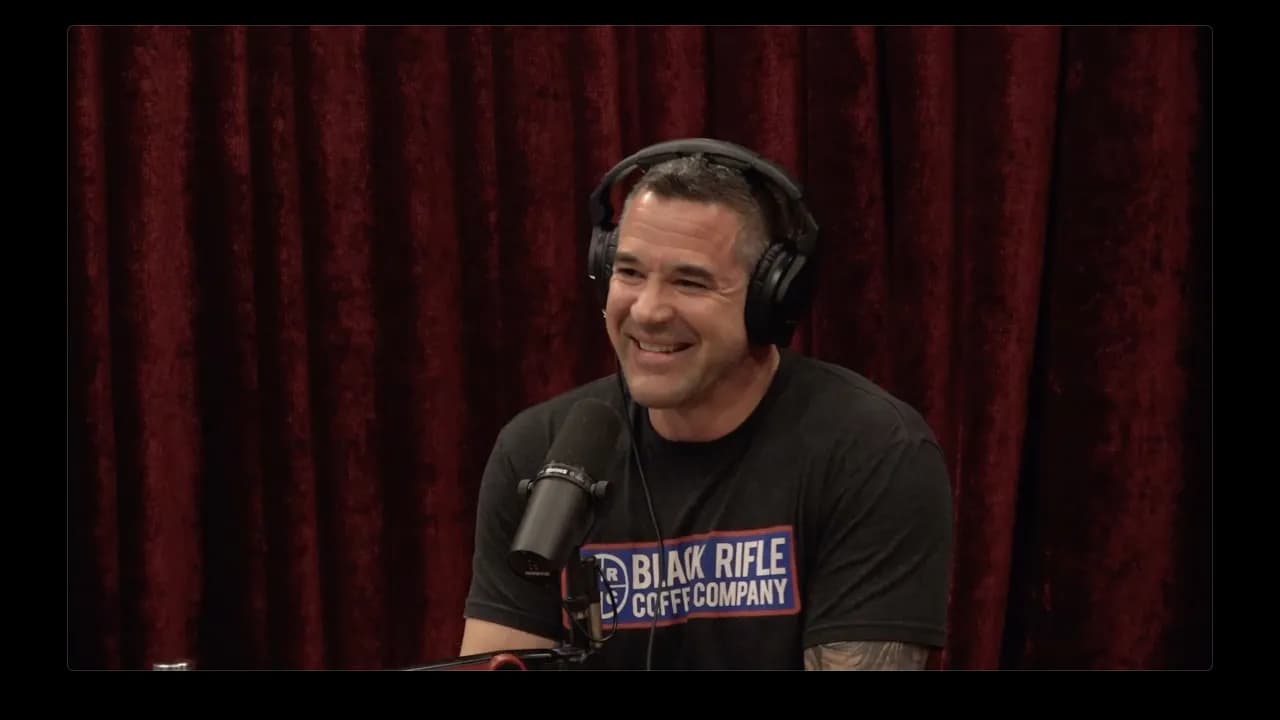
Joe Rogan Experience #2568 - Ross Edgley
In a Nutshell
Ross Edgley shares his extreme endurance swimming feats—including 60-hour swims in Loch Ness and 1,000 miles around Iceland—while detailing the physiological breakdowns like rhabdomyolysis with CK levels reaching 19,000 and hypothermia-induced hallucinations. The conversation explores how ancient warrior cultures practiced deliberate hardship for mental fortitude, from berserkers and Spartan training to Kalenjin circumcision rituals selecting for pain tolerance. Edgley emphasizes that his swims serve as conservation advocacy while demonstrating human potential, arguing that pushing personal limits shifts what people believe they're capable of achieving.
These notes were generated by AI and may contain inaccuracies.
Joe Rogan shares a story about being offered a whiskey endorsement deal. He initially considered partnering with Buffalo Trace but learned their whiskey requires eight years in barrels. After trying the proposed whiskey and finding it decent, he compared it to 18-year-old single malt scotch and realized he couldn't honestly endorse an inferior product. He ended the deal, stating he respects the sanctity of whiskey and that there's no substitute for time in barrels. The conversation highlights how Irish and Scottish distillers have perfected aging techniques, treating whiskey production almost like a religious practice.
Ross Edgley describes his 60-hour non-stop swim in Loch Ness for ocean conservation fundraising. At the 60-hour mark, he began hallucinating and experienced tunnel vision before blacking out completely. The incident resulted from hypothermia combined with cellulitis, a skin infection from his wetsuit that entered his bloodstream. He had also been awake for three days. His support team had to scoop him from the water. He remained unconscious for approximately 13 hours, experiencing intermittent consciousness during transport to the hospital. Upon waking, he found his mother and girlfriend at his hospital bed.
A year after the Loch Ness incident, Edgley attempted another charity swim in Lake Tresamino, Italy. Due to Italian bureaucracy, the swim was scheduled during a record heat wave with water temperatures reaching 36°C (96.8°F). This caused the opposite problem: heat stroke instead of hypothermia. He swam past fish that had been boiled alive in the extreme temperatures.
Edgley completed a 1,000-mile swim around Iceland. He developed rhabdomyolysis (muscle breakdown) during swims, with his creatine kinase levels reaching 19,000 compared to normal levels of approximately 80, a hard workout at 300, a marathon at 1,000, and an ultramarathon at 4,000-5,000. At 10,000, medical intervention is required. Despite being suspended in water without weight-bearing activity, the muscle breakdown was severe enough to require hospitalization, though his kidneys successfully filtered the enzymes.
During the hypothermia episode, Edgley experienced the paradoxical warming sensation where victims feel hot and want to remove clothing. His skin felt like it was on fire from cellulitis while his internal organs were shivering from cold.
Edgley discusses how various cultures practice extreme self-discipline for self-discovery. He references the marathon monks of Japan who run nearly a marathon daily for over a thousand days across seven years. He also mentions the Tarahumara people from Mexico who run barefoot or with homemade tire-rubber sandals.
Twenty years ago, Edgley spent a week with the Jamanawa tribe in the Amazon jungle for a documentary. As part of a manhood initiation ritual, he was required to bite the tongue from a killed snake. Following this, the tribe imposed a 24-hour vow of silence and instructed participants to climb trees where they were subjected to fire ant attacks without making sounds, under threat that breaking silence would cause the snake's spirit to haunt them.
The conversation references an incident in India involving a man who allowed a Russell's viper to bite his tongue during a ritual intended to stop nightmares. The venom caused severe complications including cardiovascular issues, hemostatic abnormalities, and potential renal failure. The man required immediate medical treatment.
Edgley lived with Aveni herders in Olanok, Siberia, who manage reindeer herds through a traditional semi-castration method using their teeth to make male reindeer more docile without full castration. When offered the opportunity to perform this procedure, he participated despite finding it unusual.
Rogan shares his experience with a veterinarian who questioned why his dog Johnny Cash retained his testicles. Rogan defended keeping the dog intact, arguing there's no health benefit to neutering a responsibly owned dog with proper containment. He contrasts this with another veterinarian who claimed neutering prevents cancer, which Rogan disputes as false, noting cancer in dogs likely stems from poor diet rather than reproductive organs.
Sharks have remarkable immune systems that prevent them from getting cancer. Their skeletal structure consists of cartilage rather than bone, making them evolutionarily distant from humans and other vertebrates. Great white sharks can reach massive sizes where females stop growing in length but continue to increase in girth, becoming essentially "submarines with teeth."
Ross Edgley swam with great white sharks off Tasmania, the genuine article rather than smaller species. Experienced divers explained that sharks possess ampullae of Lorenzini, sensory organs that detect electrical impulses from prey. This allows them to determine if a creature's heart is racing or if movements indicate vulnerability.
During the dive at 40 feet, the sharks immediately identified Edgley as the weakest swimmer among the group. They approached him specifically, prompting advice to stop breathing heavily and avoid appearing like prey. After a non-verbal interaction where Edgley maintained composure without panicking, the sharks assessed him as non-threatening and moved away.
Adam Greenree's friend was killed while spearfishing in Australia when a shark attacked him emerging from a reef crevice. Tiger sharks are ambush predators that attack surfers in Hawaii and have been documented ramming kayaks in the open ocean.
Tiger sharks behave differently from great whites. While great whites are curious and may investigate with a bite before realizing humans aren't prey, tiger sharks may attack from behind. Bull sharks are described as inherently aggressive and territorial, particularly in Central Florida waters where they pose significant risks to spearfishers.
Edgley completed the world's longest non-stop river swim: 510 kilometers over 60 hours down the Yukon River from Whitehorse to Dawson, Canada. After being thrown against rocks in the Five Finger Rapids, he sustained cuts that caused bleeding. Despite the injury, rules prohibited stopping or touching the support boat.
The blood attracted wildlife including black bears and brown bears. Black bears showed skittish behavior, while brown bears displayed predatory assessment, looking directly at the swimmer as potential prey despite the presence of a support boat with protection.
Statistical data shows black bear attacks are more likely to be predatory in nature. Brown bear attacks typically occur when the animal is surprised, defending itself, or protecting cubs. A 700-pound female grizzly with cubs represents the most dangerous scenario, as they will charge at full speed and cannot be escaped by running or climbing trees.
The term "berserker" derives from Old Norse meaning "bear shirt," referring to warriors who wore bear pelts. These ancient Nordic fighters embodied animal spirits in battle. The Ulfhednar were wolf warriors chosen by Odin who fought without armor, painted and biting their shields while howling.
The Berserker of Stamford Bridge in 1066 single-handedly held off English soldiers during the Norwegian invasion, eventually killed only when an enemy went under the bridge to stab him from below. Modern Icelandic athletes like Gunnar Nelson continue this warrior tradition.
Norse mythology emphasizes that fate is predetermined but individuals control their attitude toward it. Odin knew he would die at Ragnarok, being eaten by a giant wolf, yet proceeded into battle anyway. This cultural mindset explains why Icelandic warriors would fight regardless of odds.
The theory that berserkers used mushrooms before battle remains unproven, with no solid archaeological evidence. Amanita muscaria, the bright red mushroom with white spots, causes delirium and drowsiness rather than the aggression associated with berserkers. Effects vary significantly by region and genetics, similar to how peppers vary in potency.
During a blot ceremony blessing his Iceland swim, Edgley learned about Iceland's four guardians: a bull representing strength on the west coast, an eagle representing vision on the north coast, a dragon associated with waterfalls on the east coast, and a giant on the south coast. These figures originated from a sorcerer disguised as a whale sent to scout invasion routes.
Icelandic roads sometimes curve inexplicably around areas believed to be elf sacred land, with locals claiming machinery broke down when construction was attempted through these zones.
The discussion explored whether consciousness renders reality similar to how video game engines render only visible areas. In primitive societies without scientific explanations, mushrooms might allow access to entities that seem permanently present but normally inaccessible. This could explain belief in elves and other supernatural beings when combined with hyper-focused attention on nature.
An elderly Icelandic fisherman told Edgley that northern lights represent Valkyries, Odin's female warriors riding through the sky on shimmering shields and swords, deciding which fallen warriors reach Valhalla. At the swim's conclusion under northern lights, Edgley expressed gratitude to Odin for completing the journey.
Icelandic people believe in elves and hidden folk. News crews tried to film a specific rock and their cameras failed to record anything when pointed at it. In a survey, over 80% of respondents refused to deny the existence of elves, and 8% were certain they existed. Icelanders show respect for nature because their country can destroy them - earthquakes, wind, and boiling water from taps indicating lava beneath the surface.
Ross Edgley conducted an environmental DNA sampling expedition around Iceland's coast in partnership with the University of Iceland. His girlfriend became pregnant during the planning phase, creating a hard deadline to complete the swim. Hurricane Erin approached from the Atlantic with 100 miles remaining. A volcano at Grindavík released poisonous gas, and a glacier calved ice shards the size of tables that couldn't be seen at night. Edgley made it back three days before his son's birth.
Joe Rogan states that having children changed not only the amount of love he has but his capacity for love, referencing Dave Chappelle's quote from the Comedy Store parking lot. Fatherhood made Rogan stop viewing people as static entities. When meeting a difficult 40-year-old man, Rogan now sees him as someone's baby who experienced bad decisions, bad experiences, bad parenting, bad judgment, or bad luck. This perspective makes it difficult to see homeless people without empathy.
Edgley lost his father four years ago and became a father himself, with the Iceland swim existing between these events. He describes the swim as both a tribute to his father's teachings and a letter to his future son. Edgley acknowledges he was previously selfish and single-minded in his swimming, but fatherhood changed his biochemistry. The swim was documented in his new book.
Rogan respects athletes like Cameron Hanes who run 200-300 mile races to find their breaking point, describing it as a noble quest even if not smart. Edgley prefers training a couple hours every day rather than taking extended breaks, noting that time off makes him question his identity and capabilities. When resuming training after breaks, both experience the feeling of "Am I really going to put myself through this again?"
Edgley believes his dopamine system functions differently, responding to challenges like 24-hour swims with immediate commitment. He discussed the anterior midcingulate cortex with Andrew Huberman, describing it as weighing scales between grit or quit, pain and purpose. When pain outweighs purpose, the brain signals quitting; when purpose outweighs pain, continuation occurs.
Junior dos Santos was pulled from a fight due to elevated creatine kinase levels indicating rhabdomyolysis - muscle fiber breakdown from extreme training. Kane Velasquez possessed exceptional cardio, never throwing full power but maintaining 60-70% output with perfect technique, earning the nickname "Cardio Kane." Velasquez defeated dos Santos in their rematches after an initial loss when entering with a blown meniscus.
The Lawler-MacDonald fight is considered one of the most violent in UFC history. In the final round, both fighters stared each other down with blood pouring from their faces, Lawler's lip split open. Lawler screamed in the crowd with arms raised after victory. Rory MacDonald collapsed when his shattered nose pain overwhelmed his brain, causing his body to shut down.
Stress-induced analgesia occurs during extreme fights, involving pain suppression through norepinephrine. Lawler possesses exceptional genetics described as "caveman genes" or "warrior genes." In his fight against Melvin Manhoef, a high-level kickboxer from Mike's Gym in Amsterdam, Lawler absorbed devastating leg kicks before landing a knockout punch. Manhoef fought with a spike dog collar and exhibited hyper-aggressive style.
The Fighting Nerds team, led by Pablo, uses data analytics to study fight movements and incorporates animal movement patterns. Carlos Prates studies animals fighting to death online, focusing on space control. The mongoose versus cobra example demonstrates how the mongoose isn't faster but masters controlling space through feinting and drawing reactions to understand distance. All Fighting Nerds fighters, particularly Prates, press forward then slide away when opponents advance, maintaining constant pressure.
Samuel Johnson wrote "Become a beast to get rid of the pain of being a man." Edgley was inspired by sharks while swimming and berserkers with bears. The ventral striatum processes expectation, reward, and reality - when things go well, it confirms winning behavior, but when strategies fail, dopamine plummets creating a "dark biochemical cloud."
Edgley swam for four hours in what he believed was forward progress, only to discover he remained in the same spot due to countercurrents and whirlpools around Iceland's giant bay. The ventral striatum signals that behavior isn't working, requiring either anterior midcingulate cortex grit (discipline to continue despite pain) or dorsolateral prefrontal cortex strategy (reframing suffering or changing technique).
Jamie expressed confidence in his swimming ability but acknowledged uncertainty about handling whirlpools in 20-degree ocean conditions. Joe stated he would be dead within 15 minutes in such conditions. The conversation turned to Greg Simmons, who rescued a drowning woman caught in a riptide while on vacation with his family. Greg admitted he worried about not making it back. The discussion emphasized that drowning people are dangerous because they may hold onto rescuers and prevent them from reaching safety.
Ross described Iceland's south coast at Rainers Foda, considered one of the world's most dangerous beaches due to sneaker waves that appear suddenly. He witnessed tourists taking selfies dangerously close to waves and recalled a family incident where a little girl lost her life. After leaving the area, Ross and others saw helicopters and heard ambulances, confirming the worst had occurred. A WWE wrestler died in a similar rip tide incident on Venice Beach.
Ross explained that wind-over-tide conditions create overfalls where waves detonate rather than roll. During swims in these conditions, jellyfish get smashed on rocks, sending tentacles into swimmers' noses, ears, and respiratory systems. While Icelandic jellyfish are relatively mild, five or six stings can affect lymph nodes, causing itching under armpits and groin areas. Joe's daughter experienced severe jellyfish stings in Costa Rica requiring beachside treatment.
Joe discussed how people are drawn to the ocean's majesty and vastness, which puts human existence into perspective. He noted that beach towns tend to be more relaxed compared to places like downtown Manhattan because staring at the ocean forces people to confront their relative insignificance. The combination of ocean views and stars at night, including the Milky Way, reinforces this humbling perspective.
Ross contrasted Goggins' "man up, grit your teeth" approach with his own preference for swimming with gratitude. Joe acknowledged Goggins as unique and not someone to emulate, noting his internal drive is exceptional. Goggins trains daily without documentation, running 20 miles with a weight vest, then doing weights, chin-ups, and push-ups. At age 50, his intensity remains constant. Ross connected this to Carl Jung's concept of the shadow self and the Nietzsche quote about fighting monsters, emphasizing the challenge of containing one's inner drive.
Ross explained his muscular build differs from typical endurance athletes because he needs bulk for thermic heat generation and strength for arctic conditions. His strength training focuses on mechanotransduction, strengthening connective tissue, ligaments, and tendons rather than just muscle. The rotator cuff tendons must be "bulletproof" since swimming stops due to tears, not cardiovascular limits. He sacrifices speed for physical robustness.
Ross discussed Cam McEvoy, the 50-meter freestyle world record holder, who demonstrated a direct correlation between pull-up one-rep max and swim sprint speed. McEvoy performs pull-ups with 80-90 kilos and has rewritten swimming training methodology. Ross applies this concept of strength reserve to endurance swimming, where greater strength makes each stroke a smaller percentage of maximum capacity.
Ross referenced Eddie Hall, the first person to deadlift 500 kilos, who performed a CrossFit workout with 60 kilos in an unconventional manner due to his immense strength reserve. The demonstration showed Hall executing movements differently than trained CrossFitters who use proper technique, illustrating how exceptional strength changes movement patterns.
An MRI scan revealed Ross has an unusual proportion of fast oxidative glycolytic fibers, intermediate between slow-twitch endurance fibers and fast-twitch power fibers. These fibers produce significant force while resisting fatigue. Ross suggested a genetic predisposition existed alongside training adaptations, though determining the exact contribution of genetics versus training remains theoretical.
Joe discussed Marcelo Garcia, the "giant killer" grappler who specialized in neck attacks rather than arm bars because smaller fighters can defeat larger opponents through blood chokes. Garcia focused on high elbow guillotines and rear naked chokes, recognizing that opponents can endure broken arms but cannot resist unconsciousness from neck attacks.
Ross referenced stories from his father and grandfather about the heroic age of Antarctic exploration, contrasting Roald Amundsen's Norwegian efficiency with Robert Falcon Scott's British expedition. Amundsen learned from indigenous Arctic peoples, used dogs effectively, and planned to eat dogs on the return journey, while Scott's team suffered from inadequate preparation including ponies that fell through ice and mechanical sleds that broke down.
British explorer Robert Falcon Scott refused to use dogs for his Antarctic expedition, instead manhandling sleds across the ice. When Scott's team reached the South Pole, they discovered the Norwegian flag already planted there by Roald Amundsen's team. During their forced return journey, Lawrence Oates sustained a severe foot injury that slowed the entire team. Caught in a blizzard, Oates famously told his companions, "Gentlemen, I'm going for a short walk. I might be a while," before walking into the storm to his death in an attempt to give his team a chance at survival.
Ross Edgley's athletic challenges function as sporting spectacles that serve as a Trojan horse to deliver ocean conservation messages. The oceans face severe overfishing, with 90% of all big fish no longer present in the ocean. Historical tuna fishing operations that once caught thousands of fish now yield far smaller catches, yet this crisis receives little public attention. While some countries maintain fishing regulations, others ignore these rules entirely.
Somali piracy emerged from a chain of consequences beginning with foreign companies dumping toxic waste off Somalia's coast, which destroyed local fishing grounds. Somali fishermen, previously peaceful, first attempted to kidnap those responsible for the dumping and demand ransom for their economic losses. This practice evolved into broader piracy. Somali pirates began calling themselves the "People's Coast Guard of Somalia." A 2008 pirate spokesman described ransom demands as retaliation for toxic waste dumping that had occurred for nearly 20 years.
When the core economic activity of fishing was eliminated, Somali society entered desperation mode. The narcotic plant khat (a leaf chewed for its amphetamine-like effects) became prevalent, contributing to the breakdown of social order. The combination of economic devastation, drug use, and access to weapons through ransom money created conditions for widespread criminal activity.
Altitude training provides significant performance benefits for endurance activities. A hypoxia chamber (Exalt XP hypoxia trainer) allows training at simulated altitudes up to 20,000+ feet above sea level. Training protocols recommend two to three rigorous cardio sessions per week in the chamber, as exceeding this frequency prevents adequate recovery. Two months of consistent hypoxia training at 9,000+ feet simulation produced noticeable improvements in hemoglobin levels and endurance capacity during real-world activities at 5,000-9,000 feet elevation.
Dagestan averages 500 meters (1,500-1,600 feet) above sea level with mountain peaks reaching 14,000 feet. The Olympic Training Center in Colorado Springs sits above 5,000 feet. Khabib Nurmagomedov's training location reaches approximately 2,000 meters (6,500 feet) elevation. Denver, Colorado, sits at 5,280 feet. These high-altitude training locations provide natural advantages for cardiovascular development.
The Kalenjin ethnic group from Kenya produces a disproportionate number of world-class marathon runners. According to Kalenjin tradition shared during a documentary filming in Namibia, their exceptional running ability stems from a cultural practice involving circumcision rituals performed without anesthesia. Young men must remain completely still during the procedure while clay mud is applied to their faces. If the mud cracks due to flinching, they are considered undesirable within the tribe, affecting their marriage prospects and ability to pass on their genes. This practice, repeated across generations, selects for exceptional pain tolerance.
Czech runner Emil Zátopek remains the only athlete to win the 5,000-meter, 10,000-meter, and marathon events at a single Olympics (Helsinki 1952). After winning gold in both the 5,000m and 10,000m, Zátopek decided to enter the marathon despite having never run the distance competitively. He employed a strategy of running alongside the pre-race favorite (a British runner), asking if the pace was appropriate, then responding to the deliberately misleading answer by declaring he would see the competitor at the finish line before pulling away to victory.
Zátopek pioneered interval training by completing 100 repetitions of 400-meter sprints as part of his training regimen. His wife Dana Zátopková was an Olympic javelin champion, and their training sessions included Zátopek retrieving her javelins. When weather prevented outdoor running, Zátopek would run with his wife on his back through the woods or train indoors by treading on laundry in the bathtub. Despite his awkward running form that appeared painful, Zátopek's innovative methods produced unprecedented Olympic success.
Backyard ultras require competitors to continue running loops until only one person remains standing. The Last Soul Ultra saw Mark Dael win after completing 95 laps covering 636.5 kilometers over 94 hours without sleep. Dael employed psychological tactics, stalking competitors and waiting behind them during brief stops like shoelace tying, captured on night vision footage. The winner receives a trinket containing every competitor's soul as a symbolic prize. Dael's background in lacrosse and weight training provides biomechanical advantages that prevent breakdown during extreme endurance events, demonstrating the value of strength reserve for ultra-endurance athletes.
During the Loch Ness swim, hallucinations manifested as trees forming cruise ship silhouettes with waving branches appearing as supportive crowds. The swimmer thanked the hallucinated spectators at 2:00 AM before realizing they were thanking trees, with his girlfriend noting the disconnect from reality.
UFC fighters employ psychological warfare, with examples including Yuri warning opponents against shamanic rituals and voodoo. Conor McGregor disrupted Jose Aldo's mental state through public disrespect and stealing his belt at a press conference, though this approach failed against Khabib. Khabib responded to McGregor's psychological tactics by punching him during fights while demanding conversation, dismissing McGregor's claim that provocations were merely business.
Athletic success doesn't follow predictable patterns, as illustrated by contrasting archetypes: Khabib as a devout Muslim living in mountains versus Jon Jones using cocaine and engaging in destructive behavior. Both achieved GOAT status despite radically different lifestyles. Michael Jordan and Tiger Woods represent similar outliers who transcend conventional expectations.
Jon Jones refuses short-notice fights regardless of favorable matchups, demonstrating calculated risk assessment. Against Chael Sonnen, Jones declined the fight until properly prepared, then dominated in the first round despite a bad toe. Jones snapped his own toe during ground and pound against Sonnen due to excessive force while pushing off the canvas, requiring ongoing toe taping during fights. Against Vitor Belfort, Jones won via armbar despite Vitor being a Carlson Gracie black belt, then secured victory by kamura the following round after Belfort refused to tap to the hyperextended arm.
Gagei demonstrated exceptional durability until stopped by Max Holloway. Johnny Walker knocked out a 265-pound heavyweight with a knee from the tie clinch, proving certain strikes overcome durability regardless of size. Max Holloway's fight against Justin demonstrated extreme durability after suffering a broken nose from a jump spinning back kick in round one, yet completing all five rounds. Holloway complimented opponents' effective strikes, responding to a liver shot from Ilia Topuria by saying "nice liver shot" after returning to his corner.
Justin employs a signature collar tie uppercut that catches opponents due to his wrestling background, pulling fighters into the strike. His calm demeanor under pressure and ability to maintain composure while being hurt distinguish him from other fighters.
Special forces selection tests candidates' ability to lose repeatedly rather than win. One exercise involves redlining on an assault bike with heart rate exceeding 180, then attempting to pass a 6'6" opponent blocking a door. After failing and being knocked unconscious, candidates face repeated knockouts with clipboard signals, testing their response to failure. One candidate reached the door only to find it bolted shut, proving the exercise measures losing ability, not winning capability.
Water polo players excel in Navy SEAL BUD/S training due to constant treading without touching ground, combined with the sport's physical demands. The 1956 "Blood in the Water" match between Hungary and the Soviet Union occurred during actual wartime conflict, with Hungarian training conducted under gunfire. The water turned red from violence during the match, which Hungary won 4-0.
Playing for England schoolboys at age 13 against under-18 competition, an elbow to the face while coming over the top resulted in biting through the tongue. Despite the injury, the player sprinted back to defend before noticing blood filling the water. The tongue was sewn up and healed within a week. Underwater fights remain part of water polo, with cameras capturing the violence at Olympic level, including choking and striking opponents.
Ross Edgley developed comfort with discomfort during early rugby matches against Malta, learning stress inoculation training that has carried through to his current swimming career. When people comment about him swimming in Arctic storms, he responds that he still has his tongue and is not too fat.
Carlos Prates had a losing record early in his career with five wins and four losses in his first nine fights. He decided to go to Thailand where the only way to make money was to fight every week, resulting in six fights in a month. This constant fighting led to over a hundred Muay Thai fights total. The constant exposure made fighting relaxed and natural for him, resulting in him smiling and having fun during fights while smoking cigarettes the week of and day of fights.
Prates' approach exemplifies being "in the fire for so long you just get forged" through constant fighting. This connects to ancient Stoic philosophy, with Epictetus discussing "getting wintered" - that wars were fought in summer, but winter training had profound impact on preparation. Spartans were given a loin cloth and told to endure winter to fight for food, creating warriors through hardship.
Liam Harrison fights like he has rabies, described as a little demon. He is wired differently with ADHD traits, but studies show fighters with ADHD process things quicker. The key insight is that ADHD is viewed as a superpower rather than a disorder, giving ability to concentrate on loved activities to an extent most people cannot fathom.
ADHD is seen as a superpower that allows obsession with activities like playing pool for 10 hours without eating, just drinking coffee. Gordon Ryan trains 365 days a year, demonstrating both discipline and obsession. The argument is that school conditioning creates the perception of disorder when children cannot sit through boring activities, but this same focus applied to video games shows remarkable concentration abilities.
ADHD is considered entirely overdiagnosed, with many cases being people not wired for the standard norm of boring school structures. Children have the most energy after waking and eating breakfast, yet are forced to sit in chairs learning about topics like World War II when they want to play outside. The medication approach like Ritalin is questioned as inappropriate for what may simply be normal childhood energy levels.
Ross describes his dopamine working differently and uses supplements for focus during swimming: 400 milligrams of caffeine combined with Cognizin for acetylcholine interaction, creating dialed-in focus where every stroke is consciously executed with proper form. Alpha-GPC is also used but must be cycled according to Andrew Huberman's recommendations of two days on and three days off to prevent quick tolerance buildup.
Creatine supplementation was discovered to significantly affect mental focus, particularly for sleep-deprived individuals. Research shows 25-30 grams can severely mitigate negative aspects of sleep deprivation on cognitive function and memory. A study with 15 test subjects kept awake overnight showed positive effects on brain metabolism and cognitive performance within 3 hours, peaking at 4 hours and lasting up to 9 hours, particularly improving processing capacity and short-term memory.
High doses of creatine put heavy strain on kidneys and can cause health risks, making such large doses inadvisable for home use. The cognitive effects from large doses are temporary, lasting approximately 4 hours. Some people take 20 grams daily, though this raises questions about individual biological differences in tolerance.
At 41 years old, Ross is exploring nootropics and hypoxia training as the new frontier for marginal gains, believing hypoxia training raises capacity through changes in red blood cell count similar to EPO effects. He acknowledges being as fit as possible physically and now focuses on 1% improvements through various training modalities.
Sauna training should be daily, with both high altitude and high heat training available in environmental chambers. However, these should not be combined as they are counterproductive - high altitude naturally lowers heart rate while high heat immediately elevates it. Post-workout sauna sessions at 196 degrees for 20-25 minutes maintain heart rates at 147-148 beats per minute.
Heat training enables stretching positions impossible at normal temperatures, with tissue forced into position and held, significantly elevating heart rate into the 150s. This approach is particularly valuable for ultra-endurance athletes winning competitions between ages 35-50.
Ultra-endurance athletes winning at advanced ages demonstrate capillary density and mitochondrial efficiency gained only after years of training. While younger athletes have advantages in VO2 max, lactic threshold, and tendon elasticity (explaining sprint dominance), older athletes benefit from heat adaptation, hyperbaric therapy, and hypoxic chambers creating new generations of older competitors.
Alex Pereira at 39 and Yoel Romero at 49 represent outliers who move like cats despite advanced age. Romero's bare-knuckle fight with Darren Till was notably close, with many believing he won at age 49. Kipchoge's recent marathon win, along with Messi, Ronaldo, and LeBron James continuing elite performance, challenges conventional aging assumptions.
LeBron James spends millions annually on rehabilitation including massage and various therapies. He likely uses peptides like BPC-157 and TB-500, testosterone, and human growth hormone or secretagogues like Sermorelin to enhance tissue regeneration and healing, given NBA rules prohibit synthetic growth hormone releasing peptides and secretagogues.
BPC-157 was allowed then banned in the NBA, classified as an unapproved substance under WADA's prohibited list. Despite zero studies showing negative effects and anecdotal evidence of benefits for injury recovery, it's banned. Athletes in combat sports constantly deal with injuries from training with skilled opponents, making recovery aids essential for reaching competition.
Hyperbaric therapy accelerates healing from injuries and general recovery. Ross used stem cells, hyperbaric therapy, and red light therapy after tearing most tendons in his rotator cuff during the Yukon swim, avoiding surgery that doctors indicated would otherwise be necessary. The conflict between pharmaceutical companies wanting to patent peptides for profit versus those opposing therapies due to lost orthopedic surgery revenue creates barriers to widespread adoption of beneficial treatments.
There's not just that, they're helping people with neurological conditions. They're helping people recover from Parkinson syndrome or Parkinson symptoms. They're doing them intranasally for people that have lung disorders. There's a lot of really good work that's being done with stem cells. Does it mean they all are the same and they all work great? No. There's shady places. This is also part of the problem. If you're traveling to some god-forsaken part of the world to go do this therapy because it's not legal in America, you got to be real careful where you're going. There's some places like the CPI, which is in Tijuana, that's very ethical and they do everything really great. But there's other places where people get infected, they have horrible disease, they get staph infections and they wind up almost paralyzed. A lot of messed up things can happen when you're doing this stuff if you don't go to a good place. But the bottom line is though that's a problem with all medical interventions. That's a problem with surgery. It's one of the main killers in this country. The number three killer in this country is medical mishaps, either misdiagnosis or bad treatment or some sort of a mistake that someone makes. It's a problem. Human beings are very vulnerable. So it's not a cure all, but it is a very promising therapy. For people that have had incredible results, and I'm one of them, from stem cells, screaming from the rooftops like, "Hey, let's not just throw the baby out with the bath water with this stuff. This should be, we could help a lot of folks who have a lot of real serious problems with this."
That's what they said. They were like Ross, this would have been a death sentence for your career. You'd have swam around Great Britain. You've just done the Yukon. You're good. You're done. Whereas it's amazing now I've seen it that it's just managed to extend my career just a little bit more. And just also for people that aren't professional athletes, just extend your health. So many people that have had these injuries. A good friend of mine had a knee problem and he's not an athlete he's just a guy who runs and his knee was in pain all the time. Brought him into a place where he got a shot in his knee. This was 2 years ago and he's like I run all the time it never bothers me now. That's nuts man that didn't exist before. This is just the beginning. We're at the beginning of this stuff. They keep coming out with new innovations and new therapies that are even more effective. Muse stem cells being one of the greatest ones that's more recent. They need more studies, more stuff, more work. This is going to help a lot of people. We have to be really careful as to what influence we're receiving as to why this is a bad thing. This is a real problem in this country in particular because this country is so ate up with money. Money influences so many narratives in this country. It distorts reality. You're looking at everything through a funhouse mirror lens. It's hard to tell what's what. What's good for you, what's bad for you, what should be recommended, what should never be taken.
My hospital visit on that note was so bad at the end. The rotator cuffs was also like the. How bad was the food? It was pretty good actually. It was in Canada in the UK. It was pretty good. Pancakes, meat, moose meat and pancakes. Genuinely did. They gave you moose. And jerky as well. It was so good. That's incredible. Yeah, it was amazing. America, you'd get Froot Loops. Froot Loops to recover. It was amazing.
During the Yukon swim, I had a specially made wet suit. Because I can't touch the boat, no one can touch me, I can't touch land. Going to the toilet was obviously problematic. You'd have like one of them hatches out the back. We had a poo flap made like just this zip. A poo flap mate. So we had a poo flap made on the suit. It worked in training. We then took it on the swim. To this day, I think we were honestly about 6 hours into what was a 60-hour swim. 6 hours in. I didn't even think about pooping. You don't know, do you? That's what the whole expedition will come unstuck because of that. We're 6 hours in. To this day I still don't know if the poo flap was in the wrong place or my bum hole is in the wrong place. But I end up going to the toilet and it doesn't work. Like what was meant to clear the wet suit doesn't clear the wet suit. So it's filling your suit up with poop. Exactly that. I'm then faced with a decision and this goes back to what we were talking about your anterior mid singular cortex. In that moment, pain versus purpose, grit or quit. I'm like Ross. If you quit, you are going to be known as the guy who soiled himself and gave up in the Yukon. Or do you zip it up and just keep going? So, I zipped it up. I kept going. Oh, you're swimming in your own poop. But it was even worse. It was a black wet suit as well. So, it was essentially just baking, you know, like a slow cooker. So none of it got out. All of it was in there. I would say 90% remained in. Could you reach in and grab it as you're swimming? No. No. There was no reaching. I'm so sorry, Jamie. I'm so sorry. So anyway, yeah, at the end of the swim when they're taking me to hospital, I turn to everybody and I just go, you know, guys, and again, the people in Canada, the team that we had are amazing. They're from the Yukon, they kill bears, they gut wolves, they've seen everything. And they were like, Ross, don't you worry. And I said, no, guys, I'm going to apologize now. I've soiled myself in my wet suit and it's been baking for what has been 55 hours. They cut me out of my wet suit. They cut me out. And they go, Ross, don't worry. We're here. We're a brotherhood. We've been. They did. They did. They went. We're here. Oh god. And they bolt. So I'm left there with a flannel just covering myself. Oh, and you just baked poo all over. Yeah. So like I said, when they said, "How did you not realize you'd torn your tendons in rotation?" I was like, "Because I soiled myself because bears and wolves were after me."
That is a very reasonable explanation for why you didn't notice that you were in pain. It doesn't matter in any way, shape, or form. 100%. All kinds of stuff. Probably sepsis. Who knows what that does to you? That's got to be terrible. You're scratching yourself and then there's poop over your butt. Oh, the inside of your legs. Would you have carried on? Lord, I don't know. I hope so. I hope I'd be as strong as you. No one knows until you do it, right? Well, I think that's one of the things that the kind of events that you participate in really genuinely does. It changes people's expectations of what's physically and humanly possible. And they all have to look at themselves and say, "Okay, maybe I can do more than I think I can." And I think even though these are extremes and I think most people are not going to swim for 60 hours, what they're going to get out of that is this understanding that you're capable of so much more than you think you are and just raising of expectations or at least raising of the limits of the possible. And I think that alone is like a great benefit to people. I'm so glad you said that. That's exactly what I say when I say I don't recommend my lifestyle to anyone. You know, it's a terrible lifestyle choice. It's terrible. It's terrible. But I say that that's not my purpose. I don't think I think my purpose is people to get them to shift their barometer, their own personal barometer, just one degree of what they think they're capable of. Yes. And if that's what I managed to do, then you know, I will continue to soil myself in my wet suit. I think you have done that. I think you have done that. So, congratulations and continue on, sir. Thank you very much, brother. It's very good to see you. Awesome. Thank you so much. Thank you. Always good to see you. You're a freak. You were one of a kind, man. I appreciate you very much. That was awesome, by the way. Oh, you like. It was good. Well, thank you, man. You brought it. Yeah, but you crushed far more than me. I was trying. We're having fun. Thank you. It was fun. Thanks. Very fun. Bye, everybody.
Keep PowerfulJRE in your library
Save the videos and channels worth coming back to, and find them again in one place.