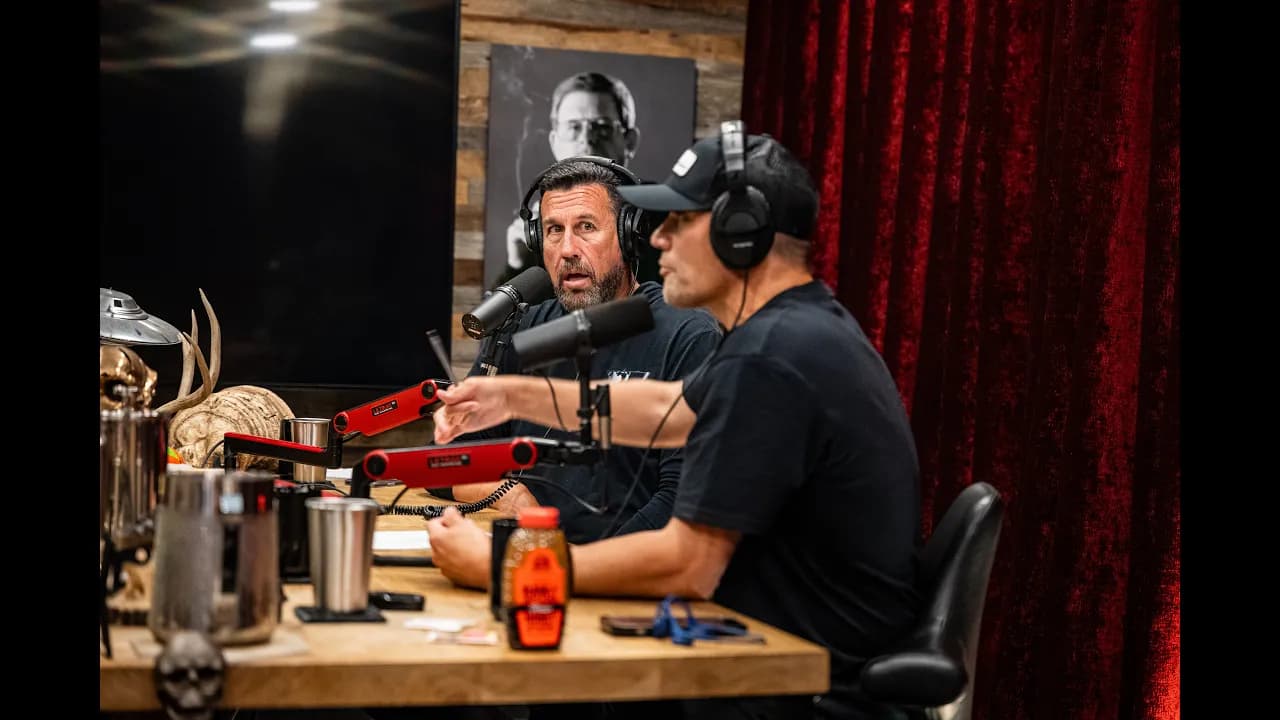
JRE MMA Show #181 with Justin Gaethje & Trevor Wittman
In a Nutshell
Justin Gaethje defeated Ilia Topuria at the White House to win the title as a 6-1 underdog after absorbing heavy body damage in round two that caused Ilia to blow his tank trying to finish. The win stemmed from Gaethje's experience in wars, refusal to set expectations, and willingness to adjust plans, contrasted with Ilia's rigid belief the fight would end early. Key themes include the power of brutal self-honesty, mental resilience built through wrestling and hard training, and Gaethje's evolution from seeking excitement to prioritizing championship longevity.
These notes were generated by AI and may contain inaccuracies.
Joe Rogan opens the conversation congratulating Justin Gaethje on winning the title in what he describes as one of the most epic accomplishments in combat sports history. The fight took place in front of the White House against Ilia, a fighter considered at least number two pound-for-pound alongside Islam, with some betting odds listing Gaethje as a six-to-one underdog.
Gaethje explains that winning the title doesn't feel real yet. He expected an internal sense of relief from no longer having something to chase, but instead finds himself thinking about it more as days pass. His father asked what it felt like waking up as champion, prompting Gaethje to reflect while sitting down that he is the champion and it's crazy. He describes being dropped off in Colorado 19 years ago by his dad to wrestle, knowing nobody, and seeing where he's at now as absolutely incredible.
Gaethje acknowledges making mistakes and doing things the wrong way throughout his career but always corrected course and got back on track. He credits coaches, mentors, and especially the team around him as huge reasons for staying on track and trusting that he belongs at the top of the league.
Rogan highlights the unique relationship between Gaethje and his coach Trevor Wittman, particularly Wittman's ability to know when to pull back, ramp up, or push. Having this awareness based on seeing Gaethje perform many times creates a giant advantage. Wittman explains that while he considers his fighters friends, he puts himself more in a father position, needing to tell them the truth even when it's hard. He's had to let fighters go when they weren't aligned, telling them to go live life and that he'll still love them when they return. His job is to be an adviser and mentor to help them reach their goals.
In the beginning, Gaethje's goal was to be the most violent guy out there, the most remembered, the guy that every time someone bought a ticket they remembered him selling the show. The goal later turned to winning the belt, which was difficult after two failed attempts. Wittman emphasizes that life involves getting up and chasing goals even when plans don't work out. The plans never work—you always have to adjust them—but the dream and vision get you to the top of the stairs one step at a time.
Wittman discusses the mental game, using an ice cream aisle analogy: people who know exactly what they want, like mint chocolate chip, go in and get it done, similar to Ilia's last three fights where he demanded what he wanted. However, when you get the stale, nasty, rotten version of what you expected, it throws you off. Wittman describes his role as guiding Gaethje, pulling him back when needed, and eliminating distractions. Their relationship is strong because Gaethje trusts that Wittman cares about him and loves his family.
Gaethje explains he doesn't have expectations when fighting so he doesn't get thrown off. His expectations come from his hard work—he expects his body to perform. He loves showing off and performing in front of thousands of people, and he's very competitive and wants to win. Gaethje has never had a coach pull him aside to talk about the mental aspect of competition because it's always been natural to him. He's comfortable with competition as a game, and he's very competitive and petty, taking everything personally.
Gaethje explains that when he goes into fights with expectations, it creates problems. Before this fight, he told Ilia many true things, which was an asset because it pushed Ilia farther away from the truth. If expectations aren't met in round two or three, there's nowhere to go mentally. Ilia wanted to prove himself right and was unwilling to be open to opinions. Gaethje got to where he is because he's coachable and listens. He posted that every person, place, or thing that's happened to him has molded his mind and body to deal with the situation on Sunday night. He constantly tries to learn and be better.
Gaethje says when he wanted to be the most exciting fighter ever, it wasn't just a thought—it was cool to him, but he was just being himself. He's been blessed with unwavering support from family, friends, coaches, teachers, and everyone from his small town.
Rogan identifies that Gaethje has been in many wars—down and dirty brawls—making him comfortable with back-and-forth exchanges and enduring. He knows he won't break if his body holds up. Ilia had only experienced rough moments against Jai Herbert and some problems from Ysef Zalo, but nothing serious. Gaethje had never experienced that level of war before.
Gaethje believes Ilia hurting him to the body was one of the main reasons he won. When Ilia hit him and Gaethje dropped, it wasn't the first body shot—probably the fourth or fifth. Ilia had landed clean shots and sensed Gaethje was hurt, which made him dump everything because it was his last chance to take Gaethje out. Gaethje went down, and Ilia had way more submissions than knockouts. Given the negativity around Gaethje's grappling and Ilia's belief he could finish on the ground, especially after the Khabib and Charles Oliveira fights, it made sense strategically. However, Gaethje would have stood back up and charged forward, and Gaethje would have pulled guard or front-rolled into grappling situations.
Gaethje believes getting hit made Ilia completely blow his tank trying to finish. Gaethje beat Ilia's ass in the first round and took it, and the damage inflicted set up the rest of the fight.
Wittman agrees it was a mistake for Ilia to demand finishing in the first two rounds. When damage accumulates, fighters must know they're going five rounds. Ilia should have stepped back, done damage, and recognized he had five rounds rather than unloading everything. Wittman emphasizes that getting someone tired leads to bad decisions that can be capitalized on. Gaethje stayed composed despite being speared to the body. A liver shot feels different than a head shot—it's like dying, whereas a head shot is like taking a shot with friends at the bar.
Gaethje made good decisions on the ground: from the triangle, from the armbar, from not being flat. Wittman believes the mindset of expecting a war is crucial. The biggest mistakes come from allowing fighters to think the fight will be easy, then it becomes hard. If you expect a war and it wasn't as bad as expected, that helps in the moment.
Wittman states that fighting is mentality. Techniques exist, but what makes the sport inspirational—making someone want to go out and beat cancer because they were inspired by a fighter—isn't the technical piece. It's getting back up. Wittman loves watching people get knocked down because his favorite part is seeing how they get up. The big story of the second round was that Gaethje figured out a way to get through it.
The change in tempo in the third round was obvious because Ilia used so much energy trying to finish Gaethje. Chael Sonnen once said that if you try to win by knockout and fail, you won't win by submission. Wittman explains that sprinting hard on the bag for two minutes leaves you tired after one minute. Gaethje does 20, 30, 40 second sprints at most in preparation. Ilia's two-minute sprint was full out, full power, every punch. You can't train for that—you have to have spots. Ilia was just unloading.
Ilia is a young man with tremendous confidence as a two-division world champion who thinks he's going to go down as the greatest of all time. He might still—he's 28, and the odds are great against that because of this loss. Gaethje hopes Ilia does become champion again and knows he has the skill. However, similar to Tony Ferguson, Gaethje didn't break Ferguson's confidence—he changed the perception of his opponents. Before this fight, Ilia was a guy you couldn't get through, couldn't push through, couldn't survive with. Once Gaethje showed people that all you have to do is get through that, nobody will go in thinking he's unbeatable. That was his identity, and it's going to be a tough task for him to fight people who aren't scared of him.
Rogan compares this to Mike Tyson and Anderson Silva in their primes, where the fight was lost before they even got in there.
Reports indicate Ilia has two fractured orbitals and a broken nose. Anytime you have eye injuries, long-term consequences vary. Wittman notes the body is resilient—broken bones make stronger bones. However, the orbital bone is a weak area where the sinus cavity is. Wittman had his orbital broken, and for six months his tooth would move when he pushed his cheek because it's right where the sinus cavity is. Gaethje broke both orbitals and the nose.
Gaethje has had three broken noses and had it fixed twice. Morab's nose X-ray looks like a spine because it's been broken so many times—it took out the whole left side and looks like it was hit with a sledgehammer. To fix it, there would need to be no contact for a year, so Ilia probably won't fix it and will just deal with it. Gaethje had his eyes and nose fixed before the Max fight, and being able to breathe was huge for quality of life. When your nose is broken, getting a haircut sucks because you can't breathe through your nose, you're constantly breathing in hair, and you choke. Every time you eat food, something's missing. Sleep is affected—Gaethje wore a nose strip to bed for 10 years and used to have a permanent scab from peeling it off.
Gaethje explains that when fighting Max Holloway, he was pressing in the first round but got caught with a jump spinning back kick to the face at the end of the round, which was dead on and perfect. Psychologically, Gaethje was not prepared mentally for that fight. It was a different circumstance—a guy not in his weight class, someone he'd never thought about fighting, and it was for fun. The whole experience was different from being mentally prepared for a fight.
Wittman explains they told Gaethje to take the fight even though he didn't want to, assuring him he'd keep the title contention fight because that's what was promised. Rogan notes that everyone could tell something was different. Gaethje told Wittman after the fight that he just didn't respect Max. Wittman takes 100% responsibility because that's how they learn—everybody makes mistakes. He remembers the Tony Ferguson fight where he didn't give any water. When Gaethje told him he didn't respect Max, Wittman wondered how he didn't catch that. Gaethje said Max was a smaller
Gaethje described being unable to find anything to worry about before facing Max Holloway, noting that Holloway was someone he looked up to and considered highly talented. He kept trying to convince himself he needed to identify something to be concerned about but couldn't find it. The discussion emphasized that fighters always need some level of concern before a fight regardless of the opponent.
Gaethje explained he had never been as present during a fight as he was against Holloway. He described being fully aware of the arena lights, the people, and hearing the crowd in a way he had never experienced before. This heightened awareness was attributed to not being scared and not being in a true fight-or-flight situation. As a result, he could hear his own thoughts during the fight, which was unusual because he is typically intuitive and reactionary without internal dialogue.
Gaethje stated he could not have beaten Holloway with the mentality he had that night, calling it his final lesson to learn. He reflected on previous mistakes including wanting to perform and impress fans too intensely before the Charles Oliveira fight. He mentioned Rose's poor performance that same night and how he told his coach he wouldn't let him down in the same way, but acknowledged allowing external factors to affect his fighting decisions rather than staying true to himself.
Gaethje identified winning two or three fights in a row as leading to complacency about the seriousness and danger of the sport, including the role of luck and chance. He admitted not doing extra work like sitting in the sauna at home. After losing to Eddie Alvarez and Dustin Poirier, he won three or four in a row and reverted to believing he was the best in the world and unbeatable, which led to another loss. These two major mindset mistakes were significant learning experiences.
Gaethje described making the Charles Oliveira fight feel larger than it was, emphasizing that a fight is just 25 minutes and the only thing he could control was perfect preparation. He stated he would not change anything about his career and believes the way he conducted himself throughout, including threatening retirement if he didn't get a title shot and calling his shots, demonstrates discipline second to none.
Gaethje shared that he has watched MMA since 1992 when his father first showed it to him as a four-year-old in his bedroom. He was immediately enthralled and became a diehard fan, particularly after the sport's growth in 2001 when he was in sixth or seventh grade. He and a friend would spend six to eight hours at Buffalo Wild Wings watching fights during college.
Joe Rogan recalled being excited for Gaethje's UFC debut against Michael Johnson, expecting a wild fight based on his World Series of Fighting performances. The fight delivered on that expectation. Rogan specifically mentioned giggling at moments where Gaethje backed against the cage, looked for shots, blocked, and countered with right hooks multiple times. Gaethje noted he wasn't nervous because that was how Johnson fought and he knew no one would forget the fight.
The group discussed Michael Johnson's fast and powerful left hand, noting it was the same hand that knocked out Dustin Poirier. Gaethje and the coaches emphasized that Johnson was trying to win and gave everything in that fight, emptying the tank in a fantastic three-round battle.
Rogan mentioned being scared for Gaethje's knees when he performed backflips after winning the title. Gaethje confirmed he was 100% fine. During training camp for Khabib at high altitude, Gaethje was doing backflips off the cage until Wittman told him to stop and save it for after the fight. Gaethje responded by saying it was the day he would become a bitch and do what he was told.
Gaethje stated his ferocious mentality has always been inherent rather than something he had to consciously work on. He believes people complicate things too much and emphasized that individuals can only control what's inside them—how they perceive things, react to things, and the work they put in. He mentioned he was probably a drug addict at one point in his life, having tried all drugs, though he was never an alcoholic. He attended school for human services with the goal of helping people come off drugs, partly to understand what others were chasing.
Gaethje explained that where he grew up near the Mexican border, high-quality drugs came across before being cut. His hometown was boring, and he chased chaos to feel something. In college, he reasoned that if he wanted to help people come off drugs, he needed to understand what they were chasing. However, he always knew something bigger and better awaited him and never used drugs as a crutch.
Gaethje credited his parents for making him attend church every Sunday, which helped him develop a relationship with God through Jesus Christ. This faith gave him the sense that he couldn't take the easy way out. He noted that living a lifestyle with no expectations or pressure is an easy way to live, but his passion to live, rooted in his faith, always outweighed the desire to feel good.
Gaethje described the shift from wanting to be the most exciting fighter to wanting the belt. After fights against Dustin Poirier and Eddie Alvarez, where opponents withstood his ferocity for multiple rounds and he got caught with shots that ended the fights, he realized he had to stop taking those shots. He previously never cared about getting hit because nothing hurt during fights, but the mindset change was simply not allowing opponents to put him in a position where the fight had to be stopped.
Trevor Wittman explained that after the back-to-back losses to Alvarez and Poirier, Gaethje recognized he was winning fights but needed to go the distance. Wittman pushed him to become a "spot fighter" rather than drowning people and making mistakes. After a three-fight win streak against Vic, Barbosa, and Cowboy Cerrone, Wittman sat down with Gaethje and asked if he wanted to be champion, explaining that being smart was required to achieve that goal.
Gaethje noted he never said he didn't want to be the most exciting fighter, and after fights he would tell Wittman he wasn't even trying to fight exciting but still did. Wittman described needing to help Gaethje sprint 50 yards, pull back for 100 yards, jog, then sprint again while knowing his red line and not crossing it.
Gaethje discussed how he appears to be getting hit more than he actually is because he rolls with punches and moves with them like water, making intuitive calculations. He noted that amateur boxing scoring considers any touch as a landed shot even without clean impact. Rogan emphasized that Gaethje's damaging blows and the way he drives through people with his hips create different effects than what judges see on screen.
Wittman mentioned that Gaethje was tested and found to have the hardest bones in the UFC. He described kicking pads held by Luke and causing swelling, and joked about getting blue balls from the nerve impact when holding pads for Gaethje's kicks.
Rogan highlighted Gaethje's early career habit of throwing leg kicks from a collar tie clinch, noting how unusual and effective it was. Wittman explained that Gaethje pulls opponents to their lead leg, creating a base on that knee and then whipping the kick with flexible hips rather than just throwing the leg out.
Gaethje described Luke as one of his really good friends who used to corner him before Wittman and would travel to Arizona with him when he had no coaches. Luke pukes every time before a fight. After Gaethje won the title, Luke was so happy he hugged Joe Rogan extremely hard.
Gaethje shared a story from the week of the Cowboy fight where the team went golfing on Sunday, which is normally a rest day. Luke and Ben got heavily intoxicated on Bloody Marys and beers. Wittman suggested telling them they would work out later to mess with them. He texted that Luke would do three rounds of full sparring and Ben would grapple for 40 minutes straight with no breaks.
On the drive home, Ben claimed he would take Gaethje down as many times as he wanted. They ended up rolling for 20 minutes instead of 40, with Gaethje securing seven submissions on his coach. Ben and Luke stayed drinking and talking about how they were going to beat Gaethje up, with a video capturing their plans. When it came time to spar, Gaethje beat both of them, with Luke punching Ben to get him to help.
Gaethje described the entire week of training camp in Arizona as one of his favorite experiences. The team is extremely dialed in and has fun together.
Gaethje mentioned using the sauna between workouts. The discussion shifted to the challenges of fighting in humid, 70-degree weather in Abu Dhabi, where Gaethje lost significant fluid weight and felt exhausted after the first round despite the cool breeze. He noted the difficulty of defending a world title in an alien environment and referenced previous outdoor fights including the 2009 Abu Dhabi event, Bodog fights on the beach, and Caesar's Palace boxing events.
The team trained specifically for heat stroke conditions by putting water on the rocks in the sauna and training in a hotter gym with the temperature turned up. They would spike Gaethje's heart rate, then have him go in the sauna for 15 minutes, come out, and do eight to 10 rounds. Gaethje noted the environment at the fight was completely different from a controlled setting, which is ultimately the best way to fight.
They did a rehearsal walkthrough before the event. Gaethje initially questioned why they needed to rehearse, comparing it to a wedding, but the rehearsal proved valuable. They got stuck in the locker room for an hour to an hour and a half due to rain, which created unexpected circumstances. Gaethje is a visualizer who couldn't visualize the arena, and he felt the same uncertainty when the storm hit.
The storm was bright red on radar, indicating thunderstorms rather than regular rain. There was discussion about pushing the fight until 10:30 p.m., though they had planned to fight at 2:00 a.m. Gaethje started staying up until 3:00 a.m. after the rehearsal to prepare for a potential late fight time.
The walkout involved walking through soldiers, which was a unique experience. Wittman was nervous from a coach's standpoint because there was no pattern to follow and no way to prepare mentally for the scenario. The pressure of fighting at the White House as six-to-one underdogs weighed on them.
Gaethje described being blown away by the experience and unable to smile at first due to the intensity. Being repeatedly reminded they were six-to-one underdogs affected them. Wittman noted the scenario was so unique that once it was over, he could finally enjoy the White House environment.
Gaethje observed someone reading the Declaration of Independence. They went through a rehearsal where they saw the Oval Office. Gaethje's first impression was that the Oval Office is smaller than it appears in pictures. He noticed the gold pieces on the wall and commented that they must be dusted every day.
Trump added gold throughout the space, including a solid gold cherub above one of the doors. He joked that if Putin comes, hopefully it doesn't fall on his head. Trump explained there was no gold originally and that he wanted gold everywhere. He redesigned multiple elements because he is a builder who likes everything in gold.
The fight was described as more historic than Rumble in the Jungle due to the setting at the White House and the American fighter being a six-to-one underdog who pulled off the win. The back-and-forth nature of the fight made it especially compelling, with the second round being particularly concerning.
All coaches in Gaethje's corner thought the fight might be stopped in the second round. Gaethje said out loud that he wanted it to continue for a definitive ending. Mark Goddard let the fight go on, which allowed the epic fourth round to happen. Wittman credited Goddard for his experience and willingness to let the fighters continue.
Gaethje believes his opponent wanted the fight stopped and was counting on the referee to end it. The opponent had already stated he couldn't see and didn't need to say it again. Gaethje stopped his opponent twice that night.
The fourth round featured Gaethje landing a heavy knee to the body, followed by elbows that caused the opponent to quit on the stool. If Goddard had stopped the fight earlier as the doctors desired, the dramatic conclusion would not have happened.
Gaethje compared his mental state during the walkout to golfing, where specific swing thoughts dominate and nothing else can creep in. During the walkout, he was focused on resetting his feet, controlling movement, moving left, and not getting against the fence rather than appreciating the historic surroundings or theatrics.
There was something special about Gaethje warming up with the American flag around his shoulder while shadowboxing. The joy throughout the building after the fight was palpable, and the energy from the crowd outside was felt even though Gaethje couldn't see them.
There were 4,000 people inside but it felt like 100,000 due to the energy. Outside, there were 85,000 plus people watching on giant screens. The weigh-ins were compared to Woodstock, with Gaethje unable to see the end of the crowd.
The UFC production team executed the event exceptionally well. Gaethje's performance was the perfect cap to the event. His opponent demonstrated elite boxing skills that led many to consider him the number one pound-for-pound fighter in the world.
Gaethje's game plan was to move left the entire time despite appearing to lean right due to his heavy head movement. The opponent is powerful when fighters move right, but moving left forces him to gather, reset, and then attack, which is slower. Gaethje constantly readjusted his positioning with subtle movements.
Gaethje's athletic ability, described as herky-jerky, twitchy, explosive, and athletic, surprises every opponent. Wittman shared examples including Gaethje doing a bicycle kick with a soccer ball that knocked over his phone setup, and snowboarding where he caught an edge, bounced off a mogul, and landed a backflip. People on the side thought he meant to do it.
The strategy involved stepping to the opponent's center and getting on his back foot line or outside of it. The jab was thrown from outside the shoulder rather than inside, pushing the opponent onto his rear foot. Gaethje's left foot had to be outside the opponent's rear foot when throwing the right hand, which was a giant moment in the fight when landed.
Gaethje was instructed not to go backwards to the left because the opponent is most dangerous there. The opponent throws and then readjusts his lead shoulder, creating a dangerous angle. Being front-heavy, the opponent attacks quickly from that position.
Wittman suggested the opponent should not have had celebration dinners the night before fights. While people love that kind of confidence, the lack of experience being the nail versus so much experience being the hammer played a role. The opponent never thought he would have to be in that position.
Gaethje believes people don't think he's athletic because he doesn't look like one, citing a college experience where someone was shocked he could do a cartwheel to a backflip. Joe Rogan and Wittman pushed back, stating everyone knows he's athletic and that his fighting shows it clearly.
After the Patty fight, some experts said Gaethje looked sloppy and older. Wittman explained those fights are supposed to be chaotic and that Gaethje was pressing and showing disdain for Patty's ability to hurt him. Gaethje didn't respect Patty's power and was walking through.
The Max fight drove Gaethje to never let his parents see him like that again. He got knocked out and doesn't remember anything, including his opponent getting his hand raised. His first recollection was being in the ambulance seeing his mom's face.
In the ambulance, Gaethje kept asking if he got knocked out, forgetting each time. When told it happened in the last second of the fight, he responded "good for him" every time. This reaction impressed Wittman as showing true character, acknowledging that the better man won that night without ego.
Gaethje's character allows him to reach his full potential because he is not held back by ego. Wittman noted that many talented people never reach their full potential due to ego problems and caring about what others think. Losing in the last second of the last round in front of the whole world was the truest test of character.
Gaethje's first memory after the knockout was seeing his mom's face with no concern, only worry. She wasn't freaked out, which allowed him to move forward without repeatedly asking if he got knocked out again.
Winning fights brings pride and gratitude for the position, but some of the proudest moments come from seeing fighters display heart and resilience even in defeat. When Cameran got kicked, Wittman stood next to him smiling because he went out on his shield and looked good doing it. The way fighters stand back up after adversity matters deeply.
Justin witnessed one of his proudest moments with Sales against Tim Means. After Means hit him with a knee, Sales fought through it, took another knee, went down, and while on the ground his right leg kept moving as he continued punching even though he was out. This demonstrated subconscious fighting spirit rather than shelling up after getting rocked.
After stopping fighters, Wittman always goes to the opponent first before his own fighter. He finds it difficult to wait to get in the octagon to check on them and put ice on them. Being able to see someone give their best and then watch them come back is the coolest part.
Wittman is excited to see what happens with Ilia after his loss. It will be a hard one to overcome, but if he takes the right lessons it could be super inspirational. Ilia is talented and Wittman hopes he overcomes it. He wonders if Ilia will stay at 155 given the big guys there, noting Ilia wasn't that big for 145.
Gaethje focused on getting bigger over his last three or four fights. He weighed 183 pounds for the Patty fight. He touched 180s this fight. On Saturday at 11am weigh-in, he went to bed at 184 and woke up at 176, showing how much weight fighters float. The bodies are crazy especially with weight cutting.
Gaethje was pissing so much after the fight he was too hydrated for the drug test and had to provide three samples because the piss was too diluted.
Drug testing after fights used to happen more often but adrenaline makes it hard to pee, leading to long waits in locker rooms. Testing after rehydration is difficult because fighters need to hydrate heavily. Ilia has a smaller body frame but his speed provides a big advantage. When fighters go up in weight, that speed becomes a huge factor. Max kept his speed when moving up.
From a coaching standpoint, if making weight is hard, longevity matters. Fighters have been dropped with jabs due to bad weight cuts. Going back down in weight is the scariest part of the sport.
Two things need to change in the fight game: weight cutting and gloves need to be bigger. More weight classes might help, or weighing in a week out with limits on how much weight can be gained afterward to allow proper recovery. However, fighters will find ways around rules and it could lead to bad performances.
Gaethje wants nothing to change because fighters are grown adults making their own choices. He can make 155 and it's good for his frame, but thinks about guys in between weight classes. Boxing weight classes from 170-185 and 185-205 are crazy, and 205-265 is already watered down.
Gaethje researched boxing deaths over the last 10-15 years with Dr. D. Almost every death came after the ninth round. Fighters would start getting tired, take a knee and lay down, even when winning and not taking much damage. Dehydrating the body through weight cutting removes nutrients, and dehydrating the brain could cause issues.
During Kamaru's last fight, he was crapping so badly it was scary. Wittman was within minutes of calling the fight off and talked to the whole team about it.
During the Tony Ferguson fight, Gaethje didn't give him water for a five-round fight. Gaethje doesn't drink water during training at all. He says water is for pussies and won't drink during practice, strength and conditioning, or anything. He hydrates before and drinks a lot after, but once training starts he goes without. This fight was different because they made him drink.
Training without water during hard sessions builds mental toughness. The mental toughness ultimately won Gaethje this fight. There are many top-level fighters who would have folded in the second round. Gaethje looked the happiest at the Tony Ferguson fight because he never once contemplated being done.
After getting hit with a body shot, Gaethje told Wittman it was a good shot. Even after the fight, he was talking about how skilled the opponent was.
Gaethje fought for so much that night. He knew how special what he accomplished was and wouldn't let a loss take it away. He imagined how disrespectful the opponent would have been if he won, and how shitty the world would have been. He wasn't going to let that happen.
People calling loaded gloves or saying Gaethje is on juice are giving compliments. People are silly and you can't read the internet because someone will always say something.
Gaethje reads comments and they fuel him. He was petty and admits this. Wittman told him not to read comments because it messes with people's minds, but Gaethje loves it. David Goggins records haters on a loop and plays it while running.
Gaethje knows what people are saying every day and that's partly why he won. The Teddy Roosevelt quote about the man in the arena applies here. At the level Gaethje fights, it's impossible to make everyone happy.
Being a champion is hard because of the pressure. Some people aren't mentally healthy and see other people's success as stealing their joy because they compare themselves and realize they suck. Gaethje loves seeing good things happen for people, like when Max knocked him out.
Because Gaethje has given everything and maximized his potential, he can be happy for others. Exceeding expectations from 2017, from 2011, and his own expectations feels special.
After the Tony Ferguson fight, no one could have predicted Gaethje's current success. There were conversations with people counting him out. Gaethje told Ilia he had zero chance against Patty and said Gaethje probably sleeps during the day more than at night because he parties too much. Gaethje called him an idiot for thinking that.
Gaethje's life is boring. He doesn't go to bars. He sleeps 8-10 hours every night, was sleeping 10 but now sleeps 8, and during fight week slept 12 hours every night.
Gaethje has a YouTube channel where he normally shows sparring and mitt work, but this camp he showed nothing on purpose because they were switching up the game plan with tight punches. Ilia had expectations but none based in reality, and Gaethje controlled that.
Gaethje made comments about Ilia's wife in an interview, saying he's so annoying with his pompous attitude that he couldn't imagine being in the same room with him constantly stealing the thunder. It was his honest take and he was joking but it was true. He said he would leave someone like that too.
Gaethje told Ilia he was going to the second round, to the third round, and would be fucked because he wouldn't be able to pull himself out with the way he was thinking. There's no way to have those expectations, face adversity, and come out positive. This is detrimental to his psyche and this is 90% mental.
The strategy has to change. You can't just hit the gas like that. We've seen this with boxers and fighters who think they can just hit the gas. Gaethje overcame the Max fight by adjusting.
Gaethje played golf every day for six months straight after that loss. DC was raving about how good he got. The mindset is coachable because he's competitive and objective. He can look at himself critically and make adjustments where many people are delusional.
Perspective is everything. Gaethje sees things from an internal perspective with no peaks and valleys. They came home through the airport with no celebration. Someone was buying them drinks. Gaethje doesn't want a parade. He needs to be the champion and take advantage of being champion. There are times to sit back and have bliss and acknowledge what was accomplished.
Gaethje is planning to continue fighting. There's nothing natural in him that feels like it's over. After a performance like that, he's in a place where he deserves to be compensated for what he's done, not for what he's going to do. He shouldn't have to fight next to UFC 300, UFC 324, and this event. Those were the biggest stages and they picked him every time. He delivered and thinks he needs to be compensated for what he's done.
Gaethje wants the UFC to make a company and give him equity so he can build passive income. He's never asked for things before but now has a personal assistant who asks for him. He wishes he was given things without asking.
Armen Sarukian bet a million dollars on Gaethje and won $57,000. He said he was going to buy Gaethje a truck. Gaethje saw Wittman's Shelby Raptor with USA on the side done by Hennessy and wants that truck, but won't take it because they didn't shake on it.
Armen is the guy right now. With Islam moving up to 170, there's nobody else. The division is crazy. Charles wants to fight Gaethje for the BMF and lightweight title. Gaethje has every belt including three real belts, two interim belts, the BMF belt, and the UFC 250 belt. There's only two of those UFC 250 belts and they're so heavy.
Justin Gaethje reflects on his accomplishments in the sport, noting nine performance bonuses in his first seven fights. With 17 total fights in the UFC, approximately 12 were main events. Being placed in the main event of a UFC fight is described as huge because fighters appear on the poster, an experience not many get to have. Gaethje states he has done this almost every single time, calling it something unattainable.
Gaethje and Trevor Wittman were in a staging room with no screens when the Gane vs. Pereira fight occurred. They heard the end-of-round horn but did not hear the finish or crowd reaction. They heard the announcement of "and new" and then "Gane," realizing Gane had won. Gaethje describes Gane moving like a cat and compares his movement to the Mike Tyson era of heavyweight boxing, noting how heavyweights used to jump rope and move with agility.
Wittman explains that Gane started as a basketball player, which involves plyometrics, constant direction changes, jumping, and agility. This background translates to his striking style, allowing a 248-pound heavyweight to move like a middleweight or even welterweight. Gaethje and Wittman note how Gane's speed and agility prevented Pereira from setting his feet. Gane used feints toward takedowns to keep Pereira thinking without committing to them. They discuss how Gane dropped Pereira with a jab.
Gaethje and Wittman review footage and discuss whether some of Gane's shots landed illegally to the back of the head. They explain the legal target area runs down the center like a mohawk, with side-of-head strikes being close calls. Some hammer fists landed illegally, but the chaotic movement made deliberate intent unlikely. The fight continued after the ground sequence until Gane landed a big elbow that rocked Pereira. They note Pereira was in real trouble at that point.
Gaethje states he would have stopped the fight at the point where Pereira was rocked. He notes Pereira was upset with referee Herb Dean for allowing shots to the back of the head. Gaethje emphasizes that fighters must bring awareness to mistakes so everyone can grow from them. He describes the first round as very competitive. Gaethje acknowledges that referees have a tough job because fighters expect them to be perfect, with their main responsibility being to protect the athletes.
Gaethje recounts a specific incident during his fight with Michael Chandler where referee Mike Beltran failed to intervene after an eye poke. Beltran did not separate the fighters and allowed Chandler to land a huge shot immediately after. Gaethje told Beltran he was not good after the eye poke, but Beltran only asked if he could still fight. Gaethje explains the correct protocol after an eye poke should include offering five minutes to recover and asking a series of questions about vision and whether a doctor is needed. He confronted Beltran after the round, stating his job is to protect fighters.
Gaethje describes a post-fight conversation with a referee after his bout with Khabib Nurmagomedov. The referee told Gaethje he knew he would never tap. Gaethje stated he tapped three times and went to sleep, but the referee continued to insist he would never tap. Gaethje notes there were no long-term repercussions from being choked out because he woke up and there was no concussion or TBI. He mentions the referee's good intentions but emphasizes that he did tap.
Gaethje discusses how people view him as an animal who does not think or feel, partly because of his savage fighting style. He explains that people dismiss fighters who compete like savages by assuming they cannot be smart. Gaethje notes he has played into this perception and finds it an asset when opponents approach him that way. He mentions never signing up to be a public speaker and feeling unprepared for the scrutiny that comes with every word being analyzed.
Gaethje states he never wanted to speak in front of large crowds or have his words analyzed by the world. He acknowledges making mistakes in speech but notes that everyone does. Wittman points out that media members must create content regardless of whether something interesting actually happened, often manufacturing stories out of nothing.
Gaethje mentions checking comments on interviews to gauge public perception. Wittman explains that the people most likely to comment are often not those whose opinions matter, noting that disciplined, high-achieving individuals like Michael Jordan are not leaving YouTube comments. He states that people who are dialed in and disciplined do not leave comments, especially negative ones. Wittman adds that if he had a YouTube account at 17, he would have posted horrible comments about everyone.
Gaethje's positive public perception is discussed, with people approaching him as their favorite fighter. Wittman notes the unique position of being considered the favorite fighter of other fighters. Gaethje states he is proud of inspiring people and plans to continue doing so.
Gaethje was asked about fighting again after promising his mom he would not make a decision immediately. Five days after his fight, he notes it would be great to go out as champion but also great to have one more fight. He states people like to watch controlled chaos at the highest level. Gaethje reveals he fought twice in less than six months this year and plans to take the rest of the year off. He discloses a severe bone edema in the tip of his fibula that occurred on Christmas, caused when the tip of his fibula clacked against his femur, creating a deep bruise in the bone marrow. He has been dealing with it since Christmas and it has not healed due to training camp.
Gaethje mentions receiving stem cells and PRP in Vegas, noting PRP put him on crutches. He received a cortisone shot the Friday before leaving for a fight, which helped significantly. Wittman suggests hyperbaric chamber work for recovery. Gaethje states he only had two massages during his camp. He contrasts his approach with high-tech recovery methods used by other fighters, noting he comes from a background where his parents threw him in the dirt rather than providing structured activities like golf from age four.
Gaethje identifies wrestling as the biggest variable in his success. He compares wrestling's mental demands to fighting, noting that all blame and success rest solely on the individual with no excuses available. In team sports like football, baseball, and soccer, athletes can point to others when explaining losses. Wrestling provides no such justification. Gaethje explains that wrestling teaches kids the reality of facing opponents who work harder, are more aggressive, and want it more. This forces kids to confront their actual abilities rather than remaining delusional about how special they are. The mental toughness developed through wrestling, including learning to wrestle while uncomfortable and cutting weight at a young age, is described as undeniable.
Gaethje and Wittman discuss how wrestling and boxing create the best employees due to the high level of accountability required. Wittman notes that training high-level fighters like Gaethje is easier because they hold themselves accountable, eliminating the need for deep emotional conversations or hurt feelings. Gaethje's accountability for everything is highlighted as a key factor in his training success.
Justin credits his parents for raising him with accountability and structure. He described himself as hyper and making poor decisions as a kid, but his parents enforced rules through grounding and restrictions, teaching him that mistakes require facing consequences. This foundation shaped his positive outlook.
Justin has always given people the benefit of the doubt, viewing everyone as inherently good. He reads online comments and takes them seriously, treating them as coming from experienced adults rather than assuming they're from young kids. This approach helps him avoid disappointment when people fall short of expectations.
He studied human services and finds joy in helping others and lifting their spirits. This drive stems from his faith and his parents' example. Justin expressed deep gratitude for his parents, calling them exceptionally good and naive in a positive way because they haven't engaged in the negative behaviors many people have.
Justin shared that the last time he used drugs was around 2016. He woke up in an ambulance after an overdose and believes he died. This experience made him commit to never using again, motivated by not wanting to disappoint his parents. He stated this was the turning point that kept him on his current path.
Joe noted that Justin's attitude appears freeing, and Justin agreed that life becomes easier when you're not concerned about others' opinions or things outside your control.
The conversation shifted to equipment. Justin mentioned the gloves he used in his most recent fight had thicker leather, making them softer and eliminating the usual excruciating pain between his fingers. The thicker material prevented the glove from cutting into the skin as easily.
Fighters commonly experience discomfort from gloves, often pulling on them during fights. Trevor Wittman is developing improved gloves with internal strapping systems.
Hunter reached out to Trevor three to four weeks prior to reignite glove discussions with the UFC. Trevor previously had a five-year NDA that was reduced to two years. The UFC incorporated many of Trevor's ideas into their glove redesign attempts, though they couldn't implement them to the same level.
Trevor brought new patent designs to UFC 300, including an internal strapping system specifically for fight gloves. The UFC was simultaneously releasing their own new glove design.
Trevor emphasized that the core issue with gloves is athlete comfort and performance, not just eye pokes. Current UFC gloves make it difficult to form a fist, requiring excessive arm muscle effort that leads to exhaustion before fights even begin. The pressure between fingers during fights is intense and hard to replicate in training.
Justin noted that when fighters touch gloves before a match, their hands are typically forced into awkward positions due to glove design.
Joe suggested a mitten-style glove covering finger tips could reduce eye pokes by approximately 80%. Trevor acknowledged this could work but noted it would be a massive change for grapplers. The concern is that removing fingertip sensation could impair fighters' intuitive abilities and spatial awareness during fights.
Justin explained that when relaxed, a fighter's hand position matters significantly. Current gloves force hands into uncomfortable positions, requiring constant effort to maintain a fist. This goes against natural protective instincts.
Trevor's gloves promote a natural hand position with better fist alignment and grip strength. The internal strapping system pulls the hand into proper position without forcing unnatural angles. This design lines up the bones correctly for punching and provides superior hand protection.
Trevor stated his goal is eventually eliminating hand wraps entirely by creating gloves with sufficient built-in protection. This would create equality between fighters, removing advantages from different taping techniques or padding amounts.
Justin has never broken his hand with Trevor's tape jobs. Commissions have consistently praised the quality of these wraps.
The gloves curve naturally like a human hand, unlike UFC gloves which are straight. When relaxed, the gloves promote a closed fist position. The internal strapping comes across the hand and seals it in place, with padding positioned to protect the side of the hand rather than just the knuckles.
Justin noted these gloves feel superior to previous versions Trevor brought. They don't require hand wraps, which Justin hasn't used since 2015. Trevor mentioned his training partner Piper also fights without wraps.
Trevor brought multiple glove sizes, including larger ones for Joe's bigger hands. The gloves feature enhanced padding on the pointer knuckle and door-knocking knuckles. Users can still grip effectively for chokes and grappling despite the design.
Joe has advocated for Trevor's gloves to Dana White and others, questioning why the UFC spent significant money developing new gloves that were abandoned after three months.
Trevor acknowledged the UFC did attempt to improve gloves and incorporated his ideas, though the final product remained uncomfortable. Joe argued the UFC hired a company focused on football equipment rather than fighting gloves, resulting in inadequate designs.
Trevor emphasized his focus is on athlete performance first. Preventing hand injuries preserves fight outcomes and pay-per-view value. Better grip strength benefits grapplers needing wrist control. He advocates for slow, tested development with athlete feedback.
Trevor's company website is OnyxSports.com (commonly misspelled). The brand produces top-tier equipment including shin pads. Justin is the primary tester and breaks equipment through intense training volume.
Justin replaces gloves every six months due to foam compression from high training volume. Typical users get significantly longer lifespan from the same gear. Cory used his shin guards for four years; Justin used his for three years despite daily sweat exposure and breakdown.
Trevor's bags feature external connectors for shin guards and knee pads, allowing equipment to dry on the outside of the bag rather than trapping moisture inside.
Trevor expressed frustration when poor equipment interferes with training, particularly noting issues with unwashed gear causing hygiene problems in gyms.
Joe congratulated Justin on his recent fight, calling it a masterpiece and one of the greatest sporting events in history. Justin felt proud representing America at the event, describing the country as a melting pot and feeling he achieved something meaningful.
Justin was nervous beforehand due to security concerns including potential drone threats. After the fight, he reflected that being taken out in the cage would have been legendary, though both agreed the actual peaceful outcome was preferable.
Justin recently went antelope hunting and referenced a Go Hunt website video. The hunt involved thousand-yard shots in windy conditions with moving targets that could see the hunters from great distances.
Luke made a 1,093-yard headshot that dropped an antelope, then missed a shot from 140 yards. Another shot at 1,000 yards hit the animal in the neck. The prairie terrain created significant wind drift challenges.
Antelope evolved to evade North American cheetahs that went extinct around 11,800 years ago during a period when 65% of North American mammals disappeared, alongside larger American lions.
Antelope evolved to escape cheetahs and can run around 55 miles per hour. Their eyeballs protrude outward, giving them a prehistoric appearance. A decoy works very effectively when hunting them. Horses allow hunters to walk right up on antelope. Using a muk, hunters can walk directly behind the animals to get close, which is a technique archery hunters frequently employ because sneaking up on antelope is very difficult.
Justin Gaethje does not bow hunt. He once shot an elk but did not recover it, leading him to decide he will never go archery hunting again unless he has the time and effort to be 100% ready to make the shot. Currently he only hunts with a rifle. Trevor Wittman notes that rifle hunting is always the most effective method, though bow hunting remains an excellent pursuit.
Whitetail hunting in Arizona ranks as Joe Rogan's favorite hunt. He describes the deer as tiny little guys known as the gray ghost. Gaethje grew up in Arizona, and while the deer are everywhere, they prove extremely difficult to locate. Rogan's buddies have spent their whole lives learning to find them, and he suggests they should go on a hunt together. Arizona stands out as a great hunting state with some of the best elk in the country.
Joe Rogan congratulates Justin Gaethje and Trevor Wittman on their performance, calling Sunday night's event an absolute masterpiece and one for the history books, possibly among the greatest events in the history of the sport. Gaethje responds by thanking Rogan. They agree to do another podcast when Gaethje decides to wrap up his career. Rogan promotes onyxsports.com for the best clubs in the world before the conversation ends.
Keep PowerfulJRE in your library
Save the videos and channels worth coming back to, and find them again in one place.