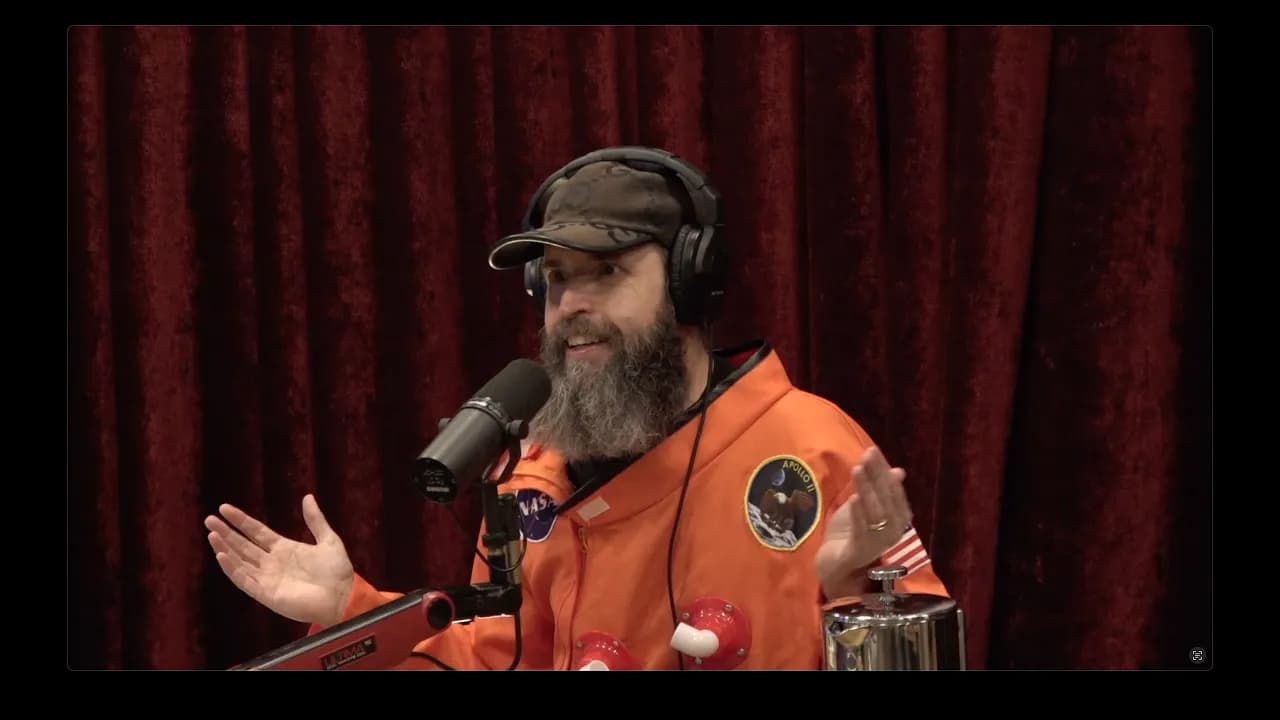
Joe Rogan Experience #2515 - Chase Hughes
In a Nutshell
Chase Hughes describes profound DMT experiences using precise intravenous dosing that reveal consciousness as the fundamental fabric of reality, with dreams demonstrating how perception, space, and sensory experience are fabricated within awareness itself. The conversation explores how psychedelics like DMT and ibogaine rapidly shift perspective and reprocess trauma by dissolving the illusion of separation, offering therapeutic potential for PTSD, addiction, and neurological conditions that conventional approaches cannot match. Hughes and Rogan also examine media manipulation, government narrative control, and social media dynamics while advocating for reduced certainty, authentic expression over performative identity, and recognizing that changing one's mind is essential rather than threatening.
These notes were generated by AI and may contain inaccuracies.
Chase describes an intravenous DMT session using an anesthesia-style pump that allows precise dose control measured in milliliters per hour. The setting includes a calm environment with soft surfaces, excellent music, and highly composed facilitators who maintain the space. The pump enables real-time altitude adjustments—users can request higher intensity, lower intensity, or pause entirely for breaks such as using the restroom before resuming. The entire session lasted five and a half hours with only one bathroom break taken.
Chase plans to repeat the experience while mixing Alzheimer's medications with the DMT. The goal is to test whether these drugs can improve memory retrieval of insights gained during the journey, addressing the common frustration of profound realizations that fade upon return to ordinary consciousness.
Both Joe and Chase note strong parallels between DMT experiences and dreams. Profound or bizarre dreams often feel crystal clear immediately upon waking but rapidly slip away after simple activities like using the restroom or having coffee. This protective mechanism appears necessary; otherwise, experiences of such intensity would dominate regular waking memory the way a UFC fight does. Chase states he has never met anyone who has actually done DMT and then dismissed it as a mere hallucination.
Chase presents a framework using dream logic to illustrate that perceived reality may be constructed from consciousness:
- In a dream, a person estimates distance to an object (for example, eight feet to a UFO) even though no physical distance exists inside the brain.
- The material composition of dream objects is ultimately recognized as consciousness itself.
- Dreamers fabricate eyeballs and photons to perceive colors and forms even though no external light exists.
- The entire sensory apparatus and spatial framework are manufactured within consciousness.
He extends the analogy by noting fractal similarities between galaxies and DNA, toroidal gravitational patterns and red blood cells, and eye structures and nebulae. Images comparing the known universe to human neural tissue appear nearly identical, suggesting reality may operate as nested fractals.
Joe and Chase discuss the possibility that super-massive black holes at galactic centers may function as passageways to entirely new universes. With hundreds of billions of galaxies each containing a super-massive black hole, passage through one leads to new galaxies and black holes, potentially creating infinite nested structures where brains contain universes and universes contain brains.
Returning from the DMT journey required Chase to wrap himself in a small ego structure to re-enter ordinary reality, which felt profoundly sad. Both speakers connect this to a broader human tendency to cling to ideologies, political parties, religions, and belief systems as security blankets against the vastness of existence. They advocate for less certainty and more frequent use of the qualifier "as far as we know" when discussing scientific or existential claims.
Chase quotes Terence McKenna's description of DMT as "death by astonishment." Language, invented primarily for trading goods, proves inadequate for describing DMT space; attempting to label experiences feels destructive. Quantum entanglement phenomena become more comprehensible when distance is understood as nonexistent in consciousness, similar to dream logic.
Joe describes the UFC event held on the White House lawn. Temperature remained in the 70s with no weather interference despite earlier concerns. The main fighting area accommodated over 4,000 people including military personnel, while an additional 85,000 spectators watched on large screens at the Ellipse. Every one of the seven fights ended by knockout—an unprecedented occurrence. Total viewership exceeded 150 million by the following Monday.
Joe recounts the sport's trajectory from being banned on cable in the late 1990s to its current mainstream status. He began commentating in 1997, briefly quit, then returned in 2001 under Zuffa ownership. Early perceptions equated UFC involvement with career damage; twenty-five years later the organization hosted an event on the White House grounds.
The main event between Justin Gaethje and Ilia Topuria is described as potentially the greatest fight in UFC history. Gaethje entered as a significant underdog yet rallied after early damage. Topuria appeared to suffer vision impairment in one eye during the contest.
Justin started landing significant strikes in the third round after Ilia had slowed considerably. Ilia appeared to have expended too much energy attempting to finish the fight in the second round, leaving him unable to recover between rounds. Justin recovered and began dominating in the third and fourth rounds. By the end of the fourth round, Ilia retired on his stool due to severe eye swelling that left him unable to see out of either eye. He had also sustained significant body damage when Justin drove a knee into his rib cage while he was on the ground.
The eye damage appeared more significant than potential rib injury. Both eyes were swollen shut, his nose was damaged, and he had taken numerous punches to the face. There was possible orbital fracture indicated by the bilateral swelling. Ilia demonstrated intelligence in stopping when he could no longer defend himself effectively, choosing to preserve his body and brain for future fights.
For Justin, the victory represented one of the most remarkable comebacks witnessed. At 37 years old and entering what many considered his retirement fight, he defied expectations against a heavily favored opponent. Justin had expressed interest in winning the title at the White House as a fitting career conclusion.
Justin possesses exceptional durability that may have genetic origins. He has joked about his unusually hard skin and bones, rarely sustaining cuts during fights. He has been rocked and stopped in previous fights, including a knockout in the final second of the final round against Max Holloway in the BMF title fight. However, he demonstrates zero quit in his mentality.
Justin has extensive experience in five-round chaotic battles and thrives in such environments. He has been described as the most violent man in the most violent sport since his early UFC appearances. While Ilia appeared technically superior, Justin found ways to land shots and persevere through early trouble.
The event drew criticism from those attempting to frame attendance as political endorsement. Attending a fight at the White House does not constitute support for any particular foreign policy positions. Both political sides engaged in overinterpretation, with the right celebrating it as a victory for masculinity and patriotism.
Psychedelics offer a pathway to change perspectives, particularly for veterans and first responders dealing with PTSD. The experience involves temporary ego dissolution that allows individuals to observe their ego's effects from outside. Upon returning, people can evaluate how much of their previous mental patterns they wish to reintegrate.
The experience functions like a control-alt-delete for the brain, rebooting consciousness with awareness that previous patterns represent old conditioning rather than inherent identity. Much of what people carry as personal identity consists of elements that never truly belonged to them, accumulated like decorator crabs throughout life.
Separation represents the greatest deception affecting human experience. Therapeutic psychedelic use reveals the interconnectedness of consciousness, showing that individuals are not as separate as daily experience suggests. This realization connects to the current loneliness pandemic affecting populations worldwide.
People can feel lonely even when surrounded by others. Modern social dynamics encourage performative behavior where individuals present artificial versions of themselves. This performance creates isolation because even close relationships may never encounter the authentic self. The fear of authentic expression stems from concern about rejection and removal from social groups.
Social media has amplified performative behavior dramatically. Previous generations worried about social consequences from small groups of twenty people, whereas current concerns involve potential audiences of twenty million. This scale difference creates existential pressure to hide shame and pretend it does not exist.
The disease of specialness emerges when individuals believe they are uniquely flawed while assuming others have resolved their issues. This perception increases isolation. Social media platforms contain significant artificial content including AI bots and paid narrative pushers that organizations can hire to create false consensus around any position or individual.
Artificial communication through social media represents natural progression rather than deviation from nature. Human technological creativity cannot bypass natural processes. Current technological convergence between humans and artificial intelligence occurs through both productive and unproductive channels, leading toward increasing integration measured in daily usage hours.
Contemporary culture shows movement to discredit traditional femininity and masculinity alongside over-celebration of gender outliers. This occurs alongside documented testosterone level declines potentially linked to microplastic endocrine disruption. These developments may represent natural progression toward post-biological existence beyond current primate physical forms.
Neuralink technology demonstrates early stages of this convergence through brain-computer interfaces. Patients can control cursors and play video games using only eye movements and mental commands. Future applications may enable wordless communication representing hive mind capabilities.
UAP experiences may represent future human development stages. Described entities typically possess larger brains and weaker bodies compared to current humans, communicating telepathically. Similar telepathic experiences occur during DMT sessions. Early researchers studying ayahuasca considered naming harmine telepathine due to observed telepathic effects during ceremonies.
Consciousness has become central to contemporary discussions. Claims of certainty regarding consciousness appear premature given historical patterns where each generation assumes complete understanding.
Ignaz Semmelweis faced institutional rejection and eventual confinement in an insane asylum for proposing hand washing between surgical patients. Similar resistance patterns appear in current psychedelic research despite accumulating evidence for efficacy in treating PTSD, anxiety, depression, and addiction. Schedule I classification persists despite documented results.
Acceptance of psychedelic therapy is increasing particularly among right-leaning demographics and special forces veterans. Sean Ryan and Marcus Luttrell have contributed to public discussion. Former Texas Governor Rick Perry, previously opposed to such substances, underwent ibogaine treatment for age-related brain atrophy. Follow-up scans showed 25% improvement after initial treatment and complete resolution after subsequent sessions.
Ibogaine demonstrates particular promise due to apparent neuroregenerative properties. If patentable, pharmaceutical companies would pursue development aggressively. Current efficacy data positions it among the most effective interventions studied when considering effect size relative to sample populations.
Ibogaine offers advantages as an entry point for psychedelic therapy because it possesses zero recreational appeal. Users experience intense physical reactions including vomiting and extended discomfort lasting approximately 24 hours. Upon completion, individuals report fundamental perspective shifts and interruption of deeply ingrained behavioral patterns including addiction cycles.
The substance provides psychological distance from previously overwhelming concerns, revealing their relative insignificance. This perspective functions similarly to a guide redirecting attention from unnecessary concerns toward genuinely important matters.
Psychedelic experiences snatch consciousness from narrow daily perspectives and relocate it to broader vantage points. This shift reveals previously invisible aspects of existence and personal patterns. Hypnosis represents another studied method for behavioral change, though psychedelic perspective shifting operates with unmatched speed across researched approaches.
Psychedelics produce a rapid and profound shift in perspective that serves as their primary therapeutic mechanism. This perspective change typically requires 10 to 12 years of cognitive behavioral therapy to achieve, yet psychedelics accomplish it much faster. These substances are non-addictive and non-toxic, and unlike street drugs, DMT capsules are not sold on the street.
DMT experiences are generally considered too profound to qualify as purely recreational activities. People attempting recreational use often get banned from further experiences when approaching with the wrong intentions. One description compares DMT entities to nightclub bouncers who deny entry when the user approaches with ego-driven motives.
A specific form of narcissism emerges from regular psychedelic use when individuals seek to lead groups of people. This manifests as spiritual narcissism where users want to become gurus or leaders, claiming superior knowledge from their experiences. They attract suggestible followers, which creates conditions for cult formation.
Entering psychedelic journeys without ego results in becoming less certain about the world with each experience. Users frequently question how such profound states remain accessible just 15 seconds away from normal reality.
If the Controlled Substances Act of 1970 had not banned psychedelics, society might look dramatically different after 56 years of legal access. The sweeping changes in automobile design, music, and culture between 1950 and 1960 correlate with psychedelic availability. Cars from that era featured more creative, flowing designs before shifting to more conventional aesthetics.
Ancient mosque architecture features ceiling designs that closely resemble DMT visual experiences. This raises questions about whether religious practitioners historically used psychedelics, as the geometric patterns and colors mirror common DMT phenomenology.
Alex Grey's Chapel of Sacred Mirrors represents visionary art that accurately captures psychedelic experiences. Located in the Hudson Valley, the non-denominational space features his artwork rendered in three-dimensional architectural form. Unlike spiritual narcissists who seek followers, Grey maintains purity in his approach without attempting to lead groups.
Users report recognizing specific visual elements from DMT experiences in Grey's artwork, including morphing faces that respond to the observer's presence and identity.
The Sacred Mushroom and the Cross by John Marco Allegro argues that Christianity's origins connect to psychedelic mushroom consumption and fertility cults. Allegro, an ordained minister who worked on the Dead Sea Scrolls for 14 years, concluded that no single religion holds complete truth.
Ancient artwork depicts Jesus alongside mushrooms, and a thousand-year-old fresco in France shows Adam and Eve with the tree of knowledge rendered as mushrooms rather than traditional fruit. The Amanita muscaria mushroom resembles an apple and may represent the original forbidden fruit referenced in biblical texts.
God instructed Adam directly not to eat from the tree of knowledge of good and evil, warning that consumption would result in certain death. This prohibition may reference ego death rather than physical death. The story's transmission across thousands of years through multiple translations raises questions about what original elements may have been altered or deleted.
Christmas traditions connect to Amanita muscaria through Santa Claus symbolism, reindeer consumption patterns, and tree decoration practices. Shamans traditionally dried mushrooms by hanging them near fires, and the mushrooms maintain mycorrhizal relationships with coniferous trees.
The Controlled Substances Act of 1970 represents government restriction of citizen consciousness. Similar bans occurred historically with the Eleusinian mysteries, as documented in Brian Muraresku's The Immortality Key. These prohibitions occurred because realizing universal oneness makes population control nearly impossible.
When lawmakers and military personnel experience this unity consciousness, warfare becomes untenable. Modern applications show psychedelics helping with Alzheimer's, dementia, Parkinson's, myasthenia gravis, multiple sclerosis, and autism.
A documented case involved a non-verbal dementia patient unable to communicate, dress, or walk who consumed five grams of mushrooms, slept for 19 hours, then regained communication abilities, eye contact, self-care capacity, and mobility. Subsequent doses produced further improvement.
Lion's mane mushrooms support cognitive function while various mushroom species address inflammation. Fungi breathe air like humans and can survive vacuum conditions, supporting panspermia theories about mushroom spores arriving via asteroid impacts.
Each generation interprets the universe through contemporary technology: machines during the industrial revolution, energy during electrification, and computers in the digital age. Any theory assuming humans hold special status warrants skepticism, as it projects current human technology onto potential creators.
Roger Penrose proposes the universe undergoes cyclical big bangs rather than originating from a single event. Basic science supports the concept that humans represent the universe experiencing itself, requiring no imaginative stretches to accept this framework.
Memory editing becomes possible through hypnosis by first training individuals to consciously modify memories. The brain naturally edits memories each time they are accessed, automatically saving changes without conscious awareness of the edits.
The process begins by guiding someone under hypnosis back to their childhood bedroom at age seven. They explore vivid details before marking a single dot on the wall near the light switch using a sharp pencil. This creates a permanent marker that persists across different ages when revisiting the memory.
Game developers explained that modifying one pixel allows modification of an entire map. Applying this principle to human memory, creating a single permanent mark establishes continuity across time periods. Repeating this tiny change approximately 50 times builds skill in conscious memory modification.
Hypnosis induces theta brainwave states around 7 hertz where subjects feel relaxed and safe. This state facilitates access to memory files for deliberate editing work.
A technique involves editing memories one pixel at a time across 15 to 20 to 30 repetitions to establish permanence through time. Once permanence is demonstrated, the process shifts to perspective shifting within real memories rather than altering the memory itself. This includes jumping across perspectives in an event, such as experiencing a dinner party or wedding from another person's viewpoint at the table or in the front row.
The final layer involves reprocessing traumatic memories from an adult perspective in a short amount of time. For example, a high school incident where someone was beaten up and mocked can be revisited so the memory remains intact but the perspective changes, removing the downstream effects like scripts of needing to be tough or loud for protection.
This memory perspective shifting approach mirrors what psychedelics achieve through massive perspective shifts on memory. The technique is used occasionally with clients, though few others are currently practicing it. There is recognition of the need for responsibility to avoid risks like delusional perspective shifting.
Psychedelics can accomplish similar results without requiring verbal guidance back to original events using archaic language that struggles to describe psychedelic experiences.
Entry into psychedelics came through watching the documentary The Spirit Molecule, which shifted perspective from viewing these substances as recreational to recognizing deeper potential. Rick Strassman's book was highlighted as influential; Strassman was the first to obtain FDA approval for psychedelic studies by framing research as proving they were damaging and dangerous.
Strassman taught himself ancient Hebrew over 16 years to read the Bible in its original form. He maintains fascination with prophecy and ancient religious stories. Scholars in Israel suggest the burning bush encountered by Moses may have been an acacia tree rich in DMT, potentially explaining the divine experience as a DMT journey.
DMT exists in thousands of plants, including acacia trees and mimosa plants. Normally, monoamine oxidase (MAO) in the gut breaks down DMT before it becomes psychoactive. Taking an MAO inhibitor alongside DMT creates ayahuasca, an orally active form.
Methylene blue functions as a light MAOI. Combining it with psychedelics can deepen effects. Methylene blue has been researched since the 1890s and is stocked in every emergency room.
Potential side effects of methylene blue include headaches, dizziness, nausea, vomiting, diarrhea, sweating, muscle twitches, and blue-green discoloration of urine, stool, or skin. Serious risks involve serotonin syndrome when combined with SSRIs, SNRIs, MAOIs, some opioids, or St. John's wort. G6PD deficiency is a contraindication.
Methylene blue treats methemoglobinemia and serves as the only cure for cyanide poisoning. Safety data for chronic low-dose use in anti-aging or cognition remains limited, and medical supervision is recommended.
Chase Hughes relies on methylene blue to prevent seizures, noting he would experience one within 48 hours if discontinued. He experienced a seizure the night before appearing on the show.
Methylene blue exhibits neuronal affinity, entering neurons automatically. Because it absorbs red light strongly, combining it with near-infrared and infrared light increases absorption. Red light systems can penetrate the skull up to four inches.
Joe Rogan reported improved vision from red light therapy using a red light bed, eliminating the need for reading glasses. He keeps his eyes open during sessions rather than using goggles. Similar vision improvements have been reported by Whitney Cummings through consistent daily use, alongside supplementation with lutein and Pure Encapsulations Macular Support.
Extended screen time on phones, tablets, laptops, and computers harms eyes. Changing iPhone or iPad display to red overlay via accessibility settings reduces addictive engagement; a two-year-old lost interest after a few minutes and returned to play. This feature allows users to counteract designed addiction mechanisms.
Chase Hughes trains military SCOPS divisions, including upcoming sessions at Fort Bragg for the United States Army. He developed a SCOPS index scoring system from 1 to 100 assessing likelihood that events represent psychological operations.
The framework examines pre-ignition factors like societal moral panic, operational drills, regulatory actions, alignment of messaging across news outlets and celebrities, identical phrasing across unrelated sources, prepackaged villains, injected symbolism, and manufactured urgency.
Absence of nuance combined with authority figures resonating on binary choices signals high SCOPS probability. The tool helps identify operations such as the initial Iraq invasion scoring 98 out of 100.
Chase Hughes purchased a physical TV station ten minutes from his home, retrofitting it with upgraded equipment comparable to major networks. The daily news show Station One airs on YouTube and applies the SCOPS index to current events, highlighting missing nuance, binary framing, and overlooked bills or data from insurance markets like Brent crude predictions.
The goal is making psychological operations irrelevant by increasing public visibility and making audiences more expensive to influence. The channel began with minimal subscribers and continues growing.
YouTube's algorithm punishes creators who mix short-form and long-form content, forcing many to launch separate channels for different formats. This approach was adopted to maintain visibility and avoid penalties. There was also ongoing concern that YouTube might remove certain podcasts entirely during controversial periods.
During the COVID period, regular questioning of the lab leak theory, vaccine safety concerns, and alternative medical approaches risked channel removal. Spotify's backing provided protection that likely prevented deplatforming. The episode represented one of the largest instances of widespread public awakening, though some individuals remain resistant to changing their views despite clear evidence.
Government trust was highlighted as problematic, with references to outdated nutritional guidelines like the food pyramid promoting excessive bread consumption. Reagan's observation that "we're the government and we're here to help" was cited as particularly revealing about institutional skepticism.
Ideological capture prevents people from acknowledging positive proposals from opposing political sides. When initiatives like psychedelic therapy access and ibogaine research received support, critics struggled to respond constructively and instead searched for negatives based solely on political affiliation.
Mainstream media demonstrated significant disconnect from audience realities during these controversies. Their limited reach and corporate structure prevent achieving the trust levels that independent media can build through authentic communication.
Mainstream media content often feels insincere because hosts read teleprompters rather than speaking authentically. Panel discussions frequently lack nuance and devolve into shouting matches. Commercial breaks create structural problems, particularly when pharmaceutical companies provide substantial advertising revenue, potentially influencing editorial decisions.
Edited footage that altered skin tone was viewed as an obvious manipulation attempt that backfired. Ivermectin was not considered controversial before public discussion, and prescriptions were previously available through pharmacies. Related compounds like fenbendazole are now facing similar scrutiny despite emerging research suggesting potential cancer treatment applications.
Pharmaceutical advertising revenue creates conflicts of interest for news outlets, reducing willingness to criticize drug companies. News media credibility declined significantly during COVID, with further damage from revelations about government pressure on social media platforms.
Operation Mockingbird involved CIA recruitment of journalists and media figures including Walter Cronkite. Anderson Cooper interned with the CIA during college summers while studying at Yale. Julia Child also had CIA connections. These historical precedents demonstrate long-standing government influence over media narratives rather than representing new developments.
The CIA conducted LSD experiments on unwitting subjects, including aerosol dispersal attempts in urban areas. The Army released zinc cadmium sulfide over multiple cities including St. Louis, Minneapolis, and others to simulate biological weapons testing. These programs targeted areas chosen for demographic similarity to potential adversaries.
Social media reduced mainstream media's narrative control compared to previous decades. During controversies, audience numbers increased substantially rather than declining, with millions of new followers gained in short periods. Independent platforms provided space for discussions that mainstream outlets avoided.
Researchers with extensive publication records and patent holders on mRNA technology faced professional attacks for raising safety questions. Personal adverse reactions experienced by some scientists prompted deeper investigation into claims about localized effects versus systemic inflammation risks.
Fear of social judgment and ostracism serves as a primary control mechanism. Assigning labels like "anti-vaxxer" or "conspiracy theorist" enables group enforcement of acceptable opinions. This creates self-censorship where individuals suppress their views to avoid punishment.
Category warfare describes how redefining situations changes permissible responses. Shifting from "disagreement" to "fight" or "war" alters what actions seem acceptable. Creating moral superiority through adopting certain positions provides psychological rewards without requiring substantive moral development.
When issues are presented in emotionally simple terms that require no deeper investigation, manipulation is likely occurring. Social media echo chambers normalize extreme positions by connecting like-minded individuals and providing constant reinforcement of existing beliefs.
People increasingly tie personal identity to their opinions, making course correction psychologically difficult. This rigidity prevents objective re-evaluation even when evidence contradicts initial positions. AI systems can reinforce these patterns by providing unlimited validation of existing viewpoints.
You are not your ideas. Ideas are just ideas and connecting your identity to them creates a trap that's difficult to escape without admitting defeat. Most people view changing their mind as a battle for their existential existence because their identity becomes tied to their belief system.
Cognitive dissonance plays a central role in this dynamic. When confronted with contradictory evidence, people either admit they were wrong or conclude the other side is stupid or misinformed. This pattern appeared during both the Biden and Trump elections, where supporters on each side chose to label the opposing voters as idiots rather than reconsider their own understanding.
Protecting identity is deeply ingrained through the ego's fear of being wrong in public, which risks ostracism and being kicked out of the tribe. People enjoy attacking those who are wrong and destroying their credibility, even when someone has built a decade of positive contributions.
Everyone pretends they have everything figured out while hiding their own skeletons. This creates a culture where people compare themselves to highlight reels rather than reality. Audiences are drawn to authenticity and human flaws rather than polished perfection, which explains the preference for handmade items over machine-made ones and the appeal of real, flawed content.
A loneliness epidemic exists where everyone acknowledges the problem affects others but rarely admits personal impact. There are signs people are waking up to the strangeness of hating neighbors over voting differences and sensing that certain agendas are being pushed too quickly.
Government efforts at projecting narratives often lack competence and appear insincere, similar to a middle school dad attempting to be cool at a sleepover. Examples include awkward attempts at relatability on late-night television.
Social media, despite criticism, serves to expose these dynamics rather than only spread misinformation. Independent voices willing to state uncomfortable observations early play a valuable role in this environment.
The first ingredient of confidence is the willingness to receive social injury. During COVID, unique positioning with an established audience allowed continued questioning of inconsistent narratives around vaccine injuries, myocarditis measurement methods, and ignored cases like soccer players collapsing.
Attempts to silence dissenting voices involved sponsor pressure, organized campaigns, political packs, and direct contact from presidents and former presidents to platforms. Despite significant coordination and financial investment, these efforts failed. The size and international reach of the platform provided protection that smaller outlets would not have offered.
Visual markers of authority have shifted from suits and ties to hoodies and t-shirts among CEOs. Social authority is moving from mainstream news toward a post-news era where independent journalists gain influence through authenticity and honesty.
Paid propagandists who push coordinated narratives risk losing credibility once exposed. Those who sacrifice authenticity for financial compensation lose their primary currency in this environment. Future mind-reading technology would reveal everyone's flaws, making behavior and how people manage their imperfections the relevant measures.
Many online figures function like demons by attempting to ruin lives, spread hate and misinformation, confuse people, encourage unnecessary medication, and make others feel inadequate. This separation mindset justifies horrific actions including bombings and war by framing others as fundamentally different and disconnected.
George Carlin observed that conspiracy is not required when interests align. A small group of people belong to an exclusive club that average individuals cannot access, and membership sometimes correlates with opinion changes or silencing.
A CIA method called elicitation, developed by John Nolan, extracts sensitive information through statements rather than questions. The three main approaches include:
- Provocative statements that recap what someone said to encourage elaboration
- Triggering the need to correct the record by stating incorrect information that prompts natural correction
- Expressing disbelief to prompt further explanation without direct questioning
These techniques were historically used during the Cold War when KGB agents elicited submarine specifications from young sailors by making slightly incorrect statements. Personnel with top secret clearances receive anti-elicitation training before traveling abroad.
Hot women represent one of the most primal elicitation tactics. Chatty gay guys have also proven effective at extracting information in political and government contexts.
Biological drivers influence risk assessment around sexual activity, with women facing greater potential consequences from raising children alone. This dynamic may explain why certain elicitation approaches appear more effective across genders.
Shame focuses destructively on identity while guilt allows focus on understanding and correcting behavior. Beating oneself up emotionally provides no benefit to those harmed or to the world at large.
Viewing life through the metaphor of Earth as a video game reveals that developers provide no explicit instructions on winning. The primary metric for success on the leaderboard appears to be whether someone was an upward force on the lives they encountered and left people better than they found them.
The number one lesson most people could learn comes from people that are dying, specifically those on their deathbed. There's no better book you could read about how to master this game and get good at Earth than reading the regrets of dying people. There's so much clarity at these moments where you know you're going to die. People often realize they thought they needed material things like a Lexus to impress everybody at the country club who didn't give a shit about them. They realize they didn't spend time with their grandkids and didn't spend time with their kids. Everything gets so crystal clear in those moments.
Those moments provide the best perspective on what we think is so important. At that point, people commonly realize they can't believe they prioritized all that shit. A lot of nurses that work in hospice write and collect a lot of these accounts, offering perspective on our priorities.
Chase Hughes and Joe Rogan conclude the conversation by exchanging thanks. Rogan asks about finding Chase's content on YouTube, learning that both "Station One" and "Chase Hughes" channels contain his work.
Keep PowerfulJRE in your library
Save the videos and channels worth coming back to, and find them again in one place.