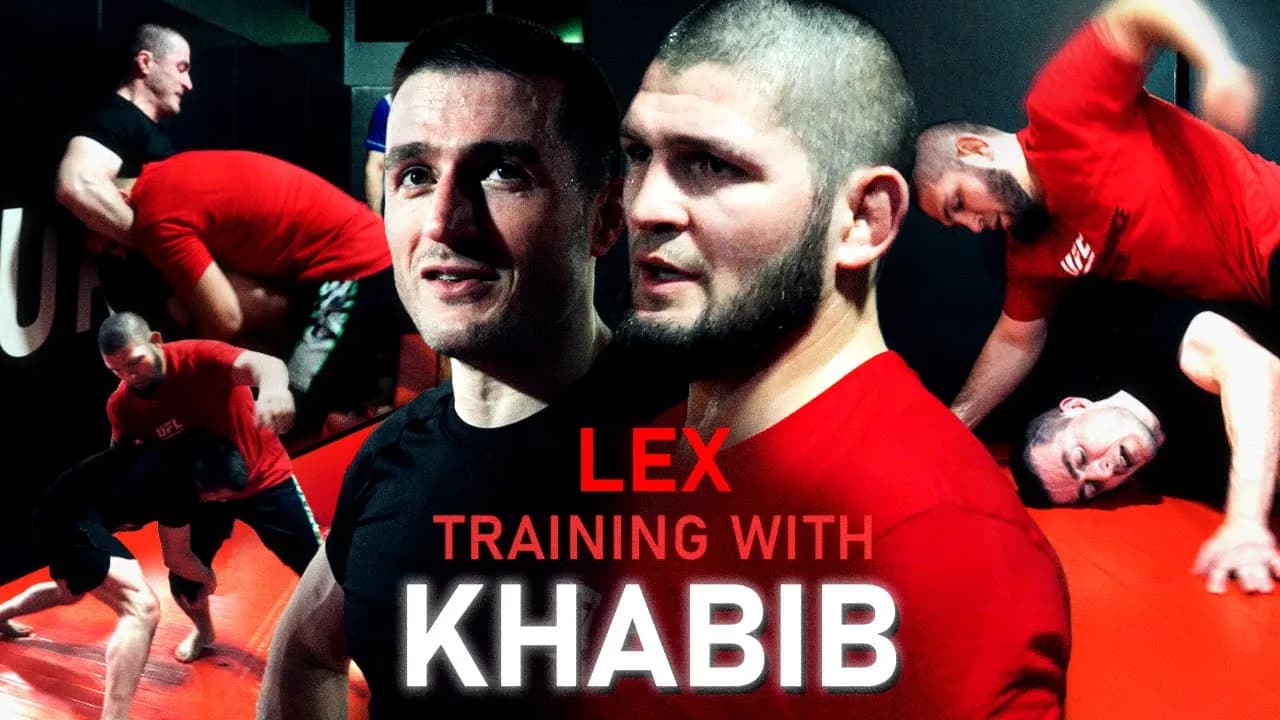
Khabib Nurmagomedov: Dagestan, MMA, UFC, Islam, Conor, Fedor & Football | Lex Fridman Podcast #500
In a Nutshell
Khabib's core message is that becoming and staying champion requires fanatical training discipline, mental toughness, and an unshakable hatred of losing rather than desire to win. He attributes his success to growing up in Dagestan's harsh mountain culture with his father's rigorous coaching, where children were constantly pushed to work, learn, and compete across multiple sports from age 15 onward. Success itself is a test from God that must be met with humility, and true legacy comes from inspiring others through character, not just achievements.
These notes were generated by AI and may contain inaccuracies.
This conversation with Khabib Nurmagomedov was conducted entirely in Russian, with English dubbing available via YouTube audio track settings. The translation and dubbing involved human translators and AI assistance from ElevenLabs.
The gym in Makhachkala operated from approximately 2000 to 2010 and beyond with extremely limited resources: one shower for seventy people using only cold water, a school gym with just mats, a single punching bag, one climbing rope, and an indoor basketball court. This facility produced over twenty world champions, including several UFC champions.
Before 2000, the training facility was located in the village of Sildi, where Khabib's father built a gym inside their home and trained local village children, including Khabib, his older brother, and relatives.
Khabib's earliest conscious memories from ages five to seven involve waking up to sounds of training drills, judo throws, his father's voice giving instructions, and the repetitive hitting and throwing sounds.
Khabib states that the best results are born out of the worst conditions. He notes that comfort can be the enemy for champions in combat sports, unlike football where proper field conditions become necessary at ages ten to twelve.
In combat sports, the most important factors are: a coach, sparring partners who push you, and mats. The sport itself is inexpensive—requiring only wrestling shoes, singlets, shorts, and a T-shirt.
Khabib argues that children born into wealthy families with everything provided would be unlikely to pursue a brutal sport involving daily injuries, exhaustion, and bruises, as both the wealthy father and the comfortable child would lack the necessary hunger.
Brazil produces many great football players due to its population of over 200 million people, deep cultural love for the sport, strong tradition, and well-organized system allowing kids to progress from school to academies to clubs.
Dagestan has strong football passion but lacks an organized ecosystem—no structured pathway from school to academy to professional clubs. Kids play on streets and PlayStation without systematic selection processes.
Dagestan has approximately 40-50 gyms for combat sports in Makhachkala alone, all full. A clear progression ladder exists: Dagestan champion → North Caucasus level → Russian nationals → World level, where amateurs get noticed.
The competition level in Dagestan gyms is extremely high, with ten to fifteen good wrestlers in every training session and excellent coaches.
Wrestling tradition in Dagestan began in the 1950s with legendary wrestlers including Ali Aliyev (five-time world champion, three-time Olympian) and Zagalav Abdulbekov. Many wrestlers from that generation became coaches after retirement, creating a pipeline of coaching excellence.
Many coaches remain locally known but possess knowledge, approach, and philosophy comparable to Khabib's father. The coaching staff represents one of the most important keys to Dagestani wrestling and fighting success.
Fighting is embedded in Dagestani culture—everyone wrestles and fights as part of the tradition. Every parent wants their children to wrestle and be physically strong. The cultural expectation is that children must be strong enough to stand up for themselves and their families.
This tradition exists across all clans, families, and villages, described as being "in our blood."
Dagestan's history spans hundreds of years of conflict. The region has been invaded by the Khazar Khaganate, Arabic Caliphate, Iranian/Persian Empire, Russian Empire, Timur's forces, and the Mongols over the past 1,000-1,500 years.
Dagestan's geography features the Caucasus mountain range as a natural wall, the Caspian Sea on one side, and the Caspian lowlands. The city of Derbent (formerly Babul Abwab, meaning "Gate of Gates") served as a major trade route and passage point for armies.
Dagestan has over thirty different languages, with some ethnic groups unable to understand each other. Khabib (Avar) and Islam Makhachev (Lak) speak different languages, though Islam has learned some Avar after twenty-five years together.
The terrain shaped history: highlanders maintained independence because large armies with horses and supplies couldn't navigate the cold, roadless mountains. Lowlands changed hands frequently among empires.
Khabib notes that understanding of Dagestani history deepens over time. He recognizes that environment shapes individuals regardless of birthplace—where and how one grows up, conditions, and people around them combine with genetics to form character.
Imam Shamil resisted the Russian Empire for 35 years of his conscious life—10 years as a regular fighter/soldier, then 25 years as leader. This prolonged resistance against one of the strongest empires of the era made him famous.
Many Dagestani villages honor local warriors from their specific clans or ethnic groups, though these heroes remain largely unknown to world history. Shamil is remembered as a leader, but many other fighters have been forgotten outside their communities.
Mountain winters are harsh with heavy snow completely isolating villages. People work throughout summer on terrace farming to survive winter. The Chokh terraces are among the most famous and ancient in the world, though every village had terraces.
Villages were strategically built in rugged terrain difficult for enemies to reach. Sildi village derives its name from "si" meaning castle, fortress, or tower. Agricultural terraces were located in accessible areas, but villages were positioned in defensible locations requiring enemies to descend one mountain and climb another.
Surviving in these harsh mountain conditions requires mental toughness—weakness is incompatible with survival.
Khabib built a sports complex in Sildi at 1,500-1,600 meters above sea level. Training there for 3-4 weeks increases oxygen in blood, testosterone levels, physical conditioning, and stamina.
Khabib's father began construction in 2016-2017 despite financial constraints. After his father's death in 2020, Khabib continued the project on a larger scale. The completed facility accommodates 100 people simultaneously for training, eating, and sleeping.
Umar Nurmagomedov conducted his main training camp at the Sildi base before his Las Vegas fight.
The Sildi facility creates jobs for local people, fulfills Khabib's father's vision, and allows fighters to train and improve both physically and spiritually. The project generates expenses without financial profit but provides happiness and meaning.
The journey from Makhachkala to Sildi takes 3 hours 30 minutes to 3 hours 40 minutes by car through winding mountain roads. Helicopter travel takes 40-50 minutes.
After becoming champion, numerous distractions emerge: massive attention, contracts, frequent flights, meetings, video shoots, and other commitments that gradually reduce training consistency.
Many champions lose their drive once reaching the top—they trained with hunger to become the best, but upon achieving that goal, they lack direction for what comes next.
Khabib observes this pattern from his father's students who became world champions, from other sports, and from his own experience. The ability to handle success demonstrates an incredibly serious mindset.
Reaching championship status differs from maintaining it—staying champion is significantly more difficult.
Even at local levels, becoming champion creates the temptation to stop fighting, quit MMA, and switch to fitness. Each successive level of achievement makes maintaining champion status increasingly difficult.
Amateur sports can serve different purposes: proving something to oneself versus serving as a springboard to professional success. After turning professional and becoming champion, staying at the top represents the ultimate challenge.
Statistically, over 35 years of MMA and combat sports, approximately 50 athletes achieved championship status, while hundreds of thousands attempted it.
Only a tiny amount of people reach the ultimate goal in fighting. Making it into this tiny list requires being a truly unique person and fighter, and a student who can accept guidance from a coach. When being guided, a person must discard the cons and take only the pros. Some people take criticism very hard and very negatively, and are very sensitive when they receive criticism from a mentor. Some accept criticism at the very beginning, but once they become champions, it becomes hard for them to take it.
A man sometimes doesn't even know what he is capable of. Sometimes he can't really understand himself until he achieves success or becomes famous, wealthy, and powerful. That is exactly when he discovers his true qualities. When he is limited in money, power, and everything that success eventually brings him, he doesn't really know how he's going to act in this new role. Nobody knows how they'll behave once they become big, famous, and a champion. Some people say and wish, "Oh, if only I'd made it like that, I would do things this way." It is better if people don't throw around such big words because you never know how you'll carry yourself once you actually get there.
Getting up there and still remaining human is a delicate thing. When it comes to Khabib, everyone loves him, even early on in his career when millions of people loved him. That is also a tough thing to deal with because maybe you start believing it and can lose yourself in all of it.
From the very beginning, if you realize that what you're chasing isn't the most important thing in life, then it gets easier. Some people's ultimate goal is to be successful, powerful, and to make it big. At the end of the day, we are not really such big, important people. It is wrong to just crown yourself king because, to put it bluntly, we can't even control the basic need to go to the restroom. We all go to the restroom. If we can't control even this, what can we actually control in this life?
Many great people have left this earth. It doesn't matter how big, strong, famous, or wealthy you are, champion or no champion. They put us all in the exact same grave, two meters down or a meter or a meter and a half. Different confessions and religions bury people in different ways. Every single person should have this realization that we are just not some kind of big, important people who decide and get to control everything.
Khabib was raised under the guidance of his father, who was a coach. His goal was always to become a champion to prove to his father that out of everyone his father trains, Khabib could show him. He looked up to his father, followed his example, trained hard, and it was like a challenge to prove to him, "Look, I am right here, Father, and everything you teach, I will take it all in zealously, worthily. I'll follow your program, do it right, and I will become a champion." That was exactly the kind of goal he had, to prove it first and foremost to his father and secondly to the entire world that he can become the best wrestler or fighter.
Khabib never thought of being crowned king after he became a champion. He was never going to walk around like, "Look how cool I am." He is really glad that the Almighty protected him from all of that because many people end up in a bad place if they act like that.
Even if you don't think about being crowned, a fire should burn within you, driving you to become a champion. Hundreds of thousands, millions of people want to be a champion, but only one can be. That is about confronting your opponent. You've got to put a barrier inside your mind where on one side you're a humble person, but on the other side you're different because you have a goal. You should still follow a code of honor. You should be a man, a righteous man, and know what you can and cannot do. You should always do that.
But in the end, your opponent is the person who wants to stop your dream. The boundaries expand just a little bit. You're already not playing humble. You just step out and you want to clear your opponent out of your way because your goal is to be the best in the world and they are blocking you. In this situation, there's no way you can act all humble.
What gave Khabib strength in training was the hatred of losing. Of course you want to win, but for him there was always this driver like, "No way. I am not losing." When they would give him a fight on a professional level, 100 days before it he was fixated. It was like an addiction, but for him it was commitment, that he absolutely had to prepare perfectly for the fight. He couldn't miss any training sessions. He would literally have this panic.
For example, if he was flying to Moscow, he would always pick a ticket so he could absolutely do his morning training session first. Then he'd take off around lunchtime. Once he arrived in Moscow, he had to fit it all around his training schedule. He simply could not miss that evening training session because he had to train during the day from four to five hours, two in the morning and two to two and a half in the evening.
He would prepare himself that way. Looking at who was in Moscow right then, wondering who he could pull into a training session there. The person had to match his level as well. He needed a fight back. He would arrange in advance who was going to come. Maybe some sparring, maybe wrestling, maybe weights, maybe a striking workout. He always had this tough and scientific approach to it. More than anything, he didn't want to lose rather than he wanted to win. Winning is a huge pleasure, but more than anything, he just didn't want to lose.
In all those hard training sessions, Khabib was thinking about not losing. That was the fuel. He trained four to five hours every single day. There is a story that Sadulaev, the legendary wrestler, told about going to a hotel in Moscow to train in the gym at night. He was the only one there, and Khabib came down and they trained together. Sadulaev said a lot of great things about Khabib and that Khabib gave him some really deep wisdom which helped him win the gold medal at the Olympic Games.
Khabib can't remember exactly what he said, but they had really great conversations. It's a great story that two legends like that met completely by chance. Sadulaev is a two-time Olympic champion. Khabib believes Sadulaev doesn't skip his training either. He never missed one back then. They both ended up there because they both hate to lose and both really want to win.
Recently Khabib came across the idea that there are athletes who simply want to win, and then there are some for whom victory isn't enough. They want domination. He believes Sadulaev is one of those as well. They want domination. For that, a person has to train and grind morning and night.
After the morning, Khabib's father never let them sleep. After Fajr, the dawn prayer, his father just wouldn't sleep himself, so they couldn't either. Every morning at six or seven, they'd be out doing their warm-up. Some people might call it a warm-up, but when you show up at the stadium in the morning, you run five kilometers, do sprints, work with resistance bands, work on the pull-up bar, do push-ups, dips, jumps, work with a partner, drilling and so on. That's about two hours of work. You drop two, two and a half kilos there. It wasn't really a warm-up, but his father always called it that. That was a full morning training at seven AM.
Then Khabib came home to rest, and at four o'clock, they'd head to the gym. The training would start at five o'clock and end at seven. By eight, he'd be home, and by eleven, he'd rest up. Yet he kept thinking that something was missing. He knew that he had a start, a competition coming up in like forty or thirty days, and he would wake up and be like, "Let me go to the sea. I'm gonna go down to the sea, do some running, some sprints on the sand, work out, and so on." Many times, he ended up going out for a third training session as well.
Sometimes his father would say, "Rest. In the morning, we're gonna have a heavy workload." But sometimes Khabib wouldn't tell his father. He'd just go out at night, head out, and train. At night when everyone's asleep, when nobody's around, he'd grab one of his close friends, give them a call, have them pick him up, then hop in the car and head to the sea. He'd train for an hour or an hour and a half, come back, and crash. Next morning, he'd get up and start all over again. This routine was nonstop.
When Khabib sees guys who do just one training session or like they say, "On Wednesday, we have a morning training, then an evening sauna session," he wonders what they mean. You have to fight in fifty days. You have a huge fight ahead and you want to take a rest in the middle of the week? Rest on Sunday. On Saturday, do a morning training, hit the sauna in the evening, take a complete rest on Sunday, and start all over again on Monday. That was just his approach.
To be at the top, the top tier, one of the best in the world, a person has to always be a little bit crazy, but in a good sense of the word. You have to be addicted to it and want this incredibly badly. You have to take a fanatical approach to the training process. Just showing up and working out, that's what hundreds of thousands of guys are doing around the world. To stand out from that crowd who have the exact same goals as you do, you have to take a fanatical approach to it.
John Danaher trains like that too. They train three times a day. It feels right this way. This is how you have to train. John has one of the best students in the world. They don't just take some random place. They're at the top, and their whole approach shows it. A person with that kind of approach just can't be somewhere in the middle. It's impossible. If you have a fanatical attitude, the right attitude toward the training process, on top of that, you have to be fanatical about it. You love what you do, and in the end, there will be results.
John creates champions. He finds a champion in everyone, across every category. The people who come to him, he has a system. Under this roof, under his roof, there is a system. People come here, and they become champions in this system. There are people there who are champions, specific established names. There are other people who came and left. They entered that black room, an uncomfortable place. They went in, stood for a year, a year and a half or two, and left. Nobody talks about them. These are the people who came in, broke mentally, and left. There are a lot of them. Usually, most people give up. There are many who give up, but then there are the ones who come in and stay there for a long time. After some time, they achieve success. They become the best. They prove to themselves that once they enter the system, they could stay there for a long time, endure, and become the best.
A person who has gone through it physically, who has lived through it, who has faced challenges, passed the tests, they are capable of a lot, highly capable. You don't just walk into martial arts and become the best. It's very difficult. It means that you go through pain, you make sacrifices, you give your time, you face setbacks and failures in training. The mental strength and capacity mean a lot there.
When talking about his system, Khabib means those schools that became the best in football or in freestyle wrestling or in MMA, in grappling, or in judo. It's really hard to enter one of the best schools in the world, to stay when they are breaking you, throwing you, choking you, to improve as a person and as an athlete, and to become a champion. It takes at least 12 years, 10 to 12 years, maybe 15. For some, it took longer. To get through the grind for these 15 years and then to break through and become the best is worth a lot.
Khabib has been in this grind since he was a kid. Wherever his father coached, there were always training camps. In the year 2004, his father put together the Dagestan national team for combat Sambo and in mixed martial arts, which was called no-holds-barred fighting. There were training camps. Khabib was 15. It was the winter of 2004, and he was the youngest guy there. The others were between 22 and 30, all active world champions. At that time, Khabib was 14, 15 years old. He wrestled with them, grappled, was in this uncomfortable environment for himself, where they always had the rule that the youngest has to do everything, and he is always wrong, and he had to deal with that. Especially in the gym, they throw you, hit you again and again. You have to show up morning and evening, day after day. This place hardens you.
Some of the guys who were at those camps back then, they're grown men now. Even then, they were older than Khabib by 10, 12, maybe 15 years. They always used to say, "Khabib, we honestly thought you were going to become some kind of scholar or scientist." Because his father was always making him read and write, read and write. He would copy out entire books by hand. There was always this control. It wasn't like his father would say, "Khabib, go do this," and you could just walk away and not do it. When he said, "Go do it," you did it. His father never forgot anything. He had a phenomenal memory. He'd be like, "Did you do it?" And everything he told you, he remembered.
Since childhood, Khabib was lucky that his father always kept him close, and he found himself in this environment among fighters who at that time didn't compete in America and Europe back then. But in the post-Soviet space, they were the best at that time. It helped him a lot to become mentally strong.
You have to give the right motivation to kids with proper communication. Khabib's father was very good at this. Khabib now realizes interacting with his own kids how wise his father was and how deeply he understood this. When a child is eight, 10 years old, and when they are just beginning to form as a person, it is important to have the right approach. Khabib now understands how farsighted his father's approach was.
First, his father tried not to give him anything for free. Only sometimes he could get something for free. For example, before a holiday, like Eid al-Fitr or before school started, his father would give money. He'd go buy clothes at the market for back to school. At other times, his father always told him, "Well, if you want it, you need to earn it. You want me to give you money just like that?" There would be some work around the house that he had to do. Khabib knew that encouragement would always be there. His father always had this kind of approach. He set a very strong personal example, very strong, and Khabib really learned a lot from him.
There was the book, Countries and Peoples. Someone gave it to his father as a gift. His father read through it, and he realized that it was perfect for Khabib, for a child who was 10, 11, maybe 12 at the time. That book was part of his life for about two or three years. It was about 193 countries. For each country, it describes its geographical location, which countries it bordered, its major rivers, mountains, cities, history, economy, finances. Just brief information about every country.
His father said, "You'll tell me about each country, and I'll give you money for it." Khabib knew this was like his own little capital just sitting there waiting for him. All he had to do was come, take that book, read it, understand it. Then his father would take the book and say, "Now, tell me what you read." And he would check. The countries were arranged alphabetically. A for Andorra, Angola, and so on. B for Belgium, Brazil, and so on. Everything went in alphabetical order. Khabib started from A and read them all straight to the very end. Like every single time when he needed the money, he did that. For example, he'd go over the first 40 countries, his father would check a box, and then he continued. That's how his father would test him. His knowledge of geography comes from back then.
At that time, Khabib didn't understand how big the world was. But since then, he's had this desire to travel. He really wanted to travel, visit different countries, see wonders of the world, the Colosseum, the pyramids. All of this is from childhood, from what he read and wrote. It wasn't just about reading. He also had to rewrite it. He had to write it down. He always wrote down what he read. This is very good advice for parents. They can tell their children to sit down and copy books by hand. First of all, eyesight improves. Reading improves. Writing, how you write improves. Your handwriting. And it stays with you when you read and write. It really develops a child.
Khabib advises parents to motivate their kids this way. You can simply create some kind of challenge that children benefit from and reward them for it after it is done. This really helps develop a child's mind. Great writers remembered doing the same thing when they were young. When they first started writing, they just simply copied other legendary writers. You read their work and then you type it out yourself, and you start absorbing that style into your bloodstream. It needs to be done in childhood. When the child is ready to learn and his mind is open, when his table is clean, not occupied with clutter, then as a father, you can help them place all the right things on the table in their proper place. Put the food in one place, flowers in another, something like that. It is important. Khabib believes he was very lucky. His father did the right thing. He provided him with the right kind of information, and he learned a lot just from being around him. He learned so much just from his presence. His father was there at home, and then they also went to competitions. He was always there at trainings and at camps, so Khabib absorbed a lot from him, and it was interesting for him too. Of course, when you're a teenager, sometimes you're tired, sometimes you want to break free. All of that was there. But his father had the right approach. He influenced him a lot and in the right way.
There is the physical component too of hard work. There is a story about the time Khabib's father made him dig a big hole just because it was difficult. The wisdom is that you just need to work. You need to stay busy all the time. These were training camps from 2005 to 2007. In the summer, they went to the mountains. There was a children's camp there, an old Soviet-style pioneer camp where they stayed doing their runs in the forest. Together, they built a small training area there with a rope, a punching bag, a pull-up bar. They did sprints there. They pulled resistance bands. After running in the mountains, they would come back and work there. There were almost no mats. They built the base themselves. It had a dining room on the first floor and an attic space where they slept. They would come downstairs, eat, go outside, train in that little sports area, then run in the forest. It was somewhere around twelve hundred meters above sea level, a conifer forest. They spent the whole summer there. There they'd train in the morning, then there was nothing to do all day, and in the evening they had training sessions again.
But during the day, so they wouldn't be busy with unnecessary things, Khabib's father sometimes gave them work. They'd ask, "Why are we digging this pit?" He'd say, "Well, people used to use it like a refrigerator. When you dig two or three meters down, it is cold inside. You can put milk there, cheese, things like that, so the food does not go bad." They were like, "Okay, but do we really need these refrigerators every day?" This was his approach back then. He always had this kind of unique approach. The philosophy here is that you gotta be busy all the time, working hard, doing something difficult.
It's very dangerous to give a child free time in adolescence. They should always be busy learning new information, improving, acquiring new skills. A person should always be busy. When you're sixteen, what can be on your mind? You should constantly develop and improve. By this time, you should already have decided what you want to become. You should already be investing in what you want to turn into.
Abubakar was a troublemaker, and because of him, Khabib got into trouble many times. When you're fourteen or fifteen years old and your brother is fighting, you don't really ask who's right or who's wrong. You just go in and interfere. But when you're older, more conscious, at twenty, twenty-five or thirty years old, that's when you start telling him that he's wrong. As kids, they just didn't ask and went right in.
Khabib never bullied anyone. Although he physically could bully, he wasn't the kind of person who started the fights. He tried to finish them. In his circle, he had some guys who were a little bit like that.
When they moved to Makhachkala at the end of 1999, there were many brothers, more than ten of them, living in one house. Some were in school, some in college, some in university. They all had one routine: trained in the morning, went to school, came home, rested, did homework, trained in the evening, came home and rested, without mothers, just by themselves.
Father gathered everyone. He took in close friends and family, his nephews, cousins, relatives, those who didn't have a father. They all lived in one house. They cooked, cleaned, did laundry all by themselves. It was like army life. When the brothers had some problems or misunderstandings, they didn't go easy on those guys. Even those who lived around there near that house, in that district, in the settlement, everyone knew that there were lots of brothers living there, so they had to be careful.
They had a football field right in front of the house. Everyone who came to play there, they constantly had fights there, misunderstandings. There were older brothers who were always watching them, keeping them from trouble, telling them "Don't do this. Don't do that. Watch your mouth." But they had their own little group. The age difference between them was maybe two or three years. There were five or six of them. They'd always go outside and play football. If their team was losing, then the game would just turn into a whole different sport.
They spent six or seven years there, almost ten years, living together, growing, training. Khabib was never the initiator of fights, with maybe just a couple of exceptions. Since childhood, his father always told him "You don't need to use force on the street."
There's a very big difference between street fights and sports. Khabib saw many fights where if you put those same guys into sparring, in wrestling, MMA or combat Sambo, one guy could beat the other very easily. But the street is completely different. There are no rules, no referees, no points.
In 2002 or 2003, Khabib had a major turning point in his life that changed his whole attitude towards MMA. His father kept him in wrestling. He trained MMA combat Sambo, but wanted Khabib to stay in wrestling. Khabib's cousin Abdurakhman, who was older by a couple of months, was training with his father. His freestyle wrestling was weak, so father sent him to Khabib's place at the School of Higher Sports Mastery.
Abdurakhman got into a conflict with a guy in the gym who was heavier, maybe one class heavier. This guy was the best in his weight, winning Dagestan and the city. They paired up and got into it. The guy said "Let's meet up after" and they agreed to step outside after training. It was raining heavily, a real downpour. The guy brought his brother. Khabib came with his. They went outside and started fighting one-on-one.
Abdurakhman shot in, lifted and took him down, threw up a triangle and choked him out. Khabib had been thinking Abdurakhman would lose, and he was visualizing getting into a fight himself. But Abdurakhman locked up the triangle and the opponent lost consciousness. They had to pull them apart. Abdurakhman won. On the way home, Khabib was impressed.
Khabib came home and told his father he was switching to combat Sambo. He said the guy Abdurakhman choked out was one of the best wrestlers in the gym, but he couldn't do anything. Khabib was fourteen years old. His father said he'd go to wrestling, but he'd come to him for techniques. Khabib started going three days to train with his father, three days to wrestling.
At that moment, Khabib realized that no matter how strong the wrestler is, lying on the back is where wrestling normally ends, but MMA only begins there. He realized he needed the mixed style. He started going to his father's trainings despite that he didn't let him. His father wanted him to do freestyle wrestling or judo, but Khabib already had the mixed style in his head.
Khabib always wanted to compete where there are no rules, where he could fully use his skills. He wanted maximum freedom. Judo, Sambo, freestyle, grappling, jujitsu. After that, he switched, and from there his journey slowly started. He started the amateur journey, then when he started getting good results as an amateur, he realized he could switch to pro and achieve success.
Khabib competed in combat Sambo, sport Sambo, hand-to-hand combat, pankration, freestyle, judo, grappling. His father put him in all competitions. He would say "You have a competition here and another one there. Now you are preparing for this one. You will compete in this weight, under these rules, in this sport." He was sending him everywhere. Father would tell him "You will need this in the future. The more competition experience you have, the more relaxed and confident you'll feel. It builds up over time."
When Khabib was young, he was losing as well. He'd go to a judo competition, win two matches and lose two matches. He'd ask his father why he was sending him there since it wasn't his sport. His father would say "No, go and compete." Khabib would go, cut weight. The next day he'd come in and see fifty competitors in his weight class. He let this weight, this competitive energy pass through him, and psychologically got better each time. He became more relaxed about it.
This moment really affected him, although then he didn't agree with his father. Back then he thought "Why should I compete in other sports?" His father said "You can wrestle, right? Well, go wrestle." Khabib was saying "But judo isn't my sport. It's hard for me there." His father said "Well, you went on four times. Look, you won twice, then lost twice. You competed four times. You're fifteen years old. You're just developing. Do you know how valuable this experience is for you? Four matches in one day."
Now when Khabib is coaching, he understands the psychological approach and how important it is. He realizes now how correctly his father prepared him for the big stage. The preparation was already happening when he was fifteen years old.
For example, when Khabib went into the biggest fight in combat sports history in 2018 in Las Vegas, he was already at his peak, prime time, thirty years old. He went through all possible competitions as an amateur and a professional. He was ready. This preparation started back when he was fifteen. It's not like they give you a fight and you prepare for two months. Preparation starts long before you even step into the octagon.
Khabib didn't want to lose. It never occurred to him that he could get hurt, that someone could hurt him, that he might break a finger somewhere. He never had that in his head, that he could get hit, that he'd get a scratch. He doesn't know if you can call it perfectionism. He didn't want to lose. And to not lose, he knew he needed to compete a lot and improve. Training is one thing, but competing is different. He understood that the more he competed, the more experience he would gain. He had to go through it. It was constantly on his mind. This understanding that he must compete a lot came to him at an early age, since he was fifteen, sixteen, seventeen, eighteen, and he never stopped thinking about it.
In his youth, Khabib wasn't always so sure he'd win. He wasn't always confident. He never stood out. He had a coach for a father, and there are trainers who have kids who compete but aren't successful. When he went to the big leagues, he had already fought sixteen professional fights across the post-Soviet space. Later, when he was signed to the UFC, he already had this feeling. With each fight, he was getting mentally stronger. His mind was becoming more and more solid, like concrete.
When he went out there, he knew these are fights, you can take a hit, anything can happen when knees, elbows, fists are flying, when you can get caught in a choke. But he thought "If they don't knock me out, how will they beat me? I have fifteen minutes. Fifteen minutes is enough to make a person tired." He had this impatience during fight week. He wanted to go in there and feel his opponent. He just wanted to be inside the cage for them to close them in, for the referee to say "Ready? Ready. Fight."
With any opponent Khabib felt from the beginning their energy, and he didn't actually have superhuman strength. But from the beginning, when he grabbed them in the first minute and then in the sixth or seventh minute, he could feel them fading. He was like squeezing this energy out of them, and he was getting better and better minute by minute.
Over the years, Khabib learned to use his strength properly. There's a sport called aikido, and the whole philosophy behind it is using your opponent's force against them. That's what he learned to do. He learned to force an opponent into positions where they have to escape wasting their energy. He wanted opponents to feel that energy, that heavy top pressure.
Khabib always had this thought in his head. His grandfather always told him "A dog that latches onto that one weak spot always wins." It's the same with a fighter. When you're fighting on pure instinct, you feel your opponent's weakness. You know where they're weak, and you have to keep pressing right there.
For example, when fighting Conor, his strengths are his striking, his timing and his speed, his boxing. Why would Khabib stand and strike with him? He has to put pressure on his weak spot. That's what separates the fighters who reach success, the highest level of success, and become the best of the best. They know how to find an opponent's weakness, and they pressure it relentlessly.
Khabib's fight with Conor was the biggest fight in UFC history, and actually in all of sports. Looking at boxing history, which is about a hundred and fifty years old, the signature rivalries like Muhammad Ali and Joe Frazier's Thrilla in Manila still stand out. Ali versus Foreman was watched by up to a billion people worldwide. Other notable fights include Sugar Ray Leonard versus Duran, Hagler versus Hearns, Joe Louis against Max Schmeling.
Joe Louis versus Max Schmeling was politics and nations. Hitler stood behind Schmeling, and Roosevelt stood behind Louis. Roosevelt was promoting Joe Louis, a Black world champion. They fought twice, in 1936 and 1938. It wasn't just a good boxing match. This was politics. This was nations. Everything came together. And it's the same thing with Ali too. Muhammad Ali with the Vietnam War, religion tied into it. Everything came together. They simply went beyond sports.
It was the exact same thing when Khabib fought Conor. That fight went beyond their sport. It impacted every sport because athletes of all kinds of different sports, everyone who loves to compete, whether it was football, basketball, soccer, or boxing, everyone was following this. Will there be a fight like that? Khabib thinks it'll happen for sure. There will always be champions. There will always be rivalries. But when it'll happen, that's just a matter of time.
It's not entirely about the athletes. It's everything combined. The way Conor talked, what he stirred up, the lines he crossed, touching on family, religion. On one side you had Conor, this really interesting champion who knew how to hype himself up, and on the other side, this undefeated somebody from nowhere, from the mountains. It all just kind of happened naturally. It wasn't staged. It was real. They had a real rivalry. People can tell what's real and what's fake. Because of that, they went beyond their own sport.
Back then and even now, Khabib kept a cool head. Nothing has changed. When you let your emotions take over, when they're off the charts and you completely lose control, that's a very bad place to be. You'll tire out faster. You'll fall. You'll fall for any kind of bait. He knew that he needed to stay calm, composed, to stick to the plan no matter what happened, and not go beyond his emotional limits. This is a very dangerous moment when you give in to your emotions. You have to control them. Every single detail, every little thing has to be perfectly in place. The second you let it all slip, everything becomes a total mess.
Once the fight was finally done, he just let all his emotions out. He had to step right in and prove it, and punish him, and show them he's better than him, and put a final end to this whole bitter rivalry. When all of that was over, that's when his emotions just went over the edge. But until the fight was completely finished, starting from training, at the press conferences, at the weigh-ins, everywhere, in front of the media, everywhere, he kept himself completely under control, and he was very good at it.
Looking back almost eight years later, Khabib is a little surprised. At that point, he was a very emotional guy too. Over these eight years a lot has happened in his life, but he's surprised that he kept it together. It wasn't easy for him to keep himself within his limits, to keep himself under control like that. But he was very lucky. His father called him at that time, two months before the fight. His advice helped him out so much.
For Khabib, it was the most important thing to know his father's reaction, how he was taking everything that was happening. There was just so much media coverage, so he knew his father was watching. It was important for him to know his take. He'd call and ask, and his father would even tell him things he hadn't even asked him about. He'd bring it up on his own.
In their traditions, in their family for generations, in their village, there's always this distance with your father. When you walk in, there are just so many things you can't let yourself do in front of your father. You have to be like a soldier in front of a general. If a soldier stands at attention like that, then with them it's even stricter. For instance, imagine you're a father sitting there, and your two-year-old kid walks up to you and wants to play with you. You can't even do that baby talk thing with your own kid. There's a certain distance that you must keep around your father. You always have to be completely buttoned up. You have to stand like a soldier in front of your father. You don't let your emotions take over.
At that point, just to know what his father thought, who was all the way across the ocean, who couldn't just fly out and be there to support his son and just be there by his side. But for Khabib, since he didn't have a visa, he just had to know exactly what he thought. He didn't care what anyone else thought. He didn't care about the opinions of millions, tens of millions, hundreds of millions watching this fight. He only ever cared about one person and his take. But he couldn't call him and say "Father, what do you think about this?" They never had that. He had to wait. He'd just call and wait to hear what he'd say.
His father knew exactly where to draw the line because he was in the exact same position with his own father since his own father was still around. And then he had a son too. He understood Khabib, how he felt about him, since his relationship with his own father was the same way. In that sense, back then, his father really kept him grounded mentally. He even told him something once: Do you know how diamonds are actually made? Under great pressure.
Khabib recalls his father's advice during moments of great pressure: "You're under great pressure, and you have a choice. You can break down and give up, or you can get through it all properly, clearly, with dignity. Go in, prepare right, make weight, recover, go in, win, and settle it once and for all." A single phone call from his father carried far more weight than support from a million people, providing the mental strength needed to focus and compete.
Khabib states that Conor McGregor did not affect him mentally at all during their fight. He maintained 100% confidence, believing he was physically and mentally stronger. He describes having an "unshakable confidence" and "rock solid faith" that he was supposed to win. He notes that José Aldo, despite being one of the greatest fighters, was psychologically broken by Conor, but this did not happen with Khabib.
Khabib identifies his fight with Conor McGregor as his toughest up to that point, describing it as his toughest mentally because "fighting's all psychology, you know? It's a mental game." However, he later states that a tougher fight came with Justin Gaethje. He explains that viewers never saw his absolute limit in fights, and Gaethje was the closest to it due to the entire process surrounding that fight.
The Gaethje fight was particularly difficult because Khabib had lost his father. Training without the person he wanted to become champion for was emotionally devastating. He experienced multiple injuries during training camp, but maintained mental sharpness despite physical setbacks. He notes that injuries, family problems, and other factors can cause fighters to lose their "fire" and focus, but he stayed mentally present throughout.
Khabib knew the Gaethje fight would be his last, having made this decision with his mother. He was aware that putting himself through another training camp and fight would be too difficult if he got injured or if the fight fell through. He considered the stress his mother would experience during the three-month lead-up to a fight. He wanted to finish on his terms rather than risk another cycle of anxiety and preparation.
During the Gaethje fight, Khabib began missing the experience while still inside the octagon. He knew it would never happen again and took in every moment, every move, feeling it deeply. He describes these feelings as unique to that specific day, evening, opponent, and cage—feelings he had never experienced before and has not experienced since.
Khabib references Buvaisar Saitiev's statement that Olympic championship feelings can only be experienced in the moment when announced on the podium. Athletes train their whole lives for these brief moments of peak emotion. Khabib agrees that such moments are rare in life, stating that happiness consists of experiencing certain feelings for a very short time. He explains that you cannot be constantly happy—you achieve something, feel the moment, then wake up the next day to continue daily routines and face new problems.
Khabib defines legacy as public recognition—when parents approach him saying he inspires their children to get into sports and serves as a role model. He notes that not all champions inspire others; some achieve success but are not seen as good people by the younger generation. He describes sports as a "double-edged sword" where some champions lose themselves or were never truly good role models.
Khabib names Shogun Rua, George St-Pierre, and Fedor Emelianenko as his favorite fighters. He admired Shogun during his Pride championship years when Khabib was 15-16 years old. Pride was the premier organization featuring the world's best fighters including Fedor, Cro Cop, Wanderlei Silva, Anderson Silva, Overeem, Dan Henderson, and the Nogueira brothers. Shogun's style—his ability to get back up after being taken down, his striking, Thai clinch, punches, kicks, knees, and soccer kicks—impressed Khabib. Shogun fought with calmness, carefulness, and emotional restraint at a very high level.
Khabib and his father analyzed fights rather than watching purely for entertainment. They studied techniques including chokes, striking, and wrestling. They re-watched George St-Pierre's fights against Sean Sherk and B.J. Penn multiple times. Khabib's father particularly admired GSP's timing of takedowns after striking and how he closed distance. Khabib's teenage and formative adult years were tied to Pride's prime era and the UFC's rise from 2006-2009.
Fedor inspired Khabib as a fellow Russian Sambo fighter from a similar training background. In 2004, at the Dagestan Combat Sambo Championship in Makhachkala, Fedor competed while reigning as Pride champion. Khabib was 15 years old and present at the venue. His father had invited Fedor and his coaches from Stary Oskol. Fedor and his brother Alexander reached the finals, with Fedor taking first place and Alexander second. The prize structure was $5,000 for first, $3,000 for second, and $1,000 for third, with a car awarded at heavyweight.
Khabib watched Fedor warm up before his fight against Ibragim Magomedov. He remembers Fedor drinking tea from a thermos and specifically warming up his nose, ears, and entire face—an unusual preparation method Khabib had never seen before. After finishing his fight, Fedor returned to drink tea and eat something, possibly honey. Khabib describes this as a great source of motivation, comparing it to a current UFC champion competing at a regional Dagestan Combat Sambo Championship.
Khabib describes Fedor's calmness and aura as distinctive. Fedor would enter fights with a calm, cool-headed appearance and knock out giants and strong fighters. Khabib notes that Fedor never showed much emotion before or after fights. While Khabib believes Fedor is calmer by temperament than himself, he acknowledges that this cold-blooded calmness affected opponents mentally. Khabib explains that both he and Fedor experience intense emotions internally while maintaining a calm exterior.
Khabib describes the multitude of emotions that hit fighters simultaneously: fear, nerves, awareness of being watched, concern about performing poorly, worry about not showing trained skills, fear of messing up or falling. The key difference among fighters is how much they can control these emotions. He emphasizes that the main competition is against yourself first—you must fight and beat yourself before competing against your opponent. If emotions turn to chaos, you cannot handle them effectively.
Khabib references Fedor's statement: "The only person who can defeat me is me. The only person who can beat me is me." He interprets this as referring to the internal fight against yourself—if you lose to yourself, you will lose to your opponent easily.
Khabib agrees with Adam Saitiev that high-level athletes should not ignore fear but must confront and overcome it. Fear is normal and built into humans by the Almighty. The question is how you deal with and overcome these natural responses. This skill comes only with experience through repeated competition and training. The more you face fear directly, the better you become at handling it.
Khabib explains that athletes experience "the jitters" before competitions. Initially, competitors feel tension, self-consciousness, fear, and nervousness—they cannot sleep at night. Through repeated competition, fighters learn to channel these nerves in the right direction. A coach can train and teach, but the individual must go through these experiences alone when lying down, waking up, walking, eating, and being by themselves. Patience is required to endure and work through these moments.
George St-Pierre has spoken about feeling fear before every fight. Khabib describes GSP as a very sensitive person who finds competition psychologically difficult to handle. In contrast, Khabib states that the Almighty gave him a different kind of calmness. Before fights, he could arrive at the arena four hours early, make himself a bed, and sleep for an hour to an hour and a half before warming up and fighting.
Khabib contrasts his ability to sleep before fights with other fighters who cannot sleep for two days due to panic, fear, worry, nervousness, and jitters building up. He attributes his cool head and calmness to a gift from the Almighty, noting that some fighters are kept awake by the accumulation of multiple emotions they cannot manage.
As a leader working with top athletes including Usman, Islam, and Umar, Khabib emphasizes that everyone is different in styles, mentalities, mindsets, and approaches to fight week and preparation. A single approach cannot be applied to all fighters—you must adapt to each person's needs. He notes that he has known these fighters since they were unknown and continues working with them at the top of their careers.
Khabib credits Javier Mendez with being essential to his coaching success. Mendez has been with him since 2012 and continued as a coach after Khabib's retirement. Mendez's experience includes training champions from Frank Shamrock to Islam Makhachev, making him one of the most successful MMA coaches in terms of results.
Khabib identifies Mendez's genius as lying in the mental side of coaching—his understanding of MMA, approach to training camps and preparation processes, and attention to sparring inside the cage. For five-round fight preparations, Mendez would bring in two or three high-level opponents, constantly rotating fresh sparring partners rather than having large group sparring sessions.
Javier has not missed a single sparring session since 2012, attending every morning and evening training session for 14 years. He is fully dedicated to his work, either giving 100% or stepping away completely.
Javier refused to corner a fighter he had not prepared himself, explaining that he does not like to corner guys he has not trained. Khabib later adopted this principle and will not corner fighters he has not trained for two to three months because he does not know how they will respond in later rounds.
Daniel Cormier was a two-time Olympian in the 96-kilogram division. He transitioned to MMA, won the Strikeforce Grand Prix and heavyweight title, then moved to light heavyweight in the UFC to make room for Cain Velasquez. Both became champions in their divisions.
Cormier is one of the few athletes to compete at the World Championships and Olympic Games in freestyle wrestling, then win Strikeforce championship, UFC light heavyweight championship, and UFC heavyweight championship.
During Khabib's prime at lightweight (84-86 kg), Cormier weighed 107-110 kg. Cormier was the superior wrestler as an Olympian. They trained together at AKA from 2012 to 2020.
Cormier belongs in the top 10 greatest fighters discussion. His rivalry with Jon Jones overshadowed his legacy, though Cormier pushed Jones harder than most opponents.
Islam has trained his entire life since childhood. Khabib has known him since childhood - they attended the same school, lived in the same neighborhood, and trained at the same gym. Islam was one of Abdulmanap Nurmagomedov's favorite students.
Islam possesses exceptional natural gifts and the ability to make sacrifices. He is deeply devoted to training and demonstrates exceptional discipline. He trained with Khabib for many years, benefiting from sparring with an older, larger training partner.
Since 2003, a training chain has existed where younger fighters develop through older, stronger partners. Khabib developed against older fighters, then Islam developed against Khabib, and now younger fighters like Usman and Amru develop against Islam. This system has produced fighters who can compete against the world's best.
Reaching Islam's level requires exceptional work ethic, discipline, and sacrifice. Fighters must give up parties, sleep, and time, dedicating their entire life to training, eating, and sleeping in a continuous cycle.
Islam is mentally very solid. He and Khabib share similar fighter attitudes toward their work despite psychological differences in other areas.
Six years after retirement, Khabib continues wrestling, grappling, and cardio training. He completed 200 minutes of live grappling the previous week and still seeks that feeling after extended wrestling sessions.
Khabib rarely allows cameras during training sessions. He prefers training without cameras because the presence of cameras interferes with the preparation process.
Khabib never aimed to be the greatest of all time. He wanted only to become world champion. He acknowledges St-Pierre, Demetrious Johnson, Jon Jones, and Fedor as part of the GOAT conversation, along with Cain Velasquez and Cormier.
Islam has the potential to break records held by Jon Jones, Demetrious Johnson, and St-Pierre. Time is running out for Islam at 155 pounds, as age affects lighter weight classes more severely than heavier divisions.
Dana White excels at separating business from personal relationships. He makes decisions based on what benefits the UFC regardless of popularity. He prioritizes the UFC above all else, similar to how mafia families operate.
Dana White's promotion skills have been crucial to UFC success. The UFC established itself as the premier MMA league in 30 years, a growth rate faster than traditional sports achieved over 100-150 years.
Joe Rogan ranks second only to Dana White in promoting the UFC. His commentary, knowledge, charisma, and podcasting achievements set standards others can learn from.
Khabib is studying Arabic to speak conversationally. While he can read the Quran, spoken Arabic requires grammar study beyond Quranic pronunciation rules.
Khabib met Ali in 2014. In 12 years, very few fighters have left Ali's representation. Hundreds have worked with him and maintained relationships. Ali inspires strong opinions - people either love or hate him, with no neutral feelings.
Ali stands by fighters until the end. Most people who know him personally and work with him tend to stay with him for life.
Khabib's father was a football fan and player. Football is popular in Dagestani villages, with street teams competing in tournaments. Khabib's first clear football memory is from 1996, watching the European Championship semifinal between Germany and England.
Khabib watched the 1996 European Championship final between Germany and Czech Republic at someone's house. Germany won with Oliver Bierhoff scoring as a substitute.
Khabib watched the 1998 Champions League final with his father. Real Madrid defeated Juventus 1-0. Khabib was obsessed with football, often the only child in his village with a ball, which allowed him to play with older boys despite the age difference.
Khabib ran to his grandfather's house to watch the 1998 World Cup opening ceremony. Ronaldo played in that tournament. At age 10, his grandfather asked why he was interested in football.
The Brazilians won both matches back then. They won against Morocco and lost to the Norwegians. The opening match was Brazil against Scotland, two-one. From childhood, there was already a love for football that grew over time. Started watching the Champions League, the Euros, the World Cup, and later the domestic leagues, mostly the Premier League.
Brazil was the team growing up, along with the Netherlands. Those national teams really appealed. When it comes to clubs, there was never one favorite national team. Today, the feeling about the Netherlands has changed, but back then there was strong appreciation for that Dutch team with Van der Sar, Reiziger, van Bronckhorst, Overmars, Davids, Seedorf, van Nistelrooy, Makaay, Kluivert. That era is gone. The same with Brazil - they were incredibly strong back then but not at that same level anymore.
The club followed is Real Madrid. When it comes to leagues overall, because of the competition and the way the league is played, the English Premier League stands out. In the Premier League, there is no single favorite team. Both Manchester United and Manchester City are liked as top clubs. Manchester City has been winning almost everything and dominated for the last ten years, though there has been a bit of a dip over the last two seasons.
The rivalry between Messi and Cristiano Ronaldo represents a moment in sports history that might never be seen again. Since loving Real Madrid, there is natural love for Cristiano Ronaldo. A very good book about their rivalry tells the story of modern football through their almost 20-year era. Two GOATs in an era that remade the world's game.
Cristiano Ronaldo is a natural born athlete. God gave him the athleticism, and he managed to maintain it. Many players have talent and physical ability but are lazy. He has athleticism, talent, hard work, everything. He played in Manchester after shining in Portugal at Sporting. It is not easy to make your mark at Manchester. From 2003 to 2008, he became a star there, and what he achieved in 2008 is simply unbelievable.
Cristiano Ronaldo transferred to an even more difficult club, Real Madrid, after Manchester United. Five years at Manchester United, then nine years at Real Madrid - that's about 15 years under constant pressure at the two biggest clubs in the history of football. At both clubs, he became the best. That is very difficult. Three Premier League titles came during his time at Manchester United.
In 2008 specifically, Cristiano Ronaldo won the Premier League, won the UEFA Champions League, won the Golden Boot, was top scorer in the Champions League and Premier League, and won every major trophy. After Real Madrid, he moved to Juventus for three seasons and won both the Italian championship and the Super Cup there, scoring 100 goals. For 20 years, 22 or 23 years, he has been at the highest level and is closing in on 1,000 goals.
It is impossible to downplay what Messi has achieved. Both of them, watching each other, competing with each other, stayed at the top. Would Messi be Messi without Ronaldo? Would Ronaldo be Ronaldo without Messi? Those are big questions. They watched each other closely for almost 20 years, pushing each other and constantly improving. By competing against one another, they pulled so far ahead of the rest. Their rivalry truly elevated the entire sport. More people started following football because of them.
The Barcelona team from roughly 2008 to 2012, that four-year period, only one team in history can compare with them - Real Madrid from 2014 to 2018. They won in 2014, in 2016, 2017, and 2018. The only interruption was Barcelona's team with Neymar, Suarez, and Messi in 2015. The Real Madrid team with Modric, Kroos, Casemiro, Ronaldo, Benzema, Marcelo, Carvajal, Casillas compared to Victor Valdes, Pique, Puyol, Dani Alves, Jordi Alba, Busquets, Xavi, Iniesta, Villa, and Messi - those are the two greatest teams.
At the national team level, France in 1998 was very close to a perfect team. The 2002 Brazil team was extremely strong with Ronaldo, Rivaldo, Ronaldinho, Roberto Carlos, Cafu, Emerson, Kleberson, Roque Junior, Lucio, Edmilson. Beyond those superstar names, there were also very strong players who stayed in the shadow of those stars. Spain from Euro 2008, the 2010 World Cup, and Euro 2012 was close to perfect.
Zidane's headbutt to the chest was a psychologically interesting, almost Shakespearean moment. As a player, he was unique. He won the Euros, the World Cup, reached finals, won the Champions League, the Spanish and Italian championships, and cups. The way he played is remembered for sweat pouring off him, how he ran, how he gave everything in every single match. He had incredible stamina and incredible endurance.
Zidane had charisma that made people want to watch him. Many very good players are fast, explosive, effective but do not have charisma, that energy that makes people want to watch them. With Zidane, everything came together. The same with Ronaldo, Beckham, Edgar Davids running around the field in those glasses with his hair bouncing behind him, Barthez, Oliver Kahn, Roberto Carlos taking free kicks, Cafu or Michel Salgado making overlapping runs, Vieira as defensive midfielder, Maldini, Rio Ferdinand, Casillas in goal.
Both Ronaldos had that charisma. The Brazilian Ronaldo in the World Cups was phenomenal. In 1998 and 2002, even in 2006 when he was already past his peak, he was fascinating to watch. So many people turned on their TVs just to watch Ronaldo. People knew that in 2010 he would not be playing. The 2006 World Cup represented the peak of that whole generation of legends that had been building since 1998, 2000, 2002, and 2004.
The preferred style of football involves players who take the initiative. Zlatan mentioned that it drives him crazy when players on his team immediately get rid of the ball when passed to them. They do not want to take the initiative. When there are three or more players on the team who are not afraid to make mistakes, that is usually enough. They take the initiative, take control of the game, drive the team forward, make mistakes but keep trying.
Cristiano Ronaldo had a moment where he missed a penalty and later in the same match stepped up to take another one. If you miss two penalties in the same game, you are under a lot of pressure. That is the point - not being afraid to fail. As a leader, taking the initiative and being willing to take risks is the beauty of sports. The bigger the risk, the bigger the potential for greatness. The more risk, the sweeter the victory.
Maradona led Napoli to the league title. When he led Napoli to the league title, who knew Napoli then? Maradona came from Barcelona to Napoli and made them champions. The whole stadium was named after him. Many guys played in Napoli, but there was never anyone like Maradona. The pressure on players transferring to Napoli means they will always be in Maradona's shadow. Fans will never give full credit because they will always compare to him.
Messi really had to live in the shadow of Maradona, especially with the World Cup. He came out of it and won the World Cup. Most Real Madrid fans, even if they do not like Barcelona, still recognize Messi's greatness.
Zlatan is one of the most self-confident people in football. He really believes in himself. He has been known for years and gets along well. His personality is liked. He is a unique player. Wherever he played, he always scored. He is a goal scorer, that kind of center forward, and always carried the team. He was a leader wherever he transferred - Milan, Inter, Juventus, LA Galaxy, Paris Saint-Germain. He was always the guy driving the team forward, taking the initiative.
The team has been in Dubai for seven to eight years now. They train at the Nad Al Sheba Sports Complex. This is under Sheikh Hamdan's office. Sheikh Hamdan helps with everything and takes care of them. The way he treats them, what he does for them, his support is limitless. He supports them in everything, and it has already been seven or eight years. Dubai has become like a second home. The Emirates, Dubai, and Abu Dhabi have become like a second home.
Over the last six or seven years, the UFC has been holding events in Abu Dhabi, and the PFL has been putting on events in Dubai. These are two of the biggest MMA organizations in the world. There is support at the government level. In Abu Dhabi, there has been support from Sheikh Mohammed, Sheikh Tahnoon, and Sheikh Mansour. In Dubai, Sheikh Hamdan has taken the team in like his own team, like younger brothers.
Dubai has become one of the world's central hubs. The local population is only around one and a half million people, actually even less than that. There is such an influx of tourists, people, business people, major events. What is happening in Dubai and Abu Dhabi is like nothing else. The only places that could really compare are major global cities like New York, London, Paris, Tokyo. Here, they have built cities, an entire country really, in just a few decades and turned it into a magnet that attracts everyone.
Muslim faith and God are central to life. Born, raised, and brought up in a Muslim family, in a Muslim community. Since childhood, religion has always been the most important thing. When saying religion, the first thing meant is Salah, Namaz. The entire life, daily routine, the way of living, training, studying, and everything else has always been built around Salah. The rest was scheduled around it. Even when choosing time for the podcast, the time was deliberately picked right after the midday prayer.
Life has been organized around worship because the purpose in this life is to worship the one God. Everything that happens after that is secondary. Faith in God and learning more and striving to get closer to God continues throughout our entire lives. There is gratitude to the Almighty for opening this door of understanding and reflection, for helping realize that we are all servants of God and that our purpose in life is to serve one God.
Faith has helped with everything. The only hope has always been placed in the Almighty. Whatever situation faced, there has always been belief that only the Almighty can truly make it easier. Religion and faith in Allah have helped with not letting success go to the head, not becoming proud, not becoming full of oneself. Only faith can help a person get through life's hardest trials.
When losing father, the thought was that if there was no belief in the Almighty, no faith in God and understanding that it was predestined, that we all come into this world and then leave it, that no one stays here forever, that no one belongs to anyone, and we all belong to the Almighty, and that we will all return to Him, it would have been extremely difficult to cope. Being a very emotional person, it would have been extremely difficult to go through all of that without faith.
Faith was the only thing that helped when losing father. Nothing else worked. Some people who have lost someone very close struggle to accept it and ask why. To answer that question, there is need to go deeper into religion and try to understand why one was even born in the first place. None of us existed, then we were born. We were little, we were not aware of anything, we did not remember anything. Then little by little, we grew up and became adults, became successful, became somebody. So why did all of this come specifically to you?
Khabib describes how religion functions as a guide through life, providing answers to the many questions that arise. He explains that religion guides him and helps him navigate life's challenges. He frequently says "Alhamdulillah" (all praise to God) as an expression of gratitude, noting that "the tongue speaks what the heart is full of." When someone's heart is mostly good and pure, this is reflected in their speech. He gives credit for his success back to God, recognizing that everything he has is given by the Almighty.
Throughout history, many people have made big mistakes after becoming successful, powerful, and wealthy, claiming their achievements came from their own greatness, intelligence, vision, or capabilities. However, Khabib notes that many others worked just as hard and were equally intelligent, yet the Almighty didn't give them the same success. He emphasizes that God chose to give success to certain people as a test, and individuals should give credit back to Him rather than taking it for themselves.
Khabib explains his belief that everything the Almighty has given is not because of who he is, but as a test. As a believer, he believes there will be judgment where all actions will be weighed on scales. There will be a day of judgment, and everyone will be held accountable for their actions.
When asked what advice he would give young people about life and careers, Khabib refers back to scripture, specifically the first word revealed in the Holy Quran: "Read" or "ikra." He encourages everyone to educate themselves, observe, learn, and improve rather than staying in one place. He emphasizes that anyone who genuinely wants to find the truth can reach it through reading, as reading enters knowledge into a person's body, heart, and mind, triggering a search for knowledge.
Khabib's advice is to read and find within oneself the strength to come closer to one God and seek to understand why humans were sent to earth. He stresses that without reading, people won't find anything, as listening to someone is different from the deeper engagement that comes from reading.
Khabib uses the example of his grandfather who passed away in 2003 and has been in the grave for twenty-three years by 2026. He extends this to consider people who died two thousand years ago, noting they've been in the grave for two thousand years compared to perhaps seventy or one hundred years of life. He poses the question of what matters more: those one hundred years of life or the two thousand years in the grave, and what happens after those two thousand years end.
The difference between believers and non-believers lies in their beliefs about the day of judgment. After resurrection, there will be judgment, and after that, people will enter eternity. Khabib notes that eternity compared to eternity makes two thousand years nothing. Many people choose their seventy years of earthly life over eternal life, but if a person understands that these seventy or eighty years are meant to prepare for what comes after, they will strive to do good deeds out of fear of judgment.
Understanding the day of judgment can keep a person away from evil and prevent them from treating others badly. Without this understanding, if someone lives completely convinced that there's nothing after death, nothing stops them from doing evil. This becomes even more dangerous when combined with power, wealth, and fame - a combination Khabib describes as "like a nuclear bomb" that can cause harm to people everywhere.
Belief in being held accountable creates a grounding effect. Khabib states that knowing there will be judgment makes people "rein themselves in" and consider their actions. This understanding helps people realize they're "not nearly as important as the image they've created of themselves," becoming more "down to earth" and grounded rather than "flying."
Khabib emphasizes that money and fame can stay in your hand but not in your heart. When money stays in the hands and is used properly for good causes, for family, relatives, friends, and people in need, that's positive. However, once wealth gets into a person's heart, it becomes very difficult to share with others and corrupts them. As a believer, he believes most people in hell will be wealthy.
Khabib is recognized for constantly growing - from being a great fighter to becoming a leader, with increasing wisdom while core values remain unchanged. He acknowledges that people only see the good side of celebrities, not the bad, and that everyone has both good and bad sides. He tries to stay on the honest path, remain true to who he really is, and show his true self to people, even though not everyone agrees with his behavior, opinions, worldview, or attitudes toward sports, religion, and other things.
Khabib acknowledges the importance of the Barcelona-Real Madrid rivalry, noting that without either team, the Spanish league wouldn't be the same. They've been competing against each other for 120 years, and it's impossible to imagine the Spanish league without that rivalry. He concedes that Real Madrid is "the royal club" and "the best," while giving credit to both teams for providing incredible football for so many years.
Keep Lex Fridman in your library
Save the videos and channels worth coming back to, and find them again in one place.