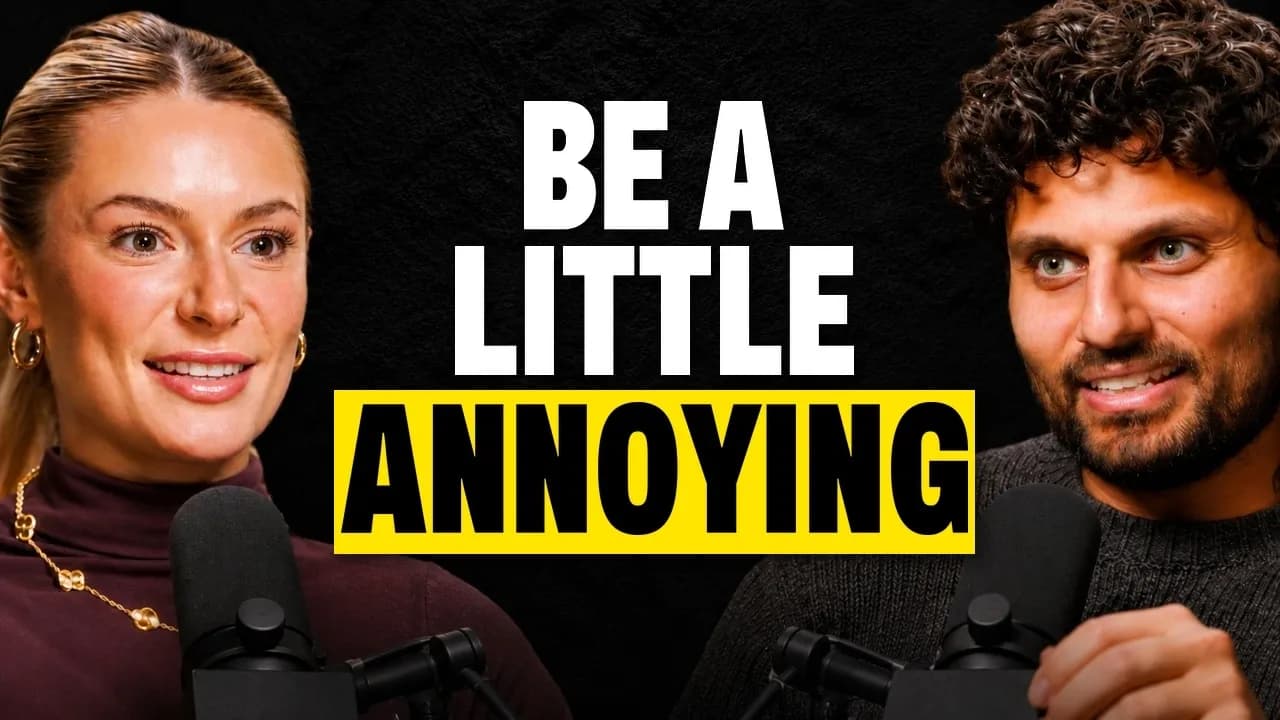
Leila Hormozi: Discipline Isn't a Trait, It's a System You Build
In a Nutshell
Discipline isn't a fixed trait but a system built by making good behaviors easier and bad behaviors harder through environmental design. Confidence emerges as an output of competence, not something you can think or affirm your way into—it requires repeated action despite discomfort, rejection, and negative emotions. The highest performers sustain success by developing emotional management skills, support networks, and patience rather than relying on willpower or avoiding difficult feelings.
These notes were generated by AI and may contain inaccuracies.
When people want to build confidence, they find it difficult because confidence is an output, not an input. Confidence comes after becoming competent in something, not by trying to be confident directly.
At age 19, Hormozi was overweight, drinking, and using drugs. She had affirmations written on her bathroom mirror, repeatedly saying "I'm beautiful. I can do this. I work hard. I have money. I'm wealthy." Despite this practice, she remained insecure and felt none of it was true.
She realized she was waiting to feel ready, but recognized that people don't feel ready until the second time they do something. Confidence, which she equates to feeling ready, requires building competence through evidence.
To build competence, she had to act her way into confidence rather than think her way into it. At that point, she wasn't skilled at anything, which explained her lack of confidence. Her first skill to develop was sales.
She moved across the country with $5,000, knowing no one. Despite being viscerally opposed to sales, she recognized it as a core skill necessary for business. She drove to California, found the closest gym within walking distance, applied to all gyms, and took the nearest one.
The gym required her to market and sell herself, including soliciting people at Whole Foods and approaching gym members on cardio machines. Her first approach was to a woman on a treadmill who immediately said "Off." She ran to the bathroom and had what felt like a panic attack.
She reminded herself that she couldn't let herself down after driving across the country, quitting everything, and telling everyone she was becoming an entrepreneur. She shifted focus to getting as many nos as possible.
Through repeated rejection, she built confidence by seeing she could handle it. Prior to this, she was terrified of rejection due to being bullied in school, not being considered cool or attractive, and having few friends.
She learned that what builds confidence often feels bad in the moment, while what feels good in the moment is often bad for long-term growth.
The times she built the most confidence were when she focused on becoming the best version of herself rather than trying to be confident. Confidence happened naturally as a consequence of becoming more competent.
The skill to develop is not confidence but being okay with being bad at something and maintaining humility. This applies to first gym visits, first dates, first sales calls, and first cold calls.
Hormozi still feels insecure about different things because there are areas where she's still at the beginning of the journey.
Instead of trying to be good, Hormozi asks "How can I be bad?" This includes trying to be a bad boss or bad friend. The rationale is that trying to be bad means taking the risks required to eventually be good.
When asked about negative Glassdoor reviews from 2016, she responded that she wouldn't have her current success if she wasn't willing to fail publicly. She's fine with looking bad and messing up.
The key question is whether someone is willing to experience emotions they don't want in order to get the ones they do want. Many people say they're willing but aren't, because when they feel like they're going to die emotionally, they run the other way.
The mindset shift came through acceptance rather than trying to eliminate negative feelings. Hormozi had beliefs that feeling immense anxiety, terror, or depression were bad feelings to be avoided.
She realized she had been buffering, suppressing, and numbing to avoid emotions that she still felt anyway, sometimes even more strongly.
The relationship with emotions changed when she decided to accept all feelings and be willing to feel them. This acceptance was necessary to achieve discipline and confidence.
She uses the metaphor of anxiety as a passenger in the car rather than the driver. Previously, anxiety dictated direction; now she drives while anxiety sits in the passenger or back seat.
Befriending negative emotions enabled her to do everything in life. The pattern is: being utterly terrified, being okay with that terror, doing the thing anyway, then experiencing relief and pride.
When stuck, she catches herself trying to avoid emotions and forces herself to lean into them instead.
Even the best athletes who have won everything still feel scared stepping onto the court because each day is different with different stakes. The belief that one day everything becomes easy doesn't happen for anyone.
The number one thing holding people back from success is inability to manage their own mind and emotions. Market conditions don't put businesses out of business; founders put themselves out of business through emotional instability.
She shared an example of a company that grew from $2 million to $90 million in three years, then shut down within six months of a lawsuit not because they lost the lawsuit, but because the founder couldn't handle the stress.
During COVID, many businesses didn't end because of market conditions but because owners couldn't tolerate feelings of uncertainty, frustration, and unpredictability.
She experienced a period with four lawsuits, family issues, 12 direct reports, four new hires, while performing three days a week. She managed by doubling down on emotional management.
At age 23, Hormozi started her first business. By age 24, she had 120 employees and the business grew from zero to $50 million in less than two years. This was the most uncertainty she had ever felt and also when she grew the most.
She used the metaphor of a frog in boiling water, where the water kept getting hotter and she had to raise with it.
To maintain sanity during high uncertainty, she established practices: getting up at 4:30 a.m. to journal, walk, make breakfast, have coffee, and meditate before 8:00 a.m. meetings that lasted until 6:00 or 7:00 p.m.
She was ruthless about taking 10-minute breaks to go outside and walk. She viewed this as pouring out her cup all day and needing to fill it back up.
High performers who win for 30-40 years consistently do the things needed to take care of themselves. Using the Michael Jordan analogy, recovery activities like naps, massages, and physical therapy are part of the performance plan, not separate from it.
She creates anchors of stability and control in areas she can manage to bring herself back to her core motivation: becoming the best version of herself.
The speaker explains their approach to life and training as wanting to discover what their body and soul are capable of, training like it's a sprint rather than a marathon. They observe that many people start projects but lack the skills to sustain themselves through uncertainty, leading them to opt out. High performers often excel at pushing hard and applying discipline, but they must also develop complementary skills: knowing when to rest, how to take care of themselves, and how to maintain their mindset. The speaker emphasizes that white-knuckling through challenges relies on willpower, which is finite, and should be reserved for things that truly matter.
When facing increased uncertainty, the speaker responds by asking what additional support systems they need to handle it, treating themselves as they would treat a friend by building comprehensive support networks including therapists, coaches, mentors, consultants, and friends.
The speaker uses the metaphor of building foundations to explain that just as the tallest buildings require the deepest, strongest foundations that remain invisible, higher aspirations require deeper personal foundations. These foundations include practices like early rising, journaling, listening, creating space, and meditating. The speaker notes that entrepreneurs often believe they must handle everything alone, but while supporters may not directly build the business, they help carry the emotional weight and anxiety that comes with growth.
The speaker finds it remarkable that people view business success as separate from emotional human connection. They note that for every anomaly who succeeds without support, there are hundreds more who achieve success because they have that kind of support system. The speaker emphasizes wanting to be great but not believing they need to achieve it alone, and points out the correlation between burnout and isolation, observing that burned-out individuals often have minimal support networks.
The speaker challenges the notion that "it's lonely at the top," suggesting this is a choice rather than an inevitability. They share how as their career has grown, they've actually increased communication with their oldest, deepest friendships, including talking to their best man three times a week despite living in different time zones, recognizing this as a response to increased anxiety and responsibility.
The speaker describes their business partnership with Chiron, where they realized through conversation that both perform better with more communication. They established three scheduled calls per week to ensure consistent support, recognizing that sharing difficult challenges makes the weight feel lighter.
The speaker explains that discipline is not an inherent trait but a system that can be built. The key principle is making it easier to do things that align with goals and harder to do things that work against them. They provide the example of someone struggling to lose weight while eating ice cream every night - rather than self-criticism, the approach is to examine the systems: removing ice cream from the house, replacing it with alternatives in the same location, and creating friction for unwanted behaviors.
The speaker shares their personal experience of wanting to stop drinking while living with six people who drank regularly. By moving out, they removed 50% of their desire immediately because the constant environmental prompts disappeared. For weight loss, they removed all junk food from the house and deleted food delivery apps from their phone, creating friction that made the behavior inconvenient enough to overcome desire.
The speaker emphasizes that memory is a liability when trying to maintain new behaviors. Rather than relying on remembering goals, they build environmental triggers and prompts. Their phone displays a meditation notification upon opening and a food logging reminder, creating systems that grab attention rather than depending on memory and desire alone.
The speaker extends this principle beyond health to relationships, noting that people who cheat often make it easy to cheat by putting themselves in environments with single friends or situations that prompt the behavior. Conversely, surrounding yourself with happily married friends increases the likelihood of staying married. The speaker and their spouse decline invitations to bachelor/bachelorette parties to avoid environments that test their commitment.
The speaker challenges conventional views on work-life balance, suggesting people seek it because they associate work with pain and suffering. They observe that many people dislike their work due to negative past experiences with terrible bosses or poor leadership, which creates lasting negative associations. The speaker argues that work-life balance conversations often stem from not enjoying the work itself.
The speaker describes their approach to building Acquisition.com by spending weeks identifying what they genuinely enjoy doing, who they want to surround themselves with, and what they could see themselves doing for 30 years, then building the business around those preferences. This contrasts with their first business, which was built around what made money rather than what they enjoyed, resulting in exhaustion and the perceived need for balance.
The speaker shares a story from their time as a cashier at a smoothie stand, where their boss inspired them to approach the job as a challenge to make every customer's day better. By gamifying the experience and focusing on making people smile, they transformed their relationship with the work and eventually regarded it as one of their best jobs.
The speaker identifies two approaches to improving work satisfaction: choosing work you genuinely enjoy to the best of your ability, and maintaining a positive mindset about any work you're doing. They note that people often have negative filters that prevent them from seeing opportunities for growth and development in their current situations.
The speaker references a 2019 Yale study by Amy Rousnooki and her team that investigated what Americans considered the most difficult job. The study identified hospital cleaning as among the hardest jobs, involving cleaning toilets, bed sheets, floors, and handling the aftermath of patients passing away. When interviewed, some cleaners described themselves as "low-skilled labor," while others identified as "healers and carers," demonstrating how mindset and self-perception fundamentally change the experience of the same work.
A study compared two groups of hospital cleaners doing identical work in the same hospitals for the same pay. One group called themselves "cleaners" while the other group called themselves "healers." When asked why they identified as healers, they explained that they believed a clean hospital was integral to the healing journey of patients. They noted that families would spend more time with patients in a clean environment rather than rushing out of a dirty place. They also emphasized that clean hospitals gave patients a sense of dignity during difficult times, such as using the bathroom or eating.
Amy and her team coined the term job crafting to describe the idea that it is not what you do for work that makes you happy, but rather how you feel about what you do for work. The healers found greater purpose, happiness, meaning, and positivity in their work by reframing their role as part of the healing and caring process. This demonstrates that even in one of the hardest jobs in the United States, adopting this mindset is possible for anyone.
Patience is identified as the rarest and most valuable trait among people in their 20s. The speaker has observed 75 people in their 20s on their team, and the number one trait of those who succeed is patience. This includes the ability to do boring work, focus on one thing without distraction, avoid shiny object syndrome, and not compare themselves to friends making quick money online.
Jacob started at Acquisition.com at age 16 and became Director of Sales by age 23. When he was told to just call phones as an SDR, he never asked when he would move up or what the next step would be. Instead, he focused on becoming ruthlessly good at the skill in front of him. This patience allowed him to acquire expertise faster than those distracted by trying to advance quickly. The irony is that focusing on moving up prevents acquiring the expertise needed to actually advance.
Patience encompasses several key skills: focus, the ability to tolerate boredom, and the ability to tolerate distractions. The speaker states they crushed their 20s because they were very patient and never trying to get to the next level, instead focusing on getting really good at where they were. They read 12 books on how to run a meeting simply because they wanted to nail that skill.
When asked what one law everyone in the world should follow, the response is: "Leave everyone and everything better than you found."
Keep Jay Shetty Podcast in your library
Save the videos and channels worth coming back to, and find them again in one place.