Lessons from Napoleon, Steve Jobs, Joan of Arc & Other Leaders | Ben Wilson
In a Nutshell
Ben Wilson's podcast "How to Take Over the World" was created to study the traits of great leaders across history, identifying vision, communication, focus, and obsession as the core commonalities. Leaders like Napoleon, Steve Jobs, Edison, Joan of Arc, and Schwarzenegger succeeded by making clear trade-offs, eliminating what doesn't matter, and maintaining relentless determination toward their vision. Wilson's own stage-four cancer diagnosis reinforces his message that sincere belief and focused action enable meaningful achievement regardless of circumstances.
These notes were generated by AI and may contain inaccuracies.
Ben Wilson has stage four cancer and four small children. The host requests help through medicine, introductions, or donations for Ben's family.
Zeal is a word commonly used to mean excitement about something. Aristotle defined zeal as a type of pain felt when someone sees another who is like them in nature who has accomplished good or admirable things that the observer is capable of but has not yet achieved.
Thomas Edison at age 21 was a telegraph operator reading a biography of Michael Faraday. His roommate went to bed, and when he woke up, Edison was finishing the book. Edison stayed up all night reading. He slammed the book shut and said: "Faraday accomplished so much. I am already 21 years old. I might live to be 50. Can I accomplish as much as he did? I am going to hustle."
This same pattern appears with Julius Caesar looking at Alexander the Great, and with Rockefeller aspiring to be like Amos Lawrence. Zeal is a unique source of inspiration from seeing someone who came before and wanting to compete with them because they accomplished so much. This pattern is common among great achievers across all domains.
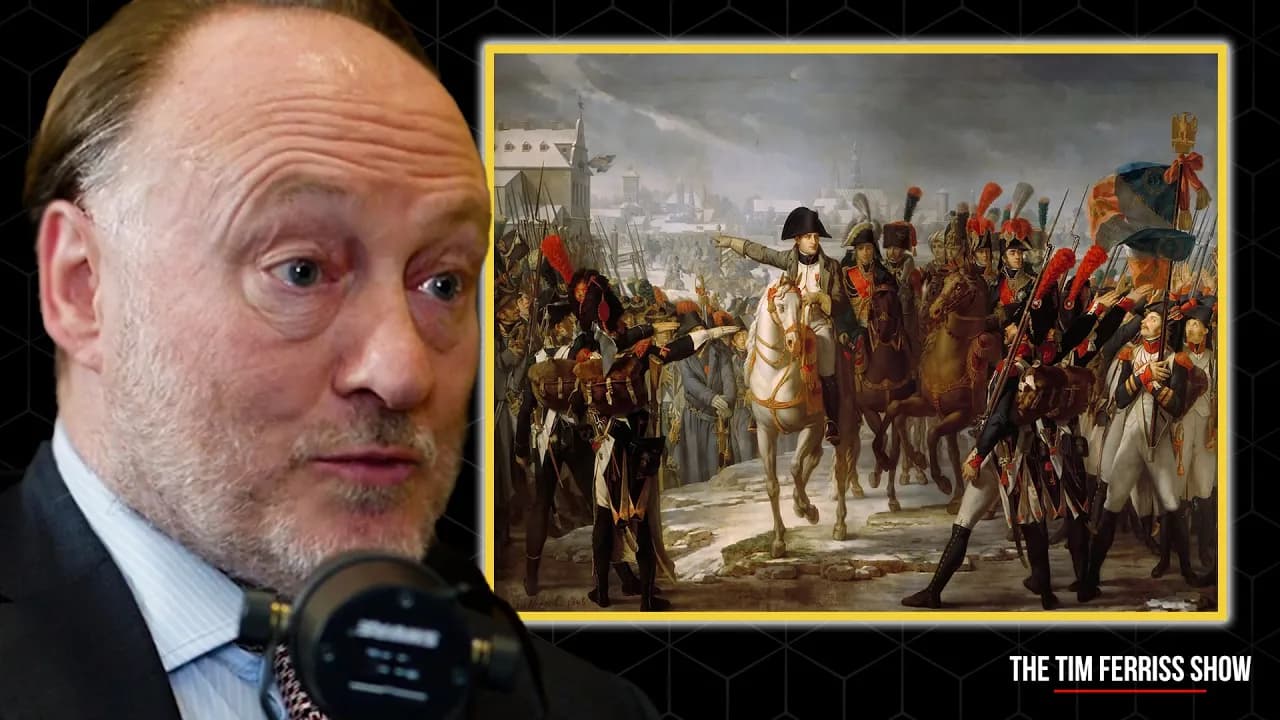
Edison was obsessed with the word "hustle." When asked which historical figure's voice he would choose to hear, Edison selected Napoleon, stating: "I like the hustler."
Ben Wilson explains that he presents diverse stories hoping listeners find one that resonates and creates that moment of recognizing someone like themselves who accomplished what they could but have not yet achieved. He identifies more with Walt Disney than Leonardo da Vinci because da Vinci's brain is fundamentally different - like studying an alien. Wilson states he could never do what da Vinci did.
Walt Disney created empires of the mind as a creative leader who got people to buy into a certain aesthetic vision. Wilson identifies with this ability. The podcast's intro music was created by Wilson in Garage Band in 60 minutes of inspiration, which the host describes as the lone exception to his general anti-intro-music stance.
Da Vinci was exceptional at artistic skill with superior eye-hand coordination. He was curious about things as they are in the world. Walt Disney was curious about things that never were - about things that could be created. Wilson leans toward the Walt Disney model of things as they could be that never have been before.
Isaac Newton's notebooks were called his "waste book" - a book of scraps and notes. The concept removes pressure to produce refined or insightful content. It is a place to dump wasteful thoughts. The most insightful realizations often emerge from moments of unimpeded creativity.
Wilson keeps a journal with detailed entries since his cancer diagnosis. He also maintains creative notebooks where he draws poorly, plans episodes, writes thoughts on historical figures, and composes paragraph-long mini essays. His best insights for episode scripts come from these notebooks.
Eminem constantly writes in hundreds of notebooks, using almost none of it. This practice creates openness essential for creative pursuit. For podcast introductions, Wilson writes the most garbage content initially to get past the blank page and into the meat of episodes, then returns to refine the intro later.
Wilson started the podcast because he wanted it to exist. Reading a biography of Napoleon inspired him. While listening to Tim Ferriss's podcast and finding recent episodes uninteresting, he thought about who he wished Ferriss would interview. He realized he wished Ferriss could interview Napoleon. This led to the idea of being "Tim Ferriss for dead people." He searched for existing podcasts doing this and, finding none, decided to create it.
The first episode was on Napoleon using Andrew Roberts' biography. The second was on Steve Jobs. The formula was set for the next eight years.
The most important realizations are negative - things that should not be done or focused on. Steve Jobs at NeXT had a retreat where the team listed five priorities for the NeXT machine. When asked which was highest priority, they concluded all five were essential. The result was a machine that came out late, over budget, and overengineered, nearly putting the company out of business.
Ten years later, Jobs returned to Apple with a changed mindset. He could make trade-offs. For the iPod, he recognized existing MP3 players had more storage and file formats, but decided these did not matter. The only thing that mattered was creating a great user experience for quickly accessing music. This underengineered product became one of the most successful of all time.
Every great product, leader, and decision comes from understanding trade-offs and realizing what does not matter. The host's podcast succeeds by stripping away elements people would have considered necessary - no intro music, no polished production - focusing only on connecting people to stories.
Elon Musk with the original Tesla Roadster rejected the assumption that electric cars needed great range and affordability. Instead, he went upmarket, recognizing people would pay for speed, coolness, and beauty.
The Wright brothers succeeded because they identified the correct problem. While others focused on propulsion and lift, Wilbur Wright realized from observing birds that control was the hard problem. Birds make micro adjustments constantly. The Wrights went to North Carolina for consistent wind, built gliders, and spent years working on control. Once control was solved, adding an engine made flight trivial.
Daily routines present competing priorities: yoga, weightlifting, journaling, meditation. Following all advice would consume the entire day. Success requires making trade-offs - saying certain things are worth cutting everything else for. Until trade-offs are made, priorities do not matter.
Focus means saying no. Wilson stopped producing other people's podcasts, shut down his agency, and declined opportunities to focus solely on his own podcast. This was necessary to make it as successful as possible.
The question of what makes someone a great leader is the central question the podcast attempts to answer.
Ben Wilson identifies a small number of common traits that link conquerors, artists, and entrepreneurs despite their different archetypes and leadership styles. The most important characteristic is vision.
Without the vision of a goal, a man cannot hope to manage his own life, let alone the life of others.
This quote from Genghis Khan parallels advice given by Silicon Valley leaders like Edwin Land and Steve Jobs, demonstrating that the same quality that made Genghis Khan a great leader also makes modern entrepreneurs great leaders.
The second critical trait is the ability to express and communicate that vision. Great leaders across all domains excel as communicators, though the medium varies. Some are great writers, some are great speakers, some excel at essays while others prefer long form, and some are better at one-on-one communication versus mass communication.
The third essential quality is focus—the ability to shut out everything else and concentrate on their goal. These three traits—vision, communication, and focus—represent the major through lines connecting great leaders across industries, domains, conquerors, artists, and entrepreneurs.
Wilson discusses how studying these leaders leads to self-reflection about personal deficiencies in these traits and the potential to change behavior based on new information. He describes the activity as "completely selfish" because he lacked positive examples from childhood and had no mentor. The Founders podcast, which turns 10 years old, originated from a 2012 Elon Musk interview where Musk explained he looked for mentors in historical context through reading biographies and autobiographies.
The value lies in compression: someone spends a 40-year career, multiple years are spent documenting their lessons, and this can be read in 40 hours and turned into a podcast that can be listened to in 45 minutes.
Wilson notes that Elon Musk himself has pointed out the remarkable links between his life and Thomas Edison's. Musk is more similar to Edison than to Nikola Tesla because Edison was both a great inventor and a great industrialist who brought products to market successfully. Their personalities and backgrounds are extremely similar, including their physiognomy—both had massive heads that people would comment on. Their fathers were both entrepreneurial but "crazy" and they didn't have great relationships with them.
Edison was considered the most famous person in America during his lifetime. Walt Disney and Jeff Bezos both cited him as their hero. A 1957 biography describes how when Edison was 5 or 6 years old, he misbehaved and his father put up a note in their village saying people should come to the town square on Saturday morning to watch him beat his kid. Elon Musk has shared similar stories about his father screaming at him for hours about how stupid and useless he was and that he would never be successful.
Both were considered "dumb" as children. In Musk's case, this may have been due to being slightly autistic and having trouble communicating and emoting. In Edison's case, it was because he was mostly deaf. Neither was shepherded toward greatness; they had to fight for it because people didn't initially think they were right.
There are also weird biographical parallels: Elon is from South Africa but his mother's family has deep roots in America and Canada. His great-grandfather was a politically minded preacher who got in trouble with the government and fled from Canada to the US, living in Minnesota or Iowa. Edison's maternal grandfather was the exact same type of person—a preacher who got in trouble with the government, was run out of town, and had to move to Canada across the border.
Wilson and the host discuss how many of these leaders had giant heads that people commented on. Oprah is another example—when she was an actress, they couldn't find hats big enough to fit over her head. The host shares a childhood story of being called "basketball head" and "lollipop" because he was skinny with a giant round head.
These leaders also had weird diets. Edison went through a period where he would only drink milk. Napoleon was known for being a peckish eater who ate quickly and lightly—he would eat dinner in about 15 minutes and get back to work. Steve Jobs had strange diets including periods where he would only eat apples for months at a time. Vladimir Putin would eat a boiled egg in a day as his entire diet. Joan of Arc fasted constantly and barely ate anything.
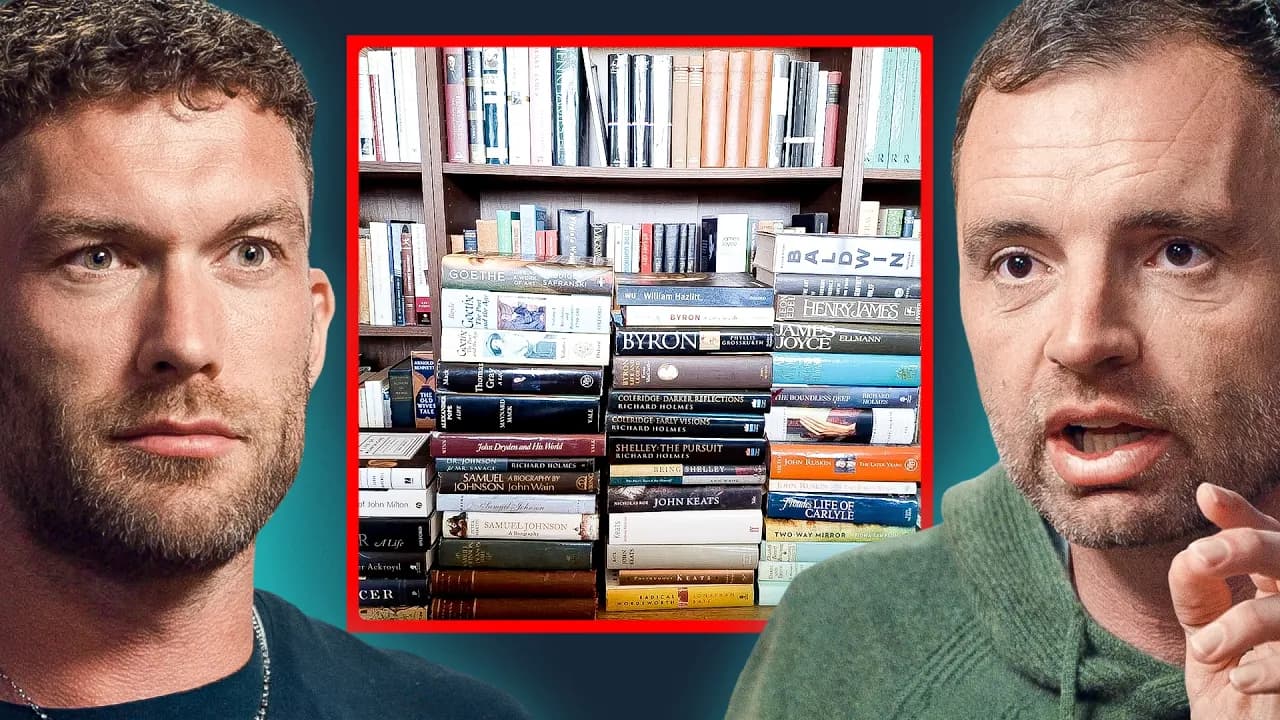
The host suggests that obsession should be added as a fourth trait alongside vision, communication, and focus. Wilson agrees that the biographies he writes about are never about "normal well-adjusted people"—they are all obsessive. He points out that John D. Rockefeller is looking at him from a book cover, and every single person he's written about was obsessed with something.
When asked which book best communicates obsession, Wilson identifies Arnold Schwarzenegger's "Education of a Bodybuilder," which he rereads every year. Unlike many biographies written retrospectively, this book was written in the middle of Schwarzenegger's bodybuilding career, and readers can feel the obsession in real time. The first 120 pages cover his story, while the second half contains his workouts.
Schwarzenegger was 30 when the book was published. He describes being viewed as a freak when he started bodybuilding in Austria—there were only five bodybuilders in the entire country, and his parents thought something was wrong with him. He explains that he will use the same playbook that got him to the top of bodybuilding to build a business empire and get to the top of movies. He talks about applying the same discipline and obsession to whatever he aims at, essentially calling his shot before doing it.
Schwarzenegger discusses how once he locked into a vision and articulated it to everyone, people started helping him. At lunch, people would say "Hey Arnold, you need to get bigger, have my milk" or "You need to rest up for your competition, let me carry that for you." Strangers would help him.
Wilson shares a quote from Goethe: "At the moment of commitment, the entire universe conspires to assist you." This is visible in Arnold's life—when he commits to a vision and articulates it, everyone asks what they can do to help.
Daniel Ek, founder of Spotify, told Wilson that he's "very easy to understand, so therefore you're very easy to help" because all Wilson cares about is podcasting. Great founders make themselves easy to help by explaining in a handful of words what's important to them. Wilson keeps a sticky note on his desk that says three words: "insanely great products"—the same phrase Steve Jobs used from age 19 to 55 to describe what was important to him.
Wilson has studied religious figures including Jesus, Brigham Young, and Joan of Arc. Joan of Arc captured his attention the most. She arrived on the scene at age 15 during the Middle Ages when the French had been trying unsuccessfully for years to kick the English out of France. She was young, female, malnourished, thin, and had no place on a battlefield. Yet once the French started following her, they immediately had success.
The only material difference between her and everyone else was her clarity of vision. Before her, the king of France, dukes, and field marshals all had competing priorities. Joan had one priority: winning the war against the English. She declared God was on their side and that following her would lead to victory. This clarity caused everyone to line up behind her, and they immediately started having success.
This connects to a Paul Graham essay that asks whether intelligence or determination is more predictive of success. Graham's thought experiment shows that keeping intelligence at 100/100 but removing determination creates a brilliant yet ineffectual person. Keeping determination at 100/100 but removing intelligence creates someone who eventually stumbles into success through relentless effort.
Elon Musk is not the smartest person at his companies—engineers at Tesla and SpaceX likely have higher IQs. Steve Jobs was not the smartest person at Apple. But they are the most determined. Musk has a quote about staying optimistic while trying to accomplish big things like going to Mars, saving the climate with electric cars, and saving the world from AI with Grok: "Optimism, pessimism, screw that. I'm going to get it done."
Wilson's main takeaways from Brigham Young were finding something you believe in—he was a true believer—and unceasing action. Brigham Young was unbelievably determined and relentless; he simply would not stop. The host mentions Brandon Flowers of The Killers, a Mormon who doesn't drink, do drugs, smoke, or party. When interviewing the lead singer of The Strokes, the singer noted that while other bands were touring and partying after their hit albums, The Killers put out another album, prompting the question: "Will you please calm down? We're trying to enjoy the fruits of our labor here."
This relentlessness is what competitors notice about successful people—they always say "Will you please slow down? Will you please act like a normal person?" because the level of determination and relentless action is not normal.
Regarding Jesus, Wilson notes that depending on one's beliefs, he is part God, which makes comparison difficult. One insight from early Christianity parallels Nike's growth as described in Phil Knight's biography—nothing dramatic changes, the company grows 50% every year for 20 years through compounding. Similarly, Christianity grew about 50% per year for centuries until it became the dominant ideology in the world. Jesus's ability to persuade is the number one takeaway from studying him. Wilson read the Paul Johnson biography, written by a believer.
The host describes his mother's extreme Christian faith, where she was diagnosed with cancer and attempted to pray it away, refusing medical treatment for two years. He had to drive from Miami to Orlando for every oncology appointment to ensure she attended. Despite being raised attending church every Sunday and Wednesday night, he wanted to explore what practical value exists in studying Jesus as a historical figure, regardless of religious belief.
Paul Johnson's biography is recommended as the best book for understanding the historical Jesus without supernatural elements. The book focuses on how the New Testament frequently describes Jesus looking and beholding, emphasizing his eyes and intense stares. This pattern of remarkable eyes and stares appears across conquerors, dictators, religious figures, artists, and entrepreneurs - including Steve Jobs, Alexander Hamilton, and Jesus.
When asked which category of leaders to study, the host identifies conquerors as most fascinating. Life consists of hierarchies - social, career, economic, athletic, artistic - but the hierarchy of violence sits at the top. Conquerors who most effectively channel violence occupy the pinnacle position. Artists commission great art, and great merchants and entrepreneurs must ultimately respond to politics. Conquest represents the pinnacle of human achievement.
"Ender's Game" is read for fun every year. "Mind of Napoleon" has been reread annually since discovery - a 300-page collection of Napoleon's own words published in 1956-1957, considered one of the best books available.
Napoleon was deeply religious but not in the traditional Catholic or Christian sense. He treated destiny as his god, stating "destiny must be fulfilled. That is my chief doctrine." Steve Jobs similarly held sincere religious beliefs, though non-traditional California atheistic agnostic Buddhism. The sincerity of belief enabled their success, as double-minded people who espouse things they don't genuinely believe are unstable and unable to accomplish great things.
Double-minded people espouse things they don't really believe in or believe only lukewarmly in what they're pursuing. True believers like Napoleon could cast aside Christianity because they didn't genuinely believe it, replacing it with another sincerely held religion. A historical French king who converted from Protestantism to Catholicism saying "Paris is worth a mass" was not a great conqueror because he lacked genuine sincere belief.
Rockefeller wanted to impose order on chaos and controlled not just a commodity but an entire industry from its beginning. His father had a mania for money, was a bigamist, and sold fake cures. His mother was old Puritan stock - a genuinely religious woman. At age ten, Rockefeller read a biography of Amos Lawrence, who gave away $100,000 in crisp dollar bills over his lifetime. Rockefeller declared he would be worth $100,000 someday and found in Lawrence's example the ability to reconcile his passions for money and Christianity.
Phil Knight describes selling encyclopedias and mutual funds poorly, then selling Tiger shoes exceptionally well. When asked the difference, he states: "Belief, I decided belief is irresistible." Passion is infectious - people like Steven Nella, a podcaster and writer passionate about the outdoors, hunting, fishing, and camping, can make any subject compelling through their genuine passion and intelligence.
Two complementary approaches exist: one focused on insights and principles, another on the power of stories. Neither approach is wrong. The same lessons can be learned from Edwin Land, Joan of Arc, or Brigham Young, but different personalities and framing of challenges make lessons click differently at different times.
The host was diagnosed with stage 4 metastatic primary neuroendocrine carcinoma. Initial symptoms included significant weight loss (40 lbs total), which he initially attributed to aging. A primary care doctor discovered a mass in his liver during a first-time visit, leading to immediate scanning that revealed extensive cancer spread.
The host had been reluctant to see doctors and was putting symptoms into Claude AI, which recommended immediate medical attention. Without treatment, he likely would have died within months. Initial prognosis was one year, with 0% five-year survival rate for his cancer type and spread. The cancer started in the lungs as non-aggressive, then spread to the liver where it became metastatic and transformed into an aggressive form.
Cancer has spread to the liver (primary concern), lungs, spine, and brain. The brain represents the biggest current challenge. Treatment so far has included chemotherapy, now completed, followed by Tarlatamab as second-line treatment. This drug was initially approved for small cell lung cancer and extended life expectancy by 6 months to a year in that population.
Some patients with the host's cancer type have been on Tarlatamab for 2 years with continued effectiveness. The drug is now covered by insurance following a recent positive study indication. Next steps include potentially enhancing treatment with a custom mRNA vaccine, representing cutting-edge cancer treatment. A specific marker called SMARCA4 has been identified, opening potential clinical trial options if current treatment stops working.
Despite having four children all five and under, the host maintains an extraordinarily positive outlook. He references Napoleon's young conscripts - 15 and 16-year-olds dying in war - and the historical prevalence of disease to contextualize his situation. He states he would choose the same life again, having found his vocation, a loving wife, and children he adores. Life ending early doesn't negate having lived a fortunate life with years doing meaningful work.
The host acknowledges having difficult moments while going through cancer and disease, but emphasizes that most of his life has been charmed. Contact information will be provided in show notes for anyone who might have resources, drugs, or connections that could help extend his time and find new treatment options.
Ben Wilson's email address will be included in the show notes for those who wish to reach out.
Ben acknowledges the difficult circumstances he faces and expresses appreciation for the support received. He attributes his survival in part to John Huntsman, a billionaire from Utah who founded a world-class cancer institute. Ben initially attempted to navigate the medical system outside this institute but received care there that he describes as remarkable. He notes that people feel they know him through the podcast and have been generous, but emphasizes that many others facing similar situations lack comparable resources or audience reach.
Ben encourages listeners to consider directing support toward those in greater need and specifically recommends donating to Huntsman Cancer Institute or other cancer research organizations to help additional people receive care.
The host affirms that Ben's message reflects his genuine character rather than a performative act, and expresses gratitude for his participation.
Listeners are encouraged to subscribe wherever they listen and leave a review. The host also promotes his other podcast, Founders, noting that for nearly a decade he has read over 400 biographies of history's greatest entrepreneurs to extract practical ideas for listeners' work, and that many guests on the show originally discovered him through Founders.
Keep David Senra in your library
Save the videos and channels worth coming back to, and find them again in one place.