14 Patterns Behind the World’s Greatest Minds - David Senra
In a Nutshell
Great minds succeed through relentless self-belief that precedes ability, using personal disadvantage and criticism as fuel while ruthlessly protecting their information diet and relationships from anything that drains or distracts them. They build simple, obsessive businesses or creative practices around one variable they improve endlessly—whether chicken fingers, vacuum cleaners, or podcasts—and refuse to sell or compromise because the work itself is the reward. Ultimately, relationships determine life quality more than achievement, and the goal is creating something so meaningful you'd do it even if no one watched, then getting it to the largest audience possible.
These notes were generated by AI and may contain inaccuracies.
Rick Rubin stated he is a lazy workaholic who has to force himself to create. He enjoys the act of creation and finishing work but dislikes the months-long process of thousands of takes in the studio. He does not wake up excited to go to work and would rather be outside than in the recording studio. Rubin has felt this way for four decades in the music industry, though he now has more control over his schedule than during his first 25 years when he worked seven days a week, 16 hours a day in dark studios.
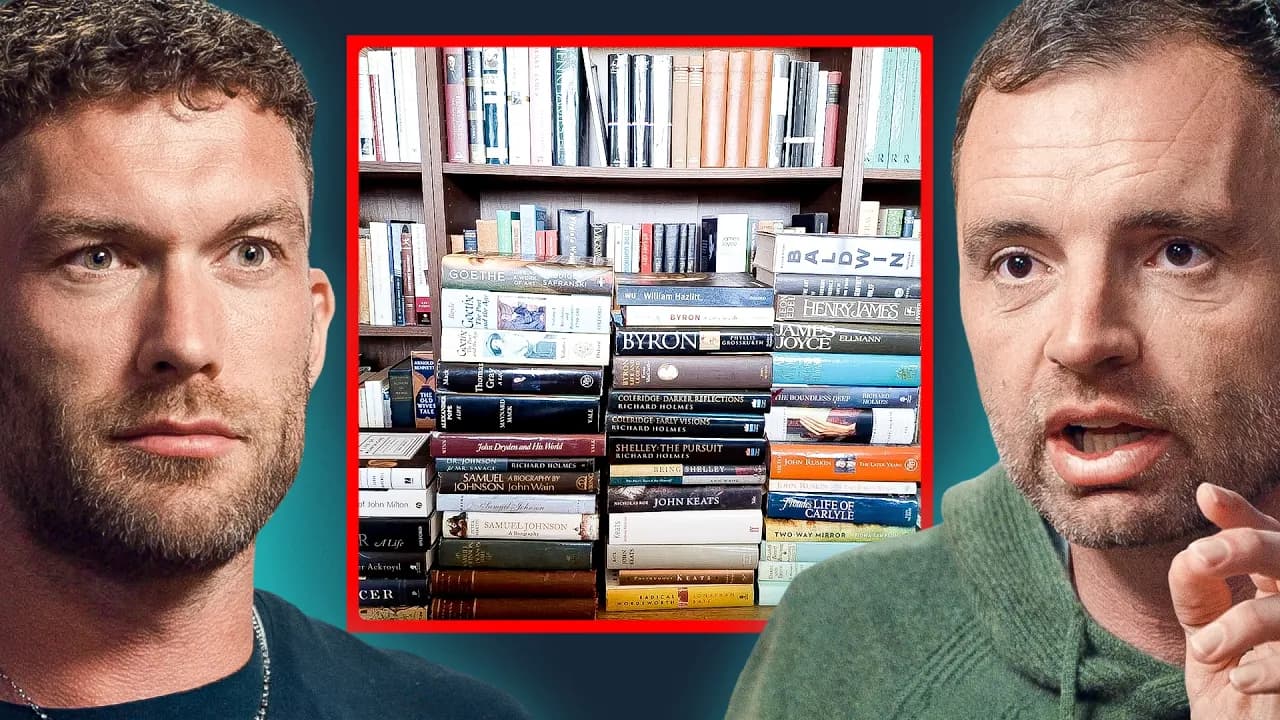
Rubin is driven by addiction to the magical moment of creation—when repeated failure and experimentation lead to one small tweak that solves the problem. He possesses encyclopedic knowledge of music history and uses it for high-level problem solving. During sessions with artists like Red Hot Chili Peppers, he pulls random books from his library, reads paragraphs aloud, and sparks new ideas from the discussion.
Venture capitalist Josh Wolf's quote "chips on shoulders put chips in pockets" describes how people with something to prove often achieve exceptional results. Adam, founder of AppLovin (a company that reached nearly $220 billion market cap with a path toward a trillion-dollar valuation), deliberately hires dysfunctional people who have something to prove rather than those from wealthy backgrounds who attended elite prep schools and Harvard. His number two, Raph, is a high school dropout who started at AppLovin at age 17, was kicked out of his house, lived in the office, and is now the second-largest shareholder with five to six billion dollars in stock.
Adam was rejected by every top VC when seeking a $1 million investment for 25% of his company (valuing it at $4 million). The VCs funded his competitors instead, which became AppLovin's explicit goal: to drive those firms out of business. Adam built an "island of misfit toys"—unusual people who failed repeatedly and would not be hired by big firms—because he believes these scrappy, hungry individuals are the best employees.
People who feel they were "born in the wrong spot" use that feeling as fuel. They reject the destiny of their birth circumstances and believe the world is malleable. Through maximum effort, drive, and intensity, they can change their environment. This mindset drives self-education, reading, and podcast consumption as tools for transformation.
In a 2013 Breakfast Club interview, Kanye West stated he was 10 years ahead mentally and focused on what 2023 would bring. He listed his achievements: becoming the biggest rock star, influencing all musicians, getting the exact woman he wanted, starting his family, ruffling feathers of two presidents, working for his idol, making Louis Vuitton, having people line up at the Yeezy store, and releasing albums including The College Dropout, Late Registration, Graduation, 808s & Heartbreak, The Blueprint series, Watch the Throne, and Yeezus.
A documentary shows Kanye West practicing his Grammy acceptance speech while walking to the train before he had released a single or rapped a bar. This illustrates that belief precedes ability. Kanye maintained a strict filter: anyone who told him to remain only a producer was removed from his life.
In another clip before his first album, Kanye repeatedly stated he would not be compared to other producers or rappers. He acknowledged his early beats were "whack" and taught himself to make hot beats. He taught himself to rap. He claimed a leg up because he hears his beats first. This demonstrates a growth mindset.
The transition from not belonging in one's original environment to feeling at home in a new one creates a "lonely chapter"—the messy middle where someone has outgrown old friends but has not yet built new ones. The Rocky montage takes three and a half minutes in movies but can last four years in reality. Doubt and uncertainty about the future intensify when people around you do not understand, doubt, or actively oppose your changes. Rapid growth feels like chaos to others and highlights their own lack of growth.
In the black pill and incel communities, ascending (being liked by women) leads to being labeled a fake incel because it proves change is possible, which threatens those who prefer apathy with acceptance over hope with disappointment.
Shia LaBeouf described growing up without support and developing a defense mechanism: convincing himself that his own opinion about his life and work was the most important. He cut out anyone providing counter-evidence that he would not succeed as an actor.
NF's lyric states: "The mind is a powerful place and what you feed it can affect you in a powerful way." Shopify founder Tobias Lütke emphasized that how you view yourself matters and that you can change your self-view. For years he told himself he was afraid of public speaking and bad at it. He changed this by writing "I love public speaking" 100 times every day for 10 minutes over one to two weeks. He now enjoys public speaking, gives presentations to thousands of employees, and appears on podcasts.
Lütke's information diet consists of old books and conversations with smart, interesting people. Conversations are evaluated by how one feels afterward—energized and alive versus drained. After some people you want to lie on a sofa; after others you want to run on a treadmill.
People should be deliberate about what they consume mentally, just as they are deliberate about what they put in their bodies. The algorithm on X should not be allowed to push whatever content it wants into your brain. After consuming content, evaluate whether you feel you can achieve more, whether the world feels against you or for you, whether you are bitter and looking for enemies, or positive-sum and thinking about abundance.
Work can be a source of meaning. One life provides one opportunity to do work that resonates. Success achieved by selling one's soul or without personal sacrifice and investment may produce external results without the internal feeling of fulfillment. People with smaller platforms who do work they love can be happier than those with larger platforms who feel disconnected from their output.
Joseph Pulitzer arrived in America as a poor Hungarian immigrant at age 17 after his father and seven of eight siblings died from disease. He fought in the Civil War because wealthy American businessmen paid for European men's passage in exchange for service. He built one of the world's most successful media businesses, owning two of the most successful newspapers including the most successful newspaper in the world. He is credited with inventing yellow journalism—sensationalism focused on violence and sex that appeals to longstanding human interests. Pulitzer later seeded the Pulitzer Prize and Pulitzer School of Journalism to launder his reputation.
David Senra's grandfather arrived in Miami from Cuba at age 38 with a newborn son, two jobs as a butcher and shoe factory worker, no education, and no English. When Castro took over, he recognized the danger immediately and made the decision to leave with his family. This single decision changed the trajectory of Senra's life despite the grandfather dying when Senra was very young. Senra grew up in South Florida meeting people who had arrived on rafts, which gave him an inherent understanding that he was born into a special environment.
Senra is pro-capitalistic but against crony capitalism. He values people who build products that improve lives and spread those products to more people, generating wealth for themselves, employees, and shareholders. He cites John Mackey, founder of Whole Foods, who started as a hitchhiking hippie in Austin with the idea that Safeway was poisoning people. Mackey built Whole Foods over decades, and stock options allowed normal employees like shelf stockers and cashiers to send their kids to college and buy houses.
Charlie Munger's maxim states that extreme business success often involves going ridiculously far in minimizing or maximizing one or a few variables. Successful entrepreneurs have very simple businesses even when operations are complex. Elon Musk constantly talks about simplifying, taking ideas seriously, deleting, and reducing complexity.
Todd Graves founded Raising Cane's with the idea of doing for chicken finger meals what In-N-Out did for cheeseburgers: a super simple menu with three, four, or six chicken finger options. The menu has not changed in 30 years. He started in Baton Rouge, Louisiana, targeting drunk college kids as his initial market but remained open during the day and attracted broader customers because he focused on doing one thing better than anyone else. The business has only four moving parts: chicken fingers, coleslaw, Texas toast, and fries. Graves owns 100% of the company with no franchises, and at the time of the conversation had 915 stores. He is 53 years old, started the company at 23, and is growing faster in year 30 than ever before. His business card reads "fry cook, cashier, CEO." He rejects multiple billion-dollar acquisition offers because he believes God put him on earth to be good at chicken fingers, and he uses the wealth for charity work.
Joe Hudson's daughter described her billion-dollar idea not as something worth a billion dollars, but as something she wouldn't sell for a billion dollars. Senra rejects the start-scale-sell model and is not interested in selling his last company. He believes if you love what you do, your exercise should be death. He gets sad when he doesn't podcast and took two weeks off, which made his life feel deficient. Some people have phases and periods in their careers, but others land on infinite games that fit their personality across time. Senra found his path at 32, and it took another five and a half years before he could pay his bills. Henry Leland founded Cadillac at 60 and Lincoln Motors at 70.
Senra had a conversation with Dana White and admires that there is no difference between White on camera and in private. White built the largest combat organization in the world with tens to hundreds of millions of followers and receives constant criticism, including after putting on an incredible five-knockout fight card at the White House. White cuts out the criticism and reframes mistakes as evidence of trying. When pinned for a situation with his wife in a nightclub, White immediately owned it. After the incident, he put a quote on his office wall: "May God have mercy on my enemies because we won't or I won't." Dana White's favorite quote is: "You can bet against me. Bet against me. Tell me it's not going to happen. Tell me it's going to fail. I love it. I love every minute of it." White also said: "I'm the world's best friend, and if you want to be friends, we can do that. But if you want to be enemies, I can do that, too." UFC was bought near bankruptcy for $2 million, and another $40 million was invested. The company lost money for seven years. When they finally turned a profit in year one, Dana's partner wrote on the board that they would make a million dollars that year, and Dana was happy enough to do it forever.
Michael Jordan is quoted as saying "Successful people listen. Those that don't listen don't last long." Despite his public image as a tyrant, Jordan is a sponge for useful information. Ed Catmull, founder of Pixar, worked with Steve Jobs for 24 consecutive years. Steve fired two Pixar board members because they never disagreed with him and therefore weren't adding value. Senra started doing video podcasts after Chris Williamson told him he could be doing better. Senra notes that people confuse self-belief with ignoring advice, which traps them in local maxima. He thinks about finding humans who can update their worldview with strong opinions loosely held, as opposed to loose opinions strongly held. Charlie Munger would state the best counterargument first when trying to convince someone of something.
Charlie Munger possessed the rare ability to articulate the strongest counterargument to his own position before explaining why he disagreed with it. This skill of thoroughly understanding opposing viewpoints before defending one's own position stands out as exceptionally valuable.
Wisdom is prevention rather than problem-solving. Problems are inevitable in life, and the truly wise approach focuses on avoiding them altogether rather than solving them after they occur.
Charlie Munger experienced profound personal tragedy, including a divorce and watching his nine-year-old son die of leukemia. Despite this suffering, he developed the perspective that problems are inevitable and the intelligent response is to prevent those under your control from occurring.
Munger advised focusing on a small number of high-quality relationships—perhaps four or five people you will do life with. He described most people as "rat poison," emphasizing the prevalence of low-quality and destructive individuals to avoid. Building relationships with great people who love you and eliminating exposure to corrosive personalities removes most controllable problems from life.
Once great work is identified, stay with it rather than jumping around. Surrounding yourself with great people while doing work that feels meaningful and beneficial to the world eliminates most preventable problems. Life will still present uncontrollable challenges like illness or cancer, but wisdom lies in preventing those that can be avoided.
It is far easier to find someone who compensates for your shortcomings than to fix them. Rather than forcing yourself to change fundamental preferences—like going to bed early versus staying out late—seek compatibility with people who share your natural inclinations. This approach preserves your frustration budget for dealing with unavoidable challenges.
There is no nobility in meaningless suffering. While meaningful suffering may hold value, suffering that can be avoided through wise choices should be prevented. The Spanish expression about drowning in a cup of water illustrates how some people create unnecessary drama and problems.
Before finding life's work, ruthlessly edit who gets access to you. Daniel Ek, founder of Spotify, emphasizes that your platform and visibility will attract people who present inauthentic versions of themselves. Have trusted friends evaluate potential relationships because the way people act with you may differ from how they behave with others.
The quality of people around you determines the quality of your life. Shitty people cause unnecessary drama and will "drown in a cup of water." Maintaining a small circle of deep relationships rather than shallow connections with many people protects against corrosive behavior. Being comfortable alone—reading books, making solo podcasts—reduces exposure to others' destructive patterns.
Rick Rubin advocates creating according to your own taste rather than for applause, critics, algorithms, or market demand. His "house on the mountain test" asks: if you bought a remote house that no one else would ever see, would you still put in your best effort to design it exactly as you want? This reveals your true preferences and should guide your creative decisions.
Rubin makes music he wants to listen to without thinking about the audience. The same principle applies to podcasting: create the content you would want to consume. If you wouldn't consume your own content, don't post it.
Grand Theft Life involves stepping outside yourself to view your life as an external observer. Toby Lutke, founder of Shopify, applies a "corporate raider" mindset—imagining he has taken over the company and evaluating every aspect that needs changing. This external perspective reveals problems invisible during day-to-day immersion.
George's framework asks what an evil version of yourself with a mustache would do to beat you. This forces identification of your own shortcomings—such as requiring excessive certainty before making decisions, being indecisive, or giving too many chances. The exercise reveals where greater decisiveness, cutthroat decision-making, or faster action would improve outcomes.
High requirements for certainty before making decisions lead to fewer mistakes but may indicate insufficient speed. Not failing can signal you're not moving quickly enough. The headroom for increased speed may still allow for a good hit rate while accelerating progress.
After achieving breakthrough success, distraction becomes the biggest obstacle. Daniel Ek's repeated advice is to "stay away from the circus"—avoid conferences, unnecessary dinners, and activities that pull focus from core work. The evil version of yourself would get less distracted and remain simpler in approach.
Natural preferences lean toward one-on-one conversations rather than group settings. Being introverted makes group activities uncomfortable. The core work of reading books and making podcasts aligns with these preferences, while the "circus" of social obligations creates distraction.
Many history's greatest entrepreneurs have struggled with relationships. The traits that drive elite entrepreneurial success—expansive personality, increasing appetite for achievement—may create difficulties in romantic partnerships. The more successful these individuals become, the more they want to succeed in every domain, which can conflict with expectations of monogamy and stability.
Arnold Schwarzenegger's former girlfriend wrote a book documenting his driven, non-normal behavior during his early bodybuilding years. The conclusion: a successful entrepreneur needs either a supportive spouse or no spouse at all.
Expansive personalities—where appetite increases with eating—characterize many highly successful people. This drive extends to every life domain, including romantic relationships, leading to patterns of infidelity. The challenge lies in maintaining deep partnerships while possessing traits that push for constant expansion and new experiences.
When selecting a spouse, business partner, or close friend, exercise extreme care. Handsome, rich, and famous individuals face particular challenges because many people approach them seeking something. Discernment—distinguishing between those with genuine best interests versus those seeking personal gain—becomes essential. The consistent advice from highly successful people is simple: make sure she's a good person, meaning not selfish and willing to contribute rather than only extract.
Jimmy Iovine represents an example of sustained partnership excellence. The documentary "The Defiant Ones" chronicles his decades-long working relationship with Dr. Dre.
Jimmy Iovine is in the music business for five decades and has succeeded from engineer to producer to record label executive, building a business that sold for $3 billion to Apple. Jimmy Iovine is approximately 70 years old and has seen everything in the music industry, having worked with everyone from John Lennon to Bruce Springsteen to Tom Petty to Dr. Dre to Eminem.
Jimmy Iovine shared that most people cannot handle success and fall into four buckets:
- Drugs
- Alcohol
- Megalomania
- Women
Megalomania occurs when people start out loved for the work they put in, but then get on stage with 80,000 people screaming their name and begin to think they're not human but some kind of god. They stop putting in the work, which shows up in their output, leading to a death spiral.
The wrong woman in your life or the wrong man in a woman's life can literally destroy you. Jimmy Iovine was dating a Playboy playmate when his dad, his best friend who he talked to every day, died suddenly and unexpectedly. Right after his dad died, he decided to get married and later said he married the wrong person.
What you are praised for in public, you will pay for in private.
The single-mindedness, resilience, motivation, permanent growth mindset, attention to detail, unwillingness to compromise, hypervigilance, anxiety, and dedication that are called reliability, consistency, and non-quitting in the business world can often make you a forgotten person around your kitchen table.
Andy Stump, a Navy Seal, built his entire identity around being a guy that doesn't quit, which made him an amazing SEAL team member but also made him stay in a marriage for a decade longer than he should have.
Certain domains where the things you do publicly aren't meant to be applied are the ones that happen privately. When public and private begin to mesh and blend together, that's what happens with modern social media where you can't see the distinction between the two.
You should not approach romantic life with a rational mind. It is a more irrational, emotional thing. The advice given repeatedly is to make sure the person you're letting into your life in a serious relationship is a good person who actually cares about you and wants good things for you.
Everybody is lying to themselves about something. One lie was thinking relationships weren't important and being a loner, when the truth is that relationships with high quality people are more important than anything else.
Recording the first Raising Cane's with Todd Graves, who built it with his own hands, felt like being high as a kite. The feeling was addictive and better than any drug.
The desire to not be a loser led to becoming a workaholic, working full-time since age 15. Work was seen as how to protect oneself, giving independence and the ability to build a world that can be controlled. Work was viewed as more important than anything else in life.
The realization came that this was a lie. Relationships are the number one priority, with work bumping up against it but still secondary.
For people who are super driven, forgoing some professional success is worth it for a deep romantic relationship, which is what makes life worth living. The irrational choice should be made.
There is an ebb and flow. Taking time to build relationships both romantic and friendship-wise means less professional success, but that is not the kind of life wanted. Some people have no friends because that's not what they're going for—they're playing a different game.
Far fewer people than think it are introverts. The mind is a powerful place. Describing yourself as introverted affects you powerfully. It's more about whether conversations give energy or drain energy.
If you go to sleep on a win, you'll wake up with a loss.
This is a Conor McGregor quote. Some people don't take their own advice and entertain the circus, going to events and loving the material rewards, drugs, and women that come with success.
James Dyson is 78 years old and owns 100% of one of the most successful private companies in the world. He would not sell it even though a friend estimated it would fetch between 60 to 80 billion. Dyson has no outside shareholders. When a friend put a flyer out saying they wanted to buy the company, Dyson responded that it was a family heirloom and not about the money.
Dyson is an engineer and designer obsessed with the work. His first autobiography Against the Odds is recommended as the one book to read if only reading one. It covers the 14-15 years of failing, including 5,126 failed prototypes before the 5,127th one worked. Dyson went to bed in a carriage house, a detached little workshop outside the main house in Bath, England, crying himself to sleep. His kids saw him failing from age four through their teenage years.
The first autobiography was read at least five times. The highlights from that book were read hundreds of times. The second biography written in his 70s was read twice. Dyson wrote an encyclopedia about inventions called A History of Great Inventions when he was 45 or 50.
Dyson picks up a product, thinks about how to make it better, makes it better, puts it back down. A short while later he picks it back up, makes it a little bit better, puts it back down. He did this for 45 years and never stopped.
Dyson is not an absentee executive. He is on the manufacturing line, in engineering meetings, and in design meetings. His fingers are twice as wide as normal from a lifetime of tinkering.
Dyson sees everything around him as something that could be improved. He loves the activity itself and has an engineering mind that treats everything like a giant puzzle.
The preference is to never make it rather than make it and then lose it. The fear of failure is the worst nightmare. This is the difference between the love of success versus the fear of failure.
Young entrepreneurs should spend time with 65 or 70-year-olds who have seen everything. Opportunities to sit down with people like Charlie Munger and Sam Walton were missed because they are now gone. Everything that happens is not personal—somebody else sitting in the same position would be getting the same DMs.
In a 1999 interview, Eminem said he was in it for the respect, not the money. If he had a trillion dollars and fell off, he'd be the most miserable person in the world. He favored status over money and skill set over wealth.
A plaque and platinum status is whack if I'm not the baddest.
Eminem wanted to be the best, not the biggest. Every rapper's goal was to go platinum and get a plaque, but Eminem's point was that platinum status means nothing if you're not the best at the craft.
Jeff Bezos says the goal is building something that can be told to grandkids about, and such things are not meant to be easy. Pride comes from building something valuable. A daughter who is 14 years old met Mr. Beast, who is a massive fan of the Founders podcast. She heard that her dad's work is really valuable to someone she admires.
Family members of accomplished individuals often receive messages from people whose lives were changed by their parent's work. These messages convey that the parent's contributions were meaningful and important. This kind of recognition is described as worth more than money, more than a million or ten million dollars from record sales.
Being admired by people you admire is more addicting and fulfilling than seeking status or money alone. The distinction is between seeking status generally versus seeking status and respect specifically from people judged to be worthy of admiration, both inside and outside one's industry. Admiration within one's own industry is considered especially important because those individuals have the highest amount of taste.
One participant opens episodes by referencing a Q&A where the other was called "the podcasters podcaster." This reflects ongoing data collection on podcasting that is shared openly without holding anything back.
An idea from Rob Moore and Andrew Huberman was shared with David and Ben of the Acquired podcast during a walk in San Francisco. The idea concerned an unmonetized asset in their podcast that was valuable to advertisers. On a later walk, David mentioned the idea would generate $3 million that year. The same approach was taken from Joe Rogan toward the end of the previous year.
The relationship is compared to the early days of George Lucas, Steven Spielberg, Francis Ford Coppola, and Brian De Palma in their twenties. They were friends who hung out, traded secrets, watched each other's movies, and gave feedback. Watching Jaws and then Star Wars results in no loss to either creator. The dynamic is positive-sum. The journey feels pointless without sharing it with others. Contributions can create ripples that affect people in tangential or the same industries.
John Kugaan, who later had a significant acquisition with TPBN, had been discussing podcasting for years before starting his show. He was an early viewer and suggested increasing from three cameras to five, explaining the reasoning. The change was implemented immediately. In a group chat, further feedback was given on a specific shot, with credit given back to John for the original idea. A profile shot was displayed to illustrate why seven cameras are used.
The standard three-camera setup includes medium, tight, and wide shots. Adding a very side-on profile shot creates beautiful framing. This angle allows reverse framing by a simple movement, producing the complete opposite framing. It is used in documentaries during story pivots when the narrative is about to take a turn. The shift functions like a minor chord on guitar, creating an intimate feeling that signals something significant is about to happen.
Danny, season 8 winner of The Biggest Loser, discussed an extra special shame felt when failing after having already succeeded. There is a significant discomfort when people who have the talent for massive success lack the constitution to handle the attention that comes with it. Lewis Capaldi is cited as an example of someone with the singing ability for billions of record sales who initially lacked the constitution to handle the attention, though he later resolved the issue.
Success should be measured by an internal scorecard rather than an outer one defined by society or others. One definition, taken from Steve Jobs, is simply whether something was made that the creator is proud of. The alternative is allowing external metrics, such as download numbers, to define success. The time required to make a great episode includes extensive preparation. For one podcast, this involves reading an entire book. The danger is reducing standards by cutting prep time from 30 hours to six or relying on summaries while still expecting the same quality.
Failure is defined as no longer making things one is proud of. Beyond creation, the work must reach an audience. There are smart and dumb ways to distribute it. It does not make sense to be an underground artist whose work nobody hears while claiming others simply do not understand it. Eventually the market must be listened to, because personal taste may not align with what resonates.
A quote from David Ogilvy states that you cannot save souls in an empty church. If the work is believed to be good for people, there is a moral obligation to get it to as many people as possible. Entrepreneurship is defined as having ideas and actually executing them, applying equally to podcasters, filmmakers, people building Amazon, and athletes. Anyone with an idea they want to bring into existence qualifies. When the work is believed to benefit the world, maximizing its reach becomes a moral obligation.
David Senra directs listeners to search his name in any podcast player or YouTube, subscribe, and listen. The audience is encouraged to join the podcast and listen to Founders as well.
Keep Chris Williamson in your library
Save the videos and channels worth coming back to, and find them again in one place.