LIVE NOW: FOMC RATE DECISION & PRESS CONFERENCE
In a Nutshell
The new Fed chair Kevin Warsh held his first FOMC press conference, maintaining rates at 3.5-3.75% with a dot plot showing nine members favoring rate hikes this year, while announcing five task forces to overhaul Fed communications, data collection, and inflation frameworks. Markets sold off on the vagueness of the new approach, particularly Warsh's comments that "markets will tell us" and his decision not to submit his own dot projection. The speaker warns this represents a major shift from Powell's style, with concerns about Fed independence if task force advisors are influenced by the administration, and advises traders to use lighter position sizing until the new framework becomes clearer.
These notes were generated by AI and may contain inaccuracies.
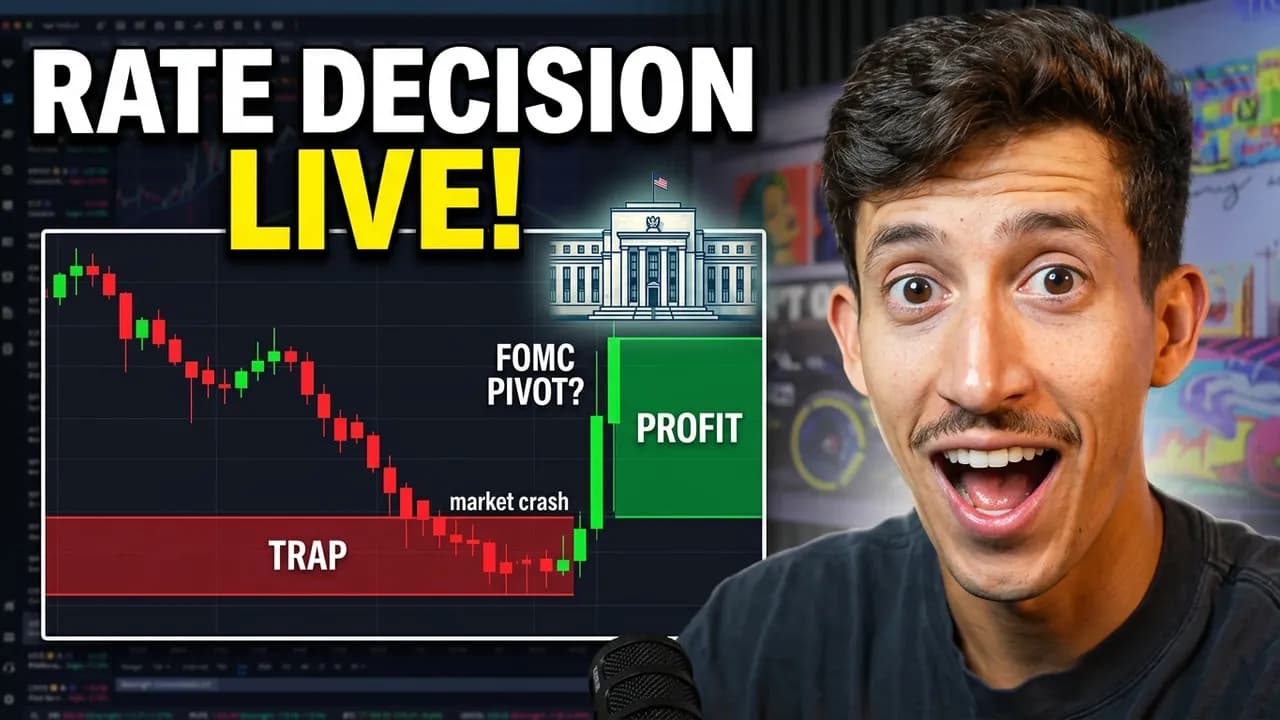
Ricky from TechBud Solutions is hosting a live stream for the FOMC rate decision and press conference. This marks the first press conference with the new Fed chair, who is expected to serve 7 to 14 years. The Nasdaq market is slightly in the green, up about half a percent, but has been consolidating throughout the day.
The primary focus is not the rate decision itself, as there is a 98.6% probability the Federal Reserve will pause. The bigger focus is the overall outlook - whether committee members are open to rate hikes this year. The dot plot is significant, with three officials expected to pencil in rate hikes this year, which could cause markets to sell off.
The guidance from the Federal Reserve matters more than the actual rate decision. If members are more open to raising interest rates rather than cutting, especially as they move away from the 2% target, this creates uncertainty. Trump closing and signing a deal either today or by Friday could potentially reduce that uncertainty.
The LPP landing page has been updated with revolving tickers based on real-time data, a risk-to-reward ratio calculator, and an economic calendar powered by investing.com. The market expectation is no change in rates. SpaceX is down 2% on the day.
The market shows a slight pullback with no break of structure initially. QQQ has strong support at 731. Markets begin selling off more significantly, making new lows on the day and from yesterday. From 0.5% in the green, the market moves to down a quarter of a percent and falling. The press conference is still pending.
Markets are oversold in shorter timeframes but have significant pullback potential in larger timeframes. Intel is performing strongly among semiconductor stocks, while weaker stocks are more open to selling off. Rocket Lab, ASTS, and RWR are showing interesting correlation - recovering while SpaceX sells off.
MSTR went from $200 to $100 per share. Bitcoin is showing signs of strong support at 60,000. The $100 level is historically a strong support for MSTR. MSTR has billions in unrealized net losses, makes no money as a software company, has a negative P/E ratio, and uses share offerings to borrow at 0% interest to buy Bitcoin. The recommendation is to buy Bitcoin directly or a Bitcoin ETF rather than MSTR.
CRM is down 2.78% and being considered for a long position. The stock has gone from $230 to $150. It has 57% upside based on fair value, high shareholder yield, 24 analysts have revised earnings upwards, and it's trading at a very low PE ratio. The company produces $42 billion in revenue. Bear case includes ongoing weakness in commerce cloud, marketing cloud, and Tableau, debt issuance of $25 billion, short-term obligations exceeding liquid assets, and cash flow rating at 5 out of 10. The stock is over-leveraged with heavy capital deployment. The stock trades near 52-week low of 161, down 34% in 6 months and 33% year-to-date.
The analysis software being used is Investing Pro, available at up to 55% off through the first link in the description. Pro breaks down to less than $9 a month, Pro Plus at less than $23 a month.
Marvell has gone from $70 to highs of $339 per share. The stock makes $2.5 billion in net income and $8.7 billion in revenue with a 102 P/E ratio. Jensen called it the next trillion-dollar company. Growth has been strong with bullish indicators across price momentum and growth health. However, the stock is overvalued and has more than 50% to lose if markets sell off. The company is paying a premium to own it.
Nasdaq is forming lower lows and getting rejected at old support levels which are becoming new resistance. Intel short position is not selling off as much as expected.
Kevin Warsh opens the press conference by expressing honor at returning to the Federal Reserve during a consequential time, noting the warm welcome from colleagues and the rigorous debate that characterized this week's FOMC meeting. The committee decided to maintain the target range for the Fed funds rate at 3.5% to 3.75% in support of the dual mandate of price stability and maximum employment.
Warsh reports that economic activity is expanding at a solid pace despite elevated uncertainty from the Middle East conflict, with strong productivity growth and capital investment. Job gains have kept pace with the workforce, and the unemployment rate has changed little. He acknowledges that inflation has been running well above the 2% goal for more than five years, creating a burden for American people, but states that "the recent past need not be prologue" and that the committee is "unambiguous and unambiguous" in its commitment to deliver price stability.
Warsh notes that the policy statement is shorter and simpler, dispensing with some older language, and that forward guidance has been removed as it was not well suited to the current policy conjecture. He refrained from offering personal economic projections, consistent with his long-held views on the Summary of Economic Projections (SEP).
The median projections show real GDP rising at 2.2% this year and 2.3% next year, with total PCE inflation at 3.6% this year and 2.3% next year. The unemployment rate stands at about 4.3%. The median participant judges the appropriate federal funds rate to be 3.8% at the end of this year and 3.6% at the end of next year.
Warsh announces the appointment of task forces in five key areas:
- Fed communications
- The Fed's balance sheet
- Use and reliance on existing data sources
- Productivity and jobs in an era of transformation
- The Fed's inflation frameworks
These task forces will enlist the best minds both inside and outside the economics profession, supported by Fed staff, with a charge to start with first principles, ask hard questions, examine current practice, consider alternatives, and propose next steps.
Warsh expects the task forces to begin work in the next couple of weeks, with framing starting in the fall and most concluding by year end. Regarding the inflation framework review, he clarifies that the 2% inflation target is outside the scope of review, stating that "until we have reestablished our commitment and ability to deliver on the 2% inflation objective," there is no reason to revisit it.
When asked about the SEP showing core PCE at 3.3% by year end and 2% not reached until 2028, Warsh reiterates that inflation is a choice and that the committee has decided to deliver on the 2% objective. He notes that forward guidance was dropped partly because it doesn't feel right at this moment, and partly because some committee members believe forward guidance isn't the business the Fed should be in.
Warsh describes current policy restrictiveness as "uneven," noting that while Fed policy appears somewhat restrictive in housing markets, it would be difficult to characterize financial markets as experiencing restrictive policy. He attributes this to different transmission mechanisms of monetary policy through interest rate and balance sheet tools.
Regarding the dot plot showing nine members suggesting rate increases by year end, Warsh explains that colleagues understand the world is changing quickly and didn't feel bound by their dots. He heard humility rather than strong conviction in their modal forecasts. He did not submit a dot himself, viewing it as not helpful in the conduct of policy.
Warsh states that press conferences are useful when there is something important to say, referencing his mentor George Shultz's mantra. He indicates that today's press conference was warranted due to the commitment to deliver price stability and the initiative to rethink practices.
Warsh acknowledges that inflation remains elevated relative to the 2% goal, in part reflecting supply shocks including energy prices driven by the Iran conflict. However, he emphasizes that the Fed's commitment to deliver price stability is strong, unanimous, and unambiguous.
The data task force will evaluate new information sources and consider methodological changes to improve data gathering, aiming to provide more accurate, relevant, contemporaneous, and actionable information. Warsh notes that most data consumed by central bankers comes from old-fashioned survey methods that don't reflect the modern economy, with response rates that are inadequate and questions that may no longer be applicable.
Warsh emphasizes the need for real-time information rather than data subject to long revision lags, noting that private companies operate with real-time data while monetary policy faces normal long and variable lags. He seeks to reduce error bounds because hard decisions must be made in real time.
Warsh argues that financial markets perform best when reacting to incoming data rather than anticipating Federal Reserve reactions. He wants to create a system where markets follow data they believe is reliable, providing better information through market prices to inform Fed decisions.
Warsh reveals there was one proposal on the table during the meeting with no discussion of other proposals. The discussion on that proposal was limited, and the group was unanimous and non-ambiguous. He notes this was the practice of having a range of alternatives, but today only one major subject was addressed.
Claire Jones of the Financial Times questioned why the Fed did not raise rates given the statement's language about inflation risks. She also asked about best practices from other central banks that might inform the task force approach.
The Chairman responded that his answer to the first question was contained in the statement itself, noting that market reactions to unfiltered comments are more helpful than further improvisation. Regarding best practices, he emphasized finding the best minds for task forces and ensuring diverse perspectives around the table, with the committee making final decisions after robust internal discussion.
The Chairman described how task forces would bring recommendations that could be agreed upon or debated internally, creating a stronger dialectic to deliver on price stability objectives. The approach involves having the best people around the table, with the committee making final decisions on recommendations.
A trader identified as Ahama Baba reported being up $4,000 on a short position in Intel, having added to the position during a gap up. The trader emphasized focusing on personal trades rather than others' positions, noting they had covered a portion of the short position for LPP traders.
Brian Cheung asked how dropping forward guidance would be explained to everyday citizens facing rising prices. The Chairman responded that the Fed's role is to prevent changes in specific prices like oil, eggs, or milk from having second and third-order effects across the broader economy, rather than directly controlling individual prices.
The Chairman confirmed ongoing breakfast meetings with Treasury Secretary Yellen, noting these discussions help maintain awareness of fiscal developments. He stated he had no comment regarding conversations with the president since his swearing in. The central bank's objectives remain distinct from fiscal authorities, though monetary policy independence does not preclude interest in fiscal developments.
Steve Liesman referenced the Chairman's previous comments about productivity enabling rate cuts. The Chairman discussed AI as potentially the most significant economic change in his adult lifetime, describing it as shorthand for American ingenuity while acknowledging both opportunities and risks. He noted the committee discussed productivity and AI, with task forces examining timing, scale, and policy implications.
When asked whether the current funds rate appears restrictive given strong job growth, elevated inflation, and soaring markets, the Chairman described policy effects as uneven, with restrictiveness visible in housing but difficult to characterize elsewhere. He rejected the notion of a cruel choice between inflation and employment, arguing that strong growth, low prices, and strong employment can be mutually compatible.
Nick Timiraos suggested credibility required tightening or threatening to tighten. The Chairman noted this view was not shared by any of the 19 committee members. Regarding AI's impact, he acknowledged the difficulty in measuring supply effects versus demand, noting data centers and infrastructure show up in GDP figures while supply-side growth timing remains uncertain. He described this as a race between supply and demand, with task forces examining when these lines cross.
Andrew asked about potential overhauls to national accounts systems. The Chairman clarified this was not the ambition, noting much data gathering occurs in other agencies deserving respect and deference. However, recommendations from Fed staff about improving data collection would be considered. He also addressed building renovations, noting he had met with the Inspector General and would review an upcoming report on building projects expected later in summer, focusing on being good stewards of taxpayer money.
Victoria Guida asked about inflation expectation increases in the SEP and whether they related to Iran war developments. The Chairman reported the committee split evenly on whether policy rates should be at current levels or adjusted, with half favoring lower rates and half higher rates through year-end. He noted ongoing discussion of first and second-round effects with no resolution yet. Regarding the SEP process, he confirmed colleagues would continue submitting forecasts while a new communications framework and potential SEP changes were under committee discussion for implementation by year-end.
Andy Harner asked about principles guiding the Chairman's reaction function. The Chairman emphasized credibility comes from delivering on commitments across monetary policy, supervision, regulation, consumer affairs, and payments. He noted having devoted more time to monetary policy in his first three weeks but stressed that delivering on all promises enhances credibility across all functions.
The committee viewed labor markets as stable, with some members seeing positive trends over three to six month periods rather than individual data points. Strong productivity-led growth was embraced rather than feared.
The Chairman's first meeting featured emphasis on task forces for new approaches, AI integration, and willingness to try different methods. Market reaction showed initial volatility with recovery, remaining within established trading ranges. The approach represents a shift from previous communications styles, with markets continuing to function as leading indicators while the Fed adapts its framework.
The market is pulling back slightly due to the vagueness in the new Fed chair's approach. The uncertainty stems from the fact that he did not vote on his own guidance, raising questions about how the Federal Reserve will continue providing market guidance that has historically been important. The speaker acknowledges the new chair seems like a very smart individual, comparable to Jerome Powell, and cautions against making quick judgments.
The new Fed chair discussed a task force that functions essentially as a group of advisors he is still in the process of hiring. He indicated that meetings might only be hosted if there is something meaningful to discuss, which could be interpreted as potentially reducing the frequency of communications. The speaker notes that people generally resist change because they are accustomed to established processes.
The new Fed chair made comments about the stock market and its influence that Jerome Powell would likely never have addressed, as Powell maintained a strict boundary against crossing into market commentary. This represents a significant shift in approach that some market participants will appreciate while others may find concerning.
The speaker expresses concern about the new chair's comment that "markets will tell us," finding it problematic if the Fed head makes decisions based on market reactions. The speaker believes the Federal Reserve's focus should be on price stability and inflation for all Americans, not on stock market performance, which does not necessarily represent average Americans.
The new Fed chair appeared optimistic and confident about using AI to achieve both price stability and employment goals simultaneously. He reiterated his previous stance that "inflation is a choice," though the speaker questions whether this confidence might be premature.
The speaker has covered approximately half of an Intel short position, realizing around $7,000 in gains for the day. The trade was executed by adding to the position at overbought levels and covering as the stock declined, demonstrating both upward and downward trading opportunities.
The speaker raises concerns about the task force structure, noting that advisors do not hold the same regulatory responsibilities as board members and could potentially be influenced by external biases. There's worry that if advisors are influenced by the administration, this could create a loophole affecting the Fed's independence.
The speaker emphasizes the importance of being open to new approaches, acknowledging that current methods haven't been working perfectly. While it's easy to criticize the vagueness, the speaker suggests withholding judgment until more information is available about the task force and its effectiveness.
The speaker clarifies that despite frequent intraday short positions, their largest positions are long-term holdings. They advocate for a level-headed approach rather than spreading panic about the new Fed leadership.
Current market sentiment appears uncertain following the FOMC decision. The speaker advises against making permanent decisions based on short-term volatility and suggests considering whether the current situation presents a buying opportunity or requires a more cautious approach with lighter position sizing.
The speaker promotes using risk calculators and planning tools to understand profit and loss potential before executing trades. They emphasize that calculated, intentional trading is more important than achieving perfect results every time.
The speaker stresses that learning comes from understanding the reasoning behind trades rather than copying them. The daily live sessions are designed to share thought processes and intentions, with the principle that "you learn nothing by copying, but you learn everything by understanding."
The speaker warns about fake accounts impersonating them on various platforms and clarifies that they only offer the LPP service for daily live trading sessions. They explicitly state they do not trade for other people, manage crypto funds, trade forex, or manage funds for others. The only communication channel is through verified Instagram, and all legitimate links are provided in the video description.
Keep Ricky Gutierrez in your library
Save the videos and channels worth coming back to, and find them again in one place.