LIVE NOW: SPACEX IPO TRADING AT $160
In a Nutshell
SpaceX IPO opened at $150 and traded up to $160, with the host executing multiple buys and sells using small positions and testing order fills. Market orders caused poor fills due to wide spreads and volatility, while limit orders were recommended for control. Key advice: use small position sizes with money you can afford to lose, avoid leverage, set alerts instead of watching all day, and expect typical IPO retracements after the initial hype.
These notes were generated by AI and may contain inaccuracies.
SpaceX IPO opened at $150 per share and is currently trading at $160 per share. The host demonstrates trading mechanics using one share as an example. Market orders can fill at unexpected prices due to high volatility. A market buy order filled at $160.48, which was $1.80-$2.00 above the listed price. A market sell order at the $164-$165 bid-ask spread filled at $165.84.
Market orders are dangerous with high volatility stocks because they can fill at any price. Limit orders should be used to control execution price. The host demonstrates moving a limit order higher when the initial price doesn't fill. The spread between bid and ask creates significant discrepancies that can hurt traders using market orders.
Rocket Lab nosedived and recovered, then dropped back down to 10-11% in the red after previously recovering to positive territory.
SpaceX is up 23% from its IPO price. The IPO price was $135. The host expresses surprise at the performance and notes a big dump occurred after the initial run-up. The stock reached lows of $160 during the session. The host is not super impressed with the performance despite the 20% move from IPO price.
A 20% move from IPO price is significant but not unusual given recent irrational market behavior. The host does not favor speculative plays but is live streaming due to viewer requests. The host asks viewers if they are impressed or let down by the price performance.
The host bought five shares at $161. The host states they will buy more but is not super impressed with performance. The host has $8,000 of exposure remaining after reducing position. A $900 profit was made on the day with 100 shares open. The host warns that this $900 can be wiped out if SpaceX dumps.
The host tested a market buy order during the drop and got filled at $155, which was better than expected. The stock broke below $156 support. The host states shorting is not allowed on this stock currently.
The host bought 100 shares at $159, filled at $159.50. The host stresses not using leverage or margin with speculative stocks. Traders should buy with money they can afford to lose. Light positions are recommended if entering. Limit orders should be used instead of market orders. Testing with one share helps verify fill quality.
The host tested exiting five shares near $162-$163. The market order fill was acceptable. The host sold 50 shares at $163.79. Volume is beginning to slow down. The host reduced exposure by selling 25 shares and is left with one share.
A nice retracement occurred after a push. The host retested at $164. Level 2 data is lagging behind actual price action. Price showed at $162 while bids showed at $164, creating a discrepancy. The host warns this is not a safe stock to trade right now.
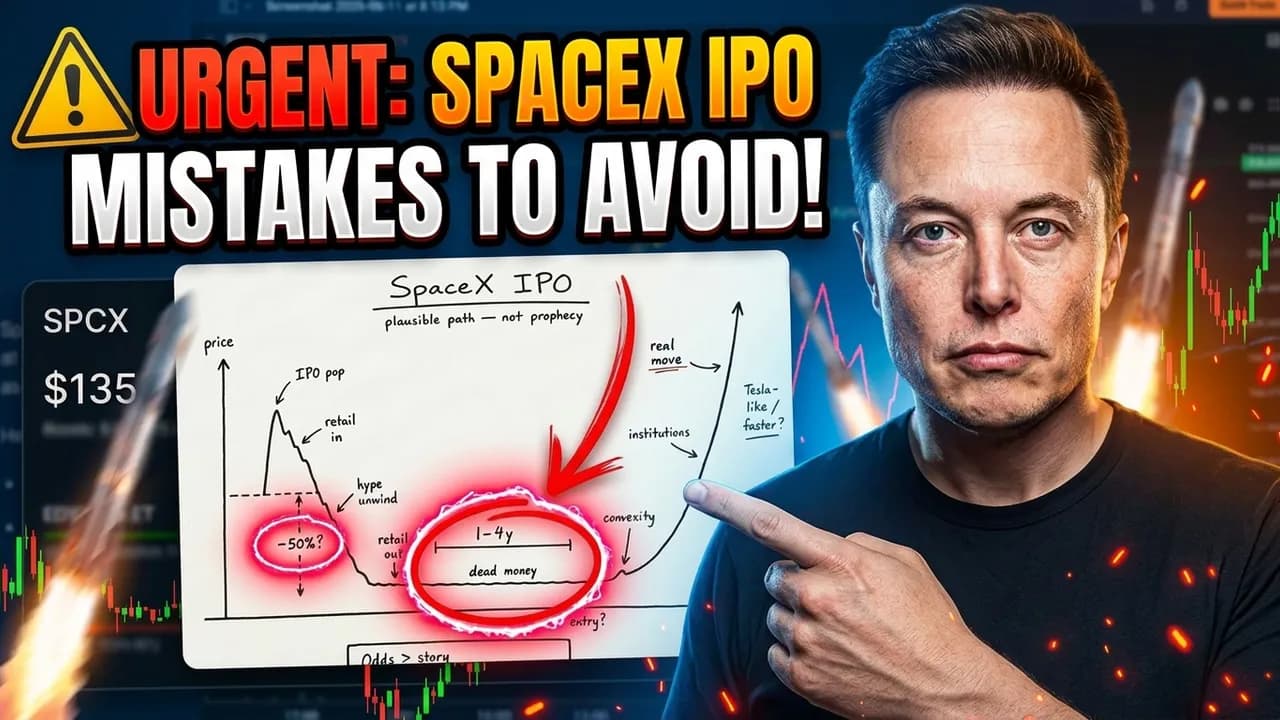
The host emphasizes habits should align with goals. Day trading SpaceX requires understanding overbought and oversold levels. IPOs typically experience huge retracements after initial hype unwinds. The host bought at $160 with a planned stop loss at $150 and profit target at $200 with 10 shares. Risk-reward ratio is $400 potential profit versus $100 potential loss. Changing stop loss to $140 creates 2:1 risk-reward, which may be less favorable.
With a $1,000 account, do not go in with the full amount. With a $10,000 account, do not go in with the full amount. 5%, 10%, or 20% exposure is reasonable depending on risk tolerance. The host reduced to 50 shares at $164.82 exit price. The host only trades shares, not options.
Best case: SpaceX could reach $200-$250 if momentum builds. Worst case: SpaceX could drop to $135 or below $100 within weeks. The host wants viewers to take risks they can tolerate. Position size should be determined by what one can afford to lose down to $135 without devastation.
IPOs typically drop within a week or later. SpaceX is not a typical IPO. Statistics show what tends to happen, not what must happen. Trump is pumping markets. The host made $954 on the trade with a small position.
Previous resistance range is being tested. Breaking above $170 could lead to $175-$180. Rejection at resistance combined with NASDAQ dropping would be concerning. NASDAQ holding above VMA is a positive sign. SpaceX is not phased by broader market weakness while Intel, MSTR, Robinhood, and Tesla are dropping. Rocket Lab showed impressive recovery.
Alerts should be set rather than watching all day. Trading more does not yield more profit. Being selective and intentional is key. Taking one or two quality trades per day is optimal. Missing trades or finding nothing that meets criteria is normal. Trading every day is abnormal. Money flows in and out of SpaceX.
SpaceX achieved an 8% move from the $150 opening price. An 8% move is impressive but not extraordinary compared to stocks like Micron Technologies and Intel that move 8% regularly. The host thought irrational markets could drive SpaceX to $200-$300. The host does not believe SpaceX is valued at $1.77 trillion at $135 per share. The stock is up 20% from IPO price and 9% since opening, closer to 5% after the first minute.
At $150-$160 per share, Elon Musk is close to becoming the first trillionaire. The host will need to verify exact ownership stake in SpaceX to confirm.
Do not use leverage or margin. Buy with money you have. Use limit orders more than market orders. Test fills with one share. Cash out when in doubt. The host provides daily live trading sessions through LPP with lifetime access and A2Z video lesson library. Promo code SAVE300 offers $300 off.
Keep Ricky Gutierrez in your library
Save the videos and channels worth coming back to, and find them again in one place.