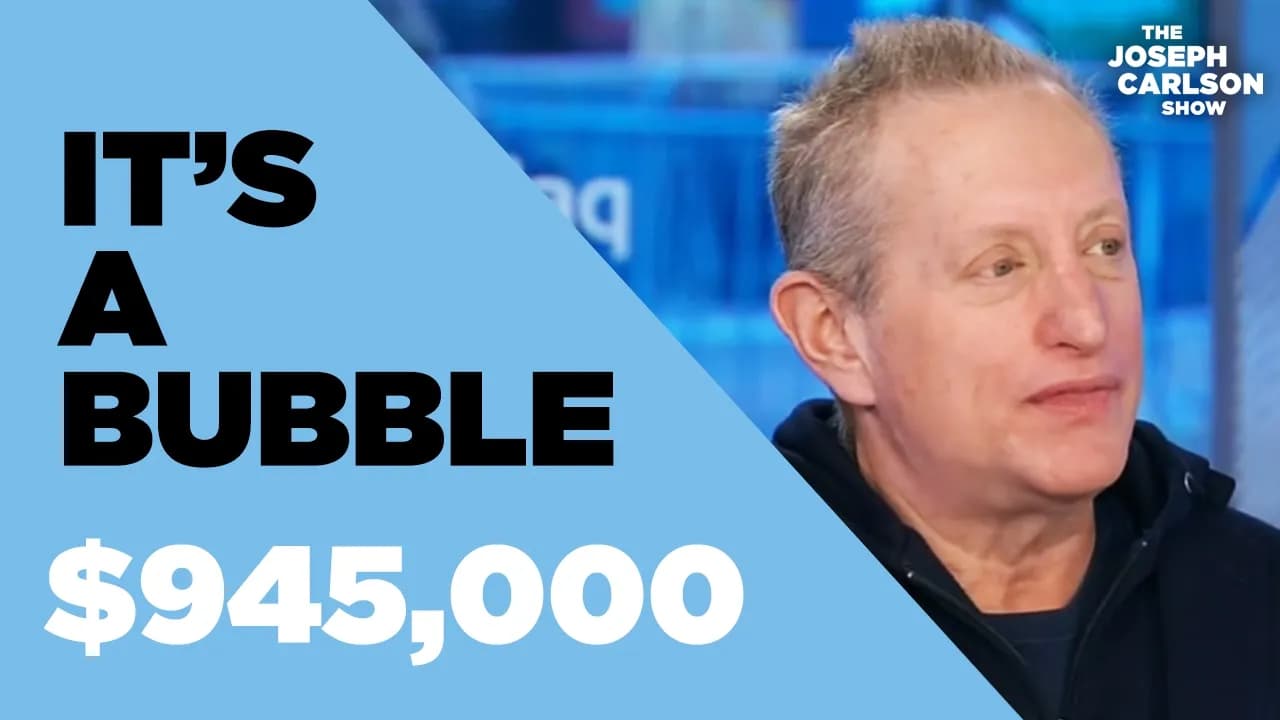
Martin Shkreli: Big Pharma's Blind Spot, Betting Against Quantum & What Prison Taught Him
In a Nutshell
Martin Shkreli argues quantum computing is a fraud limited to specific math problems like integer factorization, with clock speeds in hertz, no storage, and no practical business use compared to Nvidia GPUs. He sees analog optical computing as the real future for matrix multiplication and is exploring startups in this space, while calling AI drug discovery hype and predicting no AI-approved drugs in the next decade. Shkreli admits his refusal to accept he wasn't a top hedge fund trader led to prison, and stresses that self-awareness and psychological impulses drive most failures more than external factors.
These notes were generated by AI and may contain inaccuracies.
Martin Shkreli has been described as the most hated man in America for raising the cost of a life-saving drug by 5000%. He was labeled the propaganda face of capitalist greed. Shkreli spent 7 years in prison. He stated that his company would definitely raise the price and noted that companies can be sued if they do not maximize profits. He emphasized that businesses must do everything possible to earn maximum money, stating that if people view him as their enemy, he is happy because he is fulfilling a need in their lives.
Shkreli bought the only copy of a legendary Wu-Tang Clan album with no immediate plans to play it. He described it as a very good album. He stated that the ego is the source of all progress.
Shkreli believes quantum computing is a scam and fraud, and that people might go to prison for it. He described it as shameful and utterly shameful. His thesis is that quantum computing relies on a single algorithm, invented because of Peter Shor's thought experiment about algorithms that run faster in different media. This was a revolutionary idea in computing but not a revolutionary business idea. The key limitation is that it only works faster for specific algorithms like integer factorization or the discrete logarithm problem of elliptic curves (ECDLP), which it can solve in polynomial time instead of exponential time. For business purposes, unless working in numerology, there isn't much to get excited about.
Modern quantum computers operate at clock speeds of hundreds or thousands of hertz, not gigahertz speeds. They are single-core and single-path for tasks like merge sorting. Quantum computers will never outperform an Nvidia device or surpass one million Nvidia devices. Quantum computing also has no storage space, with no quantum random access memory (RAM), so problems must be designed with very small inputs. OpenAI has rejected every quantum computing idea presented to them.
Counter-arguments suggest we are at an early stage similar to the transistor era, where logic gates, programming logic, operating systems, and programming mechanisms would eventually develop. Shkreli acknowledges this possibility but questions whether one would bet on punched cards, vacuum tubes, mercury delay lines, or magnetic core memory, noting these technologies disappeared and their companies went bankrupt. Companies like CTR became IBM, but this doesn't guarantee success. He views the criticism as both business model and timing issues, noting that Google, IBM, and Microsoft spend hundreds of millions annually on quantum computing with the vague hope that something might come of it someday, which he finds shocking. Google has a few prototypes, IBM has a small cloud, and neither Shkreli nor his wife Chelsea could multiply 300 by 200 on any quantum computer.
Shkreli believes it's crazy to think quantum computing will break encryption through brute-force solutions. He notes that artificial intelligence fundamentally involves matrix multiplication, which GPUs spend 99.9% of their time doing in time complexity of (n) cubed. For a thousand-element square array multiplication, this requires a billion operations on Nvidia machines. He predicts complexity algorithms will become common language over the next five to ten years.
While browsing Nature magazine, Shkreli discovered a Microsoft research paper on Analog Optical Computing (AOC). Matrix multiplication in light is free and happens instantaneously. He and his wife are exploring this area, possibly starting a company. Startups like Neurofus, Opticore, and Lumai are developing optical array-hitting cores that will surpass Nvidia's capabilities. He acknowledges details remain regarding nonlinearity and storage.
Shkreli was a hedge fund manager. He started at age 16 in Jim Kramer's hedge fund, where Kramer was a skilled trader achieving 23% annual net profit after fees through constant buying and selling. Kramer assigned him to study genomics. He later moved to Tiger Capital and started his own fund, realizing he was better as an entrepreneur and private equity investor than a trader. He found the molecular market had significant alpha compared to public company markets.
Shkreli's first startup involved buying a drug from Bristol-Myers Squibb for two million dollars; the same company is now public and valued at 6 billion. Pfizer was selling drugs for a million dollars that were worth a billion dollars. The biggest obstacle was finding people to evaluate these assets. He started conducting clinical trials on animals, reading research papers and patents, and building relationships with universities and pharmaceutical companies. This process is called business development in the field.
The volume of work reading papers led to starting a small Natural Language Processing (NLP) company as a side business in 2015. They tried Watson and attempted to read all 40 million published medical research papers, which was extremely difficult for humans. Shkreli developed Sparsentan, now FDA-approved, by repurposing a Bristol drug originally for high blood pressure (a stagnant market) to treat FSGS (focal segmental glomerulosclerosis), a disease with no previously approved drugs. This helped 30,000 people who had never received medication before.
Royalty Pharma buys cash flows at greater discounts than current prices. They famously bought NYU's Remicade drug returns for about double the profits, which then multiplied 20 times.
Shkreli believes H100, B100, and B200 chips will be obsolete in 20 years due to better methods. He finds it crazy to cover Earth with computers when faster computers can be made. Sam Altman publicly stated on another podcast that optical computing may be the future. Shkreli is currently investing in semiconductors and applies the Jevons paradox, noting that a thousand-times better transformer would be bad for Nvidia. He questions whether there will be a million times greater demand for computing given human population constraints.
Shkreli no longer manages a hedge fund and manages his own money. He is in buying mode and views Dario's trade as a great buying opportunity. He describes yesterday's sell-off as ridiculous. He respects Dario for creating a trillion-dollar company but hates him personally, comparing the situation to someone showing Pandora's box and then someone else starting Pandora's Box 2 across the street. He suggests trade secret lawsuits would follow such actions. He notes this happens frequently in Silicon Valley and mentions a Waymo employee went to jail for stealing physical documents.
Shkreli helped spread and claims he started the EAC (Effective Accelerationism) movement as a counter-insurrection to EA (Effective Altruism). Effective accelerationism means move fast and break things. He references Zuckerberg's recent statement about needing to move quickly in artificial intelligence. He believes intimidation is silly and there will be time for panic later, but not now. He argues that physically, artificial intelligence can be turned off and is not that important. He criticizes obsessives who don't know how to handle the spotlight and want to draw attention to themselves by claiming their work is amazing, when it's just software that won't kill everyone.
Dario claimed two years ago that everyone would be unemployed within one to five years and that AI would cure all diseases. Shkreli states there won't be a single AI-related drug in the next ten years. AI does not help in drug discovery. He notes the difficulty of drug development, having owned computers for a long time and built the Cray drug analysis group, now using GPUs. While great, AI doesn't provide much assistance in drug discovery.
From a hedge fund perspective, Shkreli sees $400 billion in venture capital flowing into AI as effectively channeling limited partner funds into token buying. He believes there is infinite demand for intelligence and labor, and limiting the total available market to knowledge workers significantly undervalues the market. His friend who left OpenAI started Core Automation, and he is excited about AI creating companies like OpenAI Pharma, OpenAI Motors, and OpenAI Aviation, creating an entire S&P 500 index within OpenAI or Anthropic.
Shkreli believes AI is like the internet where consumers and businesses are the main winners through tax-free intelligence. He interprets the situation as needing to guess who will make excessive profits and their duration. He believes Meta is well-positioned due to distribution through Muse and demonstrated production skills. He thinks we're still in early days of AI and will look back and laugh at current chatbots. He would buy OpenAI and Anthropic today through different channels and finds Sam's hardware hedging strategy cool, noting that delivering the model will likely be more valuable than having the best model.
Regarding Elon's suggestion of peer review among competitors as a middle ground between safety and speed, Shkreli references Warren Buffett potentially shooting the Wright brothers to stop airline industry corruption of capitalism. He notes Nick Bostrom's Superintelligence scared Elon. He suggests it would be better if some effective altruists didn't get the narcissism and self-importance driving scaremongering. He believes OpenAI takes their position because they don't want to be too different from Anthropic. He credits Meta, the president, and Jensen with having the guts to call things nonsense and state that AI is just computer science, not a big deal. He notes some young effective altruists are smart, mentioning Dario, Dustin Moskovitz, and Sam Bankman as examples of people who can be smart at one thing and stupid at another.
Martin Shkreli gave Sam Bankman-Fried advice on how to hold out. Bankman-Fried was one of the early investors in Anthropic. Looking at the portfolio he built, it was crazy in 2021 and 2022, and it sounds like a genius move.
Shkreli thinks it was both unconventional thinking and speed. One of the problems is if you grow up as an intellectually gifted person, you have this huge burden. This also happened with Elizabeth Holmes. Raj Rajaratnam is another example of a hedge fund manager who was a good investor.
It was more about, in short, having this self-awareness that you have to live up to a certain standard. And sometimes the desire to live up to that high standard is very destructive, and failing and admitting that you're not that good isn't so bad.
Shkreli had a hard time admitting that he wasn't the best hedge fund manager in the world, but he was a great entrepreneur. That simple refusal to admit it is what landed him in jail.
Psychology is a really powerful force. All actions are driven by innate impulses that we don't always understand. Shkreli didn't realize how afraid he was of not being seen as a great trader.
How ridiculous. How awful.
You can be a great long-term investor, a value investor, an entrepreneur, a startup founder, whatever. You can be a great dad. A great world, whatever. But if you let your mind focus only on "I have to be this," it can be very harmful.
One of the interesting things about prison is that no matter where anyone comes from or what they did, everyone has a lot of common traits that connect us as human beings. Everyone. They're upset that their friend hasn't kept in touch, or they're longing for that person they miss, or whatever it is. It's really refreshing to remember that, no matter what heights we reach, at our core, we all want to be the best parents we can be, or whatever it is.
Martin is a very independent thinker and willing to say things and communicate in a way that other people don't. This was the reason for having him on the show.
Keep All-In Podcast in your library
Save the videos and channels worth coming back to, and find them again in one place.