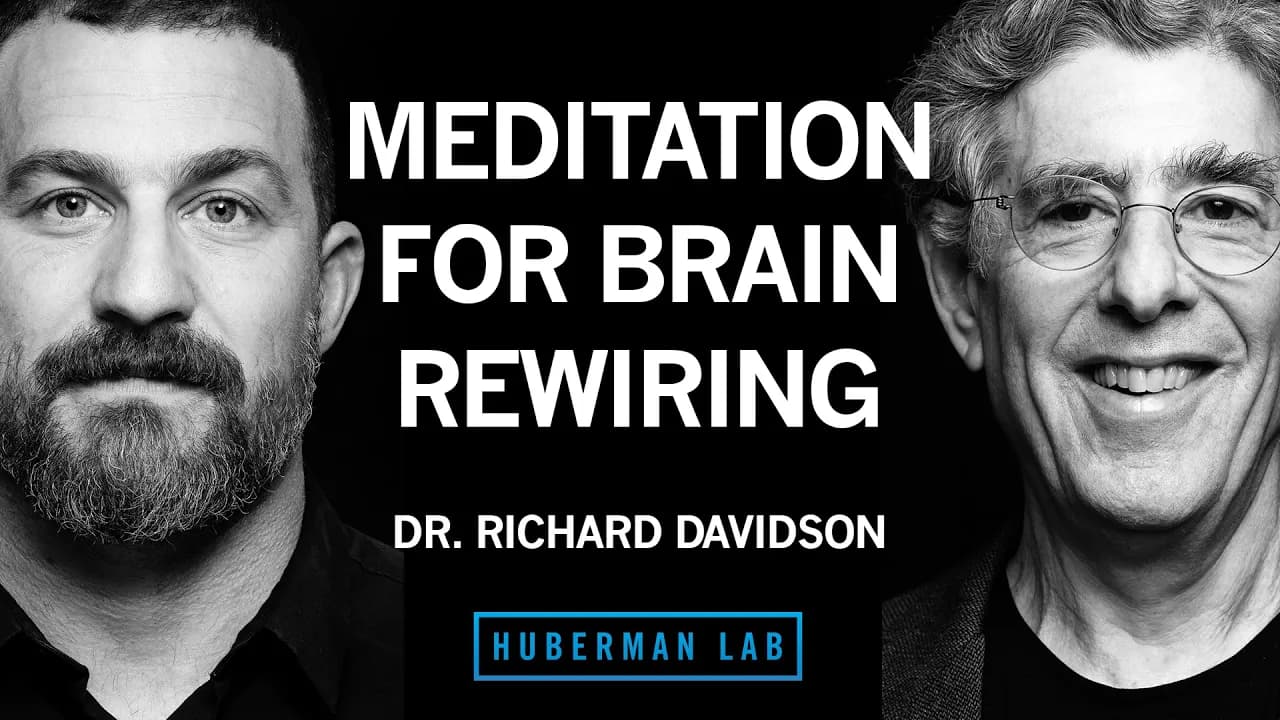
Meditation Does Far More Than Reduce Stress | Dr. Richard Davidson
In a Nutshell
Meditation and aerobic exercise should be combined, not separated: exercise increases neutral neuroplasticity while meditation harnesses it to encode positive mental states instead of toxic ones. The most effective approach pairs physical movement with intentional awareness practices focused on bodily sensations, altruism, and the four pillars of well-being (awareness, connection, insight, purpose). Just 5 minutes daily of this combined practice produces measurable biological changes including reduced inflammation, healthier immune responses, microbiome shifts, and increased longevity through enhanced social connection and purpose.
These notes were generated by AI and may contain inaccuracies.
Dr. Richard Davidson explains that meditation and exercise do not need to be mutually exclusive activities. A large randomized control trial demonstrated that just 5 minutes a day for 28 days of meditation produces a significant decrease in inflammation in the body, a more robust response to the flu vaccine, and microbiome changes. These effects persisted at a six-month follow-up. There are 200 million neurons in the gut continuously feeding information to the brain, demonstrating bidirectional influence between body and mind. These biological changes, when accumulated over time, are expected to lead to increased longevity.
Physical exercise, particularly vigorous aerobic exercise, is the most empirically well-validated strategy for increasing neuroplasticity. However, neuroplasticity is neutral with respect to its impact on well-being. If neuroplasticity increases while thinking toxic thoughts or being in a stressful environment, the likelihood of being stressed increases because negative thoughts become more strongly encoded. The real challenge is increasing neuroplasticity while simultaneously increasing wholesome or virtuous mind states.
A simple practice combines both: while preparing for or during physical exercise, reflect on how the activity benefits not only yourself but all those you touch directly or indirectly. Improving your health is a radical act of generosity that benefits your entire social network. This mindset of generosity and altruism while increasing neuroplasticity is the ideal combination, termed contemplative aerobics.
Connecting with others is one of the core pillars of well-being. In 2023, US Surgeon General Vivek Murthy issued the first health advisory on loneliness and social isolation, noting that loneliness is a greater risk factor for premature mortality than smoking 15 cigarettes a day. Loneliness affects biology, and social connection also gets under the skin and affects biology. Practices which help connect to others are anti-inflammatory and change biology in meaningful ways important for mental and physical health.
When practiced regularly and systematically with intentional focusing of the mind, contemplative aerobics increases altruistic behavior and produces measurable changes in brain function and structure using MRI. Randomized control trials show that regular practice changes both behavior and biology, and like physical exercise, these are lifelong practices.
Four qualities are essential for flourishing. Awareness includes being present, mindfulness, self-awareness, and meta-awareness (knowing what the mind is doing). Meta-awareness can be trained by intentionally adopting support for awareness, such as bringing awareness to bodily sensations during physical exercise or focusing on the present moment rather than the past or future.
Connection encompasses qualities important for healthy social relationships: appreciation, gratitude, kindness, and compassion. The quality of connection matters more than the number of people present. Insight involves understanding the narrative about who we are that filters how we see the world. Well-being comes from changing our relationship to this narrative, seeing it as a constellation of thoughts rather than changing the narrative itself. Purpose involves identifying direction in life, clarifying values, and finding meaning in even the most pedestrian activities through mindset shifts and reframing.
Six emotional styles describe the broad range of responses people show to life's challenges. Resilience measures how quickly one recovers from adversity. Outlook refers to the extent to which positive emotion persists or is savored, and the tendency to see what's right with people rather than what's wrong. Self-awareness is the extent to which one monitors thoughts, feelings, emotions, and bodily sensations, including interoception (accuracy in monitoring body signals). Social intuition measures sensitivity to nonverbal behavior of others. Sensitivity to context refers to modulating emotional behavior appropriately for different situations, with PTSD representing a failure in this modulation. Attention concerns the ability to focus attention, which is increasingly challenged by modern technology exposure.
These styles are important for well-being because they affect responses to emotionally significant events. Well-being relates to balance among these styles rather than being extreme on one end of any continuum. Being super high on some styles can be deleterious, such as hyperfocus on small nonverbal behavior among some autistic individuals.
Neuroplasticity includes the ability to adapt and change in response to the environment, along with basic mechanisms of neurogenesis—the growth of new brain cells. Every person grows new brain cells daily, and these cells are important for learning and memory. Aerobic exercise likely plays an important role in neurogenesis.
Neuroplasticity happens wittingly or unwittingly and is constantly occurring as brains are shaped by experience. Most of the time neuroplasticity happens unwittingly, with people barely aware of forces affecting their brains. The discussion serves as an invitation to take more responsibility for shaping brains intentionally.
Combining aerobic exercise with mental training would be optimal. The typical American gym environment where people do aerobic exercise while watching television represents a prescription for disaster. The exercise increases neuroplasticity while simultaneously facilitating the encoding of negative emotional content from television, making things worse rather than better.
Watching the news or social media with negative experiences while exercising creates a particularly problematic combination because it pairs increases in neuroplasticity with negative content encoding.
Strength training involves doing hard things mentally more than physically. Engaging in strength training first thing in the morning makes the rest of the day easier in terms of dealing with stress. The question arises whether engaging in hard things and recovering from them helps improve resilience.
Exposure to moderate levels of adversity, particularly early in life but likely throughout life, is advantageous in cultivating resilience. Complete buffering from adversity would be deleterious because it removes opportunities to learn to recover more quickly. Having some level of challenge and difficulty is helpful in learning to recover and strengthening resilience.
Studies in squirrel monkeys have shown that exposure to moderate levels of adversity early in life was the most important early experience in developing later life resilience.
Deliberate cold exposure builds mental toughness when done in a moderately safe environment. Doing something difficult that one doesn't want to do, followed by recovery, builds mental toughness.
During graduate school, using a sauna every morning before going into the lab provided the first sign that engaging in hard activity helps deal with stress. Getting hot and uncomfortable in the sauna led to better stress handling throughout the day.
Children appear more naturally resilient and bounce back more quickly than adults. While they may have increased plasticity, the key factor is that they don't have as large and mature a prefrontal cortex as adults. The prefrontal cortex confers characteristically human abilities including mental time travel—the capacity to anticipate the future and reflect on the past.
This mental time travel ability also creates problems because adults worry about the future and ruminate about the past much more than children. Children have the benefit of being in the present moment more, which is advantageous for resilience.
Simple awareness practices are key to cultivating resilience and can be done anywhere, anytime. Rather than allowing the mind to be pulled and pushed by thoughts and environmental stimuli, awareness practices direct the mind intentionally.
Physical exercise presents a wonderful opportunity for awareness because it generates prominent bodily sensations that serve as signals for anchoring awareness. Being aware of what's happening in the body rather than letting the mind separate and focus on to-do lists prevents combining toxic worry with increases in neuroplasticity.
During resistance training and strength training, awareness of the body becomes heightened—feeling burning in muscles, awareness of breath, and complete focus on bodily sensations. This focused attention during strength training represents a type of resilience training because the mind cannot wander elsewhere due to the demands of the activity.
The Mind and Physical Activity (MAP) study conducted at Rutgers combines physical exercise and meditation. This work is very limited with only a couple of studies completed, and major questions remain about optimal timing between physical and mental exercise.
A group at the Center for Healthy Minds at the University of Wisconsin-Madison, including researchers from the Department of Kinesiology, is investigating the optimal combination of physical and mental exercise for cultivating well-being. This represents a serious programmatic research effort.
Focusing on bodily sensations during exercise improves self-awareness and attention. Evidence shows that focusing on body sensations helps with other unrelated attention tasks requiring focus and resistance to distraction.
Mindset is really important and can change biology. In a large randomized control trial using the Healthy Minds Program app, researchers created a rigorous control group with mindset training only and zero meditation. The full version combining meditation plus mindset was best, but mindset alone was significantly better than an untreated control group.
Mindset training involves teaching people that qualities like kindness are innate and that when interacting with people, they can look for the good in others. This type of information exposure alone produced many positive changes, though not the full range seen when including meditation.
The training involved approximately five minutes per day for 28 days, and effects persisted at six-month follow-up. People continued the practices on their own after the formal trial ended.
Large randomized control trials show variability in response to interventions—some people respond robustly, others modestly, and some don't respond at all. This applies to physical exercise, mental exercise, and pharmaceutical trials.
Future work will focus on precision intervention—more individualized, personalized training based on individual characteristics. With AI assistance, digital copies of individuals including genomic and personality data will enable actual personalized interventions.
Meditation can change biology and immune system responses. People who meditate show healthier, more robust responses to flu vaccines as measured by antibody titers. New data shows that five minutes a day for 28 days produces a significant decrease in IL-6, a pro-inflammatory cytokine, measured three months after the formal trial ends.
The type of meditation may matter, with the Healthy Minds Program teaching four pillars: awareness, connection, insight, and purpose. Each pillar gets one week of focus in the 28-day program. For different people, different pillars may resonate more strongly.
Meditation produces microbiome changes with just five minutes a day, provided consistency is maintained. The gut contains 200 million neurons that feed information to the brain continuously, creating bidirectional pathways between mind and body.
Large epidemiological studies like the Whitehall studies of British civil servants show clear associations between levels of well-being and physical health metrics. When training the mind using meditation in rigorous randomized control trials, changes in the body can be observed, establishing causal relationships.
The gut microbiome connects intimately with the immune system, as certain bacteria ferment prebiotic fibers to produce short-chain fatty acids that act as signaling molecules to the immune system, including increasing T-regulatory cells to help prevent hyper-autoimmune responses.
A randomized control trial involving approximately 1,200 moderately depressed people recruited from all 50 states in the United States examined the effects of meditation on the gut microbiome. All participants provided stool samples before and three months after the intervention. The study found widespread changes in the butyrate pathway with an average of just 5 minutes per day of meditation. Butyrate-producing bacteria are particularly important for sealing the gut lining, and these changes occurred with this moderate dose of meditation.
Butyrate-producing bacteria play a significant role in preventing gut permeability. Gut permeability is associated with depression, inflammation, cardiovascular disease, Alzheimer's disease, and a wide range of other health conditions. Exercise has also been shown to increase butyrate-producing bacteria.
The vagus nerve, the 10th cranial nerve, serves as one mechanism connecting the mind and body. The insula is a particularly significant brain region because it contains a viscerotopic map, meaning different geographic locations within the insula are mapped to different autonomic organs in the body. This viscerotopic mapping enables the brain to have very specific effects on different parts of the body.
Fifteen years ago, researchers chose asthma as a model disease for studying mind-body interactions because it met several key criteria: it is a major public health issue, shows a socioeconomic gradient in prevalence, and has clear evidence that psychosocial factors modulate symptom severity. Asthma affects lung inflammation, which can be measured precisely.
When researchers initially approached a famous asthma research group at the University of Wisconsin and suggested the brain was involved in asthma, the researchers responded that asthma was a lung disease. The response was that unless one believes in magic, psychosocial stress influencing asthma symptoms must involve the brain.
Research found that a specific region in the insula is importantly involved in modulating the inflammatory response in the lung in asthmatics and is very responsive to psychosocial influences. The neural pathways through which the inflammatory response in the lung is produced have been mapped.
Recent findings show that the prevalence of premature dementia and Alzheimer's disease is much higher in asthmatics than in the general population. When there is an inflammatory response in the lung, there is likely also an inflammatory response in the brain. Neuroinflammation exacerbates premature dementia and increased neurodegeneration, and there is evidence of increased and premature neurodegeneration in asthmatics.
If stress can exacerbate the inflammatory response, mental strategies that are resilience-promoting should do the reverse. Researchers have started mapping the neural changes that occur with simple forms of mindfulness or awareness meditation and how those changes influence the inflammatory response in the lung in a positive direction.
Studies with extremely stressed-out caretakers showed premature shortening of telomeres. Mental strategies were able to stop the acceleration of telomere shortening. Certain enzymes were increased through these practices.
The modern world presents unique stressors compared to previous generations. When the speaker was a child, roaming the neighborhood on a bike until dark was normal, whereas now structured playdates are required due to heightened awareness of potential dangers, even though children may not necessarily be less safe. This constant information creates anxiety.
Meditation is not about sitting in any special posture or going to a quiet mountaintop. It can be done anywhere, anytime, and only requires using the mind in an intentional way. Combining meditation with physical exercise is particularly beneficial since most physical exercise is not cognitively demanding.
The Healthy Minds app allows people to meditate during activities of daily living such as commuting, walking, doing physical exercise, doing laundry, or washing dishes. Data shows that when people elect to do these practices as active practices alongside activities in the world, the benefits are identical to formal meditation, with no statistical difference in the benefits produced.
Prayer shares many characteristics with meditation when done regularly and consistently for a few minutes every day. A simple gratitude practice around eating involves reflecting on how many people it took to have food on your plate and offering thanks. This gives a sense of interdependence and allows a natural sense of appreciation that warms the heart.
Technology provides benefits but creates hyperstimulation. Many people find it difficult to be bored and immediately reach for their phones when standing in line. Research shows that most Americans, particularly young Americans, have difficulty sitting and doing nothing. Male college students would prefer to receive electric shocks than sit and do nothing.
When people start meditating through the Healthy Minds program, they often become significantly more anxious after the first week. This is considered a positive sign because paying attention to one's own mind reveals how chaotic it is. This initial anxiousness typically lasts about a week, then begins to go down below baseline levels.
The most important thing adults can do for children is to practice these techniques themselves and be an embodied exemplar of calm, resilient persons. Being fully present with children without checking phones or displaying anxiety is more powerful than explicitly teaching mindfulness practices. Children neuroplastically encode parental distraction and stress at a deep cellular level.
A curriculum called the Kindness Curriculum has been developed for preschool children, teaching simple mindfulness and kindness practices starting at age four. This curriculum is freely available on the Center for Healthy Minds website in both English and Spanish and is being used in approximately 35,000 schools worldwide. A randomized control trial has shown its benefits.
A simple mindfulness practice for children involves ringing a bell and instructing them to listen carefully to the sound and raise their hand when they no longer hear it. This creates palpable stillness in a classroom of preschool children.
The book "Born to Flourish" presents three key points: flourishing is a skill, flourishing is easier than you think, and flourishing is contagious, just like stress is contagious. If adults are flourishing in the presence of children, that becomes the most powerful way of instilling these qualities in children.
A study from Brigham Young showed that people with more social connection were 50% less likely to die than people with less social connection. According to the Surgeon General's report, loneliness was more than twofold the risk factor compared to obesity in producing premature mortality.
The relationship between social connection and health outcomes is bidirectional. Randomized control trials have shown that people randomized to learn practices to increase appreciation and compassion demonstrate biological changes that are health-promoting and would be expected to lead to increased longevity over time.
Excessive focus on the self, including me/my/I thinking, is associated with narcissism, greed, and other self-centered behaviors that are detrimental to mental well-being and have an eroding effect on physical health. Social connection takes the focus away from the self and brings it to the community or to others.
When reflecting on physical exercise benefits, considering how being healthier benefits family and children, not just oneself, shifts the focus from self-centered to more altruistic thinking.
Studies have given participants several hundred dollars with instructions to either spend it on themselves or buy gifts for other people. The group instructed to buy gifts for others reported significantly higher happiness levels at the end of the day.
Research shows that being generous to others activates centers in the brain associated with positive emotion much more strongly than doing something for ourselves. This generosity alters reward pathways in the brain. Altruism connects to having a sense of purpose, which is a major component of flourishing.
Purpose does not need to be grand. It can involve the simplest things done for family, community, or a cause believed in. Psychologists use the term transcendent purpose to mean anything beyond oneself. Connecting daily activities to a transcendent purpose can be enormously beneficial, even for the most pedestrian activities of daily living.
Dr. Davidson shares a personal example: scooping cat litter every night becomes a ritual where he invokes the aspiration that the clean litter benefits not only the cat, but also his wife who doesn't have to do it, and anyone who walks into the room. This simple practice takes zero extra time, yet he genuinely looks forward to doing it.
Among people 70 years and older, having a strong sense of purpose in life is probably the single most important psychological predictor of longevity. Purpose can be cultivated in anything done throughout the day, including preparing food. Even little purposes matter, not just grand life purposes.
In the early stages of developing purpose practices, reminders are needed because people tend to forget despite agreeing with the concept. The Healthy Minds app is designed to remind people of opportunities to practice these skills throughout the day.
Changing from a pessimistic outlook to a more positive one is a gradual process, not instantaneous. A person with a pessimistic view can work with their mind using simple strategies. The pillar of insight can help investigate pessimism with curiosity.
A practical technique involves asking: "Is it really all of me that's pessimistic? Is there any part of me that's not pessimistic? Can I find some place that may be just a smidgen less pessimistic?" This approach recognizes that negative states are more permeable than previously thought.
Everyone has a narrative that powerfully determines how they perceive the world, though most people don't recognize they have one. Approaching this narrative with curiosity helps open it and make it more porous and spacious. For pessimists, this awareness and insight work can be life-changing.
The vast majority of people will never meditate, and that's fine. Cultivating the skills of flourishing does not require formal meditation. These skills can be practiced anywhere, anytime by using the mind more intentionally. This can occur while commuting, doing physical exercise, doing laundry, or other daily activities.
The core practices for living a flourishing and healthy life include:
- Regular physical exercise, which increases neuroplasticity
- Mental exercise that harnesses neuroplasticity to cultivate wholesome and virtuous qualities
Neuroplasticity is neutral with respect to flourishing. The ideal combination pairs physical and mental exercise to benefit personal well-being, benefit those around us, and promote flourishing for both self and others.
Gratitude can extend beyond thanking a higher power to include all people involved in daily activities. At dinner, this might include thanking farmers who grew the food, people who prepared it, and even recognizing the extraordinary range of humanity required for simple activities like sitting at a table with plates.
Born to Flourish is available wherever books are sold in hardcover, audio, and digital formats. Dr. Davidson and Courtland Dahl read the audio version themselves.
The Healthy Minds Program app is free with no paywall, produced by the nonprofit Human (founded 2014). The app provides options to practice the four pillars while engaged in other activities of daily living, without requiring extra time.
Keep FoundMyFitness in your library
Save the videos and channels worth coming back to, and find them again in one place.