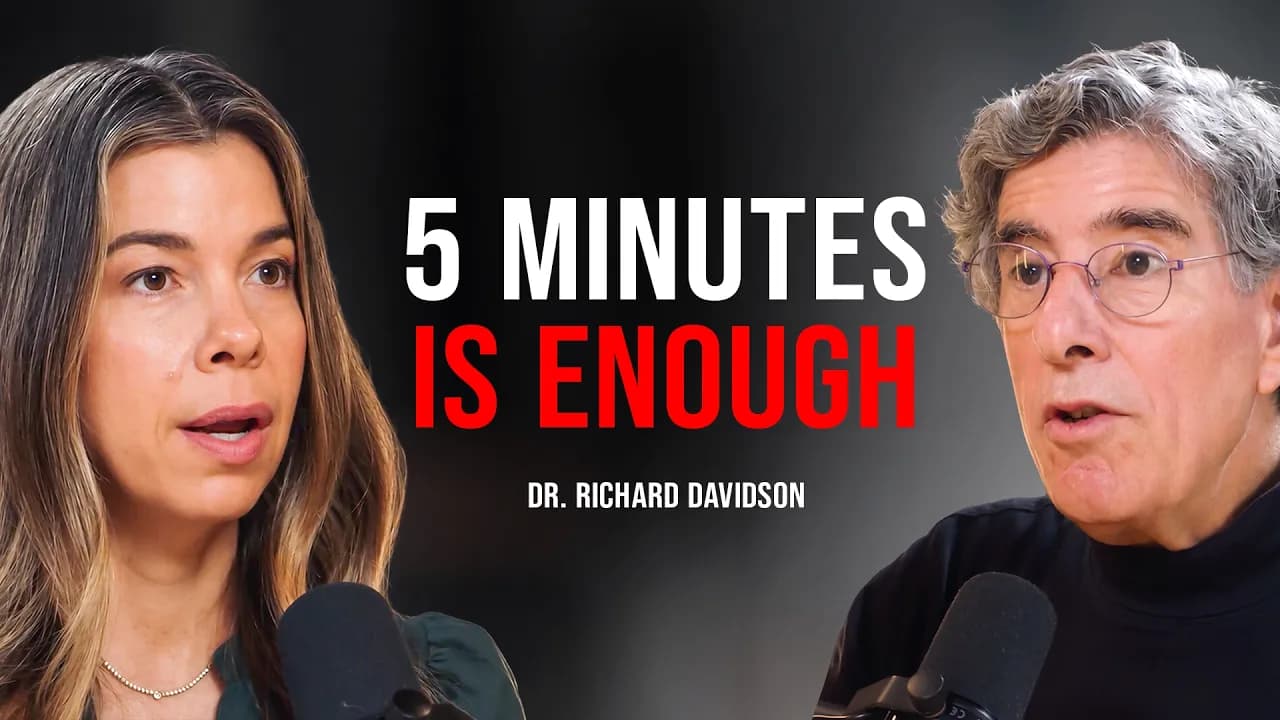
Science-Based Meditation Tools to Improve Your Brain & Health | Dr. Richard Davidson
In a Nutshell
5 minutes of daily meditation for 30 days significantly reduces depression, anxiety, stress, and IL-6 inflammation while boosting well-being, brain connectivity, and flourishing via neuroplasticity—equivalent to two 20-minute walks and likened to the "lactate of the mind" for building resilience. Key practices include focused attention (on breath) and open monitoring (observing thoughts without judgment), emphasizing meta-awareness, consistency over intensity, and the four pillars of flourishing: awareness, connection, insight, purpose. Expect initial anxiety as adaptation; pair with routines like meals for adherence, avoid device distractions, and explore apps/books like *Born to Flourish* for tools like loving-kindness meditation.
These notes were generated by AI and may contain inaccuracies.
For beginning meditators, 30 days of 5 minutes per day practice leads to significant reduction in symptoms of depression, anxiety, and stress, shown repeatedly in randomized control trials. Increases measures of well-being or flourishing. Even reduces IL-6, a pro-inflammatory cytokine.
Huberman Lab podcast discusses science and science-based tools for everyday life. Andrew Huberman is professor of neurobiology and ophthalmology at Stanford School of Medicine. Guest is Dr. Richie Davidson, professor of psychology and psychiatry at University of Wisconsin-Madison, pioneer in studying meditation's impact on the brain during meditation and over time via neuroplasticity.
Discusses health and neuroplasticity benefits from regular meditation, including 5 minutes per day. Dispels myths: meditation is not about clearing the mind or feeling inner peace during practice, but observing thoughts and stress during meditation. Like final hard reps in resistance exercise or lactate burn in cardio, stress observed during meditation acts as lactate of the mind, building stress resilience, focus, and peace outside meditation.
Brain changes during types like open monitoring meditation, eyes-open meditation, walking, seated, standing. Huberman changed routine post-conversation, started 5-minute daily meditation for stress resilience, profoundly impacting mental clarity, focus, sleep, and stress, especially on high-stress days or poor sleep.
Dr. Davidson pioneered bringing brain imaging and mindfulness/meditation studies to the West. Authored impactful research papers and popular books, including new book Born to Flourish: How to Thrive in a Challenging World (releasing later this month).
Podcast separate from Huberman's Stanford teaching/research, aims to provide zero-cost science-based tools to public. Episode includes sponsors.
Dr. Richie Davidson welcomed. Discussion on states of mind: organized patterns of brain activity with corresponding subjective mental correlates. Regular states include wakefulness, deep sleep, REM sleep, regulated by biological rhythms.
States during waking often loosely defined without rigorous boundaries. Regular states can lead to traits, shifting baseline for next state.
"The after is the before for the next during."
From paper with Daniel Goleman (Altered Traits origin). Post-state change (e.g., after meditation) persists, becoming baseline for next state. Frequent anger states lead to irritability trait (lowered threshold for anger). Online content often triggers negative affect like mild anger to capture attention.
Daily experiences impact rest of day; sleep quality example: good sleep for nights shifts state positively, poor sleep inversely. Better nomenclature for sleep states (REM vivid dreams, slow-wave less vivid) than waking states.
Broad frequencies: 1-40 Hz.
- Delta (1-4 Hz): predominant in deep sleep, density diagnostic of restorative sleep. Neurostimulation boosts slow-wave activity, potentiating daytime skill acquisition including meditation (Davidson's new work).
- Theta (5-7 Hz): transition from wake to sleep, liminal states, certain meditations.
- Alpha (8-13 Hz): relaxed wakefulness.
- Beta (13-20 Hz): activation, increases in cortical regions during cognitive tasks.
- Gamma (~40 Hz): in long-term meditators, during insight (aha moments). Experimental tasks (e.g., crossword) show short gamma bursts (~250 ms). Long-term meditators show high-amplitude gamma for seconds/minutes.
First reported 2004 (PNAS) in practitioners with average 34,000 hours lifetime practice; raw EEG visible to naked eye. Replicated by others. Gamma also in slow-wave sleep superimposed on delta.
No clear evidence meditation replaces sleep or offsets mild deprivation effects. Dalai Lama meditates ~4 hours/day for >60 years, sleeps 9 hours/night proudly. Davidson ditched alarm clock (was 5.5-6 hours), sleep increased 30-45 minutes (more morning REM), improved well-being/focus.
Optimal meditation timing: when most awake, less sleepy (obstacle to meditation). Not necessarily liminal sleep-wake transitions, despite less thought control; involves attention redirect.
Hundreds of types like sports, different brain/body effects; not lump together.
Broad categories (published typologies):
- Focused attention meditation: narrow awareness to specific object (external/internal, e.g., respiration, sound). Cultivates aspects of awareness.
- Open monitoring meditation: broadened aperture, no specific focus; aware of whatever arises (thoughts, sleepiness, distraction). No goal to eliminate thoughts (brains generate them); observe thoughts as objects. Shift from doing mode to being mode.
Doing to being: not mystical. Thinking/doing = action, planning, ruminating. Opposite: stop body movement, perceive sensations now without planning/past rumination. If ruminating/planning arises, simply be aware of it without changing/fixing; meta-awareness key.
One conjecture is that much occurs under the hood that we're typically not aware of, as lives move at such a pace with information transpiring rapidly. We notice only a small fraction. Meditation invites awareness of this. Not doing is helpful because acting in the world requires navigation for safety and protection, engaging other mechanisms.
There are at least two types of people: those who go through life feeling, doing, being, thinking, and projecting into the world, or quiet people who don't project much but just do their thing without thinking about their thinking or doing. Then there are multitracking, self-conscious, very self-aware people. For the self-aware person in meditation noticing recurring thoughts without judging, they might benefit from freedom from self-monitoring. The other person could benefit from more self-awareness to recognize their mode and see their thinking.
Totally, you're naming something super important. The second person has more than self-awareness; there's holding back, suppression. It's a lot of work and could stifle creativity.
David Cho, a brilliant artist, talks about best art coming from forgetting what anyone thinks or wants. Rick Rubin says get the audience out of your mind and let it flow. Great artists do that; we pay to see that expression, not the self-monitoring artist.
There's a phrase in the Tibetan Buddhist tradition: undistracted non-meditation, the highest form where you drop all techniques, control, tightness. You're totally awake, fully aware, with no artifice, complete freedom.
Some people embody this as a trait. Rick Rubin is like that; his magnetism is real. He stays himself amid proximity to things online or in person; it doesn't invade or change how he shows up. Energy beams interact without contaminating each other, making both better. That's rare.
Stickiness is affective hysteresis: hanging on to emotions that may not be useful, carrying stuff from previous experiences into current ones, muddling things. Emotional lives are infused with stickiness, but people like Rick Rubin have none. That's the trait manifestation of these practices.
Many use drugs to access this state. As a species and culture, we have affinity for people embodying this freedom: great comedians like Richard Pryor (devoting maybe 2% prefrontal cortex to monitoring), flow states in athletics. We feel it; it's powerful.
Before meditation, ask if in self-monitoring mode or feeling free and present to experience without questioning. Most practices shift to sitting/lying, closing eyes, focusing on breathing to get present. Dr. Davidson practices with eyes open.
Start modestly. Ask: what's the minimum you can commit to daily for 30 days consistently? Five minutes. Are you comfortable seated formally or prefer walking or non-cognitively demanding activity like commuting, washing dishes? Benefits comparable for beginners in formal or active practice.
After 30 days, 5 minutes/day: significant reduction in depression, anxiety, stress symptoms (randomized control trials); increase in well-being/flourishing; reduction in IL-6 (pro-inflammatory cytokine, systemic inflammation) over 28 days; changes in microbiome and brain.
The best form of meditation is the one you actually do. Figure it out and stick to it every day.
Challenge: 5 minutes/day for 30 days for significant health effects.
Richie Five meditation: 5 minutes/day. Host does 10 breaths upon waking before getting out of bed; day goes better.
Neuroplasticity research: enriched environments (toys for rats/mice/monkeys) increase connections, cognition. Ron Frostig (UC Irvine) showed normal cages are deprived; adding normal stimulation yields gains.
Meditation as enriched mental environment, like exercise replacing natural farming/water-fetching. Modern tech/busyness deprives us; 5-20 minutes restores what's core to human experience, like getting more sleep without alarm clocks.
Practices 2500+ years old, not modern invention. Traits achievable naturally without meditation; hermit monks in Dharamsala said some are born with qualities, don't need as much practice.
Qualities like kindness innate (book Born to Flourish with Daniel Goleman), but require nurturing like language (innate but feral children don't develop it without). Intentional nurturing needed for most to express at high levels.
Analogy: humans didn't evolve brushing teeth, but most do now.
Study in Science on boredom: participants preferred electric shocks to 15-20 minutes alone (especially male US undergraduates). People can't sit without doing something; inspecting minds frightens at the chaos.
Meditation week 1: statistically reliable anxiety increase; people say "I can't do this, it's making me crazy." Response: you're noticing mind chaos—exactly right, like soreness from new exercise.
Agitation in problem-solving/reading hard text is neuroplasticity stimulus; breezing through doesn't change brain.
Anxiety week 1 is lactate of the mind, the burn leading to adaptation.
Embrace anxiety; it's contributing. Be aware without being hijacked—meta-awareness prerequisite for mental transformation.
Meta-awareness: faculty of knowing what mind is doing. Example: reading pages with no recall—mind wandered; waking up is meta-awareness moment. Trainable skill, prerequisite for mental training.
Brain network: prefrontal cortex, anterior cingulate, insula.
People crave forgetting self, being in experience (e.g., dancing at party).
People who dance and enjoy themselves demonstrate metawareness without awkward self-consciousness. Flow can occur with or without metawareness. Mihaly Csikszentmihalyi, who first studied flow, examined rock climbers. Rock climbers seek flow states where they are completely absorbed; a momentary lapse in attention could be lethal. Arranging the physical environment this way suppresses the default mode network, associated with self-referential thought that often provokes anxiety. Flow can also occur with metawareness without diminishing quality.
Analogy: In a movie theater, one can be so engrossed in the plot that they forget they are watching a movie—this is experiential fusion, analogous to flow without metawareness. Alternatively, attention can be riveted with no lapse, but in the penumbra of awareness, one knows they are in a theater watching a movie without diminishing attention quality.
Noticing the chaos of one's mind is the seat of anxiety for beginners. Push through the first week, expect the lactate of the mind—get comfortable with chaos without reacting or trying to escape it. Goal of meditation: see and sit with chaos, not eradicate it. Even advanced meditators like the Dalai Lama (who sleeps 9 hours and meditates 4 hours daily) experience chaos; extreme meditators become comfortable with it rather than free of it.
Chaos diminishes gradually over time as a developmental process, not a step function. Some chaos remains and serves as a source of creativity. Inspect your mind for a couple hours a week: pay attention to what's happening, jot brief notes on interesting thoughts to recall later. Much creative work happens like dreams—we forget them unless captured. Chaos contains creative insight.
Host wakes with ideas from sleep-to-wake transition or dreams, records voice memos (crazy but valuable). Joe Strummer (The Clash): If an idea comes while walking, write it down—you won't remember it as potently later. Songwriters and poets constantly capture ideas surfacing from the unconscious.
During morning meditation, keep a notepad by the cushion; twice a week, jot 1-2 words for ideas that arise to preserve richness, then return to practice.
Meditation benefits kids; studied formally. Developed mindfulness-based kindness curriculum for preschoolers, published randomized controlled trial in public schools. Freely available on website in English and Spanish for teachers.
Example exercise for 3-year-olds: Ring a bell, listen until sound fades, raise hand. 25 three- and four-year-olds sit still for 10 seconds, creating palpable quiet.
Flourishing is contagious. Best for parents: Meditate yourself, be fully present with child—transmits qualities implicitly through demeanor and interaction.
Studied with 832 public school educators in Jefferson County Public School District, Louisville, Kentucky (diverse, urban, stressed educators). Randomized controlled trial using Healthy Minds Program (digital, free): Cultivate four pillars—awareness, connection, insight, purpose. 5 minutes/day for 28 days.
Outcomes: Depression, anxiety, stress decreased; well-being, flourishing increased. Accessed student data (13,000 middle schoolers unaware of study). Students of trained teachers had significantly higher standardized math scores vs. control (reading improved directionally but less robustly). Math performance degrades more under stress than reading.
Teachers calmer, more connected; students less stressed during exams, reflecting true competence.
James Hollis (Jungian analyst, books: The Eden Project, Under Saturn's Shadow): Key to good life—suit up, show up daily in school/relationships/life, but take time to exit stimulus-response. Meditation allows experiencing anxiety without reacting, improving signal-to-noise, effectiveness. Teachers likely transmit this presence.
Meditation demystified: Not mysticism, essential now amid divisiveness—5 minutes/day has measurable impact. Easier than thought; modest practice could transform the world.
Initial benefits: Lower blood pressure, reduce stress, improve effectiveness, cognition, sleep. Higher-order: Insights into consciousness via non-judgmental observation.
Practices foster humility, tap into human/spiritual/transcendent elements—connection to something larger, infusing life with meaning/purpose.
Meditation reveals mind's chaos is uncontrollable; best to observe without response. Surfaces reality of death, often terrifying and distracting (drugs, work). Long-term practice shifts this: Not energy continuation, but acceptance—we're here, then not. Live each day fully, as if last (e.g., Friday the 13th), without squandering opportunity.
Speaker's shift: Terrified 15-20 years ago (family responsibilities); now fulfilled, fine with dying today. First retreat 1974, daily practice since (rare misses for early flights).
Practice: Morning, strong black tea (15 min), then 45 minutes modal (sets timer), 3-4 nights/week 5-min before bed. Varied traditions over years.
After 30-day 5-min challenge: Check in—if resonating, continue; stick daily. Tie to daily activities (walking, commuting) via social zeitgebers—environmental signals marking routines. In Born to Flourish, address daily consistency challenges; early stages, formal or informal works.
A zeitgeber is an environmental signal that marks a biological rhythm, like light setting circadian rhythms. In the modern world, social zeitgebers are human-created, such as eating at roughly similar times daily. Pair a short practice with daily routines like eating. One practice: spend 30-90 seconds reflecting on all the people involved in getting food on your plate, fostering a sense of interdependence. This is done every time at home for breakfast as a cue.
Even scooping cat litter every night can be a practice: reflect authentically on how the cat, wife, and others appreciate it being clean, done while scooping with no extra time.
Bringing awareness to routine tasks makes us more effective, happier, and present. Discipline feels heavy, but consistency is a superpower—showing up regularly, even without max intensity, which wanes. The mind is a foe until embracing consistency. Everyone falls on a continuum between letting go and discipline; what works varies by person. For meditation, consistency is key; discover what suits you.
Consistency in exercise, even without being a great athlete, keeps one ahead of peers who quit. Max intensity often leads to burnout, unlike steady practice.
I'm more interested in being vital at 50-60, cognitively sharp, in shape, excited about life, not afraid of death.
Consistency in meditation contributes to vitality into mid-70s.
Start with lowest friction to experience benefits, then build discipline.
Online culture tricks the mind into believing non-engagement means non-existence, deeper than FOMO—life happens online, and offline means you don't exist. People escape internal mind chaos by engaging externally. Parents check phones while kids play; kids are device-babysat to quiet them.
Internet captures stimulus-captured attention; designers hijack it. Average American opens phone 152 times a day—unnecessary. We are in a grand experiment without informed consent; short-term consequences are not good.
Technology is neutral, usable for good or harm. Former Surgeon General Vivek Murthy's 2023 health advisory "Social Media and Youth Mental Health" shows psychiatric problems in adolescence scale linearly with hours of social media per day, eroding youth (and adult) mental health.
Adults demolish careers by thoughtless online posting, throwing away 20-30 years of success. Polarization eliminates nuance or common ground.
Younger generation says not being on social media/texting means not existing socially. Solution: take digital hygiene seriously as trainable skill, educate youth via school curricula on healthy device relationships—start before first phone.
Meditation may reduce impulsivity and proneness to external chaos by sitting with mind's lactate, but no hard data yet—empirically tractable. Experiment: use established lab behavioral measures of impulsivity (beyond self-report), backend device data with consent for robust evidence.
Most valuable discipline is don't do—no-go response, like Olympians avoiding foods more than eating specifics. Train no-go: e.g., feel phone in pocket, don't take out unless needed. In meetings, phones on table impair interaction even with notifications off.
Study: cognitive performance normal only if phone in different room; otherwise, brain uses extra resources suppressing phone thoughts, diminishing focus regardless of table/upside down/backpack/under chair.
Use lock box, separate room, no-phone zones (podcast studio, gym, study, considering bedroom/loft). Workouts improve without phone.
Turning off your phone 22 hours a day will make you best in class.
Presence enables effectiveness; self-control is trainable byproduct of flourishing, tied to metawareness. Moffitt and Caspi's PNAS paper on Dunedin (New Zealand) birth cohort: self-control at ages 4-5 predicted at age 32 less drug abuse, fewer court proceedings, $6,000 more annual earnings (matched SES). Strategies boosting self-control yield these outcomes, save taxpayer money.
First 1974 retreat: 16 hours/day practice, body in fire-like pain; after day 3, vow no moving in hour-long sessions. By day 4, breakthrough: directly observing pain reveals it's differentiated, with constituents, leading to release.
Imaging work uses heat pain stimulus (precise/safe). Neural signature splits physical pain vs. emotional reaction/interpretation (distress mostly secondary). Meditation transforms emotional pain signature as trait effect, especially from retreat practice (intensive); matched lifetime hours, but retreat-intensive practitioners show more change.
More than a couple hours/day meditation. Hard to self-direct; online resources exist, but in-person better for compliance (no phone, silence). Set phone-free zones for richest life experiences; examples inspire.
No "Olympic" for device addiction—requires self-control, like obesity response (lifestyle, exercise, GLP drugs). For youth, excelling by not doing what others do.
Useful mindfulness meditation improves focus, manages stress and anxiety, improves mood, and more. Waking Up app is a terrific resource for consistency in meditation practice. Many start but struggle to maintain. App offers variety of meditations in different durations, providing novelty to avoid boredom and flexibility to fit any schedule, even 2-3 minutes per day. Try at wakingup.com/huberman for free 30-day trial.
Self-control is a distinct benefit of meditation. Exercise requires some self-control but most flow through it once started.
Question on how much of a good life involves forcing ourselves versus honoring what's right. In daily life, starting day with something unappealing builds larger benefits by going against reflexes and impulses. People feel overwhelmed fighting themselves, tired of resistance, out of practice overcoming it. Philosophical: how much forcing for betterment versus living freely.
Initially fought mind in meditation, enduring physical pain like knee fire and back pain for an hour, feeling pride in toughing it out but miserable. Later discovered strategy of making friends with mind, welcoming it with ease rather than fighting. Healthy Minds Program invites being where you are, minimal discipline, not pushing away thoughts. If restless, meditate walking. Discipline is intentional mind use at minimum to activate networks.
Lab focuses on neuroimaging of brain networks and outcomes. 5 minutes/day can be eyes open/closed, walking/commuting; shuts down default mode network, activates awareness/attentional networks. Little imaging on exactly 5 minutes, but shows biggest early changes in connectivity: functional (integration across networks) or structural (white matter via diffusion weighted imaging). With 5 minutes/day for a month, measurable changes in superior longitudinal fasciculus (connects prefrontal/parietal, pathway for central executive network interacting with default mode).
More incentive for 5 minutes/day; could do 7-10, aim for 6 months daily. Consistency is repeated showing up.
Prayer practice every night before sleep: if fall asleep, get out of bed and pray. Never missed since starting; better sleep (multiple reasons). Sometimes falls asleep praying but values consistency, devotion by showing up, removes perfectionism. Joy from consistency.
Sleepiness common early in meditation/practice. Teacher Mingyur teaches sleepiness meditation: be aware of sleepiness, investigate with curiosity, don't fight. Acknowledging without fully giving in changes it; fighting gives it power.
Idea from Martha Beck: if feeling sucks, look at it, feel it until it changes shape, view through different lens, morphs away. Mind looking at mind transforms states.
Humans' meta-awareness more developed than other species; possible rudimentary in others correlated with mirror self-recognition test (elephants recently passed: Bronx Zoo used elephant-sized mirror, rouge on trunk, touches if recognizes self).
Course on plasticity of flourishing: four key trainable pillars.
- Awareness: mindfulness, voluntary attention, self-awareness, meta-awareness.
- Connection: qualities for healthy relationships (appreciation, gratitude, kindness, compassion); opposite is isolation/loneliness; trainable, linked to well-being.
- Insight: curiosity-driven understanding of self-narrative (beliefs/expectations); not changing narrative first but relationship to it, seeing as beliefs/thoughts.
- Purpose: meaning in daily activities (e.g., taking out garbage, cleaning kitty litter via reframing); learnable.
Flourishing is a skill, easier than you think, contagious (benefits others).
Course provides intellectual (declarative learning) and experiential procedural learning (skill-based, different brain networks); weekly lab for practices.
Awareness: 5 minutes daily meditation, observe chaos without following.
Connection:
- Appreciation when eating: connect to people who brought food.
- Loving-kindness/compassion meditation (few hours over 2 weeks changes brain):
- Loved one: envision challenge, aspire relief/ease (phrase: "May you be happy, may you be free of suffering").
- Yourself.
- Stranger (recognize face, e.g., coworker, bus driver, barista): imagine difficulty, aspire relief.
- Difficult person: imagine their challenge, aspire relief. Few minutes/day changes brain (temporal parietal junction enhanced for distress stimuli, positive affect networks), behavior (more altruism via economics tasks, reduced implicit bias sustained 6+ months).
Insight: In difficult situation, imagine how different person (known/famous) views it; taste perspective difference for distance from own filters, less fused/identified.
Purpose: In activity (dishes, laundry), reflect how beneficial to self/others ecosystem.
Science study (~3,000 people, texted randomly): what doing? Where is mind? How happy? Adults mind-wanders 47% time; less happy when not attending, even in boring tasks ("a wandering mind is an unhappy mind"). Focused mind is happier (not necessarily happiest). Distractions intrude into activities problematic; intentional scrolling ok.
Balance: get outside self without losing self to external pulls.
When overwhelmed by problems that seem monumental, people forget their agency and the actions they can take right then to handle themselves and show up better. Navigating this feels like walking a narrow bridge.
Data from meditators suggest this bridge widens with practice, becoming easier to access, similar to how a fit person experiences less resistance to warming up for a hard workout. They know initial achiness passes after five minutes, conserving energy for the workout.
Familiarity with the process reduces resistance. For example, the first 10 minutes of a bike ride are agony, but knowing it changes reliably at a certain point makes it tolerable. Rob, the producer who has done multiple Iron Mans and runs regularly, feels like garbage for the first 20 minutes before feeling great. Familiarity with one's own mind makes capacities more readily and spontaneously available.
Beginners in cultivating flourishing forget to use helpful practices in moments of friction. Even meditators unconsciously start eating without a moment of appreciation. With regularity, cues like sitting down to a meal spontaneously elicit appreciative responses. This reliable outcome requires time and consistent practice.
Ritualizing practices, like a pre-podcast ritual, builds consistency. This quiets unnecessary neural networks, freeing energy for essential ones. Martin Picard, an expert in mitochondria (a friend of both speakers), substantiates that energy involves electrical and chemical signaling between neurons, handled by mitochondria. Meditation is grounded in biology, physics, and chemistry.
Disclaimer: Compelling clinical trials show psilocybin helps major depression, trauma, addictions; MDMA (not a psychedelic) for trauma via empathogen effects. Dangerous without proper health monitoring; no FDA approval yet; many Schedule I (illegal, no known medical use). Avoid if predisposition to psychosis or mania.
Data show psychedelics access unconscious patterns, rewire default mode network and resting networks, reduce anxiety. Overlaps with meditation historically.
Excited about research resurgence for clinical use: promising data for severe intractable depression and alcoholism. Less optimistic for normal people seeking self-development, flourishing, or spiritual growth.
Psychedelics provide glimpses of different modes of being, but real change depends on post-experience integration. Concern over untrained psychedelic guides: many U.S. universities (including Davidson's) offer one-year certificate programs for people with little prior training, insufficient for nuances.
Residue is often just memory of the experience, not embodied transformation. Key questions: Is the person kinder? Does their spouse find them more enjoyable? Is their flourishing contagious? Little convincing evidence for broad flourishing at scale. Supports clinical use for distress but cautious for general population.
Questions remain on standardizing integration. Long-standing traditions exist, now intersected with Western standardized medicine. No standard meshing with meditation heard. Stanford combines with transcranial magnetic stimulation (TMS) to direct plasticity toward specific networks.
Promising to combine neuromodulation with psychedelics or meditation. Research combines neuromodulation with meditation to boost impact, targeting sleep facilitation.
Using tES-TI: Two electrodes at high carrier frequencies (e.g., 15 kHz and 15,001 kHz, 1 Hz offset) target deep brain structures non-invasively where delta slow waves generate for deep sleep. No subjective sensations, unlike TMS; delivered during sleep without waking subjects.
Definitively increases slow-wave activity density during deep sleep. Participants feel better in wakeful life. Ongoing study (with Giulio Tononi's lab at Wisconsin): micro-randomized design. Single participants get 5-minute pre-sleep meditation some nights, not others; combines with tES-TI. Measures next-day experience sampling for mood and synergy on slow-wave sleep.
Preliminary findings on pre-sleep meditation unavailable (study ongoing, ~20 participants completed).
Another paper shows pre-sleep meditation impressively boosts growth hormone release. Recommendation: Do 5-minute meditation in the hour before sleep to double benefits.
Limited data on open monitoring meditation (or any meditation) and creativity due to poor psychological measures.
Boosts creativity by increasing awareness of associative thoughts. Inspect own mind: watch and write down interesting thoughts. Practice: no specific object, open, aware, awake, not distracted or lost in thought trains.
More creative thoughts occur than credited; most forgotten. Improves retention. Recommend despite meager data—no downside, empirically documented other benefits.
Davidson educated on meditation, states of mind, accessing them, impacts on being and traits. Inspire 5 minutes daily (morning or before sleep). Excited for slow-wave sleep study update.
Books: Altered Traits (previously discussed); new Born to Flourish: How New Science and Ancient Wisdom Reveal a Simple Path to Thriving by Richie Davidson and Cortland Dahl (neuroscientist, contemplative scientist, chief contemplative officer at Healthy Minds Innovations, human.org).
Davidson pioneered rigorous science in meditation, educating millions. Mutual gratitude expressed.
Huberman outro: Links to Davidson's work and Born to Flourish in show notes. Subscribe to YouTube (zero-cost support), follow on Spotify/Apple (leave 5-star reviews, comments). Check sponsors. Huberman's book: Protocols: An Operating Manual for the Human Body (pre-sale at protocolsbook.com; covers sleep, exercise, stress, focus, motivation with science). Follow Huberman Lab on social media. Neural Network Newsletter (hubermanlab.com): zero-cost podcast summaries, protocols (sleep, dopamine, cold exposure, fitness).
Keep Andrew Huberman in your library
Save the videos and channels worth coming back to, and find them again in one place.