Meet Dave Blundin: Who I Am and What I Stand for | Meet the Mates (Bonus Episode)
In a Nutshell
Dave Blundin founded Link Ventures to back young technical founder teams at the earliest stage, providing full operational support so they can build faster without friction. He stresses that real entrepreneurial skills come from lived experience, not classes, and that three best friends who trust each other form the most durable founding teams. The biggest opportunity—and risk—is the rapid acceleration of AI, which he believes will create a step-change in civilization comparable to humanity 2.0.
These notes were generated by AI and may contain inaccuracies.
Link Studio is described as the highest talent density place on the planet, with 100,000 new students coming in every year who can blue bike to the location.
Tuesdays are the front of the week and very busy with board meetings. Dave typically does two or three board meetings on a Tuesday, along with internal meetings, interviewing young up-and-coming rising stars, and getting coffee.
Dave's title in 10 words or less: managing director and founder of Blink Ventures, a venture fund in Cambridge. He also teaches at MIT and is a serial entrepreneur.
Day-to-day work centers on convincing young up-and-coming would-be founders to start companies and make it a life-changing experience for themselves.
Dave counted nine hats last he checked, including chairman and controlling shareholder of the two companies he founded that are still operating, the studio, teaching at MIT, and family responsibilities.
Dave was born in New Jersey. His parents lived in an apartment that was a converted chicken coop. His dad received a job offer to double his salary with hardship pay to move to Tehran, Iran, so Dave spent most of his early childhood in Iran.
They received a letter from the embassy stating it was not safe to leave home at the same time every day, prompting the family to move to London. Dave then spent time in London, followed by high school in Connecticut, and then attended MIT.
Before Link Ventures, Dave was a three-time founder and co-founder of operating companies. He is a serial entrepreneur from the day he graduated until the venture. He does not think of himself as an investor but as a founder.
Building companies teaches lessons that cannot be learned any other way. Stress cannot be faked. When building a company, drama and stress come up out of nowhere all the time. Dave MCed 200 consecutive monthly companywide meetings at Bestark. As the company grew, the audience grew, eventually requiring telepresence to remote offices. There is no way to study this in school; it must be lived and experienced.
Blitzy currently has 80 people and is growing to 300 by the end of the year. It is described as a beehive of activity. Notable people associated include Brian and Sid. Dave's son Jack works there but was in Florida at the time of recording.
Dave's first project at the MIT AI lab was building neural networks on the Connection Machine, the biggest supercomputer in the world at the time. The machine was barely stable and he only had access from midnight to dawn. He used it for years. The neural nets worked, but getting anything intelligent out of something at that scale was very hard. It was a valuable learning experience.
Teaching is a passion. Dave loves the energy and the brilliance of the students, who are like an unvarnished clean sheet of paper that can go anywhere. He tells students that the Cambridge ecosystem has the highest talent density in the world and represents a unique opportunity, especially at MIT with all the available equipment. Students should not take it for granted. The people they bump into are almost impossible to replicate at any other period in life.
Networking at MIT means learning from peers rather than just the school. It is all about the people met. Lifelong best friends and co-founders are found through these connections.
The most common misconception students walk in with is thinking they are going to learn anything in class. Technology changes so rapidly that no curriculum can keep up. Students learn everything from their peers and make lifelong best friends and co-founders. They think it is about the classes, but it is not.
A question no student has ever had the courage to ask is: "Can I get someone else to do my work for me?" This is the right thing to do. Great builders and entrepreneurs delegate when someone else can do something. Students are taught it has to be their own work, but that is the wrong lesson.
The core thesis is that founders are going to get younger and younger and time to reaching billion-dollar valuations is going to get shorter and shorter. Founders will need more and more support. Link Ventures provides payroll, accounting, office space, food, and in the future compute, so founders can grow quickly without barriers slowing them down.
They bought an apartment building so founders have a place to live and do not waste two weeks finding housing. The goal is to make everything as smooth and fast as possible.
Dave's office contains MIT signs and banners. A sign in the corner reads "DB2" for his website db2.ai. There is a never-ending pile of swag from 30 companies.
Mike Sailor, Dave's former MIT roommate and founder of MicroStrategy, is mentioned.
Link Ventures operates at the founding stage, taking raw groups of friends and turning them into great companies. They write $1-10 million checks, while firms like a16z and Sequoia write $100 million checks. It is a completely different stage.
The ideal team is three people who are best friends, all technical, all trustworthy, and who trust each other. The only failure mode seen in companies is if the team disbands. Three people who really love each other very rarely disband.
Link Ventures offers an incubator environment with everything visible in the space. They provide comprehensive support that three founders alone cannot replicate.
To get a meeting, founders should have any of the partners (Boaz, Fraser, or Lisa) come to Dave and say the team could be the next Meror or the next Blitzy. Dave meets with such teams instantaneously, doing this about 10 times a week.
A deal is killed faster than anything when there are only two people and no third. Dave asks where the third is. If the vision is compelling, founders should be able to convince somebody to be the third.
The Holiday is a Star Trek-themed AI room with walls covered in monitors. Users walk in with no instructions and the AI immediately starts talking. Users can create a virtual world, songs, or code through completely free-form voice interaction with AI.
The project has been worked on since January. Hardware comes together quickly but software is not trivial. It will be added to modularly. Launch day was May the fourth (May the Fourth be with you).
The Forge is a voice-driven AI space on another floor of Link Ventures expansion room. The AI is named Ember. Users can compose songs, generate videos, or turn photos into artwork.
During the demo, Dave requested a cool space-themed video with a Star Trek holiday inside the holiday theme, Chris Pine recent Star Trek cinematic style, relentless enthusiasm emotional tone, outer space setting in a distant galaxy, characters including Alennena (a podcast goddess) and Captain Kirk dealing with an alien invasion issue, with phaser fire, aliens, and cool deep background music.
The system went into procrastination mode because it knew rendering would take time. Dave noted that with enough GPUs, the movie would appear instantaneously as soon as the sentence finished. He estimated this capability within 3 months.
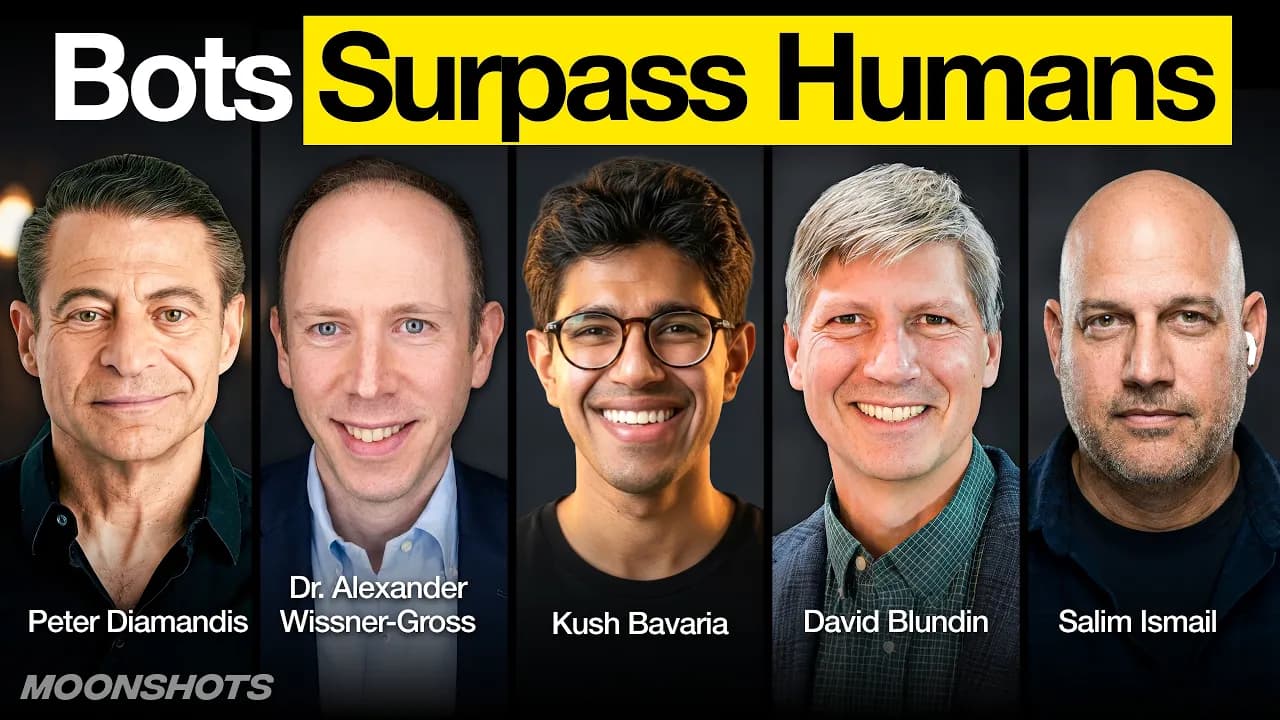
Moonshots is a twice-a-week podcast. Peter and Seem had already started it and asked Dave to be a guest. The appearance went very well and Dave learned a lot. Alex Gross was then asked to join originally as a guest, and the audience fell in love with him instantly. It is now four best friends talking about exponential change twice a week.
Peter has been Dave's best friend since MIT, going back over 30 years. Dave met Seem through X-Prize, which offers exponential change prizes totaling a billion dollars. Alex was met separately at MIT through John Warner or Mark Cassidy. Kendall Square's genius density makes such encounters possible.
Dave compared choosing a favorite co-host to choosing a favorite child or favorite ingredient in a chocolate chip cookie. He described Alex as the sugar, Seem as the chocolate, and Peter as the butter (or Greek yogurt substitute since Peter would not eat butter). The combination tastes good when everyone is together.
The most surprising conversation was realizing Elon Musk is just a big regular guy. People are intimidated by the magnitude of hyper-successful AI stars, but they turn out to be everyday awesome people.
Exponential self-improvement of AI is not taken seriously enough. Dave believes people compare it to the industrial revolution, but it is more like civilization. Prehistoric humans, then current humanity, then 2026 and humanity 2.0. It is that big of a step change.
If starting over with everything he knows, Dave would build a company that gathers every GPU's logs, every token in, and every token out. Governments could argue for decades over access, but at least the logs would exist. This would make it easy to discover anyone using AI for evil or nefarious purposes through the log history.
Time is short. Whatever founders are doing, they should do it 10 times faster, as fast as they possibly can. The window of opportunity is the best tailwind Dave has ever seen, but it should not be taken for granted that it will last forever. Run everywhere you go.
Keep Peter H. Diamandis in your library
Save the videos and channels worth coming back to, and find them again in one place.