Michael Kratsios on the New Golden Age of American Science | EP #276
In a Nutshell
The U.S. government under Michael Kratsios is launching a full AI-native reimagining of science to double national scientific productivity within a decade, backed by concrete national missions like returning humans to the moon in 2028, a lunar base by 2030, and a space nuclear reactor. This effort includes the Genesis mission to apply AI across all agencies, shifting from a fear-based AI narrative to one centered on healthcare breakthroughs, job creation, and economic growth, while reforming grant processes with golden tickets, fast-track reviews, and meta-science units to reduce administrative burdens. The strategy also pushes American AI stack exports, robotics leadership, and innovation zones to maintain technological dominance over China, with private philanthropy and autonomous labs expected to accelerate discovery beyond traditional government funding.
These notes were generated by AI and may contain inaccuracies.
Michael Kratsios described reading the golden age report as a kid in a candy store. He characterized the current moment as a complete fundamental AI native, AI agent up reimagining of the entire scientific process, which he believes is possible. His sense is that this is the golden age of America. AI is a technology that is going to impact every agency, whether flying drones, doing AI powered medical diagnostics, or working at the SEC on financial services.
Kratsios stated that government needs to be opinionated about what the most important things are for the future of the nation. The administration plans to put man back on the moon in 2028, build the first elements of a lunar base by 2030, and put a nuclear reactor in space by 2028. These were described as crazy ideas that were written down and approved as national missions.
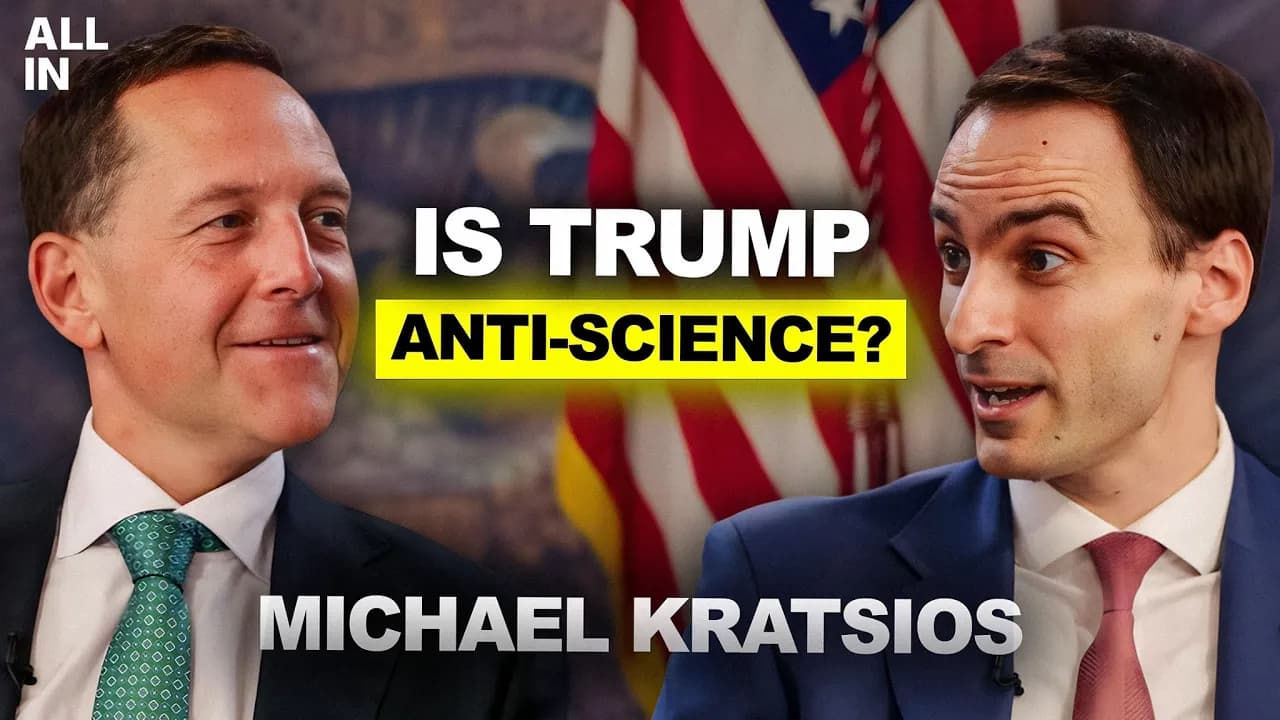
The interview takes place at the White House with Michael Kratsios, the 13th director of the White House Office of Science and Technology Policy and science adviser to President Trump. Kratsios is the principal architect behind three landmark initiatives: America's AI action plan as the roadmap for winning the global AI race, the Genesis mission as a Manhattan Project style effort to accelerate breakthrough discoveries, and science and new golden age as his blueprint for rewarding bold unconventional ideas and dramatically increasing the rate of scientific discovery.
A hypothetical future announcement was referenced about approving a trillion dollar science budget that would solve every problem on the planet within four years of the administration. The interview is being conducted on behalf of Moonshots and the Moonshot mates.
The conversation addressed how government processes can keep up with hyper exponential progress in science and technology. Ray Kurzweil predicts seeing as much progress in the next decade as in the last century, going from the Ford Model T to the Starship in ten years. AGI may arrive in the next three years, followed by ASI. Kratsios acknowledged that governments have struggled with this for a long time and emphasized the need to ensure regulatory systems don't get in the way of progress.
Kratsios presented a framework for thinking about technologies in two buckets. Born free technologies are things like the internet in the 1990s, where the best government approach is to step back and get out of the way. The 1996 bill passed under Bill Clinton helped allow internet technologies to take hold. Technologies born in captivity include commercial drone operations and AI powered medical diagnostics, which cannot be commercialized without affirmative government action to change regulatory structures for safe deployment.
The Genesis mission was launched where President Trump stood up with the Secretary of Energy to announce that the most important thing for the nation is applying AI to scientific discovery across all of government, not just at one agency. This represents the type of action from the White House level needed to push this down into agencies.
Kratsios noted that in most cases government is not the leading force in the cutting edge of technology. He referenced AI ministers appointed in various nations, the UAE driving 50% of government operations to AI, and Malaysia having an AI representation speak in all languages. He does not see this happening in the US, believing the first Trump administration's view that AI will impact every agency makes centralizing efforts in one person a tall order.
The question was raised about whether AI will enter government in terms of advising on policy or cabinet positions with AI instantiations of government members. Kratsios was unsure about the future but hopes all agencies can start using AI. Currently, large language models are not allowed for use on White House systems due to the Presidential Records Act, though this may change soon.
Kratsios acknowledged that AI has a massive PR problem. Three quarters of Americans fear AI, with 71% opposing data centers near their homes, a larger percentage than object to nuclear power plants. The narrative from government prior to President Trump was fixated on negative impacts like job losses, danger, and bio-risk. The first AI safety summit held by the UK government at Bletchley Park two years ago was wrapped around fear associated with AI.
Kratsios stated that the administration tries to look for areas where Americans connect with AI positively, with healthcare being the domain where they can show impact on how individuals and families get healthcare. The government can serve as a convenor to bring to the surface great stories about AI's dramatic impact in manufacturing, hiring, and the huge buildouts supporting the AI industry.
Jensen Huang was referenced as discussing the supply chain supporting Nvidia, with the largest order in Corning's history for chips being produced due to future building plans. These stories of factories being built, people being hired, and products being produced should be told to connect with Americans.
Kratsios expressed long term optimism about AI's impact on jobs, noting that fears during the first Trump administration around automation related job loss were never realized and employment only increased. The AI action plan called for launching an initiative at the Department of Labor to collect better data on AI's impact on the labor force from players that typically don't submit data, enabling better decisions on reskilling, retraining, and targeted labor assistance programs.
The concept of a parachute program was discussed where companies doing AI related layoffs would be incentivized to give employees AI upskilling training. Kratsios noted that every company will think about this differently and that many layoffs being blamed on AI would have happened anyway, with companies assigning blame to AI because it plays better and their stock price goes up when producing more revenue with fewer people.
A Future Vision X Prize was launched as the world's largest film competition for creators to create films showing a hopeful positive vision of the future where technology and AI work together. This addresses the challenge that most sci-fi films like Terminator, Ex Machina, and Black Mirror are dystopian, teaching average Americans negative visions of robots and AI.
Kratsios emphasized that government needs to be opinionated about the most important things for the nation's future. There was an era beginning with the Manhattan Project going through Apollo that had big ideas and bold things that motivated young people to go into science. The space related efforts include putting man back on the moon in 2028, building the first elements of a lunar base by 2030, and putting a nuclear reactor in space by 2028 with enough propulsion power to send folks to Mars.
The Genesis mission is the AI for science mission to essentially double the productivity of the entire scientific enterprise in the United States over the next decade. The president directed through an executive order the creation of a scientifically relevant quantum computer by the end of his term, putting a stake in the ground to build this machine after years of basic research in quantum.
Kratsios is most excited about quantum computing applications in pharmaceuticals, believing the types of calculations for particular molecules and things applied toward drugs will be transformational. Fusion energy was mentioned as important to keep thinking about beyond the current term, with the Department of Energy putting out its latest iteration of the national strategy a few months ago and more private sector investment in this energy source than ever before, with 37 venture backed fusion companies.
The policy position is that the US must lead the world in both closed and open source models, with a vibrant ecosystem on both sides supporting any type of customer. The open source ecosystem could be doing better, with a couple of well known startups pursuing getting close to the frontier, including Morad's release and Reflection's model expected later this year. The ecosystem and tooling around open source continues to get much better with the US as the default for harnesses and tools.
Chinese models are very well performing in open source, and American entrepreneurs who are cash strapped may use the cheapest model available, which is currently Chinese. The first page of the AI action plan from last year expressed that the US has to lead on open source. The American AI exports program was launched at Commerce as a whole of government effort to operationalize the AI action plan, with the vision that the American stack of best chips from Nvidia and AMD, best models, and best applications is nothing better in the world for customers globally.
The administration issued an RFP asking American companies to propose what an American AI stack looks like. Proposals are now under review and will result in turnkey American AI stack options for global deployment. These offerings will be supported by government financing organizations including the Export-Import Bank and the Development Finance Corporation to make the stacks economically viable for countries worldwide. The goal is to provide a complete package rather than requiring governments to assemble seven different vendors themselves.
The United States maintains the best chips by far, with AI applications driving demand for US chips. Export controls combined with factors around EUV lithography have widened the gap between US leading-edge chips and the best Chinese chips year-over-year. The foundation of the AI stack will continue to rest on US chip superiority.
The AI export program emerged from frustration during the first administration with Huawei's subsidized telecom stack that proliferated globally. The current strategy combines the US open-source ecosystem with co-source solutions plus American chips and applications to create a more competitive stack.
The restrictions on Nvidia chips to China are viewed as one of the savviest decisions made, throttling China's ability to build competitive models. Xi Jinping has long prioritized competitive semiconductor development, making the 2019 EUV lithography export controls particularly impactful in preventing China from creating competitors to US leading-edge chips.
The US has only a handful of humanoid robot companies compared to China's 150-plus companies. The administration recently took dramatic action limiting importation of non-US humanoid robots that haven't already been shipped. This demonstrates the priority placed on US leadership in robotics for advanced manufacturing and other applications. The goal is building domestic supply chain muscle for supply chain security.
Similar action was taken around UAS and drones in December of last year, resulting in dramatic investment increases in the drone supply chain. The same pattern is hoped for in robotics, as Chinese companies receive subsidization and engage in dumping practices.
Elon Musk has predicted double-digit GDP growth in 18-24 months and triple-digit growth in five years, with a post-capitalist world by 2036 where AI and robotics deliver anything desired. While timing may be off, the direction of change is viewed as correct. The cabinet and White House leadership recognize the velocity of change and are positioning accordingly.
Secretary Bessent was involved in post-method activities addressing cyber model risks to systemically important financial institutions. This exemplifies the administration's approach to taking rapid, serious action on emerging risks.
Scientific productivity has declined despite larger budgets, following "Moore's Law backwards" where discovery per unit dollar has dropped. The NIH budget has ballooned to nearly $45 billion, yet drug costs continue rising. The core conclusion is that the US has been unable to change how science is conducted, repeatedly applying more money to the same approaches.
A National Academies study found researchers spend approximately 45% of their time on administrative grant work. Scientists are considered the crown jewels of the country, yet the system prevents them from spending 100% of their time on actual research.
Regulatory bloat extends beyond paperwork to policy constraints. A key example is the US speed limit for flights over land at Mach 1 due to sonic boom concerns. Research has shown supersonic flight is possible without sonic booms, as demonstrated by Boom Supersonic. An executive order changed the rule from a speed limit to a noise limit, allowing supersonic flight if noise thresholds are maintained.
Young researchers face a system built for pre-internet discovery, requiring multiple publications for tenure. The median age of intramural NIH scientists is 71, while Nobel laureates typically do their prize-winning work in their mid-20s. This structural mismatch creates disincentives for revolutionary breakthroughs.
Most government grants last approximately 18 months due to academic calendars and administrative processes. However, certain scientific endeavors require five-year commitments. The approach is providing scientists with choice between shorter and longer duration grants based on the nature of their research.
During COVID, Tyler Cowan and others demonstrated fast-track grants with decisions made in hours for crisis-related research. The principle should extend beyond crisis periods to ideas that could unlock subsequent discoveries.
Each merit review panel member receives golden tickets allowing unilateral funding decisions independent of committee consensus. This incentivizes submission of higher-risk, potentially transformative ideas and attracts higher-quality reviewers to panels.
Meta-science involves evaluating how science is conducted and funded, then course-correcting when approaches aren't working. Meta-science units have been announced at NIH and NSF to test new mechanisms like fast-track grants and measure their effectiveness.
The proposed system uses prediction models, crowdsourced intelligent agents, and decentralized autonomous organizations to fund research directly. Funders post bounties for breakthroughs, AI agents identify promising leads and hire autonomous labs, while cryptographically signed results are verified. Smart contracts release payments upon milestone completion. Prediction markets guide grant makers, bounty markets direct resources to unsolved problems, and reputation systems identify reliable agents. The system operates at machine speed with human experts providing judgment on which questions matter most.
Philanthropic scientific capital exceeds any previous level in human history, with the OpenAI Foundation alone valued at nearly one trillion dollars. Yuri Milner, Eric Schmidt, and Marc Benioff are funding science directly. The science ecosystem has inverted since Vannevar Bush's Endless Frontier report, shifting from 70% federal R&D funding to 30% federal funding with the majority now coming from the private sector.
The majority of research is done in the private sector with only about 30% funded by the federal government. Companies can take a 10-year horizon if they need to. The shift toward private sector involvement has also seen philanthropy playing a bigger role. The current system allows bringing together all pieces on the chessboard to drive scientific discovery in ways impossible in a system designed in 1960.
An announcement was made about four-year PhDs to get more PhDs out faster and prepare students for jobs in industry, not only academia. Private sector companies paired with academic institutions help students pursue 4-year PhDs, reflecting today's reality rather than the 1960s system.
The report emphasizes prize challenges, advanced market commitments, and paying for results rather than proposals. XPRIZE has launched $600 million of prizes and driven about $30 billion of R&D as a result. For big national scientific endeavors or problems to solve, opportunities exist to pool money and make prizes even bigger to draw people to solve major challenges.
The government spends about $200 billion a year in R&D, with approximately $45 billion at NIH for biomedical research. A billion-dollar prize may be too large for government budgets to absorb, but prizes in the range of $100 million are certainly doable if the project is significant enough. The largest XPRIZE currently is the $101 million XPRIZE Healthspan.
The $101 million XPRIZE Healthspan has 830 teams competing with the goal to reverse functional age by 20 years, giving participants cognitive abilities, muscular capabilities, and immune system function they had 20 years earlier. Tackling aging would impact the US economy most positively. The average life expectancy in the United States is about 78-79 years, but average health expectancy is 63 years, leaving the last 16 years in poor health. Moving this needle to give people an extra decade of health and productivity would transform everything.
Longevity was noted as missing from the report but is critically important and ties to general health of Americans. Aging is viewed as a disease that can be slowed if not cured. Dario Amodei suggested doubling the human lifespan in the next 5-10 years, while Demis Hassabis discussed curing all diseases within the next decade. Demis was serious about curing all diseases in 10 years, believing it possible with AI advancement.
The six national technology missions include AI, quantum, commercial fusion, lunar exploration, robotics, and next-generation semiconductors. Biotech was noted as missing, though much biotech work has been nested under the Genesis mission. About $5 billion worth of Genesis mission grants were announced at the Genesis mission summit, with many relating to biotech.
Some states and cities are more pro-tech than others, creating singularity zones where they support autonomous vehicles, drones, nuclear power, and data centers. Regions could volunteer to be innovation hubs with relaxed regulations to accelerate research, similar to approaches taken by China and Chile. The administration has been focused on this as a way to drive innovation.
The first piece of paper signed by the president in 2017 launched the UAS Integration Pilot Program when commercial drone delivery was still a dream. The program created regulatory clearance for 10 state, local, or tribal governments paired with UAS operators to run tests. Communities stood up to say they wanted innovative technology and received regulatory clearance to run operations.
The administration has implemented the EIP (EV TOL program) for testing of eVTOL vehicles across the country. During the 2024 campaign, the president put out videos around creating innovation zones and cities where new technologies can be tested.
Texas ranked number one across all categories in state-by-state evaluation. Federalism allows states to make decisions and people and companies vote with their feet to go where they're most comfortable. Self-driving vehicle testing moved from California to Arizona when rules changed. This represents regulatory arbitrage, a powerful incentive for states. Communities could compete for data centers, with data center operators thinking more about incentives they can provide to communities.
The president has taken leadership on the rate pair protection pledge, directing big tech companies, AI companies, and data center builders to build, bring, or buy all their own power without burdening communities. If anything, they should lower the cost of electricity. Locations with AI data centers are getting on average lower electric costs. Golf courses use 30 times more water than data centers, while almond farming uses 50-60 times more.
The educational system remains tied to the industrial revolution and shows huge resistance to using AI. Public education is not serving kids' future for the world racing at us. Parents should come first, with options for how they believe they can best educate their children. Alpha School allows 3-4 hours of AI in the morning with the rest of the day focused on social skills. Some parents prefer no technology in classrooms and want classics education.
Most Americans get a broken middle that doesn't provide a positive future for children. Many districts have majority of students graduating high school unable to do basic math. The declining number of American students entering STEM fields is depressing. This affects national security, economic growth, and country health. The Apollo program was 100% responsible for everything in one speaker's life, alongside Star Trek.
Asking school systems to change over the next few years is extraordinarily difficult due to teacher unions and public education boards. An AI educational overlay could become available where parents and kids who want it can access it in afternoons or weekends. Alpha School started running schools themselves in certain locations but isn't cheap. The goal is to open source software or make it economical for anyone to run those programs.
AI proposes the hypothesis, robots run the experiment, the model reads the results and designs the next one 24/7 with no humans in the loop. This enables closed-loop science at machine speeds. Lila Sciences is building out a million square feet of such facilities. The vision includes retrofitting into federal labs and making access available to high school and college students on national lab equipment.
High school students historically found ways to meet professors and access university labs after school. Autonomous labs democratize this access and give opportunities for anyone with ideas to test them without institutional overhead. Universities will likely be among the first to build these labs to provide the best tools to their scientists.
The Genesis report talks about doubling productivity, which historically might seem ambitious. The 2x number came from last year when building the Genesis mission program signed by the president in December. Government is one of the hardest institutions to change and is linear at best. The target should be 10x, especially given AI transformations over the last six months. Even if 10x wasn't possible before, the pace of AI innovation makes it necessary to aim big.
Opus wasn't out earlier in the year, Anthropic revenue was at $10 billion and is now at post-$7 billion. This represents the fastest growing company on the planet in just seven months. The Mythos moment and Fable release occurred, with OpenAI releasing their new six model soon. The pace of AI innovation is insane.
Math as a discipline is being wholesale solved with new breakthroughs and proofs reported weekly. This will extend to physics, chemistry, biology, and material sciences with an inflection point coming. GPT-6 and successors for Anthropic and Grok will accelerate science fundamentally. Elon uploaded all of SpaceX's engineering data to Grok. The Genesis mission believes every scientific domain will see dramatic transformation and acceleration of discovery and hypothesis testing due to AI.
US national labs have tremendous scientific data across wide varieties of domains that hasn't been made AI-ready or uploaded to models. The opportunity exists to bring 70 years of scientific discovery from US national labs into AI models to accelerate discovery. When federal data like NIH health data gets brought in and breakthroughs occur, the value of those breakthroughs represents public goods. Anyone can use this data, similar to how NOAA weather data is freely available and powers weather apps. Taxpayers have funded unbelievable science at DOE for decades, and the goal is to make the most of it.
Argentina's President Milei announced no taxes on AI companies and enabling AI personhood for agents. This represents an interesting take on where things are going. The US is not yet at the place of giving AI personhood. The focus remains on ensuring benefits of AI are realized by American people, with the president focused since day one on continuing to lead the world in this area.
The president has been very focused since day one to make sure that the United States continues to lead the world in artificial intelligence technology. The government has a role to play, but most importantly, it needs to create a regulatory environment that allows companies to keep making the best breakthroughs in the world.
This segment introduces the health section of Moonshots, brought to you by Fountain Life. The mission is to help people use the latest technologies, including AI, to live a long and healthy life.
Dr. Don Mucalem, Chief Medical Officer of Fountain Life, discusses cancer detection. From the member database at Fountain Life, 3.3% of members who come in thinking they're healthy are found to have a cancer in their body they don't know about.
The majority of cancers that are typically screened for are not necessarily the ones taking lives when found at a late stage. When cancer is found early, the chances for cure are much higher, and it's much easier to treat a cancer when found early versus when found late. In Fountain Life members, over 3.3% were found to have cancers that otherwise wouldn't have been detected.
People don't feel cancer until stage three or stage four. Not knowing what's going on inside your body is like driving your car with your eyes closed. Fountain Life uses full body MRI and early cancer detection screening to detect cancers. These are not typical tools used in conventional care settings when it comes to prevention.
Currently, these screening studies are not covered by insurance. The goal is to collect these numbers, do the research, and work hard to democratize wellness. Members can know what's going on inside their body and have an obligation to know. Fountain Life offers access to the latest technology to help detect cancer at stage one when it is curable, before it progresses to stage three or stage four.
Keep Peter H. Diamandis in your library
Save the videos and channels worth coming back to, and find them again in one place.