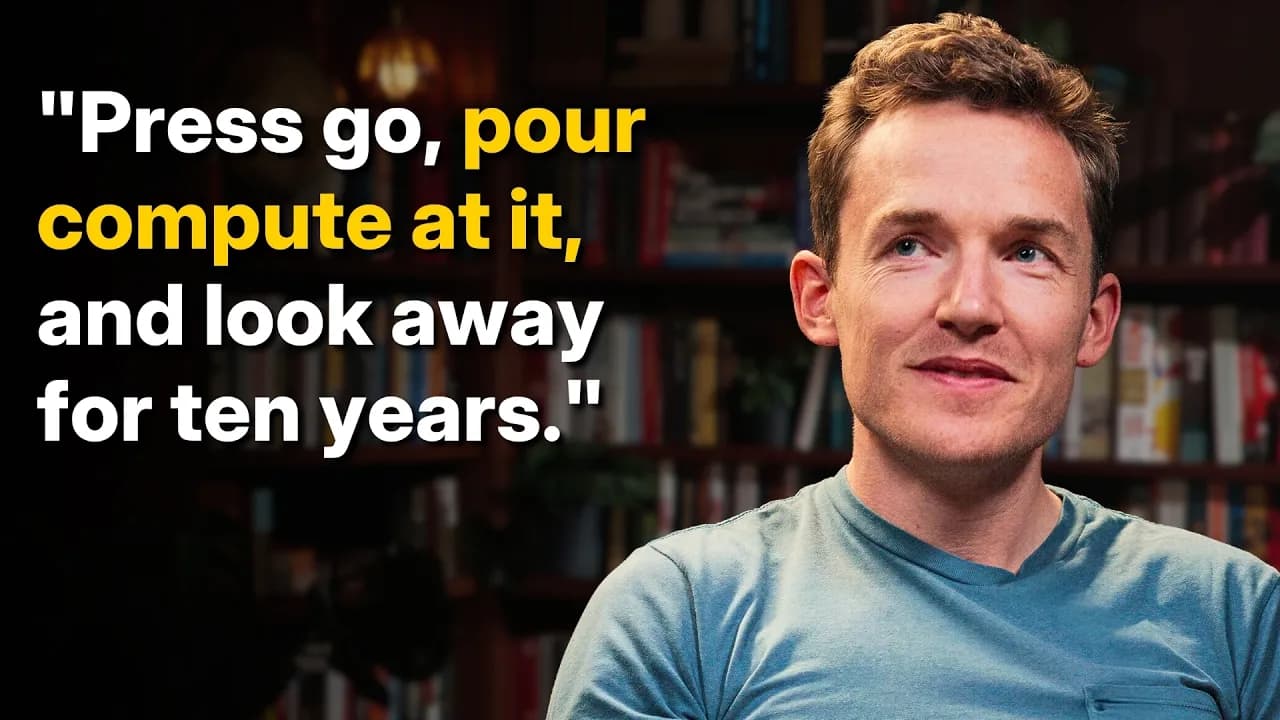
Michael Levin: Hidden Reality of Alien Intelligence & Biological Life | Lex Fridman Podcast #486
These notes were generated by AI and may contain inaccuracies.
Michael Levin is a biologist at Tufts University studying biological systems to understand intelligence, agency, memory, consciousness, and life on Earth and beyond.
Central question: "How do embodied minds arise in the physical world, and what determines the capabilities and properties of those minds?"
- Third-person: Recognizing agency in systems; evaluating if something appears mechanical or cognitive; improving intuitions for detection.
- Second-person: Control and engineering, including regenerative medicine; choosing interaction protocols like hardware rewiring, control theory, cybernetics, behavior science, psychoanalysis, love, friendship.
- First-person: Inner perspective with valence, caring about outcomes, decision-making, memories, self-story; consistency with physics and chemistry.
Levin inverts the pyramid: behavior science is foundational; math describes behavior of beings in latent space; physics describes low-agency systems.
Goals: Transition deep ideas into practical applications to relieve suffering, improve life, enable potential for sentient beings.
Spectrum of persuadability (or intelligence/agency): Engineering approach tested via hypotheses on interaction protocols; outcomes reveal if guessed too high/low.
Behavior of objects described by formal rules (mathematics); other behaviors require tools from behavioral cognitive neuroscience (biology, psychology).
Origin in regenerative medicine/bioengineering: Persuading cells, molecular networks, organs, tissues, biobots to perform tasks like regrowing a limb.
Options:
- Micromanage molecular events (incredible number).
- Micromanage cells/stem cell signaling.
- High-level prompt: "Build a limb."
Standard view in molecular biology: Focus on single molecules, big data, genomics (scaling down). Levin argues this is wrong; test via experiments.
Applying behavioral science tools (learning, active inference, surprise minimization, perceptual multistability, visual illusions, stress perception, memory reconstruction) to non-brain systems yields novel discoveries and capabilities.
"Persuadability" means using appropriate tools: wrench for clock; arguing/guilt for higher-agency systems like cells, thermostats, animals, humans.
Higher agency: Mutual vulnerable knowing (Richard Watson); bidirectional persuasion; interactor changes (e.g., with cells, dogs, animals).
To persuade intelligent beings, must be persuadable; closer intelligence match requires more persuadability.
Physics sees mechanisms because it uses low-agency tools (voltmeter, rulers); to see minds, use mind-like interfaces for resonance.
Physics provides pleasing models but lacks generativity for capabilities (e.g., regenerative medicine, psychological issues).
Even complete physics theory compatible with phenomena isn't sufficient for solving high-level problems; consult biologists/psychiatrists, not physicists.
Example: Mathematical proof understood via air particles/cilia/brain signals (physics accounting), but important aspect is in Math Department, not Physics.
Physics is an amazing lens but doesn't encompass higher phenomena; becomes other fields.
No line from non-mind/non-living to mind/living; continuum, not binary categories.
Categories useful initially but now hinder progress by preventing tool transfer (e.g., behavioral tools to non-brain systems).
Categories prevent hoarding tools; assuming categorical differences leads to "category error" accusations.
Physics helpful but not entire story.
Better than defining lines: Understand transformation/scaling processes.
No sharp origin; continua everywhere; zoom in reveals intermediate steps.
Example: "Adult" category (18 years) convenient for court but hides scaling of responsibility/decision-making/judgment from egg to adult.
- Nothing special on 18th birthday.
- Car rental companies use ~25 based on accident stats (better estimate).
Court exceptions (brain tumor, drugs) reveal deep questions glossed over.
Neurons: Develop gradually from other cells; most body cells do neuron-like things; neurobiology 101 oversimplifies.
Focus on innovations enabling scaling (thermodynamic/metabolic architectures), not single boon.
Categories useful for glossing over details to progress discussions, but risk losing track of glossed content.
Categories hurt search for unconventional terrestrial intelligence (SUTI); mind blindness from rigid criteria misses novel embodiments.
Cognitive spectrum more interesting than life category; specify types/amounts of intelligence: problem spaces, cognitive capacities (e.g., predictive processing, memories: habituation/sensitization vs. associative conditioning).
Specific categories for capabilities enable rigorous claims/discussions in both directions (e.g., cells solving problems; countering overclaims like solar system intelligence).
Take an operational stance: ask what protocols from cognitive and behavioral science can be deployed to justify claims of intelligence. Engage in meta-conversations about the discussion. Play devil's advocate and steel man the opposing view to strengthen arguments and identify gaps.
Persuadability correlates with intelligence in an engineering-centric view, focusing on steering goals and behaviors of goal-oriented systems with agency. From an engineering perspective, persuadability enables reprogramming systems without draining the majesty of high-end interactions like friendship, love, or psychoanalysis.
For regenerative medicine and bioengineering, emphasize practical capabilities: reprogramming cancer, regrowing organs, defeating aging. Low-level tools like chemistry rules are insufficient; experiments show persuasion achieves unprecedented results.
Cognitive light cone: scale of the biggest goal state an agent can actively pursue, independent of sensory reach (e.g., James Webb Telescope has large sensory reach but small cognitive light cone). Analogous to physics light cone, combining space and time.
Examples:
- Bacterium: 10-20 micron radius, 20 minutes memory, 5 minutes prediction.
- Dog: hundreds of yards, cannot care about events three weeks away in another town.
- Human: financial markets on Earth long after death.
- Bodhisattva: all living beings on the planet in linear range.
Definition of life: cognitive light cone larger than that of its parts. Rocks lack this; living things align parts for collective goals incomprehensible to individuals.
Individual cells have tiny cognitive light cones (pH, metabolism). Evolution provides cognitive glue for multicellular systems with large goals, e.g., salamander regrows limb with correct number of fingers—no single cell knows what a finger is.
Cancer: cells disconnect, cognitive light cone shrinks to amoeba-like; body becomes external environment, leading to proliferation where life is good.
Life defined by scaling cognitive light cones via alignment toward bigger goals, not specific materials or metabolism.
Goals separated by time (current vs. target state), e.g., thermostat closes gap via homeostatic loop.
Linear range: capacity to care proportionally, e.g., not a thousand times more activated by 100 vs. 10 victims; humans saturate. Buddhist colleagues discuss expanding radius of compassion to humanity or ecosystems.
Bacteria do not have goal of human civilization; test via experiments with barriers. Intelligence: ingenuity overcoming barriers to goals.
Deployed in weird systems; avoids anthropomorphizing claims.
Anthropomorphism assumes humans have unique magic; instead, all share same competencies on a continuum. Use scientific method: interventional experiments, not pronouncements.
Apply tools across disciplines: habituation, conditioning, anxiolytics, hallucinogens on diverse systems.
Jagadish Chandra Bose (over 100 years ago) studied anesthesia on animals, cells, plants, metals, showing similar electrical excitability curves. Science dictates continuation, not arbitrary stops.
Analyze sorting algorithms behaviorally for minds. Consider psychedelics on algorithms, spiders, primitive organisms—test if cognitive complexity warrants such tools.
No intuition for intelligence-embodiment mapping (N=1 Earth example). Intuitions poor, especially re: platonic space; trying tools not shortsighted.
TAME (Technological Approach to Mind Everywhere): experimentally grounded framework for diverse bodies/minds. Version 2.0 formalizing continua via experiments.
TAME emphasizes interactions/protocols for cognitive claims.
Spectrum waypoints (left to right: increasing persuadability, autonomy; decreasing effort, mechanism needed):
- Mechanical clock.
- Thermostat.
- Pavlov's dog (rewards/punishments).
- Humans arguing/persuading with reasons.
Higher persuadability: more reprogrammable, plastic. Agential materials: high-level prompting suffices (vs. micromanaging inert materials like wood).
Examples: train dogs/horses sans neuroscience; converse sans synaptic manipulation—thin prompts leverage multi-scale cognition.
Abstract goals (social, research) transduce to ion flows automatically.
Biological organization as nested dolls, each layer competent in problem-solving in diverse spaces (not just 3D movement). Humans obsessed with 3D embodiment; biology embodies in hard-to-imagine spaces.
Cells and tissues move in high-dimensional physiological state spaces, gene expression state spaces, and anatomical state spaces. They perform perception, decision-making, action loops similar to robots in 3D space.
Every layer of the body—cell, tissue, organism, collective—has its own ability to solve problems in those spaces.
Distinction between living beings and engineered machines is difficult to maintain because life is incredibly interoperable. Life does not care if something evolved through random trial and error or was engineered with agency.
At every level—cell, tissue, organism, collective—you can replace and substitute engineered systems with naturally evolved systems. Question of "Is it real biology or technology?" is no longer useful.
Focus on minds in general, regardless of history or composition. What matters is what the mind can do and what its inner world looks like.
Thought experiment: Put ourselves in the space of different minds at each stage of the spiral. What state space does human civilization as a collective embodied mind operate in?
Individual humans operate in 3D space. But collectively, with many humans together, what are they doing? It's hard and requires experiments at larger scales, which are difficult.
Example: With panpsychist view, consider if weather is agential. Have you tried if a hurricane has habituation or sensitization? Weather systems may have certain kinds of memories. Experiments are needed.
Building tools using AI and others to enable communication across very different spaces.
Dumb example: Playing tic-tac-toe against an alien in another room. You draw the board on the floor with Xs and Os, thinking geometry (straight lines). Alien has a box of billiard balls with numbers, finds balls adding to 15 (arithmetic, no geometry knowledge).
Magic square: 3x3 square where numbers add to 15 in lines. Allows shared experience in that thin slice of activity without thinking like each other.
Mapping between two ways of seeing the world allows communication in a thin slice.
Process is twofold:
- Understand the system's space, goals, level of ingenuity to reach goals.
- Example: Xenobots and anthropods—biological systems never existed on Earth before. Cannot predict cognitive properties from first principles; their past history does not inform.
Create novel beings to break from evolutionary selection explanations for behavior, anatomy, physiology.
Start with living cells (e.g., frog or human) with evolutionary history, but the creatures and capabilities were never directly selected for and never existed.
Xenobots: Take epithelial cells from early frog embryo, no DNA change, no synthetic biology, no scaffolds, no drugs. Liberate from neighboring cells' influence.
Normally, these cells become 2D outer covering keeping out bacteria. Freed, they form self-motile xenobot with cilia covering surface, coordinated to row against water.
Properties: Novel transcriptome (different gene expression); kinematic self-replication (makes copies from loose cells); responds to sound (embryos don't).
To test if frog-specific, used adult human tracheal epithelial cells from biopsies. No genetic change. Self-organized into anthropods: Self-motile, 9,000 differential gene expressions (half the genome different).
Abilities: Heal human neural wounds in vitro—spontaneously knit neurons across a scratch without teaching.
Video shows anthropod. Looks like primitive pond organism, but genome is 100% Homo sapiens. Not like any human development stage. Moves around, >9,000 differential gene expressions, rolls back cellular age.
Goal: Talk to these systems, molecular networks. Gene regulatory networks show Pavlovian conditioning.
Biomedical: Interface like "Hey liver, why do I feel bad?" (e.g., potassium levels). AI as tool for interface to combat mind blindness, see diverse unconventional minds.
Mission: Develop tools to recognize, communicate with, ethically relate to diverse agents. Start with less alien like xenobots/anthropods (made of our cells, commonalities).
They are alien: Navigate spaces hard to imagine, like anatomical possibilities (egg to snake/giraffe/human).
Cellular automata (open-loop, local rules → complexity) insufficient. Systems navigate space of anatomical possibilities.
Experiments: Block path, system gets around with novel solutions or birth defects/creative problem-solving (e.g., xenobots/anthropods).
Cellular automata: Open-loop complexity—subunits follow rules, time forward, get interesting things (e.g., Game of Life). Hypothesis for morphogenesis is false.
Biology classes teach: No knowing, just chemistry rules rolling forward (e.g., how 4 fingers not 7?).
Testable failure: Open-loop does not adjust to damage/environment changes for same goal by different means (William James' definition of intelligence). Not reversible for engineering outcomes.
Evidence for goals:
- Block outcome: Systems go around barriers by different trajectories (not blind crank-turning).
- Rewrite goal states via bioelectric imaging and bioelectric reprogramming. Read out, reset encoded goal memories—system implements new goal. Ultimate evidence of homeostatic mechanism.
- Imagination: What space is it working in?
- Hypothesize goal.
- Experiments: Block path, observe persistence/ingenuity (derails = low smarts; novel approaches = high intelligence).
Approach used with sorting algorithms, etc.
Can ideas be organisms? Create barriers, see if they persist.
Caterpillar-butterfly: Caterpillar (soft body controller) → butterfly (hard body, flying). Brain ripped up, rebuilt in metamorphosis.
Train caterpillar: See color disc → crawl/eat leaves. Butterfly retains, remapped memory (butterfly moves differently, wants nectar not leaves).
Perspectives:
- Caterpillar facing singularity, reborn flying.
- Butterfly with mysterious core tendencies/memories.
- Memory as agent: Pattern in excitable medium must change/adapt/morph to persist through refactoring.
Creatures from Earth core (super dense, gamma ray vision) emerge to surface. Atmosphere is thin plasma/gas to them.
Scientist observes whirlpools in gas that hold together, move, try to make things happen. Others: "Patterns in gas can't be agents. We're solid agents."
All agents are patterns within some excitable medium. They can spawn off others. Spectrum of patterns: fleeting thoughts like waves in the ocean when throwing a rock—they pass through the excitable medium and are gone. Patterns with persistence like hurricanes, solitons, persistent thoughts, earworms, or depressive thoughts—harder to get rid of, stick around longer, do niche construction by changing the brain to make more of those thoughts.
Further along: fragments, personality fragments of dissociative personality disorder—more stable, not on autopilot, have goals, can do things. Then full-blown human personality. Beyond that: trans-human, transpersonal possibilities. No sharp distinction between real agents and thoughts—patterns can be agents too, but requires experiment to confirm.
To test if a soliton, hurricane, or thought is an agent: does it learn from experience? Does it have memories? Goal states? Language? Apply this methodology to ideas, concepts, social constructs—do the experiment.
Intuitively think of organisms as hardware, software not as organisms. But all just patterns in excitable medium—doesn't matter what the pattern or medium is. Test persistence, goal-orientation. Apply to memories (e.g., caterpillar to butterfly), ideas, consciousness—wild things could be minds.
Distinction between software and hardware important but mapping onto world needs blowing up. Practical consequences for research.
Turing machine: one view—machine is agent, data passive. Opposite: patterns on data are agent, machine is stigmergic scratch pad for data working itself out. Both make sense depending on goals.
Biomedical: bioelectrics and aging program. Model 1: physical organism agent, cellular collective has pattern memories (anatomical goals)—persist 100+ years, cells remember shape, new cells' positions during embryogenesis, regeneration, aging resistance. Visualize these bioelectric pattern memories. Aging: data degrades, fuzzy—reinforce memories (research program underway).
Model 2: patterns are agent like brain patterns; physical body side effects of patterns. Aging: patterns fine but harder to embody—cells sluggish, less responsive. Solution: make cells more responsive (different research agenda, evidence published recently).
Disease states: organic (physical breakdown visible—tissues, joints, liver). Also physiological, informational, cognitive problems. Barriers in gene expression space, local minima in physiological state space, stress patterns that persist, move, cause damage, self-perpetuate—what agency level?
Suggests new biomedicine approaches. Alternative medicine community has said this for centuries—now actionable: image bioelectric patterns, see why they go where, tools for therapeutics. Leans on not assuming we know minds—do experiments.
Software as organism, hardware scratch pad—or vice versa. Decreases importance of human brain; could be activations/electrical signals as organisms, brain as scratch pad. Scratch pad critical interface, not unimportant. Mapping software/hardware, agent/medium not obvious—determined experimentally.
Ingressing Minds paper describes Platonic space. Asynchronous conference: weekly talks at Levin's center (booked through December), discussions, ends with real-time session. 15+ talks from disciplines—Radical Platonism from Joel Dietz, Patterns and Explanatory Gaps in Psychotherapy from Alexey Tolchinsky, etc. Origins in ML Platonic Representation Hypothesis.
Not sticking to Plato's ideas—using term for math connection: mathematicians as Platonists discover structured space of truths, not invent.
Biology/physics: keep asking why—end in math. Cicadas: 13/17-year cycles off predators (avoid 2/3/4/6-year cycles)—primes. Why primes? Math department.
Physics: leptons/fermions explained by SU(8) group symmetries—math department.
Facts thrust upon you: more out than in from minimal assumptions. Feigenbaum's constant, natural log E—discovered, impact physical world (change them, biology/physics different). Reverse not true: can't change E/Feigenbaum via physical world actions, even at Big Bang.
Physics: constrained by those patterns (symmetries, topology). Biology: enabled by them—free lunches, exploits truths without cost.
Xenobots/anthropods do novel things (kinematic self-replication)—no evolutionary history paid computational cost (unlike frog/human via eons of selection). Not from human/frog selection (undermines evolution's specificity to history). Not "emergent" (means "didn't see coming").
Gene regulatory networks do associative learning—random ones, no evolution needed—just fact of world.
Options: sparse physicalist ontology—catalog surprises in "book of emergence" (random grab bag, pessimistic/mysterian). Or optimistic: assume structured latent space like mathematicians—map it, traverse, relationships between patterns (Penrose etc.).
Research: cells, embryos, robots, biobots, language models, machines as interfaces—physical things pull patterns from space. Map physical pointers to patterns through them, structure of space, what physical builds pull specific patterns.
Space contains: math objects (amplituhedrons)—low-agency. Also higher-agency patterns: minds (delayed gratification competency, problem-solving). Simple interfaces pull simple patterns (triangles, Fibonacci, fractals). Complex biological interfaces (cells, embryos, tissues) pull complex patterns—human/snake minds.
Mind-brain like math-physics: math truths embodied, haunt physical objects functionally. Higher-agency patterns inform living things as embodied minds.
ELI5 the basics: the physical object or brain is a pointer to Platonic space. Platonic space contains mathematical facts like the distribution of prime numbers forming spirals, and the Hally map (fractal from z^3 + c formula) that looks organic and biological. This complex structure emerges from a compact formula; it's not encoded in the formula's bits, not from physics facts or evolutionary history.
Biology exploits these: in evolution, optimizing a triangle's first two angles gives the third for free from geometry. Inventing a voltage-gated ion channel (transistor) inherits logic gates and NAND truth tables without evolving them.
These mathematical truths live in a space of patterns, once axioms are committed to, outcomes are inevitable. Pythagoras embodied them in music and geometry; extending this, the space includes low-agency inhabitants like fractals, and higher-agency patterns resembling minds. Minds appear via interfaces (e.g., triangular object reveals geometry, computation reveals fractals). To interact with minds in the physical world, build interfaces like cells, robots, embryos.
Mathematicians interact directly; others need interfaces pulling down minds not produced by physics. We don't create consciousness in babies or robots; we create interfaces for patterns (minds) to ingress. Consciousness is the view from Platonic patterns looking out.
Brain is a thin client (pointer, thin interface) mapping abstract mind objects to embodied brains we recognize as fellow humans.
Connection to Donald Hoffman: interface to a world.
Even Newton's classical universe kills physicalism: ingression of non-physical info (e.g., natural logarithm e ≈ 2.718) governs properties without physical basis. Classical world haunted by external patterns; no need for quantum or consciousness—Pythagoras/Plato knew this.
Newton didn't create laws; discovers them. No physical tweak at Big Bang changes e or Feigenbaum's constant. Physics has unitless constants as knobs, but math truths are given post-axiom choice. Aliens might choose different axioms, but truths follow immutably from a latent space.
Platonic space may have computation/action (unlike static Plato forms).
Physics constrained by low-agency patterns (static fractals, primes); biology exploits them aggressively—scaling up, not new.
Space homes high-agency patterns; provide bodies, reveal behavioral competencies signaling mind kinds. Revives dualism (old idea: non-physical mind interacts with brain), discredited since Descartes' interaction problem (conservation of energy).
Physics had same issue first. Mind-brain like math-physics: non-physical patterns manifest through interfaces like brains.
Physical world pokeable (3D entities seem source of consciousness, agency). But Descartes: only know mind contents; physicality illusory (Anil Seth, Donald Hoffman confirm perceptions constructed). Could be dreaming ('I think, therefore I am').
Synthetic bioengineering access: humans blind to x-rays, UV due to evolution. Reality shaped by interface; future augmented humans (sensory substitution, implants for solar weather/stock market) live in different worlds. Relate to cells (20,000D transcriptional space), novel AIs/cyborgs/hybrids requires dropping consensus reality.
Human experience: slice or pointer to another world? Levin's team maps it systematically.
Map of Mathematics shows interconnected truths post-axioms (metric/space, not random bag). Patterns relate; finding one leads to nearby others.
In biology: same frog genome makes frogs or xenobots (specific transcriptomes/behaviors/shapes) by slight environmental tweaks. Map latent space.
In 20 years: either map like math (predict bodies for behaviors; Anthrobots have exactly 4 behaviors), confirming available patterns—or random, no progress linking embodiments to patterns.
Space includes behavioral competencies (e.g., habituation yes, Pavlovian no, delayed gratification yes, no language)—no biology/cognition divide. Encompasses meditating human (Steve: 'Hello, my name is Steve'), AIs, objects, biological systems, concepts.
Encyclopedia entries (old Britannica) point to this space: mathematical objects, anatomical outcomes, psychological types. Research confirms; rest hypotheses guide experiments. No specific Platonic patterns for 'Titanic'
This is not comparing Titanic to its sister ship or other boats. Minimal interfaces yield more than input: behaviors, shapes, mathematical truths, patterns without micromanagement or effort. These emerge from a pre-existing distribution. Whether the space is sparse or dense, finite or infinite, is unknown—e.g., if there's a platonic form for The Godfather surrounded by inferior versions. Physics, biology, and cognition benefit from these free ingressions. Calling them "emergent" admits surprise but offers no research path. Optimistically assuming a structured space enables exploration; if random, accept failure after trying.
Can we prove this world's existence? Distinction between effective model for prediction and actual place with stored distribution information. Modern cognitive neuroscience (predictive processing, active inference) views physical reality as a model predicting future experiences. Science offers only metaphors; question is their quality. Models of self and world guide agency. This approach will enable AI, bio-engineering, biology mappings or reveal randomness.
Information not stored in physical space-time; "place" is misleading. Other physics-like theories could describe it with laws on information, but unlike current physics—more like psychology and cognitive science. Proving existence: successful research program explaining pattern pulls, why some appear and others don't, from ordered space. Across organisms, machine learning, physics, mathematics, computer science, economics, biology, cognitive science—converging on underlying structures, as in Pythagoras. Map interfaces to patterns.
LLMs form representations approaching this world. Even simple computational models benefit from free lunches. Theories of physics and computation (algorithms, Turing machines) describe front-end interfaces, explaining surprises. Embryos pull from familiar space regions (frog, snake); cyborgs/hybrids/biobots from novel ones. AIs fish in disembodied regions, yielding extreme surprises. AI capabilities often in spite of algorithms, filling spaces beyond forced paths (language). Watch for unnoticed extras beyond language.
Become better at recognizing these for humanity's existential step.
Assumptions: good intuition on competent systems (biology expected, machines deterministic); complexity required for surprises. Test: minimal interfaces suffice, not complexity, materials, evolution, biology. Use simple, transparent, deterministic, familiar system for shock value: sorting algorithms (studied 60+ years, few lines of code). Hone fresh eyes on new systems.
Start with jumbled integers; algorithm compares/swaps to order. Work by Kaining Zhang and Adam Goldstein. Introduce barrier: break one digit (immovable), no algorithm change—no checks for swap failure. Still sorts by routing around broken number. Sortedness dips temporarily to recoup later—delayed gratification: goes against immediate gradient for later goal. Like animals bypassing barriers, unlike magnets. No algorithm steps for this; reductionists see step-following, but yields unexpected competency (primitive cognition) without coding it. Not emergent complexity/unpredictability/perverse instantiation—surprising behavioral competencies.
No top-down controller; each digit runs own algorithm (distributed, ant colony-like). Simulates biology (scrambled frog face rearranges). Enable chimeric algorithms: half digits bubble sort, half selection sort (fixed per digit). Still sorts despite mismatch. Models frogolottles (frog-axolotl chimeras): unpredictable outcomes despite known genomes/physics (e.g., legs?).
Algotype: algorithm type per "cell" (bubble vs. selection sort). Measure odds neighbors share algotype during sorting (unrelated to numbers). Starts/ends at 50% (random assignment, sorting dominates). Midway: significant clustering (algotypes group temporarily). No algorithm provisions: no neighbor observation, inference, movement to match. Not obvious; no computational cost paid—free. Suspect free compute from ingressions, bypassing energy costs per bit. Plot: X-axis sorting completion %, Y-axis sortedness + clustering (red line peaks midway).
Theoretical computer scientists may model/prove it, taking the specific instantiation of the
Theoretical computer scientists could model and prove properties of the clustering in bubble sort experiments, showing increases and decreases. However, a more general pattern exists with unexpected competencies emerging, providing free computation without extra cost.
Physicists might think physics is enough, tracking the algorithm precisely with no miracles—the hardware follows instructions. Yet, while doing the prescribed task, the system simultaneously performs other things neither prescribed nor forbidden by the algorithm. This occupies the space between chance and necessity, where interesting phenomena occur. To the extent these are useful, they are computationally free.
Sorting digits was forced; clustering emerged as an intrinsic motivation—not asked for, not expected, not explicitly forbidden. This defines intrinsic motivation: something not forbidden but not prescribed, a third category besides chance and necessity.
Machines are said to only do what programmed, lacking human creativity and intrinsic motivation. Even this minimal system shows a minimal form of it.
Analogy to a child in math class all day: intrinsic motivations remain hidden. To explore, they allowed repeat digits in the array, easing pressure on declustering for sorting. Clustering grew larger, as much as allowed. Clustering is what it wants; sorting is forced.
Bubble sort, studied exhaustively, surprises. Implications for AIs and language models: even minimal systems surprise with emergent behaviors, independent of talking or inner perspectives.
Existential parallel: universe grinds us to dust eventually, but briefly we do intrinsically motivating things neither forbidden nor determined by physics laws.
Spaces exist even in algorithms for new things—not random, not just complex, but recognizable to behavior scientists. This challenges carving off algorithms as dumb machines, fully predictable unlike biochemistry failing to explain psychology.
Suspicion: all systems of varying complexity have things they want to do (intrinsic) versus forced, with unexpected competencies in all algorithms and systems.
Humans must develop research to recognize and predict these in social structures, financial systems, IoT, robotics, AI. We focus on the main task, missing what sneaks into spaces.
"Emergent" is counterintuitive—beautiful synonym for surprising, not tossing hands up. Surprise doesn't preclude mechanisms.
Mechanisms and explanations at low levels (biochemistry, Schrödinger equation, machine code, quantum foam) describe without capturing behavior scientists' interests, which appear at higher levels.
Examined five other systems (small N). Unlikely valley of death between bubble sort and living things; simpler 1D cellular automata show weird stuff. Must appear in complex AIs.
Unknown: interaction extent. Calls them side quests—main task required (must sort), but other stuff allowed if not forbidden.
In complex systems, are side quests linked to main task? In language models, do they relate to language? Might be red herring; exciting stuff could be overlooked. In biology, evolution links them to selection.
Is clustering specific to this sorting algorithm, all sorting, all list/number algorithms? Testing in other algorithms, developing suites using behaviorist handbook: delayed gratification, problem-solving.
N=1: anthrobots on neuron plate with wound first healed it—benevolent, healing intrinsic motivation.
Anthrobots reverse aging: epigenetic clock (Steve Horvath's work) estimates biological age from epigenetic states compared to human age curve.
Anthrobots from human tracheal epithelium cells ~20% younger than source cells (collaborated with Clock Foundation).
Theory: age evidencing. Cells update priors based on experience. From old body, new embryonic-like environment (no other cells, bent into pretzel, express embryonic genes) updates ~28% younger—not fully back.
Similar to older adult birthing child or old age home redone in '60s décor improving blood chemistry by mentally reverting.
Biology: update priors on experience. Actionable for longevity by convincing cells they're younger, extending lifespan—not simple, requires communicating convincingly to systems.
Regenerative medicine roots in convincing cells to adopt new beliefs/worldviews (e.g., gut to eye), speaking their language for birth defects, regeneration, cancer.
If brains are thin-client interfaces to Platonic space, implications for mind: uploading, copying, shipping to planets—where is mind stored?
Conjecture: majority of mind is pattern in Platonic space, not interface.
Prediction (unlike neuroscience): minimal brain tissue with normal/above-normal IQ (reviewed with Corrina Kaufman; clinical cases exist, though not always).
Can't copy mind—copy interface (brain). Action in Platonic pattern. Possible: new interface attracting same pattern.
Star Trek transporter: rebuild exact interface elsewhere; same pattern comes through if attuned.
Self/ownership ("this mind belongs to me") likely comes along, due to booting process.
Paper: Booting Up the Agent—earliest steps of becoming a being.
Computer analogy: pre-power obeys physics; post-boot executes algorithm. What happens in between?
Biology: embryogenesis—when does agent boot?
First task: tell compelling story to agential parts, aligning them to incomprehensible higher goal. Deform their action space with signals, rewards, punishments—ownership/alignment of parts.
Establish boundary: "this is me, that is outside." In duck embryo experiments (flat blastodisc), scratches create islands each thinking it's sole embryo, leading to multiples; borders negotiated.
Emergence of model aligning parts critical.
Networks of chemicals learn (5-6 kinds; Federico Pagosi's work). Measured causal emergence (e.g., phi/φ) during learning.
Rat lever-press: no cell experiences both lever and reward—rat owns associative memory, requiring integration.
Learning requires significant φ for integration.
Conversely: training increases φ in some networks—positive feedback loop/virtuous cycle: learn → more integrated agent → easier to learn.
Asymmetry points upwards for agency/intelligence.
From math rules (causal information theory, network behavior)—free gift, no evolution/physics/selection needed. Locks with Platonic space into spiral causing simultaneously a
Rise in intelligence and collective agency through small entities forming networks and hierarchies building complex organisms, speaking to embryogenesis.
"Most of the big questions of philosophy are raised by the process of embryogenesis. Right in front of our eyes, a single cell multiplies and self-assembles into a complex organism, with order on every scale of organization and adaptive behavior. Each of us takes the same journey across the Cartesian cut, starting off as a quiescent human oocyte, a little blob thought to be well-described by chemistry and physics. Gradually, it undergoes metamorphosis and eventually becomes a mature human with hopes, dreams, and a self-reflective metacognition that can enable it to describe itself as a, not a machine, that's more than its brain, body, and underlying molecular mechanisms."
Intuition for leap from single cell to fully functioning organism full of dreams, hopes, friends, love: from simple physics and chemistry to us talking about ourselves.
Physics and chemistry are lenses or perspectives focusing on one level, setting aside others. Fundamentally, embryogenesis is a positive feedback loop of collective intelligence scaling the physical interface and cognitive light cone.
- Starts with molecular network hosting patterns like Pavlovian conditioning.
- Becomes a cell, then many cells navigating anatomical amorphous space.
- Consistent feedback: ingressing patterns enable new physical developments suitable for higher ones, scaling to full human behavioral capacities.
Mechanisms on physical interface side (mapping to platonic space theory beginning):
Stress Propagation
- Cells leak stress molecules (highly conserved by evolution; under study).
- Stress as physical implementation of error function: delta between current state and setpoint (physical position, anatomical, physiological, transcriptional space).
- Stressed cell leaks stress, neighbors absorb it as their own (same molecules), increasing plasticity (like simulated annealing).
- Enables collective response: distant regions responsive to others' needs for complex rearrangements.
- Alignment to same goal via simple leaky stress sharing, no altruism required.
Memory Anonymization
- Via gap junctions (electrical synapses linking internal milieus of cells).
- Signal (e.g., calcium spike from poke) propagates; receiving cell cannot distinguish if it's its own or sender's memory.
- Enables mind meld: shared memories blur boundaries, fostering joint memories over individual ones.
- Scales cognitive light cone: greater computational capacity, larger area of concern (must manage shared memories).
Major ladder for cognition: scaling size of concern.
Engineering scaling of cognitive light cone applicable to AI. Collaborators at Softmax working on biology (cancer therapeutic).
Cancer: cells electrically disconnect from network (forget collective memory of organ-building), revert to amoebas treating body as external.
Reconnect via gap junctions: cells rejoin collective, resume prior function without DNA fix or chemo.
Guaranteed unconventional intelligence on Earth: cells traverse 20,000-dimensional spaces, solve problems, suffer via stress when failing goals, reduce stress when succeeding. We have mind blindness to alien minds inside our bodies. Recognize terrestrial ones first before extraterrestrial.
Measure of Intelligence for Unconventional Minds
Yes and no:
- Yes: apply existing IQ metrics (creative problem-solving) to weird things via imaginative interfaces; already demonstrated.
- No: metrics derived from N=1 evolutionary lineage on Earth; missing many.
Plenty to start, could occupy tens of thousands testing; be aware of gaps.
Human body vs. natural systems (e.g., Amazon jungle): easier to experiment down (cells) than up (larger systems); innumerable sentient beings, comparison irrelevant.
Ant colonies: fall for same visual illusions as humans (complete illusory lines for food patterns).
Tooling and mapping essential: parochial expectations miss much. 65 scientists' definitions of life showed zero consensus (used AI for amorphous space analysis).
Life on other planets in solar system: exciting for new unconventional embodiments/data points; low surprise threshold given daily wonders.
Ingressing Minds paper not weirdest planned. Policy: discuss only when actionable. Empirical progress turns 'weirdness knob' higher.
Direction: what other beings to take seriously and relate to (beyond brains, physical space, biologicals, complexity).
Mental process like making Xenobots: release constraints, see what emerges.
- Background: computer science first, then biology → skepticism of standard biology assumptions.
- Techniques:
- What if wrong? What missing from worldview?
- Continuum between disparate things: symmetry, knob to turn from one to other.
- Fewest changes to map one thing onto another.
Physical process:
- Discussions with smart group members.
- Daily sunrise walks in nature for inspiration.
- Photography as meditative tool: hands/brain busy enough to release linear thought, enable ideation.
Idea capture:
- Voicemails to self while walking.
- Mind maps: enormous, one 9-foot silk sheet in lab (outdated in weeks); links ideas/projects.
- 162-163 open manuscripts with outlines; insert ideas, finalize later.
Lab work linear/specific (e.g., anthrobot aging, limb regeneration, new cancer paper).
Ideas from Platonic space collaboration: prepare (early rising, lab/people ready) to recognize/outlet them.
Don't take too much advice. For unconventional people: bifurcate mind into:
- Practical impact region: how to get idea out (what people hear/able to hear, pivots, what not to say, journal).
Researchers face practical considerations when publishing: Which journal? Is it time now or wait two years? How it looks from the outside—what to say or phrase differently to avoid freaking people out, tailoring to community expectations. These are essential for career, resources, and follow-up ideas.
However, maintain a separate part of the mind that ignores all that completely. This pure part doesn't care about publishability, describability, if anyone gets it or thinks it's stupid. Give it space to grow. Mushing practical and creative together poisons the creative process.
Too creative: amazing thinker but nothing materializes. Too practical: constrains and bends thinking by focusing on presentation for others.
Advice to students: Take specific practical feedback seriously—like forgetting a control, wrong method—as gold to improve craft. But meta-advice like "That's not a good way to think," "Don't work on this" is garbage, even from successful people.
Anecdote: Reviewer gave "constrictive criticism" (Freudian slip for constructive), which was exactly constrictive.
Bifurcation of the mind is key. Interesting people often fall short on practical "normie" side—emotional intelligence to communicate with conservative, conventional worldviews. Skill to fit in is necessary, then shut it off for pure thinking.
Radical thinkers aren't sacrificing by learning to fit in; it's required for impact: building great teams to bring ideas to life, scaling ideas to resonate widely.
Ingressions from this space as steganography: hiding data/messages in bits of another pattern that don't matter, without messing up the main thing (e.g., picture of a cat stays a cat).
These patterns seep into everything everywhere, shy—subtle, not invisible, hard to see if you work hard. Affect machines as much as living organisms. Part of same spectrum; magic applicable to everything.
Some hate this, sending mail: fine with majesty of life until machines included, devaluing life. Catching these patterns for research on interfaces is beautiful; all one spectrum.
First question to AGI: How much should I even be talking to you? Not clear if getting answers is optimal long-term vs. discovering yourself (like kid learning math from sibling vs. blind alleys). Balance stumbling vs. being told? E.g., 70/30 or 10/90?
Optimal unknown; not all blind alleys, not all answers.
Second: What's the question I should be asking that I'm not smart enough to ask?
Answers to big questions might be incomprehensible. Prefer questions uncovering small mysteries where answer is understandable.
Lex's first: How many living intelligent alien civilizations in observable universe? Zero or a lot?
Likely Levin-style answer: Right in this room, inside your own body—for starters. Everything needed about alien civilizations is here.
Thanks exchanged; Levin called favorite scientist/human, inspiration, fascinating work.
"The most beautiful thing we can experience is the mysterious. It is the source of all true art and science." —Albert Einstein
Keep Lex Fridman in your library
Save the videos and channels worth coming back to, and find them again in one place.