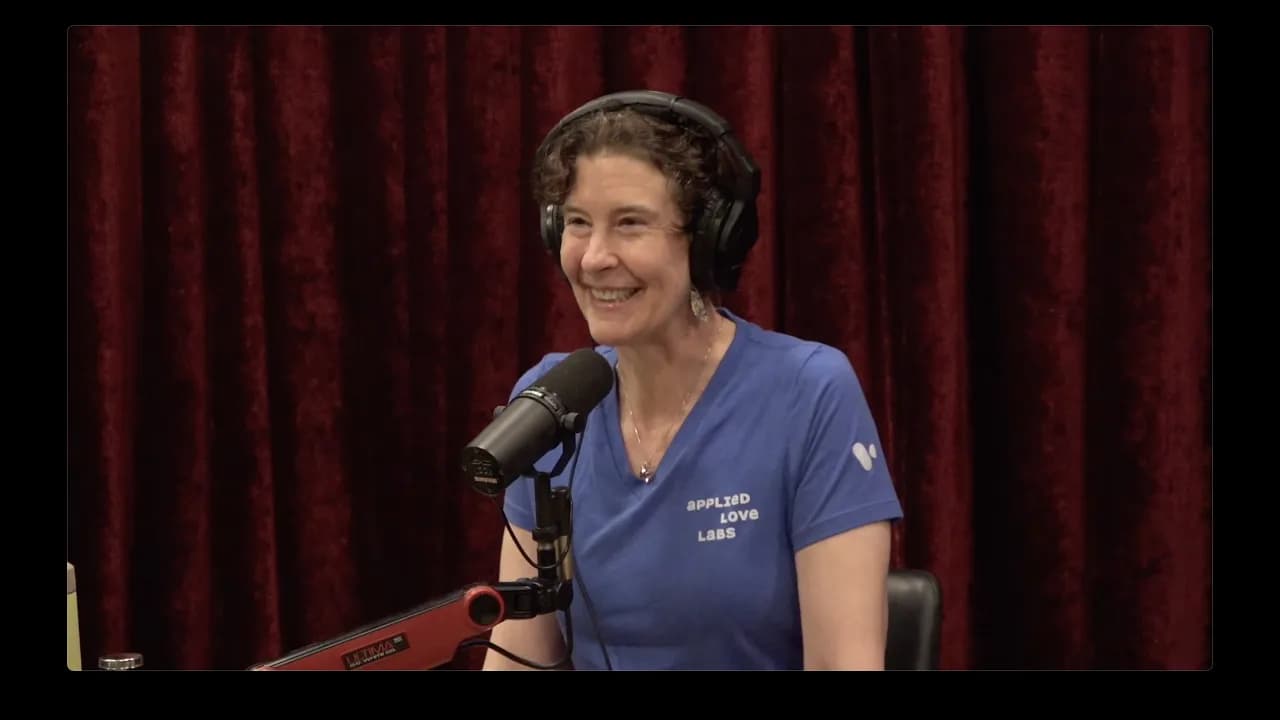
Joe Rogan Experience #2513 - Dean Radin
In a Nutshell
Dean Radin argues that psychic phenomena like telepathy, remote viewing, and presentiment are real, supported by 150 years of controlled experiments and government programs like Stargate that produced actionable intelligence. He presents evidence that these abilities are partly genetic, with historical suppression during the Inquisition potentially explaining their rarity today, and that consciousness exhibits non-local properties connecting across space and time. Radin also explores how intention can influence physical systems and describes his work developing genetic and pharmacological approaches to enhance cognitive and potentially psychic capacities.
These notes were generated by AI and may contain inaccuracies.
Dean Radin began as a violinist through halfway through college. He realized that pursuing music professionally required athletic-level stamina and physical strength, which he lacked. He has a genetic condition called Jill Bear syndrome, a mutation affecting a liver enzyme that prevents quick recovery from exercise. This causes significant fatigue but provides benefits including elevated unconjugated bilirubin, a powerful natural antioxidant, resulting in cardiovascular health comparable to a 20-year-old. At age 74, his cardiac calcium scan showed a score of zero despite high cholesterol.
A violin represents the classical concert track, while fiddle refers to the style of playing, primarily associated with bluegrass and folk music. The transition requires learning to play less precisely, with slightly off intonation that sounds more authentic for bluegrass. Radin competed in the Illinois State Fiddler Contest around age 25 against a teenage Allison Krauss.
Radin switched from music to electrical engineering in college because he enjoyed taking things apart and building things. He earned a master's in electrical engineering, then a PhD in experimental psychology. His career followed a pattern of choosing new directions after mastering a field. During college, he learned about the Institute of Noetic Sciences, founded by Apollo 14 astronaut Edgar Mitchell after his mystical experience in space, known as the overview effect. The institute's motto was exploring the frontiers of consciousness.
Noetic refers to intuition carrying a sense of certainty that the intuition is correct. Downloads during meditation exemplify this phenomenon. Mainstream science often dismisses such experiences as coincidence or memory frailty, despite data existing from studies dating to the late 1800s.
Science excels at testing subjective experiences under controlled conditions to determine whether phenomena are real or coincidental. The term control means excluding coincidence, information leakage, and other confounds through experimental design. Studies of telepathy, previously called thought transference, now use strict isolation protocols. After 150 years, the evidence for telepathy is considered very strong by those familiar with the literature.
Skeptics who know the literature either cannot identify plausible flaws or refuse to examine the evidence because they consider the phenomena impossible. The intelligence community invested substantial time and money in remote viewing research through programs like Stargate. Operational remote viewers produced actionable intelligence, including details about Soviet submarine construction.
State of mind is critical. Anxiety, fear, distractions, cameras, or external pressure impair performance. Remote viewing requires a relaxed, focused mental state. Brain wave measurements confirm that mental states are dynamic rather than binary.
After his doctorate, Radin worked at Bell Laboratories, the largest lab in the world at the time. He conducted small experiments on mind-matter interaction and precognition. He presented this work at the Parapsychological Association conference, an affiliate of the American Association for the Advancement of Science, using the Bell Labs imprimatur. Following the presentation, he received an invitation to join the Stargate program.
Radin took a one-year leave of absence from Bell Labs to work at SRI International under Hal Puthoff, later Ed May. The program operated under Top Secret SCI Special Access Program classification, requiring a signed book for access. The research division focused on fundamental questions: whether the phenomena are real, individual talent differences, limits, shielding possibilities, and camouflage resistance. No consistent physiological, psychological, or medical markers distinguished talented remote viewers from others. Talent appears partly genetic, and openness to experience predicts better performance.
After completing a year working on Stargate, Radin returned to Bell Labs and was soon invited to Princeton to work with the Princeton Engineering Anomalies Research (PEAR) laboratory. The lab, headed by the dean of the school of engineering, had been conducting mind-matter interaction and remote viewing research for nearly 30 years. Radin's position was in the psychology department, but his role was to lead a multidisciplinary program across multiple departments including philosophy, psychology, civil engineering, and the PEAR lab.
The goal was to pull together every discipline because the subject matter was too complex for any single field. Radin was explicitly told on day one that the job was impossible. In academia, success occurs within silos where experts spend 20 years becoming specialists in narrow topics and then spend their careers keeping up with that specific area. Departments received funding from the grant and were willing to participate superficially, but genuine cross-disciplinary collaboration was resisted because academic value resides within individual silos.
Centers for interdisciplinary study sometimes force collaboration, though participants may already be committed to their own important work. New disciplines have emerged historically when foundations provided funding to bring people together. Neuroscience formed this way 60-70 years ago when separate fields studying biology, cells, and the nervous system were unified. Consciousness studies is currently emerging as its own discipline, having previously involved only philosophers and anesthesiologists.
Beyond the coordination challenges, Radin conducted meta-analyses of telepathy experiments. This statistical method combines results from similar independent experiments to determine if findings replicate and to calculate overall effect sizes across all studies. He wrote a book on meta-analysis that received little attention.
Radin ran precognition experiments using random number generators where participants attempted to influence bit distributions (more 1s or more 0s) through intention. The PEAR lab found that intention generally shifted random bits in the intended direction across large participant groups. Individual participants showed unique response patterns or signatures when interacting with the machines.
Using neural networks, Radin demonstrated it was possible to identify which person performed a task based solely on how the random bits behaved. This suggested the potential for technology that could identify individuals and detect their intentions through machine learning applied to random number generator data.
After three years at Princeton, Radin left due to frustration with the multidisciplinary coordination requirements. He joined a company outside Washington DC where he continued developing the neural network approach to intention detection. The system reached a stage where a patent application was being prepared. A retired general connected the work to Navy interest for submarine communication applications.
The company was acquired and the new leadership terminated the project. The vice president overseeing the lab refused to continue the work without reviewing the data, citing disbelief in the possibility.
Following a 1992 recession layoff, Radin learned that the Stargate program had funded classified research at the University of Edinburgh. He secured permission from Ed May to complete an unfinished automated Ganzfeld telepathy testing system after its developer died. The system automates the telepathy protocol, removing most human elements except for the two participants.
While at Edinburgh around 1993, Radin began developing the presentiment experiment. The concept originated from common experiences where people receive intuitive warnings moments before danger, such as slowing down before a traffic light where a truck runs a red light.
The laboratory version wired participants to measure skin conductance, pupil dilation, and brain waves. After pressing a button, participants waited five seconds before a random number generator selected either a calm or emotionally arousing image (positive or negative valence). Results showed that 1.5 seconds before image selection, participants' physiology responded differently depending on whether the upcoming image would be emotional or calm.
A colleague shared a story about preparing for a hunting trip. While loading a six-shot revolver, he experienced a strong feeling that the fifth bullet was wrong. He set it aside, left the hammer over the empty sixth chamber, and went hunting. Two weeks later after drinking, a fight broke out and someone grabbed the revolver, pointing it at another person's face. The trigger was pulled and the hammer fell on the fifth chamber with a click. The colleague realized he would have been shot if he had loaded that bullet.
Natural remote viewing talent varies dramatically. Joe McMoneagle and others could provide accurate descriptions of hidden targets while continuing normal activities like eating breakfast. McMoneagle reported receiving complete information about afternoon targets instantly in the morning.
For individuals without natural talent, training focuses on avoiding naming initial impressions. Participants are instructed not to name mental images that arise because naming triggers associative thinking that blocks accurate perception. Training progresses from simple scribbles to complex drawings incorporating feelings and sensory impressions, eventually forming coherent images.
After receiving security clearances, Radin reviewed Stargate briefing materials containing remote viewing results. Viewers produced near-veridical drawings of targets located elsewhere in the world, inside envelopes, or in secure facilities, using only random five-digit target numbers as identifiers.
The mechanism connecting a random number to a distant target remains unknown. Theories require moving beyond strict materialism. Consciousness appears to exhibit non-local properties similar to quantum entanglement, connecting across both space and time. This non-locality would explain the functionality of precognition, telepathy, and remote viewing.
Radin suggests humans evolved to suppress attention to non-local information because constant awareness of distant events would interfere with immediate survival needs like detecting predators. Historically, individuals who retained these abilities were often shamans within tribes, valued for locating resources but typically unable to care for themselves independently.
In ancient societies, individuals with strong psychic abilities were often supported by their tribes because their minds were occupied elsewhere. Modern society lacks this support system due to constant distractions and different survival needs compared to 10,000-20,000 years ago. Indigenous societies that maintained these practices did so because they had genuine need for non-verbal communication in isolated environments without modern technology.
Dean Radin gave a presentation to Australian government ministers and military personnel about telepathy. An indigenous representative approached him afterward and confirmed that her people had known about and used telepathic communication for thousands of years in the outback where phones didn't exist. The cultural practice persisted because they maintained the need and avoided modern distractions that cause these abilities to atrophy.
Remote viewing represents a relearning of skills that were once common. Some individuals retain genetic traits from ancestors who possessed these abilities. A significant portion of psychic talent appears to be genetic, passed down from people in ancient times who had these qualities.
Joe McMoneagle served in search and rescue operations behind enemy lines and consistently returned safely with his team and their targets. He attributed his success to using intuition in the field to make critical decisions about which routes to avoid. When the military recruited for people with psychic abilities, they specifically sought individuals who had combat experiences where they never got hit despite dangerous situations.
McMoneagle and his sister both reported psychic experiences prior to their recruitment, suggesting a familial genetic component. This pattern indicates that people selected for these programs often came from families with documented psychic phenomena.
While at UNLV, Radin analyzed data from a smaller casino that provided jackpot and payout information. The analysis revealed that jackpots occurred more frequently and payouts were larger within plus or minus one day of the full moon. Table games also performed better during this period, which aligns with traditional magical and religious lore associating full moons with heightened activity.
When Radin suggested the casino might want to keep this information private to avoid crowds during full moons, the general manager responded that increased traffic would be welcome since the house always maintains an edge.
A New York Times article about Radin's work in Las Vegas led to book publication interest. His previously unpublished Princeton book found a publisher, which caught the attention of Interval Research, a Paul Allen-funded organization focused on developing the wired world. The 10-year project beginning in 1990 brought together 100 researchers from Apple, Xerox PARC, MIT, and other institutions.
Radin was offered a research position with a budget 10 times larger than his UNLV funding and a salary three times higher. The organization allowed a small percentage of blue sky projects to push creative boundaries alongside their patent-focused work.
When Interval Research concluded in 2000, several researchers formed the Boundary Institute as a nonprofit to continue their work. The organization lasted approximately one year before the dot-com crash made fundraising impossible. Radin was then invited to join the Institute of Noetic Sciences, where he has remained for 25 years.
President Carter publicly confirmed a remote viewing operation that located a crashed nuclear bomber in Africa that was invisible from aerial surveillance due to jungle canopy coverage. Multiple remote viewers were tasked with finding the aircraft, which carried a bomb that authorities wanted to secure.
Fran, a map dowser, was given a blank piece of paper with X marks corresponding to an actual map location. Without knowing the target was in Africa, she marked the location. Search teams found the bomber within a couple of kilometers of her indicated spot. Local natives confirmed something had crashed in that exact area.
Carter reportedly had a UFO experience before his presidency. Folklore suggests he was briefed about alien life and became emotionally distraught, possibly because the information conflicted with his religious beliefs.
Two submarine commanders approached Radin after a lecture on telepathy and shared an incident where a crewman awoke from a dream and insisted they needed to surface because something bad had happened at home. Despite being under classified maneuvers at depths of at least 300 meters, the submarine surfaced at the next opportunity and confirmed the family emergency was real.
Both commanders independently verified the story. The incident was notable because it occurred at classified depths where electromagnetic communication is impossible, and the information proved accurate with no false positives. Submariners are psychologically screened for stability, reducing the likelihood of fantasy-based reports.
Radin found that military personnel, particularly officers up to generals and admirals, were receptive to psychic research findings. Their acceptance stems from life-and-death operational environments where intuition becomes critical, and their career advancement depended on making accurate intuitive decisions affecting others.
Four volumes of Stargate Archives detail the program, though not all information has been released. Military operational details involving people and methods remain classified, as do some research components. Special access programs create situations where colleagues working adjacent projects cannot discuss their work.
The fundamental paradox of psychic research classification is that the work itself demonstrates ways to penetrate secrecy, while the classification system exists to maintain secrets. Remote viewing and telepathy theoretically allow access to any information with the right talented individuals, making traditional security measures ineffective.
Gary Nolan suggested examining genetics of highly talented psychics. The Side Genes project recruited 3,000 self-identified psychics from psychic families through internet outreach, with extensive vetting including face-to-face interviews. DNA analysis was completed on 13 verified individuals due to funding constraints.
The study compared psychic participants' DNA with matched controls using standard genomic comparison methods. Results showed psychics possessed wild type DNA without unusual variations. Controls showed significant mutations in intron sequences, the epigenetic portions of DNA that regulate gene expression.
The intron mutation appeared to suppress psychic sensitivity. A genetics specialist on the team discovered that countries with longer exposure to Christianity showed higher rates of this mutation. Researchers connected this to the Inquisition's systematic targeting of individuals with psychic abilities, healers, and those demonstrating precognition over hundreds of years.
The Inquisition targeted witches, healers, and people with precognitive abilities outside church authority. While magic was acceptable within church bounds through anointed priests, independent practitioners were eliminated. This created a non-evolutionary pruning of humanity's psychic capabilities.
Saint Joseph of Copertino reportedly levitated up to 30 feet, sometimes drifting into church rafters, witnessed by thousands including Pope Urban VIII. He negotiated with Inquisition authorities to relocate to a remote area and cease public demonstrations. Saint Teresa of Ávila, patron saint of air travelers, documented her levitations occurring during states of deep spiritual rapture.
Discussion of historical accounts of levitation, including a nun describing a violent force lifting her that required other nuns to physically hold her down. The Maharishi's Transcendental Meditation organization promoted yogic flyers and city programs claiming yogic powers. Demonstrations at university events showed practitioners in full lotus position hopping approximately two and a half feet, which Joe Rogan identifies as plyometrics rather than true levitation. When asked why true flying doesn't occur, the Maharishi responded that too many people think it's impossible, framing it as a sociological phenomenon.
Dean Radin explains his interest in writing about magic despite his background at Princeton and Bell Labs. His experiments typically show small psychic effects requiring statistical analysis, but personal experiences suggest the limits may be unknown. He questions whether phenomena like levitation are dismissed because they're considered outside the norm and have permeated cultural consciousness as nonsense, potentially creating blocks for others attempting such feats.
Radin describes attending a spoon bending party after hearing about a woman who could bend the bowl of a spoon rather than the neck. Standing in front of her and mimicking her hand position with thumb and finger, he bent a 1961 spoon 90 degrees without visible force or finger indentation. The person instructed him to bend it completely, which he did. He notes he is not physically strong enough to accomplish this through normal means.
The metallurgical mechanism involves applying 50 to 70 pounds of sudden impulse force, which momentarily softens the grain boundary lattice structure for approximately 20 seconds, allowing the metal to be manipulated like putty before instantly tightening again. However, the initial force causing this effect has no conventional explanation. Radin experienced fear on an airplane afterward, concerned about unknown effects on the aircraft's metal structure at 30,000 feet.
Joe Rogan attempts to replicate the bowl bending with the same spoon but cannot do it, even with significant effort. The neck can be bent with leverage and both hands, but bending the bowl shape with one finger is extremely difficult. Radin confirms the spoon was not pre-weakened before his initial experience.
Participants at spoon bending parties were told that successfully bending metal without force would earn a "warm former" button, referring to the sensation that the metal feels warm and putty-like. The button represented certification of the ability. Radin describes entering an obsessive psychological state where obtaining the button felt existentially necessary, despite not being an egotistical person. This motivation is relevant to understanding how traditional magic is supposed to work.
Magic requires several factors including belief, motivation, imagination, and other elements that are difficult to replicate in controlled experiments. Radin distinguishes between long-term meditation practice for developing skills and what he calls "screaming at fire" - intense, immediate motivation. The button obsession created this state temporarily, but once achieved, the need vanished completely.
Radin tried replicating the effect on an airplane but stopped due to safety concerns. He later attempted similar effects on quarter-inch aluminum aircraft-grade bar stock without the button motivation, achieving only a fraction of a millimeter of movement. No filming of these attempts occurred. Some 1970s metallurgical and physics research examined metal bending, with researchers divided on whether effects were genuine.
Radin proposes the mechanism is similar to micro-psychokinetic events, involving changes to probabilistic structure at the atomic level. Targeting a strip across the metal could momentarily shift grain boundaries. The state of mind during the successful bending was peculiar - he didn't recognize the bending was happening while it occurred, suggesting analytical focus would have prevented the effect.
Analytical thinking appears to interfere with psychic phenomena. The left brain maintains stability about how the world works and enables analytical communication, while the right brain focuses on form and function where remote viewing and psychic phenomena occur. This is presented as a general framework rather than a strict left-right brain division.
A second side genes study analyzed genetic correlations with psychic experiences using data from 23andMe and Ancestry, which provide exome sequencing rather than full genome data. Participants completed questionnaires about their experiences. Analysis identified 212 single nucleotide polymorphisms correlated with psychic experiences, one with a probability of one million to one. One identified SNP is associated with multiple brain functions. The research requires tens of thousands of cases and controls for definitive results, similar to schizophrenia genetic studies, but funding limitations prevent this scale.
Radin views consciousness and the physical world as a tapestry woven together, both necessary for understanding reality. This aligns with dual aspect monism, which posits one underlying reality that splits into mind and matter. Carl Jung called this the unus mundus - the one world from which things split. Jung suggested meaning causes this split, creating tight correlation between mind and matter like two sides of the same coin.
Beyond mind and matter, the underlying reality could split into infinite other aspects including other worlds, universes, and possibly alien forms of existence. Science fundamentally doesn't answer why questions - why electrons have specific charges, for example. At the quantum level, phenomena like superposition, entanglement, and "spooky action at a distance" appear to violate conventional reality rules.
Human experience is limited to human-centric time scales and provincial perspectives. Historical examples include viewing fuzzy stars without recognizing galaxies; modern instruments like the James Webb telescope reveal at least 3,000 galaxies in the observable universe. Each new instrument extending human senses opens previously unimagined realms of reality. Without consciousness, awareness of anything would be impossible.
Full-blown idealism holds that everything is consciousness and the physical world emerges from it. Most founders of quantum mechanics were idealists who believed everything ultimately was consciousness, and many were mystics deeply engaged with Eastern philosophy. This perspective remains common among leading physicists.
Mystic traditions contain truths distorted by history and language. Religious institutions, including Catholicism, have historically acknowledged magic and supernatural phenomena while discouraging attention to them. When Radin asked Sadhguru why yogic traditions warn against pursuing psychic abilities, the response used the metaphor of enjoying wind on an arm while riding in a car - the power is so great that without knowledge, it could cause harm. The traditions suggest practitioners are dealing with forces too powerful to understand.
Some spiritual traditions discourage psychic exploration to maintain institutional control over knowledge. Within Catholicism, such practices are labeled demonic and prohibited by catechism. Similar beliefs persist in government and military contexts, with figures like JD Vance suggesting UFOs are demons. This perspective deflects investigation of both psychic phenomena and UFOs.
Spiritual traditions also warn that psychic powers are seductive and practitioners may be too weak to handle them responsibly, potentially using abilities for personal gain or control over others. Yogic training requires three to five years of ego work before developing siddhis. The physical postures associated with yoga in the West are primarily preparation for extended lotus position meditation. Human tendency to abuse power and influence is acknowledged as a genuine concern.
Radin and colleagues formed Cognigenics seven years ago to explore whether genetic engineering could enhance perception, cognition, and memory, potentially bypassing decades of monastic training. The company investigates whether genetic edits could accelerate development of these capacities. Ethics, power seduction concerns, and safety considerations are acknowledged as separate issues requiring careful examination.
An interanasal delivery method has been developed for RNA interference that allows compounds to be delivered through the nose directly into the brain. This approach downregulates specific receptors and is administered as a multi-time treatment because the RNA effects last for a period of months before requiring re-administration.
The current focus of this work is addressing dementia, specifically targeting short-term memory loss through downregulation of receptors including the 5HT2A receptor associated with psilocybin. This method aims to achieve similar memory improvements without the hallucinatory effects.
A case study published in Frontiers in Neuroscience described an 80-year-old Japanese American woman with Alzheimer's who had declined over a decade to urinary incontinence, single-syllable speech, and complete caregiver dependence. After receiving a 5-gram dose of psilocybin mushrooms, she experienced agitation and profuse sweating initially, followed by prolonged sleep. Around hour 19 she began speaking in full sentences and recalling life events. In subsequent days and weeks she regained urinary continence, began dressing herself, maintained eye contact, remembered social interactions, and held lucid conversations. A subsequent 3-gram dose increased verbal expression, humor, and walking agility. The improvements were temporary and did not reverse the underlying neurodegeneration.
Studies in mice and rats demonstrated 100% improvement in memory for both aged and normal subjects, along with nearly 100% reduction in anxiety. Monkey studies confirmed the compound reaches the brain via PET scan tracking with radioactive tagging, specifically targeting the limbic system and hippocampus where memory is encoded.
Psilocybin acts as a 5HT2A agonist, initially increasing receptor expression which produces hallucinations, after which the brain compensates by downregulating the receptor. The RNA interference approach directly downregulates 5HT2A without the initial agonist phase, potentially producing immediate effects without hallucinatory onset. The treatment duration is estimated at a couple of months before declining, requiring re-administration every two to three months.
No clinical data exists yet on effects in healthy individuals without dementia because FDA permission for human trials has not been obtained. The compound is not intended for over-the-counter availability and would require prescription along with a specialized delivery system that atomizes the compound and propels it to the back of the nasal cavity where it can cross the bone separating the nose from the brain.
Concerns include potential misuse by healthy individuals seeking cognitive enhancement, particularly among younger people. The delivery method requires specific equipment beyond standard nasal sprays.
Ethicists are involved in evaluating the implications of enhancing human cognition and perception, including the theoretical possibility of enhancing extrasensory perception. The same delivery platform could be adapted for other compounds targeting different receptors as understanding of neurodegeneration advances.
Potential unintended consequences are being considered, including the historical example of trans fats which were initially developed to help people but proved harmful. Two monkeys in preclinical testing showed aggressive behavior that resolved into a calm state for two days following treatment, demonstrating the anxiolytic effect.
If a compound were developed that produced genuine, undeniable psychic abilities such as telepathic communication, significant caution would be warranted. Telepathy functions as a two-way phenomenon, meaning the ability to receive thoughts also enables injection of thoughts and potential control over others. Without substantial prior training to reduce ego influence, such power could be highly seductive and dangerous.
Training approaches include meditation practices used by monks to diminish ego influence. Psychedelic experiences often produce personality transformations resembling the positive aspects of PTSD, resulting in increased compassion, prosocial behavior, and interest in service to others. Understanding the mechanisms behind these rapid, lasting personality changes remains important.
Widespread adoption of such technologies could fundamentally alter human interaction, potentially creating cooperative societies where propaganda and manipulation become ineffective and where individuals with parasitic or psychopathic tendencies would be exposed. This could transform justice systems, politics, economics, and resource allocation.
However, resistance would likely emerge from entities benefiting from current power structures. Scientists working on related topics sometimes face suspicious deaths or disappearances, which is why all research is published in the public domain rather than kept secret.
Science fiction portrayals of hive mind scenarios present both positive and negative visions. Some depictions show loss of individual creativity and expression, while others suggest collective access to skills and knowledge could enhance overall creativity. The ability to query a collective consciousness rather than external databases could represent a paradigm shift comparable to how smartphones transformed access to information in ways not predicted by earlier science fiction.
Control of ego rather than complete elimination is considered necessary because humans remain embodied systems requiring some degree of individual agency. This involves recognition of ego impulses combined with mindful practices that prevent automatic acting on those impulses.
Direct, in-person conversations create different experiential qualities compared to remote communication methods. There appears to be an additional element of mind-to-mind connection occurring during physical presence that is absent in virtual interactions.
We're connecting with all the people that are listening through our minds somehow. There's a weird thing that happens when people are in proximity to each other in the same room. The downside compensation for having phones everywhere is that teachers are running scared because kids don't know how to write anymore. If you start relying on Perplexity or any other kind of AI, you're in serious trouble because those things are not perfect. They have hallucinations. They give you bad information.
A lawyer involved in a case was citing various cases that just didn't exist because he had gotten them from AI. It probably looked structurally correct except it wasn't actually real. He thought he had the case wrapped up and the judge said none of these things you're saying have happened. They're not true. The point is you're relying now on the device to do all the thinking for you. You're not absorbing much of that information the same way.
As a scientist, AI is making the job much easier. Using Claude Code a lot in genetic research makes things more efficient because for coding, it took a lot of skill and time to write something that did what you wanted to do. When asking AI to help write something, immediately seeing all kinds of things that it doesn't know. Asking where it got that information, it responds that it scraped it off the entire internet, but it didn't look at certain parts because the algorithms are designed to work fast. It pulls the surface off and usually that's okay, but it could be a troll Reddit post. Half of Wikipedia is written by teenagers.
You need to already have a knowledge base so you can challenge what it's telling you because sometimes it's completely off. This is in the beginning stages of this application. If you think about the beginning stages of the printing press, most of the books were like how to spot witches. The danger is that AI is eventually right itself and it's already getting to that point, then we completely lose what's going on.
That was already true with the development of neural networks back in the 80s when the first idea came up. You would learn that this is related to that through neural network training, but you couldn't figure out what it learned because you have all of these weights and nodes inside the network encoding the information that you couldn't extract out. It couldn't even tell you how it learned it, but it did and it learned it really well. A lot of that is going on in the AI world too.
If you emphasize disciplined thinking and teach people specifically how to think and how to learn and how to do for themselves, they could then expand upon that knowledge with AI instead of using it as a crutch. One of the things that gives pause is the popularity of long-form conversations like this because we have this concept that we're losing our attention span, but long-form podcasts are one of the most popular mediums. There is still a hunger from a lot of people who grew up at a different time where they did learn how to think and now they're missing it.
There are people that grew up at a different time where they learned how to think and now they're missing it, and they can find it in long-form conversations, or it's always going to be something that some people intuitively gravitate towards because they need more stimulation than they're getting from simple TikTok videos and Instagram reels. The generalization about perceptions of people that we've lost all of our ability to concentrate is not accurate for everyone.
If you leave junk food in front of a lot of people they will eat it. If you leave healthy food in front of disciplined people they will say they don't want the junk food, they're going to have the eggs, eat healthy, take vitamins, and do what they're supposed to do because they know the benefits of it. They may still want the junk food but they're able to override that with disciplined thinking.
Education may move into a realm of being able to understand your own personal psychology, understand the value of discipline and the value of having a structure to the way you think. Whatever AI is doing, it's just giving you information. It doesn't make you smarter. It's not giving you more knowledge. It's just giving you data. You have to then learn how to assimilate that data in an actionable way where you could use it in life.
Every single technology that comes around, when television came around people were terrified that people were just going to stare at the TV all day. A lot of them did, but also television led to the internet. It's definitely distracting people, but we have more access to information and more of an understanding of so many different things than ever before. You have the ability to have a three-hour conversation about a very esoteric subject. There's a lot of people that have a hunger for interesting things.
Not being a dooms guy when it comes to technology, having a feeling we're going to sort it out, but it's going to be a bit of a battle, a bit of a struggle. It's a new thing and exceptional people are always going to exist. There's always going to be people that aren't going to be willing to just give in to whatever this thing is that gives them this crutch and just become a blob that just presses buttons to get information instead of thinking. People are always going to want to think. It's part of what's fascinating about being a person is learning new things and expanding your understanding of things. Just pretending you do is a party trick, but the real fascination is actually learning something that changes your perceptions.
Humanity is extremely resilient. Every single person has some percentage of mutations which is part of the resilience. That's why we can survive an asteroid hit or survive a mistake that happened somewhere. Ultimately optimistic about it. Looking back at things like the pyramids, what happened to those folks? It could have been the Ice Age and now they all moved to Africa. Something definitely happened. Some strange shift. The question is how many times has that happened over the course of human civilization.
We want to think of it as been this linear progression from caveman to where we are now, but that doesn't seem to be accurate. There's a lot of people that want to resist the idea even if you have data. They don't want to look at it because they think it's nonsense. There's also a perception that there's no way people were more advanced 5,000, 10,000, 15,000 years ago than they are now. But it kind of is possible. It's not impossible.
There's some very weird evidence in the form of 2,300,000 perfectly cut stones that point to true north, south, east, and west that were put in place by the civilization that just emerged out of nowhere with this ability. To pretend it's not and just write it off to people were smart seems inadequate. They did something we can't explain to this day. Hardly anything in the natural world is linear.
If we mess it all up right now and we have a nuclear war and there's only like 50,000 people left, how long before we get to this position where we're trying to almost get past this again? It's like a rough adolescence. How long do you need to take? Do you need 100,000 years of a high technology society? We're like 20 years, 50 years into it and we're having a problem.
That's where things get really weird when people start talking about UAPs and these whatever these beings are, if they are real. Are they us from the future that is coming back to make sure that we don't mess it up and to sort of hold our hand through this experiment? A fan of Hal Puthoff's ultraterrestrial idea that these are not from the future. They're from the past. They just happen to be way more advanced than we thought. A million years more, 100,000, something like that.
Thinking about convergent evolution, when at UNLV there was an ornithology laboratory nearby. Going to the museum and seeing what looked like penguins, but the director said those aren't penguins. Those are auks. Different birds from the North Pole and the South Pole because of convergent evolution were shaped to be like this bird. They looked absolutely identical.
A lot of these aliens that people talk about are basically like humans. Why do we have so-called Nordic aliens that look a lot like people in Scandinavia? Either they come from a planet that is almost exactly Earth-like which is possible, or they've already been here a long long time. The same for many of the other aliens that people talk about. They're humanoid. Humanoid is shaped by evolution to be in a certain place.
We're so well shaped by evolution that we can go outside on an average place and even though there's only a couple of miles of atmosphere, we're perfectly fine. There are examples of very bizarre heads and skulls found in places like Peru that don't have the sagittal suture and have a brain capacity that's 30% larger than ours. Gary Nolan talked about this. There are real examples of it. These aren't theoretical. You can find these skulls that have a larger brain capacity.
They've attributed it to a real practice of flattening heads of shaping skulls. But the question has become whether that real practice emerged to mimic a type of creature that was already there. Some of that is shaping. Some of these are. But the ones without the sagittal suture are really weird because that's a thing that all human babies have because as your brain grows and your head grows, your skull is kind of malleable. That doesn't have it.
Some of these that they found actually have more brain capacity, so the shaping of it wouldn't change the brain capacity. Some of them do have that sagittal suture, but some of them don't. The positioning of where it connects with the spine is different. Where the spinal column enters the bottom of the skull is very much further back than normal. A genetic adaptation or a different kind of person. A different kind of person that coexisted.
If that was an actual different kind of human being that existed along with us, that explains a lot. They're not here anymore unless they're ultraterrestrials and they're living in the bottom of the ocean. If they are, who knows? You could get to a point where a civilization becomes so advanced that the biological entities aren't necessary anymore. That would explain why they could exist at the bottom of the ocean, why they could exist with no oxygen, why they no longer become dependent upon their environment to survive.
They might have created environments. There's always been stories about five different locations in the deep ocean that they're aware of activity that things have happened there. They continue to happen. If you were going to study Earth, if you had to be local, where would you go? If you can come here from another dimension or another galaxy, you'd probably go in the ocean. They've observed these transmedium crafts. They're able to fly and go into the water.
Orcas are kind of transmedium. They fly, swim. Could be an alien. It's an alien form of a penguin. At a certain point in time, if we could get far more advanced than we are now, and we found out about a society that is at a stage where we are currently, we would go visit. We would observe and we would also probably try to stop nuclear war.
It is an interesting question because the prime directive in Star Trek is you don't mess with them, but they always do. The original Star Trek came out in the 1960s. Part of the personal mission was to make Star Trek real, including beaming people up. The Vulcan, the most rational creature on there, was the one who could do the mind meld. That's why thinking an advanced species takes this stuff for granted. That advanced species may be us. Might need a little evolutionary push with genetics, but we could do that too.
In this concept of the ultraterrestrial that these things have come from the past, how are they here? They've always been here. They just exist, but they exist in a different way. Imagine even given current technology, if there was another ice age coming and we may have a thousand years to prepare, would we be smart enough to do that? Could we do it? Yes, probably could. Another thousand years passes and you're below ground somewhere and then there are the cavemen who are beginning. Do we interact with them or not? It's an interesting question. We don't want to get involved in all that mess because we don't, sort of like how we don't visit North Sentinel Island. Those people that live the uncontacted tribe. You're literally not allowed to go there. Let them develop the way they shall develop.
If it turns out that there is some activity, that there are some things that we can't explain that are happening from deep in the ocean, we're going to have to come up with some sort of an explanation. If that is an actual intelligent species, an intelligent life form, there's got to be some explanation for that. The ultraterrestrial one is just as good. There's an explanation for everything. The question is are we smart enough to figure it out and how long will it take? Both of those are complete unknowns.
That's yet another reason why liking the kind of work that is done, that you need to have very high tolerance for ambiguity, which is done. Okay with not knowing a lot of basically everything. Knowing enough to be able to be dangerous, but otherwise not minding that not knowing. Very thankful that people like that are out there doing this work and expanding on this. It's really fascinating when if something like this does emerge, it would change the human race. Think about the small amount of people that are involved in this research. Tiny, kind of crazy. It's a huge responsibility in a lot of ways.
Fortunately also enjoying it. Having fun while doing this because otherwise would have chosen some other door. Had plenty of opportunities to work with golden handcuffs somewhere but getting bored easily and this is the one area where never gotten bored. Very thankful. Asking if there was an audio version of the book. Having an actor do it because not wanting anybody to have to suffer with 12 hours of the voice because it won't last that long. There's an actor that does it who's very very good.
There's one other story to say that's in the book. This is a synchronicity which again gave the idea that we don't know the limits of what we're dealing with but it's important. After Interval started a nonprofit called Boundary Institute. It was in Silicon Valley. Found an office park in Los Altos which is just outside of Silicon Valley. Found a space liked it. Decided to get that. That's where the new place would be. Close enough to where living so able to walk to work. Always walked a certain way. One day decided to walk a different way and going past another office called Syquest Inc. PSI Quest, Inc. Thought that that's an interesting coincidence because we're
Dean Radin describes walking a different route to work and noticing a small sign for Saiquest Labs right next to their office at Boundary Institute. Initially mistaking the company for Personnel Services Incorporated, he became curious about why a personnel services company needed a laboratory.
Over the next couple of weeks, he repeatedly knocked on the door and peered through the blinds, finding the space empty until one day he encountered someone inside. When the door opened, the man's jaw dropped and he immediately identified Radin by name before any introduction was made.
Radin had never met this individual before and questioned how he knew his identity. The man explained he had been trying to contact Radin to invite him to join his board of directors but had not known where to reach him. The door opened and Radin was standing there.
The man described his current activity as yoga nidra, the yoga of sleep, practiced in alternating three-hour cycles of wakefulness and sleep over 24 hours. During waking periods, he was visualizing and intending for Radin to appear. At the moment Radin knocked, the man was awake and actively attempting to manifest his arrival.
Upon touring the laboratory, Radin discovered that the equipment, shielded room, and specialized chair he had been drawing on his whiteboard at Boundary Institute matched exactly what existed on the other side of the wall. Both parties had been drawing each other through focused intention without prior knowledge of the other's existence.
The four-part synchronicity involved Radin drawing what he wanted into existence on one side of the wall while the other person was simultaneously drawing Radin. They were pulled into the same location through shared intentions. Though everyone maintained the sense of exercising free will in choosing the office location and actions, the events suggested they were being guided by the other party's focused intention.
Radin began researching the magical aspects of yoga nidra, noting it centers on focused intention practiced in a non-ordinary state and represents a genuine magical practice from the yogic tradition.
This experience reinforced the overlap between established science and practices traditionally labeled as magic. While not reaching the dramatic level of fictional portrayals like Harry Potter, substantial elements of these practices demonstrate real effects that align with current scientific understanding.
The conversation concludes with mutual appreciation, plans for future meetings, and a lighthearted reference to bringing nose spray for the next discussion.
Keep PowerfulJRE in your library
Save the videos and channels worth coming back to, and find them again in one place.