Moderna’s Dr. Stephen Hoge on AI and the Future of Healthcare
In a Nutshell
Moderna’s mRNA platform, built over a decade before COVID, now enables rapid, individualized cancer vaccines that train the immune system on each patient’s unique tumor neoantigens. In a Phase 2 melanoma trial, this personalized approach cut recurrence risk 50 % beyond standard immunotherapy, and the same manufacturing process is scaling to treat thousands of cancer patients per year. AI is compressing discovery timelines from years to weeks, but physical limits—manufacturing slots, trial enrollment, and the multi-year observation periods required to prove clinical benefit—will still pace how quickly these advances reach patients.
These notes were generated by AI and may contain inaccuracies.
Melanoma used to be a death sentence. The approach involves teaching the immune system what a specific cancer looks like rather than just prompting it to search for cancer cells. This concept of training the immune system on an individual's unique cancer forms the foundation of Moderna's personalized medicine efforts.
The program features A.J. Murphy, Chief Operating Officer of Blackstone Private Equity Strategies, for the Monday Morning Meeting. Winfield Sickles joins for the Economic Weather Report and macro analysis. Dr. Stephen Hoge, President of Moderna, discusses how AI is impacting drug discovery and the future of personalized medicine. Dr. Nick Galakatos, Head of Blackstone Life Sciences, joins for the Debrief.
A.J. Murphy has nearly 30 years of industry experience across multiple cycles. Despite rising rates and market complexity, deals are still getting done. The third quarter showed the biggest sponsor-generated M&A pipeline of the year. The firm is particularly busy in energy and defense sectors.
Energy has experienced a tailwind for some time, with power demand accelerating the cycle. The firm continues seeing significant buying and selling activity in energy. Defense is as busy as it has been in many years globally, driven by stepped-up defense budgets and new technology entering the sector.
Private equity should be viewed on a longer-term basis. Public markets are at all-time highs but highly concentrated in one sector. Private equity offers broader exposure across sectors and geography, creating broader portfolio exposure and wealth over extended time periods.
Winfield Sickles identifies rates as the number one concern from client and investor meetings. Geopolitics and wars have driven energy and food prices higher, reflected in recent inflation prints. A large pile of government debt contrasts with a resilient economy, strong corporate earnings, and solid consumer spending. The AI infrastructure boom adds another factor to the economic dichotomy around rates.
US energy independence is underappreciated and provides significant advantage. The US economy growing above trend makes debt servicing easier compared to other countries. Earnings season will provide insight into corporate and consumer resilience through loan growth, business activity, consumer spending, debt servicing, and balance sheet health.
Cloud revenue performance in the third quarter will be closely watched following strong second quarter results. Winfield posts monthly "Notes from the Road" on LinkedIn - a three-minute read with three hot takes on macro developments.
Dr. Stephen Hoge grew up in the Midwest, studied neuroscience at Amherst, attended medical school, and became an emergency room doctor. He left medicine to become a McKinsey consultant for seven years before joining Moderna in 2012 when it was a two-year-old startup.
Messenger RNA is nature's information molecule and software system. Genes communicate with cells through messenger RNA, which provides instructions for protein production. All cells in all life communicate using messenger RNA. The challenge involved making, scaling, and delivering messenger RNA into the right cells safely and reproducibly.
Ten years of work between Moderna's founding and the COVID pandemic response focused on developing messenger RNA technology. The big idea was that if messenger RNA could treat or prevent one disease, it could treat and prevent many - potentially dozens or hundreds of diseases.
Stéphane Bancel stated Moderna would never be a one-drug company. It could be zero or 100 drugs, but never one, because successful messenger RNA technology would allow copying and pasting to create new medicines dozens or hundreds of times.
Once Moderna had the COVID sequence, the vaccine was developed within one hour. This rapid development was enabled by the previous ten years of work building systems to identify the most effective messenger RNA sequences for specific proteins.
The COVID vaccine targets the spike protein, which can be encoded by over 10 to the 80th different messenger RNAs - more variants than molecules in the known universe. The company had to select the optimal sequence from this vast possibility space.
Before COVID, Moderna had nine different vaccines tested in humans. This extensive experience allowed the algorithm to learn optimal messenger RNA design. When SARS-CoV-2 sequence arrived, the algorithm selected mRNA-1273 without needing alternatives.
AI accelerates drug discovery through productivity gains in sequence design, protein design, and clinical trial enrollment. Tasks that previously required entire teams of strategists or scientists can now be completed by one person in dramatically shorter timeframes.
The next frontier is whether AI can move from productivity enhancement to suggesting drug ideas and seeing around corners. In individualized medicine, AI will be key to unlocking personalized treatments. In medicines for large populations, humans remain effective at discovery, making AI's additional value less clear.
Patients are living, breathing beings made mostly of carbon rather than collections of ones and zeros. Physical existence motivates medical treatment beyond intellectual considerations.
While discovery processes can be compressed from years to months or weeks, measuring outcomes in humans remains necessary. If cancer recurrence is measured over three years, that timeframe cannot be accelerated regardless of discovery speed.
AI will accelerate discovery most in areas requiring much more information than currently accessible, particularly where personalization matters most. These include cancer, autoimmune diseases, and infectious diseases because each person's immune system is individual.
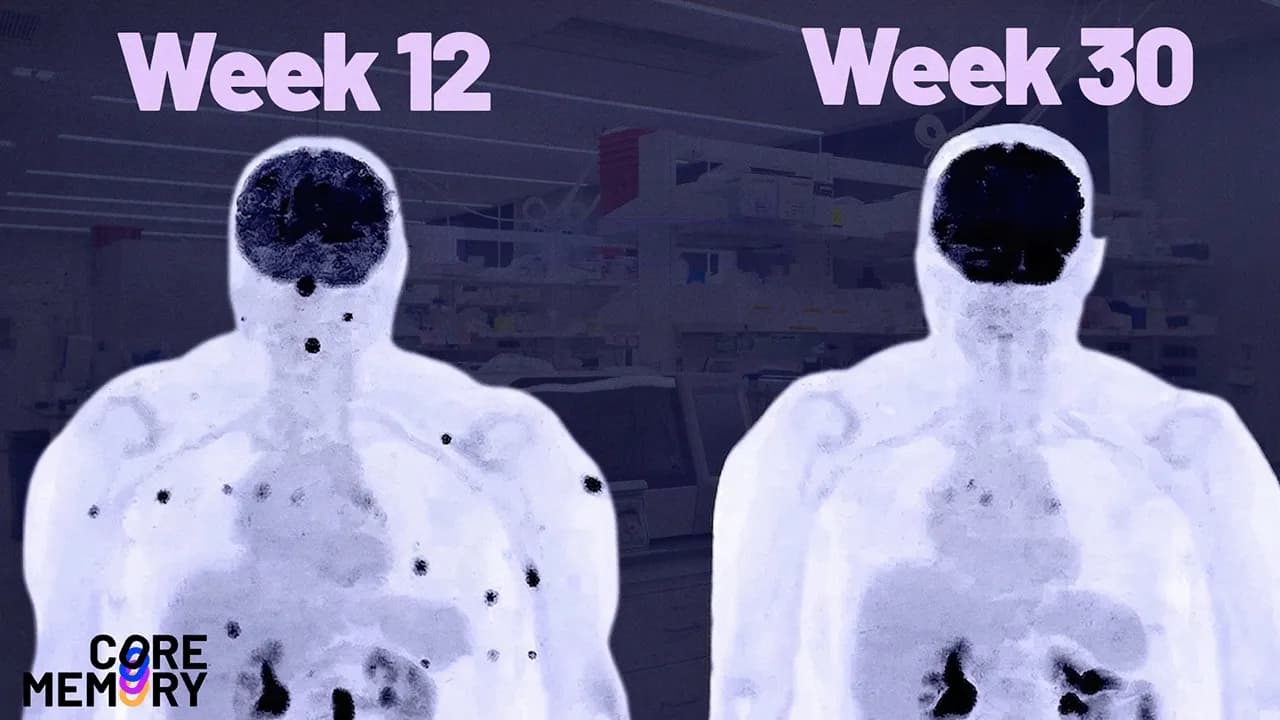
The phase two melanoma trial showed clinically significant improvement over existing immunotherapy. The 50% improvement over previous gold standard treatments represents a game-changing advancement in cancer treatment.
Neoantigens are mutations that exist only in an individual's cancer cells. Each person's cancer acquires unique mutations during growth. Creating targeted products requires making individualized medicines that will never work for anyone else due to unique mutation profiles.
From 2015 to 2019, Moderna developed technology to safely generate T-cell responses teaching immune systems what specific cancers look like. This enabled running experiments testing whether targeted immune responses could outperform nonspecific immunotherapies.
The melanoma trial involved 1,300 individuals across 42 countries. Approximately 700-800 participants needed individualized vaccines. The process requires delivering almost 1,000 individualized medicines with unknown timing of patient enrollment.
Individualized cancer vaccines must be manufactured and delivered within six weeks. The process involves sequencing tumor tissue to identify the signature of unique mutations, selecting approximately 34 neoantigens, designing mRNA using algorithms, manufacturing the product, and delivering nine doses to each patient.
Scaling individualized cancer vaccines differs from COVID vaccine scaling. Instead of scaling up production of identical products, the approach requires scaling down and scaling out - copying the manufacturing process across multiple machines and operators. This scale-out capability was developed to execute clinical trials.
The overall clinical program will enroll 4,000-5,000 people for individual cancer treatments. Current operations at thousands of patients per year scale are considered commercially meaningful, with tens of thousands representing highly meaningful cancer treatment volumes.
Physical limitations of medicine manufacturing and clinical trial enrollment cannot match AI capability expansion pace. Enrolling 1,000 people with skin cancer is feasible, but scaling to 10,000 stage three patients faces population limitations, and 100,000 would require everyone in clinical trials.
Translating AI innovation into economic impact will face pacing constraints from physical infrastructure requirements. Clinical trial mechanics and manufacturing facility limitations create natural boundaries that won't scale at the same pace as AI investments.
Moderna secured a $750 million investment from Blackstone during a period when the company was spread thin between cancer research and infrastructure investments. The relationship with Blackstone provided both the capital needed to run the study and valuable expertise that led to refinements in the trial design. The trial was successful, resulting in an FDA filing and approval this year. Dr. Hoge's family received the flu vaccine and are now on label for it.
Pennsylvania is experiencing a thousand cases of measles, a disease not seen in decades. This resurgence highlights how society has lost understanding of these diseases' impact on communities and individuals, not just those at highest risk. There have been deaths, and memory of diseases like polio, smallpox, and measles has faded because they were relegated to the past. Dr. Hoge emphasizes that while individuals have the right to make personal choices, there are community impacts that can be life-threatening. Over the long arc of public health in America, there has been a collective sense of responsibility that needs continued conversation.
When Dr. Hoge joined Moderna, the company had about 20 people; it now employs approximately 5,000. During the pandemic, Moderna was 100 times smaller than companies like Pfizer, but is now only 20 times smaller. Despite the growth, the company remains relatively small and thinks it's just getting started, always working on the next medicine.
Moderna is preparing for its first pivotal rare genetic disease trial in propionic acidemia, a condition where patients lack an enzyme in their liver causing metabolic crashes, hospitalization, and death during minor illnesses due to insufficient metabolic reserve. Approximately 1,000 people worldwide have this devastating disease. Moderna has worked on this program for ten years, and phase three equivalent clinical trial results are expected in the next couple of months. If successful, the drug could become available to the entire affected community.
Dr. Hoge attributes optimism to the entrepreneurial biotechnology space and the scientific belief that hard work solving problems can make tomorrow better. He notes that optimism is not a guarantee but rather the idea that improvement is possible. He describes optimism as a great privilege, representing the belief that we can do better.
While endorsing STEM fields, particularly from his neuroscience background, Dr. Hoge advocates that education should not end with STEM alone. He emphasizes understanding how technological disruption plays out in social fabrics and who defines the rules for human interaction as artificial intelligence develops. The combination of STEM plus humanities is essential because what makes humans special is the ability to accomplish far more in groups than any individual could achieve alone.
Dr. Hoge practices intermittent fasting, not eating on Mondays and Thursdays for nearly ten years. He has deeply embraced the science behind this approach, noting that constant eating in American culture creates a pattern of constant build without recovery periods. The practice has helped him recognize that food-related mental noise can be turned off with practice. Interestingly, he notes that hunger patterns shift - being hungry on Wednesday and Friday but not on Thursday despite the fasting schedule.
Nick Galakatos explains that AI will likely first unlock new cures in cancer and autoimmune diseases because these conditions involve multiple factors working together rather than single causes. Tumor cells are heterogeneous, making single-drug approaches ineffective. Traditional chemotherapy kills everything indiscriminately, but AI-enabled approaches allow hitting multiple targets simultaneously with better safety profiles. mRNA technology is uniquely suited for this multi-target oncology approach, as demonstrated in Moderna's phase two trials.
Blackstone's $750 million investment in Moderna's flu vaccine was based on compelling clinical data from a phase three trial involving 40,000 to 50,000 patients globally, showing the vaccine to be 30% better than standard flu vaccines. The FDA approved this vaccine in August, and it is now available at pharmacies. Blackstone's belief in mRNA technology stems from its versatility, ease of manufacture, and adaptability to both individual and mass population needs.
Keep Blackstone in your library
Save the videos and channels worth coming back to, and find them again in one place.