Neuralink's DJ Seo: Inside the Race to Connect Brains and AI
In a Nutshell
Neuralink's Telepathy implant already lets paralyzed patients control computers and robotic limbs by thought alone, while Blindsight aims to restore vision by stimulating the visual cortex directly. The company is scaling aggressively through vertical integration and robotic surgery to move from restoring function in patients with severe disabilities toward future high-bandwidth brain-AI interfaces. Key operational lessons include using first-principles "all-green-light" scheduling to strip away artificial constraints and prioritizing hardcore engineering talent over neuroscience expertise.
These notes were generated by AI and may contain inaccuracies.
The session begins with a two-minute video showcasing Neuralink's impact. The first product, Telepathy, enables individuals who have lost the ability to command their body to communicate with a computer through thought alone. A cursor moves on screen based on neural intent. One patient, previously locked-in, non-verbal, and quadriplegic due to ALS, now controls a computer entirely by thinking. The patient describes the experience as miraculous, noting that before the implant they were locked in, but now they can do things other dads cannot, creating a powerful experience for their child.
The Convoy team at Neuralink develops assistive robotic devices controlled by the brain implant, aiming for physical independence in the real world. Patients describe moving robotic arms in different directions and axes, calling the experience incredible and life-changing. One patient regained the ability to gesture with an arm, restoring functionality thought to be gone forever.
For patients losing speech due to ALS, the brain-computer interface restores voice. A patient demonstrates speaking by thinking, saying "Hello" and "I'm talking to you with my mind."
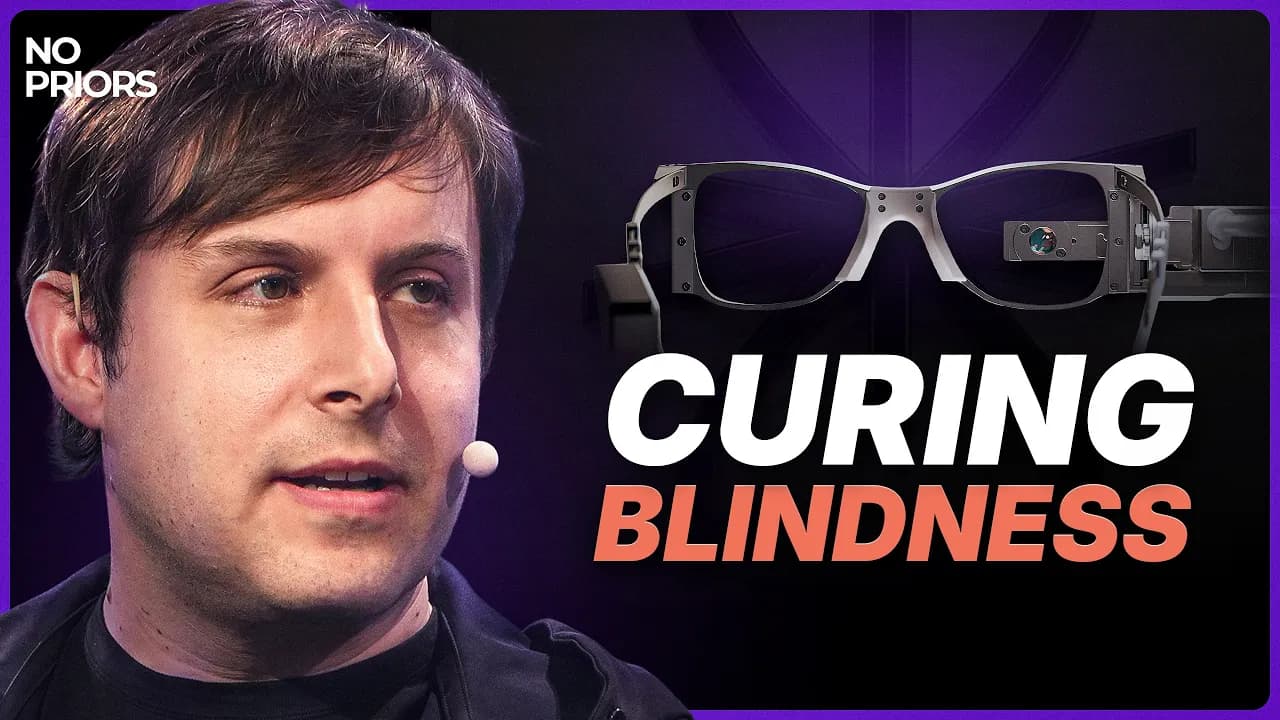
The second product highlighted is Blindsight, designed to restore vision for those with total loss of vision, including loss of eyes or optic nerve. An external camera captures scenes and writes directly to the visual cortex through electrical stimulation, creating phosphenes. Patients describe the experience as life-changing.
The moderator notes the video brought tears and describes Neuralink as one of the most inspiring projects globally, emphasizing the difficulty of the work and its life-changing impact. DJ Seo co-founded Neuralink with Elon Musk and others in 2016.
AI has been central to Neuralink's origin story. The key insight in 2016 was the I/O bottleneck between human output and AI capabilities. Bridging this gap seemed crazy at the time but has become increasingly real. DJ's personal fascination with the brain began in childhood, viewing it as the most interesting compute system and the only known form of general intelligence. As an engineer, he wanted to understand what makes humans human and explore the inner cosmos.
Academically, DJ was introduced to brain-computer interfaces in the late 2000s, a couple of years after the first human received a Utah array implant—a rigid silicon shank with a through-the-skin port. This enabled a quadriplegic patient to regain some autonomy, which DJ found inspirational. At the time, he was studying at Caltech, focusing on building miniaturized low-power electronics. He pursued a PhD at Berkeley with the goal of applying semiconductor principles to miniaturize these systems and move them from lab settings into the real world.
Meeting Elon Musk and the team toward the end of his PhD, the sheer ambitiousness and scale of the project made it impossible to refuse.
Many smart people remain unaware of how far along Neuralink is, despite over 20 patients whose lives have been transformed. For those who have heard of the company, the implanted device recording neural intent and neural decoding algorithms are fairly well known. What remains underappreciated is that from day one, the company focused on scale—not just the device, but the entire infrastructure: surgery, deployment, and building extremely difficult factories. This scale requires substantial capital and boldness.
Vertical integration is the lifeblood of Neuralink and Elon companies, enabling fast iteration loops from design, develop, and deploy while stacking best talent across the entire tech stack. The vision of robotic surgery comparable to LASIK, deployable to millions and billions of people, is not fully appreciated. Building surgical robots involves unbelievable breakthroughs that enable scalability. Building for scale from the beginning appears slow because infrastructure is built under the waterline, but once visible, growth becomes massive quickly.
The world of atoms is unforgiving. Investment in team building, developing muscle, and learning hard lessons from physical systems is invaluable.
All patients and participants have incredible stories. Special moments occur when patients first encounter the digital barrier dropping with Neuralink. DJ highlights that the role of caregivers and family members is often underappreciated. He names specific caregivers: Nolan's mother Mia, Brad's wife Tiffany, and Ken's wife Cheryl. Their stories of love, sacrifice, and resilience are deeply inspiring.
DJ shares his core life philosophy: fulfillment comes from helping others. Just as one's present self differs from past and future selves, others are different from oneself. Striving to help others brings fulfillment similar to striving for oneself. This belief drives the team's extreme fulfillment in helping those who cannot help themselves, igniting hope for current and future patients.
Blindsight represents a completely different paradigm from the motor prosthesis. It targets patients blind due to diseases of the eyes or optic nerves. An external camera captures the scene and writes directly to the visual cortex in the back of the head. Electrical stimulation changes the polarization environment of neurons, creating phosphenes. More electrodes equate to more pixels, enabling vision restoration.
The next-generation version is currently in preclinical testing, with plans to move to human trials potentially by the end of the year.
At the interface of BCIs and AI, thinking directly to Grok prompts represents a simple future application. Over some time horizon, AI becomes an exocortex—a layer above the limbic system similar to the neocortex, driving cognitive abilities. The ultimate ceiling is enabling direct, uncompressed, high-fidelity, multimodal transfer of concepts, going beyond the "I learned kung fu in the Matrix" example.
Current systems convert neural intents into legacy systems like keyboard, mouse, and language. The real breakthrough will occur when bypassing these to compute on raw intent directly. This is not distant: transformer architectures are already doing incredible things, and nothing fundamentally prevents training on latent manifolds of neural systems. Scale is the key component—things seem impossible without scale but become inevitable with it.
At the current scale of approximately 20 participants, Neuralink is seeing interesting results building a neural foundational model. State-of-the-art LLM models and transformer networks are being fine-tuned with neural data, revealing counterintuitive patterns. Scale remains critical, and the world of atoms remains unforgiving with substantial ground work ahead.
DJ initially had a different conception of "Elon time"—the insanely aggressive schedule. He learned it is not arbitrary management tactics but a rigorous engineering and first-principles tool, particularly applicable in the world of atoms. The concept of an "all green light schedule" forces the team to consider: if every light is green with no administrative burdens, delays, shipping delays, risks, or legacy bottlenecks, how fast can something be built?
Stripping away man-made bottlenecks and asking what is physically possible reveals that 80-90% of perceived constraints are simply unexamined assumptions. Framing everything from a physically possible first-principles baseline is a powerful framework. This approach is not for everyone and comes at a cost in shifting priorities, stress, and cultural ramifications, but when it works, it produces reusable rockets and electric vehicles.
Neuralink has a saying: "You don't have to be a brain surgeon to work at Neuralink." No neuroscience background is required. Many of the best people at the company are hardcore engineers who learn neuroscience on the job. The company is generally looking for hardcore engineers, as many problems are engineering challenges in manufacturing, robotics, software, and firmware.
Software and firmware roles are currently critical. With the scale and quality of data now being collected, training state-of-the-art models is extremely interesting. Inherent challenges include labeling datasets and determining true human intent, as well as designing systems to clean data—core AI problems. The invitation is extended to brilliant individuals who do not want to work at frontier labs.
Neuralink's strategy is to "beast head and then expand," making systems generalizable rather than specialized for motor cortex, visual cortex, or auditory cortex. The biggest bottleneck is biology, which is difficult to overcome. Regulatory approval and payment/market dynamics are also challenging but somewhat easier to address.
The strategy hinges on optimal timing for resource allocation to pipeline products. The first approval is the hardest, requiring building clinical evidence of safety. Once achieved, subsequent products can go through faster processes like PMA supplements and 510k pathways. Building preclinical and clinical data ahead of time enables this pipeline approach.
Current focus remains on restoration of lost function, involving serious medical devices and surgery. Everything is framed around benefit-risk analysis. Quadriplegic patients have much higher risk appetite for potential benefits. The transition point to non-medical, augmentation use cases for otherwise healthy individuals is not entirely clear—specifically, when benefit-risk crosses the threshold.
Ideas exist about what the benefit side could be and how to reduce risk. Once approved, off-label use becomes possible: if a neurosurgeon can be found and payment arranged personally, healthy individuals could receive the implant. Once on the market, a handful of people might walk around with Neuralink devices.
The hard problem of consciousness is an extremely hard problem. Injecting new senses may provide pathways to quantitatively understand it. The session concludes with thanks to DJ for participating.
Keep Sequoia Capital in your library
Save the videos and channels worth coming back to, and find them again in one place.