The Future Of Brain-Computer Interfaces
In a Nutshell
Max Hodak of Science Corp details their Prima retinal implant, which has restored form vision to over 40 blind patients via a 2mm silicon chip under the retina, bypassing dead rods/cones with laser-projected light on bipolar cells—published in NEJM, with approval imminent. BCIs mark a takeoff in neural engineering, starting with restoring sight/motor function for the disabled (e.g., kilobit/s decoding soon), evolving to superhuman enhancements via biohybrids and high-bandwidth links, amid neuroplasticity enabling rapid adaptation. Over 10 years, expect 20/20 color vision, full sensory restoration, and Profusion's portable perfusion for indefinite organ support, reframing medicine as brain-centric API engineering in an AI-BCI convergence era.
These notes were generated by AI and may contain inaccuracies.
First people to live to a thousand are alive right now. Biotech has been incremental, but now feels different. BCI (brain-computer interface) is not a specific product; multiple BCI companies targeting different applications with different probes. Firmly in takeoff era; something new has happened on Earth.
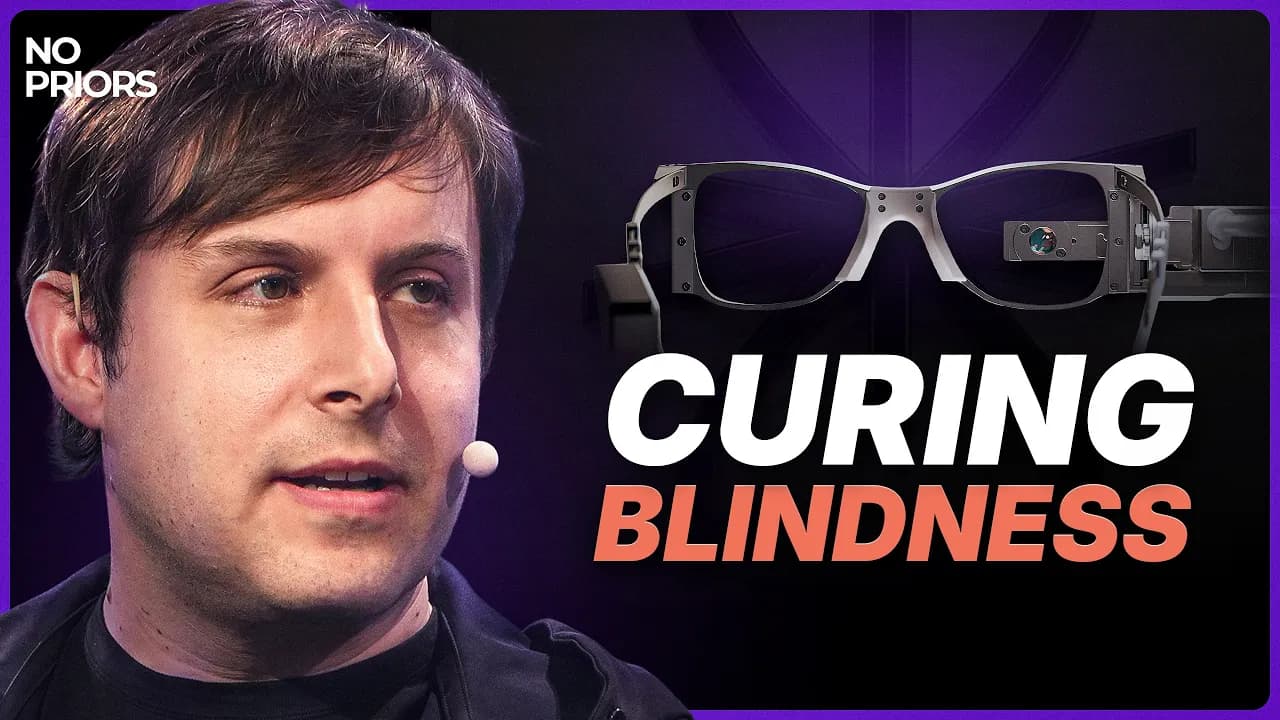
Max Hodak, co-founder of Neuralink and founder of Science Corp. Science announced more than 40 people received first BCI treatment restoring sight. Finished big clinical trial last year, published in New England Journal of Medicine in fall. Tiny 2mm x 2mm silicon chip implanted under retina. Array of solar panels. Patients wear glasses with camera and laser projector. Laser projects image; implant absorbs light, excites cells above it. Retinal stimulator bypasses dead rods and cones to restore visual signal. Big clinical trial in Europe across 17 sites showed huge effect. Submitting for approval; hope for market later this year.
Brain is powerful computer encased in skull, connected to world via handful of senses and motor control. Two main uses: replace natural connections (e.g., simulated reality/Matrix) or restore lost functionality (blindness, deafness, paralysis). Structural neural engineering: add new brain areas, understand information processing to build smarter machines or treat depression/addiction.
Currently restoring capability to diseased/conditioned people, like AI going from no cognition to AGI (human-level), then ASI (superintelligence). BCIs are category like pharma; different modalities for different things. Ultrasound for digital ambient or digital Adderall (stimulate focus/sleep); possibly consumer, no brain surgery (though high-quality ultrasound currently requires drilling skull).
Implantable BCIs require serious brain surgery; start with most disabled patients for best risk-reward. Current cortical motor decoders ~10 bits/second; inferior to keyboard/mouse (20+ bits) or speech (40 bits/second). Healthy people won't elect surgery yet. As bidirectional, richer representations improve, risk-benefit shifts. Aging makes everyone patients; eventually restores functionality, then surpasses normal (people with implants become superhuman).
Neuroplasticity misunderstood. Critical periods in early development; miss them, hard to wire later. Cases of congenital cataracts fixed in adulthood failed: brain overwhelmed, patients wore eye patches, some committed suicide. Brain stays plastic in adulthood under feedback: electrode anywhere in cortex, patient learns to control neuron firing in minutes via flashing light.
Cortical motor decoders use original representations plus brain adaptation via feedback. Early experiments fixed weights on handful of neurons (e.g., neuron A = up, B = down); brain learned to control.
Brain fits to reality like descending energy basin; stable, resists change. Psychedelics may anneal surface for new states, but snaps back. Ongoing plasticity enables learning/memory; limits in module interconnections post-critical periods.
Prima (Science's implant): brain craves input when blind, generates hallucinations/noise. First laser hit: "Oh, I see a flash." Pair with tone; play tone alone, patient sees phantom flash. Rehab needed to discriminate real vs. phantom percepts. Qualia is normal black-and-white sight (small field of view).
Canadian conjoined twins: one head, four hemispheres; thalami connected by biological cable (visible on MRI). Share conscious experience; coordinate tasks without speaking, conscious of it. Can see through each other's eyes? Adds image modes beyond eye-open/imagination (some aphantasic lack internal imagery). No confusion like schizophrenia; distinguish sources. Possible phenomenal binding over cable.
Close to native 20/20 acuity, color, full field of view possible in 10 years (not current). Broader: neural engineering vs. drug discovery. Started with retinal prosthesis (huge need, doable now). Drug discovery inefficient (e.g., $1M/patient gene therapy marginal for few; decades wasted). Trial: patients blind to faces for decade now read eye chart letters.
Brain only organ that matters; empirically better at engineering it. Next decade: restore sight, hearing, balance, kilobit/second motor control (cochlear implants exist; motor decoding known; vision breakthrough).
Early optic nerve stimulation: low-res flashes (phosphenes), invasive. Second Sight (decade ago): electrical stimulator, 4.5-hour surgery, titanium box; stimulated ganglion cells (1.5M). Got basic letter recognition via flashes, but no gestalt image. Cortex stimulation: psychedelic flashes, no form vision. Prima trial first for coherent form vision.
Macular degeneration (age-related most common), retinitis pigmentosa, Stargardt disease, diabetic retinopathy. Globally 200M affected; severe geographic atrophy 1-2M. Device agnostic to cause.
Drugs need exact molecular fix (hard); bypasses that, just restore signal.
Brain processes information via 12 cranial/31 spinal nerves (API of brain). Reality = spikes on these nerves. AI progress unifies neuroscience/AI; learning more from AI than expected (reverse of predictions).
Hard to measure signals, but once recorded, quickly decode neural representations. Retina: 150M rods/cones → 100M bipolar cells → 1.5M ganglion cells (100x compression: edges, motion, blobs, color). Second Sight skipped bipolar layer. Rods/cones = bitmapped image; optic nerve = compressed.
Stimulating a cell in the retina does not produce a single pixel but rather an edge, motion, or direction gradient. Selective excitation is not feasible due to insufficient precision and lack of knowledge on the appropriate patterning or codec, resulting in flashes of light. An empirical discovery showed that exciting bipolar cells with an image produces an image in the mind's eye, as this is the critical processing step in the retina to preserve.
The company was not founded around a specific patent or IP but took a neural engineering centric view of healthcare. Initial ideas included a BCI probe in biohybrid and recognition that a retinal prosthesis was the most valuable near-term build, with technology ready by 2021. A first principles approach was used, but in biology, this must be combined with understanding evolution's nuances. Intuitions suggested challenges past the retina. The retina features a 2x2 matrix choice for lost rods and cones: stimulate bipolar cells or optic nerve cells, electrically or with optogenetics. All four quadrants were explored.
Stimulating optic nerve cells proved difficult, requiring 1 million degrees of freedom calibration per patient, impractical in practice. This led to bipolar cells. Both electrical and optogenetic stimulation were developed. They have in-house state-of-the-art optogenetic gene therapy, publishing a paper last fall on the world's most sensitive optogenetic opsin proteins, making neurons responsive to light like indoor office lighting. These can target bipolar cells but are 5-7 years from clinical translation with potential pitfalls. For electrical stimulation, they surveyed the field, acquired a small European company developing Stanford-invented technology from a decade ago.
Deepest hard skill is software; degree in biomedical engineering, grew up programming, started with a Learn Visual Basic book. Always interested in the brain, inspired by science fiction like The Matrix. Attracted to digital worlds without physical constraints: space, resources, speed of light. Insight: brain and consciousness matter most; engineering the brain makes the rest replaceable. Surrounding consciousness with correct inputs is key.
BCI is a longevity/healthcare adjacent story. End goal of AI is superintelligent machines; for BCI, conscious machines. Consciousness may lack external measurement; only know your own. BCI needed to study it directly, understand underlying physics (new or emergent), build superintelligent conscious machines via ultra-high bandwidth connections. At the very beginning; current trials low bandwidth but will scale higher. Biotech historically incremental with 10-year timelines, but now in takeoff era like post-industrial revolution; life unchanged for thousands of years before steam engine, unimaginable changes in 10-15 years.
Prima implant for retinal blindness uses electrical stimulation. Does not treat glaucoma (optic nerve loss); biohybrid BCI potentially applicable there. Pipeline has three elements:
- Retina work (Prima implant for blindness)
- Neural interfaces
- Profusion with Vessel program
Inspired by nature: brain as neurons, so culture neurons on neurons to form biological connections. Device seeded with engineered stem cell-derived neurons (not patient-related). Key IP: hypoimmunogenic stem cells, hidden from immune system, no per-patient manufacturing. Loaded in dish, engrafted onto brain without wires or modifying patient's brain (unlike optogenetics/ultrasound). If graft cells die, no worse off; potential to grow throughout brain forming connections. Seen in animal models. Like Avatar ponytails: big new cranial nerve with connector (USB port). Creates internet nerve like corpus callosum (200 million fibers connecting hemispheres for integrated experience).
Neuralink was ultimate startup PhD: executing technically complex multidisciplinary company. Brain has representations (geometric objects encoding states, e.g., hand activity in neurons). Primary motor cortex (2 synapses from muscle) easy to understand, corresponds to joint torques. Deeper brain: abstract representations, e.g., inferotemporal cortex maps of objects/faces (latent space manifold: vase, Eiffel Tower, car, person, zebra).
Brain representations like latent space; AI models (image/language) produce similar representations. Evidence AI on right track; dismissals like stochastic parrots wrong. Neuroscience shifting to AI for easier study. Neural activity is another latent space; translate via models for cool applications. Motor decoding classic (cursor/keyboard control since late '90s); electronics problem solved by smartphone dividend (efficient, small, low-power implants closing skin, avoiding infection).
Biohybrid for highest-end applications; trade-offs (added biology complexity) but handled well. BCI not single product like pharma; multiple companies/probes for applications. Biohybrid backloaded, not for all scalable impact needs.
Profusion: heart-lung machines (ECMO - extracorporeal membrane oxygenation). Inspired by Lancet case: 17-year-old in Boston on ECMO waiting for lung transplant (heart ok, lungs failed), playing video games, homework, friends. De-prioritized, off list; ethical dilemma (alive via $500k/month ICU, fairness to others). PubMed search "ECMO ethical dilemma" yields pages of results; often discouraged as "bridge to nowhere." Asked why not destination therapy vs bridge; response was
The response received was shouting and throwing things, indicating something felt wrong, but there wasn't a position to pursue it then. There is an important unification here. The same fundamental technology has transformed organ transplantation, called NMP (normothermic machine perfusion) rather than ECMO, but it's the same idea.
Twenty years ago, if a car crash happened at 3 AM, kidney or liver transplant surgery would happen at 4 or 5 AM. Now it gets scheduled for the afternoon or next day. Over 75% of liver transplants in the US use this perfusion technology. Existing systems cost $500,000, can only be moved by private jet—one company's private jet logistics business is bigger than its medical device business. There is clear engineering potential to refine this.
What if you could check a kidney's luggage on a United flight to the East Coast? Or make a device a 17-year-old could bring home in a backpack? In one case, they stopped changing the oxygenator filter, it clotted a week later, and he died.
Other problems include closing the skin around the brain implant so tubes connecting blood supply to the circuit allow skin to heal without infection risk—otherwise, it must be cleaned very carefully.
There is a huge gap between scientific breakthroughs and current practice. People don't appreciate that keeping an end-of-life patient alive in an ICU almost indefinitely already exists, but it's poor quality of life—patients ask for it to be withdrawn. Nobody wants to be a brain in a hospital bed connected to tubes. High quality of life requires something people can live with: vision, hearing, balance, motor control, ability to be out in the world.
This reframes medicine's problems fundamentally. At Science, several projects are one project over the next 10 years.
Started as an engineer with first principles thinking, now associated with Elon Musk. Neuralink started when an email came in early 2016 from Sam, subject: "crazy question be like Alon starting a brain computer interface company who should run it." Assumed they were talking to many people; first thought of MIT friends, but then emailed back asking to be considered. Sam introduced to Elon, who already had the idea, name Neuralink, and had heard the name from people he was talking to.
Over second half of 2016, a shifting group met weekly in the evening, snowballing into Neuralink. Initial group included people from Duke: Tim Hansen (sewing machine idea originator, grad student in the lab where speaker was undergrad), professor they went to at UCSF, and a collaborator—very small community.
Elon saw AI coming more clearly earlier, implications that it can't be separate from humanity—needs to merge to upgrade humanity rather than get left behind. Motivating factor: natural history of Earth shows greater intelligence is dangerous—humanity dominates, keeps closest relatives in glass boxes to prevent extinction.
No specific technical idea initially, but pull together smartest people and resources, eventually consensus on thin film polymer threads.
Example of coming from pure software to hard-tech, doing breakthrough commercializable research. Advice to 2016 self:
- What was done right: Clear sense of wanting to work in brain-computer interfaces in college. Persistent high agency to join great lab at Duke (medical center, didn't take undergrads)—snuck in via independent study in chemistry department as back door to primate neuroscience group. Most college education happened there. Deepest skill is software, but doing primate BCI neural decoding since 2008.
- What wasn't done: After college, started Transcryptic, a robotic cloud laboratory. Inspired by synthetic biology work needing to press plate reader button every 3 hours for 3 days. In software, this wouldn't happen—automate it. With AWS emerging, build central robotic cloud lab exposing APIs for scientists to run experiments over internet.
Raised money, stepped down as CEO early 2017 to join Neuralink—had millions in revenue, early promising point. But over last decade, promise not fulfilled—hard slog. From 2012-2016, identified with Ben Horus's essay "The Struggle." Should have gone to work for someone like Elon earlier to level up ability and learn the game.
Promising kids often say "I'm going to do it myself, start company, plow through." Sometimes works, but startup running is oral tradition—nucleating moments like PayPal, but usually passed down from Silicon Valley cultures. Huge difference getting it right at 20 vs. 26-28.
Science is next, assembling accomplished crew. Once something works, more resources and smart people come. Hoping for that in these spaces.
Interdisciplinary problem needing great people in different areas. Things possible today were unimaginable years ago. Best team in the field.
Next 10-20 years of Science BCI: Event horizon at 2035—can't see past it. First people to live to a thousand may be alive now, many more than thought—not one or two. Earth at exceptional change moment influenced by tech, twin plot lines of BCI and AI.
AI is real, not yet priced in. People don't get BCI possibilities—parallel but distinct. Intelligence widely available to those with agency—optimistic, p(doom) well below 50%, not zero.
Won't cure all disease by 2035, but new options reframe human condition. Reconfigures interface between computers/humans and humans/each other. BCI equivalent to brain-to-brain interface in many cases, new territory.
Thanks, Gary.
Keep Y Combinator in your library
Save the videos and channels worth coming back to, and find them again in one place.