No body, no arrest: What happened to kidnapped Irish racehorse Shergar? | 60 Minutes
In a Nutshell
Shergar, the world's most valuable racehorse, was kidnapped from Ballymany Stud Farm in Ireland on February 8, 1983, by masked gunmen believed to be IRA operatives seeking ransom to fund their campaign. After chaotic and unsuccessful ransom negotiations, the kidnappers announced the horse was dead, and he was never seen again. Most evidence points to Shergar being shot and buried in remote bogland in County Leitrim shortly after the kidnapping, with no arrests ever made and the case remaining a cold mystery.
These notes were generated by AI and may contain inaccuracies.
Legends and lore form part of the Irish national tapestry. The story of Shergar, a champion racehorse and Ireland's answer to Secretariat, dominated tracks in the early 80s until he was kidnapped. The crime was thought to be an Irish Republican Army plot launched amid the Troubles, the violent conflict that convulsed Northern Ireland for 30 years. The horse was never found, no one's been arrested, and one of sport's great unsolved mysteries has never moved beyond cold case status.
With central figures dying off and memories fading, the investigation ventured to horse country not far from Dublin in County Kildare. This area, known as the Curragh, Gaelic for "place of the running horse," has a thousand-year history of chariot racing by kings and chiefs. Today it serves as the beating heart of Ireland's thoroughbred racing industry.
The Curragh hosts the Irish Derby each year. In 1981, the race was won by Shergar, born in a nearby stable. Shergar's saga was only beginning at that point.
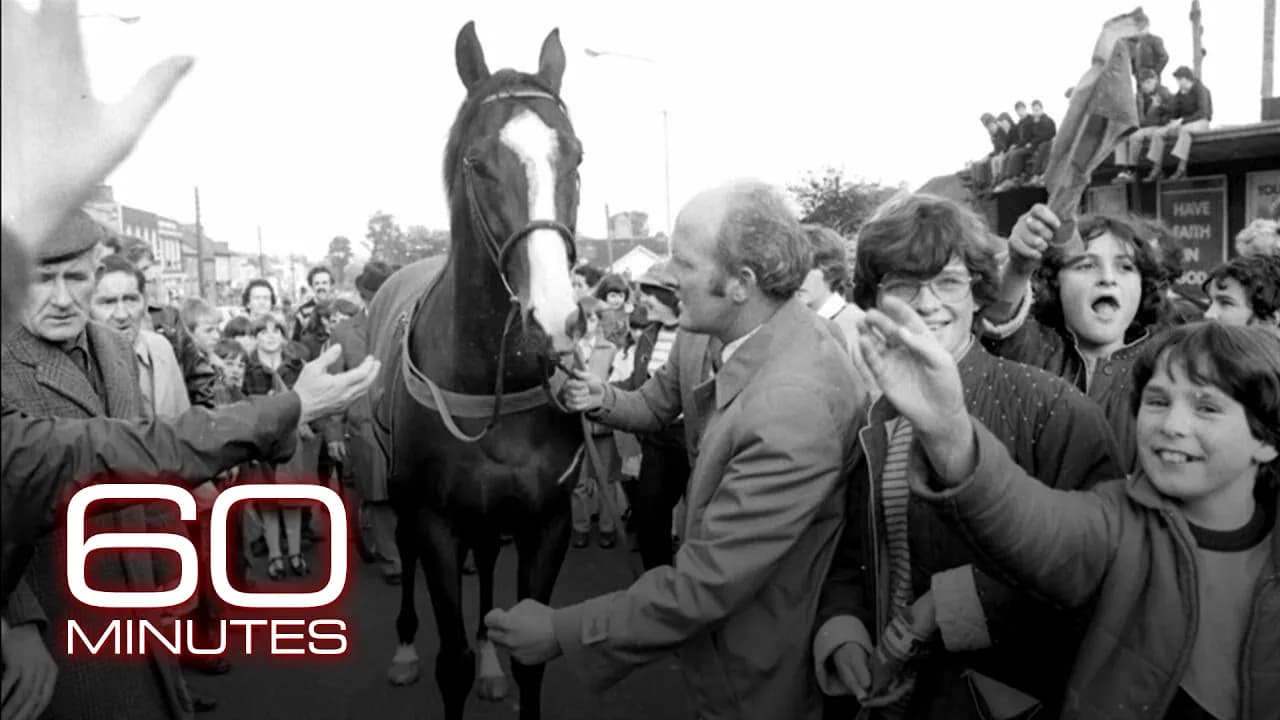
Shergar demonstrated overwhelming speed and stride that distinguished him at the 1981 Epsom Derby, England's equivalent of the Kentucky Derby. He won by 10 lengths, the largest margin in the race's history. Commentator Derek Thompson noted Shergar's distinctive white face made him recognizable to crowds.
Shergar is considered among the best thoroughbred racehorses of all time. After his racing career, the typical future for a champion horse involves becoming a stallion. Shergar received a hero's welcome back in County Kildare and was retired to Ballymany Stud Farm.
Shergar's owner was the late Aga Khan, spiritual leader of the Ismaili Muslims and one of the richest royals in the world. The Aga Khan retired Shergar to Ballymany Stud Farm, hoping to create a dynasty by syndicating the horse and selling 40 shares for $250,000 each, totaling more than $50 million in today's currency.
Fortunes changed on the night of February 8th, 1983, when masked men with guns broke into Ballymany and kidnapped Shergar. Jim Fitzgerald, Shergar's head groom who was there that night, described the traumatic experience. Masked gunmen knocked on the door, forced everyone to the floor at gunpoint, and ordered Fitzgerald to take them to the stable where Shergar was kept.
Fitzgerald was bundled into a car and driven about 30 miles from the farm, then released while the kidnappers made off with Shergar. He had a gun pointed at his head and was told to get out of the car and remain silent about the incident. This forced silence was familiar in Northern Ireland as a hallmark of the IRA, but unusual in pastoral Kildare.
The kidnapping occurred during the Troubles, a period in Northern Ireland marked by many years of bombings, shootings, and killings. The sectarian violence rocked Northern Ireland for almost 30 years, pitting Catholics against Protestants mostly over questions of British rule.
The IRA, the Catholic paramilitary group, raised funds for their campaign through bank and post office robberies. Shergar wasn't any horse - he was the most expensive horse in the world. Bank robberies weren't paying off, leading someone to propose kidnapping Shergar and holding him for ransom. The goal was transactional - cash for guns - rather than symbolic.
When police arrived at Ballymany the next morning, there were hardly any clues. The following day brought an unusual call to Derek Thompson, who was working in London. The press association in Fleet Street contacted him at 2:00 a.m., informing him that the kidnappers of Shergar wanted to talk to him and directing him to fly to Belfast.
Thompson and two other horse racing journalists were summoned to Belfast by the kidnappers. They arrived at the Europa Hotel, known as the most bombed hotel in Europe. A voice over the hotel intercom directed Thompson to a farmhouse 30 miles outside Belfast, where phone negotiations continued for the next 12 hours.
The kidnappers stated they had the horse and wanted to negotiate a price. Ransom demands kept changing - £40,000 one day, 2 million the next. The Aga Khan's office received calls as well. Three days after the kidnapping, a final call stated "The horse has had an accident. He's dead," after which the phone went dead.
With a champion stallion missing, the investigation continued. Police gave daily updates indicating they were making no progress. The country became captivated by the deepening mystery, leading to an Irish folk song and various theories about Shergar's fate.
Theories included kidnapping to pay off US mafia debt or shipment to Libya for Omar Gaddafi. The Curragh region features 80 miles of gallop surrounded by unplowed grass rich in limestone, beneficial for horse bones, and fertilized by roaming sheep.
Richard Brabazon, whose family has trained horses in the Curragh for generations, believes there was an accident and Shergar was killed. He noted the difficulty of covering up such a large operation and handling a big animal, mentioning that burying a donkey once took him half a day.
Most people in the area believe the kidnappers couldn't handle a stallion like Shergar and shot him within a couple of days. This theory was circulated in a 1998 memoir by former IRA member turned informant Sean O'Callaghan, who wrote that the kidnappers drove Shergar to County Leitrim near the border with Northern Ireland.
County Leitrim would have provided a soft landing for the captors. If the local leader received a phone call saying they needed to dispose of the horse, there would have been people available to do it. The area is sparsely populated and remote, making it an ideal place to bury a body that was never meant to be found.
Journalist Tommy Conlon led investigators to boggy terrain in County Leitrim where lore has it the kidnappers disposed of Shergar's remains. In the winter night of February 8, 1983, the place would have felt almost deserted, and anyone met on the road would likely "say nothing" - a reference to the code of silence.
Kevin Mallon, a convicted IRA operative once broken out of prison by helicopter, is named in Sean O'Callaghan's book as the ringleader of Shergar's kidnapping. Attempts to contact Mallon at his seaside house near Dublin were unsuccessful, with a family member stating he wouldn't know anything about the incident.
Some cold cases eventually resolve through crisis of conscience or dying declarations, but the Shergar case appears to be a long shot. The kidnapping is viewed as a massive shame given Shergar's status as a symbol of Ireland, representing freedom, beauty, and wildness.
Keep 60 Minutes in your library
Save the videos and channels worth coming back to, and find them again in one place.