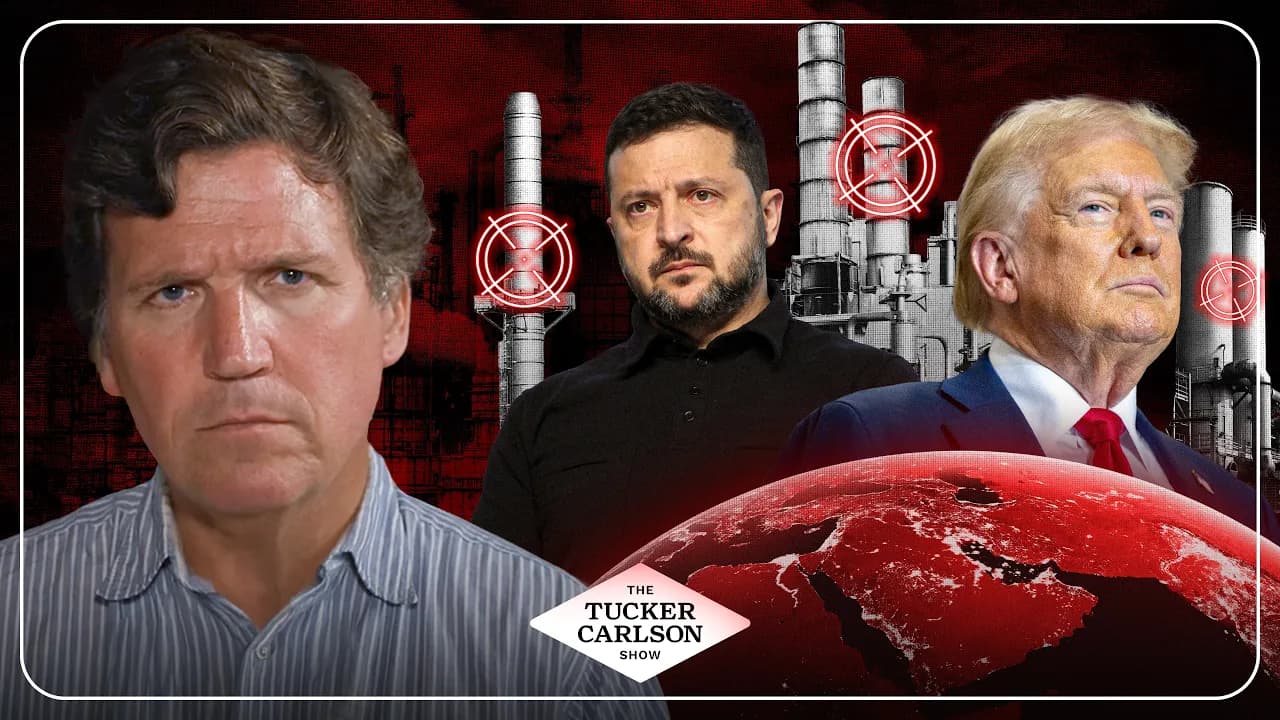
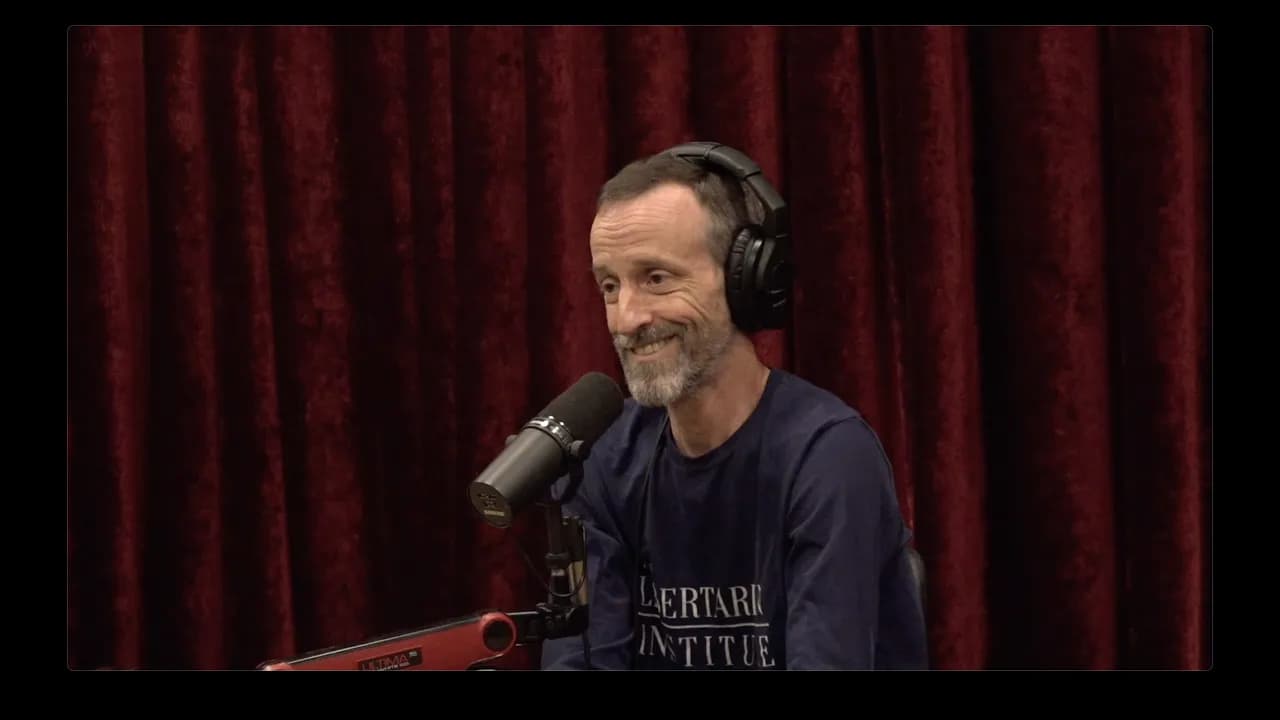
“Prepare for War” - Tucker Confronts Britain’s Most Pro-War Advocate
In a Nutshell
Britain must urgently rearm to 3.5% of GDP to deter Russia, because projecting weakness invites aggression—Putin invaded Ukraine after seeing no serious Western response to Crimea, just as Germany attacked Poland after Britain failed to act over Czechoslovakia. The 1994 Budapest Memorandum proves the point: Ukraine surrendered its nuclear weapons for Western security guarantees that were never honored, showing that only credible conventional strength, not nuclear threats, prevents war. True deterrence requires rebuilding military capability and rejecting welfare spending over defense, rather than relying on nuclear escalation or hoping diplomacy alone stops a nuclear-armed Russia from testing NATO's resolve.
These notes were generated by AI and may contain inaccuracies.
Mr. Remmon states that the United Kingdom needs to be prepared for war because the country is coming under attack in various ways from Russia. This includes murders and attempted murders, specifically an attempted murder in Salisbury and a murder in London carried out by agents of Putin. Putin has invaded Ukraine and Russian people close to the state have discussed the potential for nuclear war. The way to avoid war is to prepare for it, and if prepared for war, it doesn't happen. The core concern is the lack of preparedness.
Russia is threatening Britain through actions like the Salisbury poisonings and submarines operating near undersea cables. Mr. Remmon believes Putin wishes to reassert Russian power, viewing Russia as a failing state with an economy in the doldrums since the Soviet Union's collapse. Russia has lost territory, which is seen as shameful against Russia's historic destiny of expansion. This explains activity in Georgia and Ukraine, as Russia wants control over neighbors and a sphere of influence as a nuclear-armed power.
Russia's GDP is smaller than the UK's despite its larger population, because its GDP per capita is significantly lower. Russia is described as an economic failure due to deep corruption and ineffective resource management. While Russia has inherent wealth as the largest country in the world with vast resources, this hasn't translated into economic strength, consistent with Russia's history as a poor country despite its resources.
Britain is participating in the war against Russia by supporting Ukraine's defense of its territory. This is compared to America helping Kuwait against Iraq. The UK signed an agreement with Russia, the United States, and Ukraine that guaranteed Ukraine's territorial integrity in exchange for Ukraine giving up its nuclear weapons. Mr. Remmon argues that Britain should be concerned about fellow NATO members, particularly Poland and the Baltic states, which face cyber attacks and feel threatened.
Article 5 of NATO would involve Britain if another member is attacked. Russia has made bellicose statements about the United Kingdom. From the Russian perspective, Britain is helping to fund a war against Russia, making the UK a combatant in that war. This perspective is also held by Russia toward the United States, Germany, and NATO.
The discussion centers on the 1994 agreement where Ukraine gave up its nuclear weapons in exchange for assurances of territorial integrity from Russia, the United States, and the United Kingdom. Mr. Remmon argues this treaty matters and that Ukraine would not have been invaded if it had retained nuclear weapons. The counterargument is that the United States never pledged to go to war with Russia over Ukraine, and there is no treaty obligating America to fight Russia.
There were subsequent verbal agreements that NATO would not expand to Russia's borders. Russia has understandable concerns about nuclear weapons controlled by another country on its borders. The 2014 overthrow of the Ukrainian government by NATO is cited as a significant event. The question is raised whether America's word is worth anything if it persuades a state to give up nuclear weapons and then fails to maintain its territorial integrity.
The argument is made that if Britain stops fighting the war in Ukraine, Russia will be less likely to use nuclear weapons. The counterargument is that if Russia takes Ukraine, it will move on to the next objective. The fundamental principle of world order is the integrity of nation states. If nation states are up for grabs, then China could take Taiwan. Projecting weakness invites aggression, as seen with agreements over Crimea that signaled to Putin he could act with impunity.
The first Gulf War was right because it was about territorial integrity of nation states. The second Gulf War was a mistake because it was none of Britain's business and based on the false pretext of nuclear weapons that didn't exist. Liberal interventionism is opposed - it is not Britain's business how Iraq is managed internally by Iraqis or how Putin manages Russia. The concern arises when Putin invades neighboring countries.
Britain currently has a military strength of under 19,000 ready for combat. For perspective, Britain lost more than 19,000 soldiers in single days during the First World War. Russia has a standing army of one and a half million. Russia's military was thought to be powerful enough to roll up Ukraine in a fortnight but failed, though it could send hypersonic missiles into Kiev today and end the war, relying on Putin's restraint.
Britain's defense spending is 2.7% of GDP, described as pitifully low. The country is spending approximately 400 billion pounds a year on welfare benefits. The argument is that money could be redirected from welfare to defense. There are 6 million people in Britain who work even though they would be better off on benefits. The public is increasingly worried and fed up with people making welfare a lifestyle choice.
The national interest should be the biggest concern, not abstract international order. No one wants war with Russia, which is why there's increasing support for building up the military to defend Britain. The question is whether the average Briton would choose bombs over food, housing assistance, or unemployment benefits. The goal is not to intimidate Russia, which wouldn't succeed, but to be taken seriously so that Putin doesn't miscalculate as he did with Ukraine.
Putin did not take Ukraine seriously and thought he could invade it and take it over very quickly. Intimidation suggests intent to be aggressive and implies a penalty for crossing boundaries. Showing resolve means demonstrating strength so that an adversary concludes an attack is not in their interest. The goal is to make Russia believe that interfering with the UK would not be worth it.
Britain's interim defense expenditure target is 3.5% of GDP. The emphasis should be on equipment rather than troop numbers. Russia is not expected to invade Britain directly because of geographic distance. The discussion centers on conventional deterrence through strength rather than immediate escalation to nuclear weapons.
Both Russia and the United States have openly threatened to use tactical nuclear weapons. Deterrence requires strength; stepping directly from no defense to nuclear weapons lacks credibility. No one will take a threat seriously if the only response to Russian action in Poland or Estonia is nuclear escalation, because the response would be disproportionate.
Nuclear weapons served a useful purpose during the Cold War because both sides realized the other could wipe them out. The use of nuclear weapons in Hiroshima and Nagasaki is considered justified for bringing World War II to an end. The argument states that the United States and United Kingdom were in a state of total war with Japan after the attack on American soil, and that the bombings shortened the duration of the war.
Aquinas's conditions for just war are presented as: legitimate authority, important cause (self-defense after attack), and proportionality measured by shortening the war. The counterargument holds that proportionality means the response cannot be vastly larger than the initial attack, and that killing non-combatants who committed no crime violates fundamental principles of justice.
Once a war begins, the objective becomes winning the war. Nuclear weapons are considered morally justifiable if the risk to one's own side is sufficient. The claim is made that Japan was a defeated nation by the time of the atomic bombings, had already been firebombed multiple times in Tokyo, and posed no invasion threat to the United States.
Blood guilt and group punishment are antithetical to Western civilization. The basis of Western justice systems is punishment of only the guilty. The Gulag and events in Gaza are cited as examples of the wrongness of killing people who did nothing wrong.
Germany's case for invading Poland included the claim that 15% of Poland had been German territory carved off at the Treaty of Versailles, including part of Prussia. The UK destroyed its empire fighting the war. The argument questions whether Britain benefited materially from victory, noting the end of empire, loss of India two years later, and permanent stationing of American troops.
Britain's self-respect was maintained by defeating Nazism, but the presence of foreign troops on British soil for 80 years raises questions about sovereignty. NATO membership is described as a voluntary grouping with no ability to compel member states. Article 5 is framed as a request for assistance rather than an automatic obligation.
The territorial integrity of nation states is presented as worth defending to reduce future wars. Britain's own borders face challenges from small boat crossings, with 19% of the population now foreign-born compared to 8% twenty years ago and 2% forty years ago. The Rwanda scheme is mentioned as a potential solution for illegal immigration.
A nation state's legitimacy requires the ability to control its borders and make decisions rooted in its population's core interests. Failures in immigration administration are acknowledged, including visa overstaying. Ukraine is described as having been significantly Russian-speaking in 2022, with Putin creating a stronger Ukrainian national identity through the invasion.
Ukraine is characterized as having been controlled by NATO and United States intelligence agencies since at least 2014. The 2014 government change is described as a US-orchestrated overthrow when Ukraine was moving toward closer ties with Russia. The choice is presented as between Russian or Western control rather than genuine independence.
NATO is distinguished from the European Union or International Criminal Court because it does not override national sovereignty. Member states retain their nation-state capability within NATO. The command of troops by allies during wartime is described as a long-standing norm of international affairs predating NATO.
Peace in Europe between major nations has existed since 1945. Britain's prosperity has historically depended on peace. Material improvements since 1945 include better feeding, housing, and conveniences unavailable in 1945. The suicide rate is higher now. The country has shifted from majority Christian to majority atheist.
Britain is considered a better country than in 1945 because Nazism was destroyed. Problems acknowledged include bad governments, poorly handled immigration, and excessive state control. The alternative presented is that Germany would have eventually invaded Britain.
Britain's experience in 1914 and 1939 showed that appearing weak led adversaries to believe Britain would not act. Germany thought Britain would not honor its guarantee to Belgium. Britain joined both world wars rather than being attacked directly, entering to help France and Belgium under treaty obligations.
Britain had a treaty with Belgium, and Germany attacked Belgium on its way to attack France. Projecting strength could have prevented the First World War. If the Kaiser had believed there was a significant British army and that Britain would take the situation seriously, he would not have gone through Belgium. Without the invasion of Belgium, Britain would not have entered the war. The projection of strength avoids war, and this lesson should be applied today. If an enemy thinks you are weak, you get into war by accident. Showing strength prevents invasion. If Hitler had thought Britain was strong, Poland would not have been invaded. Hitler repeatedly stated publicly and through diplomacy that he did not want to go to war with Britain, and after seeing no action regarding Czechoslovakia, he believed Britain would do nothing about Poland.
Eton College lost 1,200 students in the First World War. This represents the equivalent of losing a full five-year cohort of students. The First World War resulted in the loss of an entire nation and all of Christian Europe. When viewing the names of the fallen in the Eton College chapel, it becomes clear that these were terrible losses. Mothers cannot be told that their sons died for a good cause protecting Belgium. The overriding lesson is that the war would not have happened if Britain had projected strength, and the war was not worth fighting in the first place.
In traditional British political terms, the First World War was fought to maintain a balance of power on the continent because Britain felt threatened by Germany in its imperial possessions and by the buildup of the German Navy. The First World War may not have been the right war to fight, but the Second World War clearly was. The connection between the wars lies in the Treaty of Versailles. The Congress of Vienna, led by Castlereagh, resulted in a generous peace treaty with France that Napoleon himself said he would have given Britain had he won, leading to 100 years of peace. The catastrophic mistake of the Treaty of Versailles was allowing the French to lead the negotiations.
Two world wars killed tens of millions of people, destroyed Britain, and depopulated parts of the country. Both wars were initiated in defense of small, non-contiguous countries with no cultural history or connection to Britain. The Napoleonic Wars raised the question of whether it was worth trying to stop a dictator from having a commanding position in Europe, which has usually been seen as being in British interests. As a businessman, cost must be part of the calculation, not just potential upside. The Congress of Vienna got the peace right after getting the war right. The First World War got the peace wrong, while the Second World War got the peace right, leading to 80 years of relative peace in Europe.
Britain is helping fund Ukraine's defense of its territorial integrity against Russia. Britain is not directly at war with Russia, though Ukraine is fighting a war against Russia. The United States and Britain are argued to be fighting a war against Russia through their support of Ukraine. In a previous conversation, a former Labour adviser suggested that the first thing needed in the UK would be to round up people who disagree with the program and put them in jail.
During the Second World War, the British government immediately rounded up all Germans, including German Jews, as enemy aliens. A German Jewish man was interned in Shropshire in 1939, joined the British army the day he left the camp, and ended the war as a brigadier. The British government has never apologized for violating its own ancient principles by rounding up not only members of the opposition party but also their families, including Oswald Mosley and everyone who worked with him, along with their wives.
America arrested hundreds of thousands of Japanese people during the Second World War, the majority of whom were American citizens. America has apologized for this action, but not enough. Citizens cannot be arrested because of how they look. There have been attempts in Britain to penalize people for opposing a war with Russia, including accusations against George Galloway of being a foreign agent.
George Galloway is considered a brilliant orator and an interesting political figure, one of the best orators in modern British politics. His views are described as completely bonkers. He is charming when met in person and is a good Catholic who met Pope Francis and told him he should not be so mean about the Latin mass. Galloway cannot live in the nation of his birth because he opposes certain policies.
Britain cannot simply adopt a First Amendment because it has an uncodified constitution. Britain has historically protected freedom of speech through the way politicians have behaved, but freedom of speech is now being attacked. People must be free to oppose policies, including being Russian apologists, though they will be ridiculed for it. Journalists and Britons should be allowed to watch RT or any other news source they want in their own country. Lord Haw-Haw's Germany Calling broadcasts during the Second World War became a source of ridicule, and the more people listened, the more ridiculous they thought the Germans were. Banning things is not advisable because propaganda can be laughed at.
If Britain's and America's war against Russia provokes Russia into responding against the UK and the United States, and Britons are killed, the question arises whether their surviving loved ones can be told it was worth it. The freedom of the United Kingdom is worth an elderly life. However, one cannot say the country must be strong and ready to go to war without accepting that if a bomb drops on your house, that is a bomb you would have to accept.
The government of the United Kingdom is punishing and prohibiting people and ideas it does not like, while Russia is not doing the same. Russia has put fewer people in jail in the last year for social media posts than the UK. Russian citizens have been known to fall out of windows. For Britons whose ancestors have lived in the country for thousands of years, the threat to freedom comes from their own government, not Russia. There is no favor for the way free speech is being policed in Britain.
Standing at the next election is planned in hopes of a Conservative government that will restore freedom of speech. Limits on free speech are considered wrong and should not be allowed, but they are not affecting normal political discourse. There is opposition to people praying outside abortion clinics being arrested, which is considered improper and against freedom of speech, but this is not at risk of determining a general election. Some overzealous enforcement of laws meant to stop harassment goes much too far, but there has been no attempt yet to stop free political speech.
Saying "Free Palestine" or "From the river to the sea" can result in arrest in the UK, and many have been arrested. Elderly women have been arrested for these statements. Palestine Action was banned, and elderly people who belong to it have been arrested, making the government look foolish. The government needs the power to stop terrorist organizations, but it has confused people who support Palestine Action politically with people who want acts of violence. Arresting elderly people for supporting a political view is not right, though arresting people who propose and prepare acts of terrorism is reasonable. Overzealous efforts have made the government look very foolish. Freedom of the press allows governments to look ridiculous when they are overzealous.
There is optimism about the ultimate success of free speech in Britain. Britain is not picking a fight with Russia but wants to be strong. The conversation concludes with gratitude for the time spent and the graciousness shown throughout the discussion.
Keep Tucker Carlson in your library
Save the videos and channels worth coming back to, and find them again in one place.