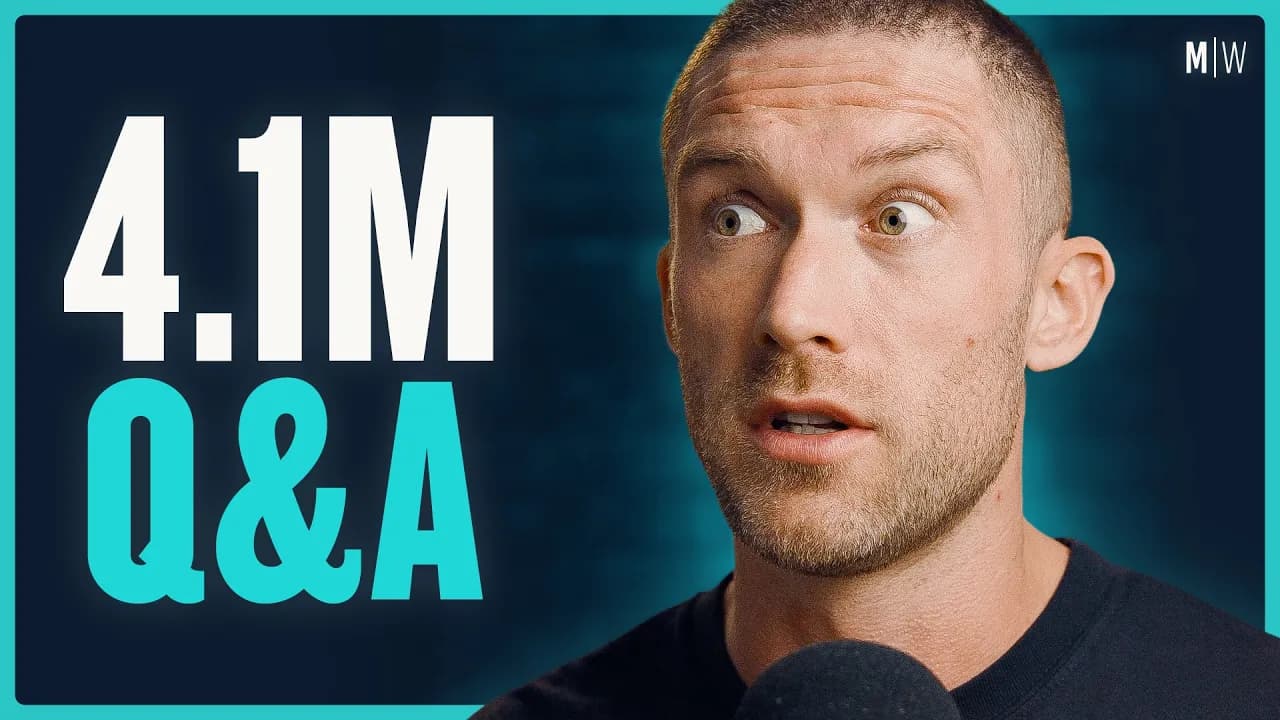
Q&A: Becoming A Dad, Health Update & Favourite Peptides
In a Nutshell
Chris Williamson shares he's still battling chronic mold and Lyme issues through hyperoxygenation therapy, saunas, and binders, while preparing to become a dad and prioritizing "golden life and dad life" over business growth. He recommends peptides like BPC-157 and TB-500 for recovery, warns that most dating standards online are inflated compared to reality, and advises against overthinking decisions since the heart decides and the head executes. He emphasizes that modern stress feels amplified because our nervous systems haven't adapted to social threats replacing physical ones, and that genuine ambition feels like love for the work rather than running from inadequacy.
These notes were generated by AI and may contain inaccuracies.
Chris Williamson opens the Q&A episode by announcing the new chriswillix.com/stories platform where listeners can submit questions, stories, life hacks, problems, and voicemails. The platform allows direct engagement with future guests where submitted content can be shared with them.
Bryson Rebels asks about fatigue in the self-improvement space. Chris notes sensing a cultural shift away from "grind sloppy content" and "fuck your feelings, just work harder" messaging. He identifies several contributing factors including uncertain futures, AI job displacement concerns, and geopolitical uncertainty. He observes that 2020's biggest financial niches focused on slow investment strategies (401k, dollar cost averaging, S&P), while current trends emphasize get-rich-quick schemes and vibe betting.
Chris explains his approach to balancing content by creating more roundtable episodes and casual hangs that deliver self-improvement value without feeling like mandatory homework. He mentions the Alex Petkash Odyssey episode as an example - a 2.5-hour retelling that doesn't require note-taking or life changes.
Yander 03X asks how to know when to end a relationship with someone whose ambition leaves them feeling lonely 90% of the time. Chris states that whether the partner still wants the relationship or is using busyness as an excuse doesn't matter - the loneliness itself is the key issue. He emphasizes not trying to convince yourself that feeling bad is acceptable through mental gymnastics about positive qualities.
Chris warns against being in love with someone's potential rather than who they actually are, noting that happiness cannot exist when you want things to be different. He references a list of 25 relationship evaluation questions available at chriswill.com/valentine/valentine.
The recommended approach involves having a direct conversation: "I feel lonely almost all the time, and I understand that you're chasing your dreams at the moment, but your dreams are kind of my nightmare." Chris stresses setting boundaries and prioritizing personal wellbeing over continuing to accept relational scraps.
J Cass 3586 inquires about the mental state during Achilles rupture recovery. Chris describes rupturing his Achilles playing cricket in mid-2020, noting it occurred during the pandemic which made recovery timing optimal since there were no missed social plans or external pressures.
The recovery involved a strict 12-month rehabilitation with a one-hour daily morning routine focused solely on Achilles rehab. Chris attributes his full current mobility and strength to this diligence. He describes the worst period being the 13 days between rupture and surgery, during which his leg atrophied to two-thirds normal size and his quad completely disintegrated.
Recovery resources included reading "The Obstacle is the Way" by Ryan Holiday, "The Art of Resilience" by Ross Edgely, and watching the Amazon Prime documentary "Resurfaced" about Andy Murray's hip replacement. Chris created a special podcast setup with his foot elevated and continued recording episodes, including the Gad Saad episode.
Barrett W. asks if accidentally looking at another man's butt makes him gay. Chris jokes that this is how people become gay, referencing the childhood "look down here" hand gesture prank, and humorously states that Tim Dillon and Douglas Murray are on their way to the person's house.
Anonymous 12835 asks about upcoming debate episodes. Chris confirms more debates are planned, with the next one focusing on AI featuring Zack Cass (pro), Liv Boeree (moderately skeptical), and someone from 80,000 hours (quite skeptical). He mentions wanting to bridge entry-level and technical AI discussions.
Future planned topics include geopolitics with potential guests Professor Jang, Peter Zeihan, and possibly Eric Weinstein. Chris notes scheduling challenges with Peter Zeihan's Singapore lockdown and travel commitments.
Max Forbzo inquires about openers for the Dublin show. Chris confirms there will be an opener to be announced, with tickets available at chriswilliamson.live. Dublin has sold out, with Edinburgh scheduled for October 11th and 10-12 additional UK/Ireland dates. The new show "Mostly Wise" includes Q&A, meet and greet, and surprises.
Listeners with tickets can submit worst first dates, problems, or life hacks at chriswilliamson.live/stories to potentially be brought on stage during the shows.
Arthur Gami asks about Chris's changing hairstyles. Chris explains having the follicular constitution of a golden doodle, with only two hairstyles: very short or curly. He mentions having long hair at the start of the year, shaving it off, and currently having long hair again, avoiding the afro stage.
Your Pokedad asks about doing an episode on Red Rising. Chris confirms it's one of his favorite fiction series and that Pierce Brown will appear on the show after completing "Red God." He highly recommends "Dungeon Crawler Carl" by Matt Dinerman as similarly compelling, with the author also scheduled to appear. Chris's dream roundtable would include Brandon Sanderson, Matt Dinerman, and Pierce Brown.
Kurt Moon 6456 asks about beliefs that once protected but now confine. Chris identifies his previous approach of highly scrutinizing every decision, which prevented mistakes and hasty life changes but now limits risk-taking. He notes the irony that people can actually withstand more risk when older due to greater resources, support, experience, and contacts.
Chris references Sasha Chapin's observation that what people call planning is often catastrophe fantasization - the publicly acceptable version of anxiety. He's working on moving more with gut instinct than over-analysis, accepting this will result in more mistakes.
Constructor 50008 asks about lime and mold problems. Chris reports still dealing with mold issues, describing it as extremely difficult to eliminate. The most effective treatment mentioned is hyperoxygenation therapy involving being held at 104°F (40-40.5°C) for four hours with blood filtration.
Chris emphasizes that chronic complex illness requires slow detox over time through hundreds of saunas, binders, HBOT sessions, morning walks, and adequate sleep. He explains keeping health struggles private to avoid becoming "the guy that's always got a health problem going on" and making it his entire personality.
Chris acknowledges the broader challenge of balancing requests for help with concerns about indulging victimhood, noting he's still in the trenches with health issues including brain fog, mood problems, and energy issues.
Chris promotes Momentous Fiber Plus as a three-in-one fiber supplement addressing digestion, gut barrier strength, and blood sugar stability. He notes 95% of Americans don't get enough fiber and emphasizes the 30-day money-back guarantee with international shipping available.
Cara asks why she needs others' advice before making decisions. Chris identifies this as stemming from lack of self-trust and need for external legitimization. He shares that when running nightclubs, much of his and his business partner's role involved being sounding boards for each other to validate decisions.
The primary reason for seeking advice is because decisions will eventually meet the real world. It is reasonable to ask trusted people for feedback before committing to a course of action. Very rarely would decisions be made in isolation. Historically, people would ask many others before making major life changes like leaving their tribe.
A useful approach is to practice making small decisions without seeking advice as a form of exposure therapy. This helps build comfort using intuition rather than overthinking.
The full Shadow Force episode featuring Doug Baldwin as Nightwolf Hawk has been redacted at the request of the imaginary American-Japanese secret spy agency. Only short clips have been released. The full episode will not be published.
The internet portrays dating standards as extremely high - requiring men to have everything together, be emotionally intelligent, earn high income, be providers, and meet height requirements. In reality, the average American adult is obese, divorced, and has less than $1,000 in savings.
When spending time with actual women in the real world, most do not maintain an extensive list of unrealistic requirements. The bar is low in practice, while online discourse inflates expectations dramatically.
People who carry internet-derived standards into real dating situations are likely to remain unhappy. High standards from others do not necessarily indicate they are a good catch - sometimes it reflects their own lack of self-understanding.
The best outcome of developing emotional awareness is genuine connection to life experiences. Successes feel authentic rather than immediately moving to what comes next. Many people who prioritize constant work are surprised when achievements fail to produce emotional satisfaction.
The worst outcome is inability to detach from failures. Pain becomes unavoidable when things go wrong. Many successful people have learned to detach from pain to continue pushing forward, but this also prevents celebrating wins.
The question becomes whether avoiding feeling successes is worth avoiding feeling pains. Chris Bumstead's statement that you have to feel both the bad and the good applies here.
The transition from a "macho grinding hustler" archetype to someone who experiences emotions has made many things harder, including meditation retreats where emotional material surfaces during extended silence. However, this approach creates a three-dimensional experience of life rather than floating through it like a ghost.
The period between doing significant inner work and seeing outer world results creates painful mismatch. This resembles monk mode or latent leverage - pulling back on a slingshot before release.
The pain stems from seeking external validation that the difficult inner work is worthwhile. When the outer world remains indifferent, doubt emerges about whether the changes are beneficial.
High congruence people like Donald Trump and Andrew Tate experience alignment between their thoughts, feelings, and actions regardless of external opinions. Change creates uncertainty because the new path lacks proven results.
Advice for this period:
- Practice faith that the process is valid
- Externalize internal work through celebrations and milestones
- Recognize that uncertainty and challenge are the entry price for meaningful change
- The absence of quick, easy, stress-free achievement does not invalidate the process
The favorite animal is a platypus due to its unusual characteristics - described as a "freak alien otter" that is cute but has venom, lays eggs despite being mammalian, and exists between mammal and reptile classifications.
Golden retrievers are considered their own category separate from regular dogs. The ideal animal would be a platypus-golden retriever hybrid.
Thinking about projects, fantasizing about outcomes, and discussing plans produces neurological rewards similar to actually doing the work, but in reduced form. This creates satisfaction without requiring action.
Talking about the thing is not doing the thing. Making time to do the thing is not doing the thing. Writing about doing the thing is not doing the thing. Planning extensively without execution becomes failure by default while avoiding public judgment.
Commitment device strategies:
- Create a habit group with friends for accountability
- Use financial penalties ($1 torn up for each missed day) with social tracking
- Video yourself destroying the dollar bill as escalated social pressure
- Find training partners or co-working arrangements
- Start with the smallest possible version of the goal
Pain-pleasure principle approach:
- Document past, present, and future costs of inaction
- Document past, present, and future benefits of taking action
- Reread this analysis regularly, especially each morning
Experiencing health issues despite not smoking, not partying, maintaining regular sleep patterns, exercising, and attempting to be a good person feels cosmically unfair. Comparing to others who engage in unhealthy behaviors yet remain well creates frustration.
Attempting to construct meaning or justification for health struggles can reduce agency and create apathetic, nihilistic thinking. The belief that personal action can influence outcomes is more valuable than the actual impact of those actions.
Three states of being:
- Going against the grain: swimming against waves while trying to get offshore
- Making things happen: effectively swimming and positioning on the surfboard
- Life flowing through you: actually surfing waves without excessive thinking
The goal is moving from feeling that life happens to you toward feeling that life happens through you.
There are times when it feels like you're dancing in rhythm with the music of life. And there are times where it feels like you've got two left feet and it's a three over four beat that you just can't catch a break on. When it's been that way for a while, it really sucks. Daniel Schmachtenberger shared that there's no one who has become a truly humble and empathetic person without going through a period where they literally didn't know if they could get any better. This is the difference between just going through a hard time and genuinely having your entire worldview changed. Everybody's going to go through difficulties, but not knowing if you're ever going to be able to get out of it changes you on a fundamental cellular level emotionally.
The last two years have really brought a realization that from the outside, other people's suffering can look like nothing, but from the inside, it feels like the world's falling apart. People can really suffer and tell no one about it. Giving as much care generally to the world is something that wasn't realized enough before. Going through hardship yourself makes it impossible to ignore just how hard life can be, and you need to be flippant and dismissive not to realize that other people should be treated with way more care.
At some point in the future, looking back on this period will bring more pride than ever before for continuing to do the project, for not stopping, for not giving up, for things being hard but just keeping going. It's a beautiful opportunity to have the story of being in the trenches and coming out the other side.
Going from recording videos on the sofa to having a full team in different sets is a big change. The core of the work remains coming up with ideas, choosing the guests, and working out what to talk to the guests about. When other creators take their eye off the ball and not be in touch with that, it shows. Who's on, what are you talking about, and what are the ideas that you have in your mind that you think are important—that is what the podcast is. That is what content is.
Taste cannot be replaced by amazing writers or researchers. Playing about with being fed more information from aggregate news websites feels like being puppetted. Reading time has been squeezed, but that's a discipline thing. You don't need to read that much to come up with really great ideas—four pages of a Sasha Chapin article yielded three things to talk about on the show.
Outsourcing stuff like that is basically the beginning of the end for most shows unless the host sucked from a taste perspective and a discernment perspective. The first 800 guests were booked personally with no assistance on the show—outreach, time, scheduling, calendar, sending over the link, sending over the address. Now other people make that stuff happen, which gives more time to focus on taste.
There is always shiny object syndrome. There is always something that can be done that's going to distract. As opportunities become more attractive and more seductive, saying no becomes a more difficult task. The no muscle is being hypertrophied as much as possible.
There will be a huge run of UK podcasts at the end of tour. The tour schedule at chriswilliamson.live shows four days back to back, which is heavy, going from Edinburgh to the most southerly show in England. A tour bus is the only way, including an overnight sleeper tour bus, then two more shows.
After finishing in Dublin or Belfast, there will be one day off in London, then a full run for probably seven or 10 days in London after tour. The plan is to get out to the UK a little bit early to be as prepared as possible, do the entire run, then rip the ass out of the cinema production. Confirmed guests include Finn and Horatio again, Alan, Bugsy Malone round two, Brian Cox, Mary Harrington, possibly a round table with Freya India, Bonnie Blue round two, another Rory Sutherland, and possibly David Deutsch.
Previously tentative about revealing upcoming guests, now it's cooler to let people know exciting guests are coming on. The genius plan is to get fist by the show and then get fist by the cinema production, with Halloween in the middle on Saturday, 31st of October in London, dressed up like Spider-Man.
Watching since 200k subs means being here since the start of 2022. At 4.1 million subs now, 50% of the duration of the show was at 200k subs. Half the time of this podcast got to 200k subs and the other half got to 4.1 million.
The biggest improvements noticed when looking back at old episodes are confidence sitting down with a guest and the ability to sit with silence. A screen test revealed just how nervous it is despite no one watching except some nameless, faceless casting director. The reps of sitting down in a room have changed everything. Speaking to Elon at the moment and back on Rogan soon—Rogan is called the final boss of social anxiety.
The first time speaking to Jordan Peterson in 2021 involved doing breath work walking around Newcastle trying to get heart rate under control. By the third or fourth episode, it was boredom waiting because Peterson was a bit late. That level of comfort socially was something that definitely wasn't there before.
Being able to sit in the silence and give people room is almost like there is a third participant even if there's no audience. When doing the show, there's you, the guest, and the people that are listening—they need time to think as well. There's almost a third participant one-on-one which is their brain. People will have something if you don't interject, and silence is really appreciated. Patience and comfort with patience are two of the biggest improvements. The first ever episode didn't understand that you could nod silently and thought that every time nodding, it had to go "mhm, mhm, mhm"—that's gone now.
For boys aging from 18 to 24 who want to become a man, there's no need to speedrun becoming a man. Most of childhood is spent unable to wait to become a grown-up and most of adult years trying to become a child again. 18 to 24 is a sick time—ask anybody in their 30s or 40s how fun it was with no responsibilities, just able to explore. If you spend all of your life wanting to be somewhere or something that you're not, you will miss your life. The manhood thing will come along for the ride.
What makes a good man: a guy who knows where he's going, is having fun while he's going there, and is comfortable in his own skin. Those three things reliably make the sort of man that other people want to be around. Filter it through some wisdom—make sure the thing you want to do and the comfort you have in getting there isn't getting there to screw over a bunch of people in business or to be exploitative or manipulative or a liar.
Three pieces of advice for someone transitioning out of the lonely chapter: be gentle with yourself if you're a bit socially inept because you've basically been in monk mode isolation. Don't judge too quickly people that don't seem to be like the person you're like now. If you can imagine having a more refined palate as a foodie, food reviewer, or expert chef, there would be fewer restaurants you could go to that you'd enjoy because your discernment and standards have raised. The same thing happens with development—there are going to be fewer and fewer people like you.
Be gentle with yourself if you seem to be cycling through people despite feeling like you've arrived at this chapter or pause point in the lonely chapter. It's still going to take time to work out connections. Don't have the discordance of not connecting with them as an indicator that you've done something wrong—just go steady with it. Celebrate that you've made a change, left things behind, patterns, ways of operating, friend groups, the weekly routine, and now you've got to a new stage. Coming out on the other side is one of the best things you can do, and not fully indulging in that will be a waste because at some point soon if you keep growing, you're going to have to do it again.
The meditation retreat was called Journey with an H, a Jhana meditation practice. Jhana is very different to mindfulness because classic mindfulness, vipassana, feels a little bit more cognitive and a bit more aggressive—you're pushing away thoughts. A thought rises, you notice it, you release it, and in the releasing of it there is a degree of pushing, then you come back to the breath, counting, or waiting for concentration, clarity, equanimity.
Jhana is significantly different in that you are inviting these emotions in. Something arises—a thought might be "I'm distracted" and then a judgment around the thought of being distracted. With Jhana, you say "Oh, here's a part of me that's thinking about work" and invite it in: "I'm so grateful that there's a bit of me that's so diligent and cares about what it is that he does. How I'm really grateful for that bit of me that works so hard. Come here. Come on. Come into the bed." Some people have a sauna, some people have a hot tub, some people have a bed outside the bed. Inviting that part of you in so that it feels like it's valid, then shame around being distracted because you want to do the meditation well—look at this bit of you that always wants to do things well, he's got such high standards, come here too.
The retreat was in Northern California during the global reset week for OpenAI, which meant tons of AI programmers going straight from the most autistic locked-in making the future of the world stuff to thinking about the breath, relaxing, sitting with thoughts, no screens and silence for seven days.
Goals are contracts to self-criticize until we succeed, like running away from a monster that never gets tired. This contract makes permanent success necessary to avoid being swallowed by misery. That was so palpable when trying to speedrun through something that just takes time—sitting on the cushion waiting for stuff to occur, the judgment of whether you're doing it right or not, the desire to hurry it up, all of that is just criticism that is making you miserable. The appetite that monster has is endless.
Forgiveness is choosing to no longer suffer the things that you cannot change. It is simply to give up on the hope of changing the past. It's awfully useless to cling to the idea of altering history. You forgive to lighten yourself. One of the big practices was on forgiveness, including forgiving yourself and forgiving yourself for not forgiving yourself yet. This endless compassion, especially self-compassion for not having enough self-compassion, is alien to lots of people. Lots of people were trying to find the foothold or handhold where they can use some part of underperformance or not enoughness to propel them forward.
Your best decision-making does not come from your head. For most of the important decisions in life, your heart
Your best decisions do not come from your head. For most of the important decisions in life, your heart decides and then your head makes it happen. Not the other way around. A lot of the bad decisions that we make come from when we have too much head, especially for people that listen to shows like this one. When we have too much head and not enough heart. There are people out there that are rash and make impulsive decisions, but most people can talk themselves out of pretty much anything, especially if they're clever. If you're not careful, you can talk yourself out of something that your heart and your gut knows is true.
Suppression is not the same thing as strength. People who say you should have gotten over your wounds by now assume that development comes with age, not work, and that we don't keep accumulating wounds. There is an assumption that by adulthood, you should no longer be having to deal with the same sort of challenges that you did in the past. If you have spent a lot of time grinding, focused outwardly, being responsible for other people in your life, providing, working on yourself, but not necessarily reflecting on yourself, there's going to be a huge gap there. You need to spend a lot of time just gently thinking and allowing that to come up. The judgment of you should have sorted out your wounds by now assumes that the main development comes from just aging as opposed to actually working on yourself.
The biggest challenge was just long sits, one and a half, two hour plus sits per day, multiple times per day. It's a really unique kind of effort because you're not doing anything. You're sat on a cushion cross-legged, noticing thoughts arise, bringing them in, doing a bunch of other stuff that's part of the Jhana practice. It is really, really effortful, but there are some things that are highly recommended. Journey is good, and if you're the sort of person that wants to work on self-compassion, it's about as good as you can get.
Expect more multi-guest episodes. Round table episodes are enjoyable and a great way to sneak personal development in while it sounds like you're just listening to a bunch of the boys chat. The Human Muska Sigura Mostly Wise episode was perfect. One of the best things ever done, starting off talking about whether every man should take erectile dysfunction medication and then rinsing Human for having six girlfriends.
When recording solo episodes for the first thousand episodes, it was a bedroom window with curtains in front of it, or a wall, or an Airbnb. No one is on the other side when recording alone. Anyone that's ever tried to look down the pipe of a camera recording solo has felt this like I'm looking into the void. It's a black thing. It's terrifying. It never goes away just how absurd it is that there's this weird sort of black circle and you're just spewing things into it.
When imagining guesting, the show guested on the most is Rogan. Done episode five recording in August. Done Steven's show twice and maybe some friends' shows like Propane Fitness back in the day. When here, for a long time it was a bedroom wall or an Airbnb or a hotel window or like a toilet or whatever spare room in a house was being recorded in.
SIBO stands for Small Intestinal Bacterial Overgrowth. It's one of the most common gut maladies. H pylori and candida are probably the other two. Pretty much any guy that's ever tried to be a bro lifter has got SIBO just because the turnover and the fermentation of food in your stomach can get a bit gnarly. The classic antibiotic protocol was done. The breath test will tell whether it's hydrogen based or ethanol based or whatever, and then just go through the standard process. SIBO's relatively easy to treat. It's kind of linear. H. pylori and candida are significantly more gnarly to treat. If you need to go and do a GI map of some kind or a total tox test or something like stool samply things, very sexy. The breath test is painless and easy. It's just annoying. Follow the doctor's advice, do the antibiotics, and then see how you are on the other side of it.
Don't tame limitless ambition. In 5 years or 10 years time, you're going to look back at this period where you were completely obsessed and driven and riven by your desire to achieve things and go, "Oh, fuck." Working at that same work rate now is so much harder than it was back then. Embrace it more. Let it climb inside of you and wear you like a parasite, like a skin suit. What if you didn't have to push back against it? The difficulty in enjoying little moments is hard. You're always looking for what's coming next. You're comparing who you are to who you want to be. There's always going to be a gap between them. Let it ride itself out. What if it was more like a fever than an Achilles rupture? There's nothing you can do to speed it up. You can just sit in it and try and enjoy the ride as much as you can and eventually it's going to calm down. As opposed to being in conflict with this thing. In 10 years time when this level of ambition has maybe dissolved a little bit or evaporated, you're going to think you're not enough because you're not ambitious enough. We're permanently living in this gap between who we are and who we think that we should be. Those things can flip. You can have the exact opposite problem in the exact same dynamic facing in different directions in not that long of a time. Let it ride itself out. Let it wear you. Take advantage of it. It's the freest discipline and motivation that you're ever going to get. The enjoyment of the little moments may be difficult, but what's more difficult is you thinking that you have to enjoy the little moments and then beating yourself up for it and the shame and the frustration at the fact that you've got shame and the resentment, your frustration about the fact that you've got shame and your boredom at your resentment about your frustration at the shame. That's where most of the pain comes from. Just try for 30 days of just letting it happen and not trying to stop it because it's not going to be there forever.
Don't think that pretty much any idea that anyone has is their own regardless of how many people they've spoken to. Originality is just undetected plagiarism because everybody is inspired by their experiences. The way that you saw some guy walk down the street toward this bus and you thought, "Huh, he seems really nervous." Isn't it strange that people get nervous when they've got nothing to be nervous about just walking for a bus? That makes you think about what happened when you were and before you know it this new idea has come out. As an aggregator curator of many people and this central hub thing for the wisdom vers insights over the last 8 years, it's definitely allowed being a attractor like a gravitational well for all of these thoughts and frames and insights, but you filter them through what you think is important. It's not necessarily about is this idea completely from start generated by you. If you read James Clear's Atomic Habits and you take his habit process to improve your life, does that mean that all of the thoughts and frames that were developed off the back of his habit structure aren't yours? They're because of his. We're all influenced by the people that came before us. Using aphorisms and pithy short sentences because they're like idea handles that allow grabbing onto something and picking it up and remembering it so you don't forget what's important. Anybody that thinks that they've had an original thought is wrong because you're speaking in a language that wasn't created by you. So even that is constrained. You only know the words that you've learned by reading or hearing other people say things. Unless you're creating your own language. Don't feel shame or insufficiency because you've taken the best of what other people have already figured out. That's one of the coolest things that we can do and it's certainly one of the quickest ways that you can make development. Any idiot can learn through mistakes. Prefer to learn through the mistakes of others.
The genuine ambition piece and the insecurity disguised as ambition, the outcome is really what matters here. Sure, the fuel that you're using can be more or less toxic. You want to be using genuine ambition. Just love this work as opposed to I'm running away from not being enough. Have to forge myself into something so that the world will love me. Please just see that I'm valuable. It doesn't feel the same from the inside, but so many people have more pain than they do pleasure, especially in early life. A lot of what we're doing is like alchemizing all of this bad stuff into good stuff until we get to the point where we go, "All right, I've tried the external validation to fill an internal void thing. I've realized it doesn't work. Now I can turn and face what's happening inside." Facing what's happening inside before doing that is so much tougher because you still feel worthless in the eyes of the world and it's way easier to have the world tell you you're worth something and you not feel it then go and go okay they've done it they've said it to me I still don't feel it I need to work on myself as opposed to the world still hasn't told me this thing that's a fear I'm going to somehow like gymnastic flip my way out of this without any evidence to the contrary.
Looking back, signs when building a life that was wanted rather than one that felt like it had to be earned. A lot of it is am I celebrating my successes or am I feeling relief at a lack of failure? Like is it joy or simply the abatement of fear when things go well? That's a big one because that basically tells you when you succeed am I coming into this from a place of negative framing or positive framing. Am I happy that it went well or am I happy that it didn't go badly? And that is what are you running away from versus what you're running to. That was the biggest indication. If you're ambitious, if you're achieving things in the real world after a long enough time, if you're introspective, you just run out of that fuel. With the man that had the ambition tearing him up inside, just keep going and that fuel will run out. And then like a rocket ship taking off, the booster rockets fall off on the side and a new fuel source takes over.
Fear less is one of the ones that is almost said to other people. First off, because it's an important lesson to be reminded of, but more so because every time it's told to somebody else, you want to be reminded of it yourself. It's probably not going to go anywhere near as wrong as you think it is. And worrying is a horribly useless way to spend your mental energy. And no amount of anxiety is going to make any difference to anything that happens. So it keeps on being told to other people, but that what if something goes wrong? How can I fix this? What are the ways that this could be an error? That sense, that fear-based framing is very prevalent. It's been very prevalent, and it's getting better, but it's not something never taken. Probably need people to say it more. That may be a good start. And in saying it to other people, it bounces back.
Big Golden keeps on trying to sign up into buying a dog. Stepped out this morning, morning walk, four goldens within the first five minutes. They're really turning on the taps. Believe that I'm in the Truman Show, but it's an entire industry of people trying to get a golden retriever bought. Want to become a dad. Can't wait to become a dad. Got full-on preparatory dad brain. A lot of what's been done up to now has been building this person, life, business, inner and outer cathedral of good things and it's been done a pretty good job of kind of becoming ready to be a dad. If looking back in five years time and what's got is a couple of golden retrievers and three kids that would be a huge win. Newtonic can be an insanely huge company and doesn't really care about the money. It'll be fun when we get the big exit. Already turned down one offer. Way more proud of the fact that an offer was turned down to buy about 18 months after being launched from some company that would have come in and made honorary members of our own baby. Way more proud of that than of the fact that we get it to the size that it's going to become. The pod having more exposing, deep, sincere, earnest conversations, doing things, bringing people together so that they can just have a laugh and relax and let you guys feel the weight of the world relieved from your shoulders a little bit. All of that is secondary to golden life and dad life. When becoming a father, it is just when becoming a dog father and a real father, it is just going to be farmer's dog and toxin-free baby grows and flame retardant but completely healthy paint for the nursery. It is just unrelenting father content. Two goldens, three kids, more pod, more Newtonic hopefully fix health. That's the next five years.
If being roped in as Andrew Tate's defense here, saw a video from his lawyer at the moment and there were a few. Know he's a fan of Trump. Loved the press announcement thing. He sort of walked out. Justin Waller was with him and he sort of stood in front and did this thing and he pointed he must have got some more people from different law firms to join the case or whatever. He says, "We've been joined by these guys, very esteemed guys, best guys, best guys, wonderful guys." Watched too much Trump. There's just a little bit in there. Wonderful guys. Best guys. We got a great team. Best team. Extradition to the UK is no small thing. If he gets pulled out of the US there is a big case waiting for him in the UK. Haven't watched that big party did talking about we get a whiteboard breaking down how the case is all of this and a billion dollars from Romania and all this stuff. Don't know what's going on with any of that. Am I more of a manosphere type guy? It depends who you ask on the internet. Either the middle of the manosphere or a gateway drug to dangerous ideas or a bluepilled cuck feminist. And it literally just depends on which algorithm on Twitter that you're looking at. All of those things. Like tricexual in that way.
Holding fast. Like William Wallace. It's just not going anywhere. Much to James Smith's chagrin. It's not going anywhere. Somebody asked what's James Smith's haircut? Like how does James Smith get his haircut? And it was like just genetically. It's just his jeans cut his hair. So, you know, one of us, one of the people in Mutonic has to have a hairline. And he's got the racist accent. I've got the hairline. That's the way it works.
Do take peptides. Have been for a long time trying to fix health. Probably wouldn't if it wasn't there's something to fix. Like to use sort of therapeutics and stuff to fix problems as opposed to enhance things when it comes to like more medical style. Is five migs of Tadalapil daily okay? Yeah, probably. Halfway between pharmaceutical and supplement. BPC 157, TB500, thymus and alpha and SS31. So, recovery and gut, more recovery because had a tooth extraction a little while ago and trying to regrow a bone in my face. Immune support with the thymus and alpha and then mitochondrial support with the SS31 because tired all the time. Last year tried Cmax and Sean. Tried me frag 23. Even tried like PT41. That was interesting experience. Lots. Tried lots of them. TB500 and BPC helped a lot when ruptured Achilles. It was six years ago that was taking it, but this is not medical advice. Have liked some of the effects of them, but you need to make sure that what you're getting is actually what you're getting because so much gray market horseshit is out there. So, please be careful.
Got two reading lists. They've got five books at the top that the most important ones from the list of 100 chrisilex.com/books and chriswex.com/morebooks so that's 200 and there's a top five in both there's a top 10. Today it's read rising one that isn't in there is dungeoncrawler kl and another one that everyone should read is the precipice by Toby. However, there's 200 there. So, chriswellelx.com/books and chriswx.com/morbooks.
Do drink protein shakes. Momentous. Their way is money. Grass-fed, non-GMO, European cows, healthy, NSF certified. Like, Olympians can use it. Really great, really clean. Then RTDs, use Pioneer Pastures. They imagine, Core Power, but made from A2 milk. Super healthy, no gnarly. Tastes amazing. 30 grams of protein. Pioneer Pastur's rules. If you want a ready to drink, and if you need a powder, Momentous is the best.
Check it. What are we talking about? It think it's just finished yesterday. So, it came out. It was out for six days. Now, it's gone. So, if you didn't buy this, unlucky. However, go to mwmerch.com and you can sign up for the next drop and you'll get it before it's gone.
Several guests claim that modern life is more stressful than previous eras. And always asked, "How is that possible when we used to worry about Viking invasions and saber-tooth tigers?" Never feel like you get a good answer. What do you think? Great question, and it's certainly something that is thought about. Previous generations were fighting off wars and worried about whether or not the cold would kill them and their family. And today, we're concerned about being kicked out of a group chat or about someone ghosting us over text. The problem is that we have a nervous system that was designed for bears and is now concerned with isolation socially and it's not updated. That ancient system is still working in a way. It's like adapted to the new ecology and the new ecology is safer and more sedate. But that means that smaller concerns feel bigger. We don't know what it's like to be chased down by a saber-tooth tiger. We don't know what it's like to maybe be killed by a invisible tiny little microbe, which is germs and dirt that we didn't know that we were supposed to clean. We don't know what it's like to worry that the crops will fail next autumn or that we're going to be killed by the cold this winter. That kind of doesn't matter to our nervous system because it's not aware of just it's not taking a era based lifetime like generational perspective. It just knows what your life's like. And yeah, a nervous system that was built to run away from predators now feels like prey when we have to set a boundary with someone because there's that is what our life is. Our life is playing very different games. They're not games of survival. They're games of social acceptance.
Our society lacks the traditional support structures that historically kept people grounded during difficult times. Families that would have provided unconditional support are often absent, leaving individuals without the stabilizers that would have kept them in place. In today's meritocracy, people are valued only according to their ability to contribute to the world.
When comparing current challenges to those faced by ancestors, shame often arises about feeling anxious over relatively small concerns. However, the absence of threats like saber-tooth tigers or Viking invasions doesn't invalidate modern emotional responses.
The fundamental principle is that you're allowed to feel the way that you feel, regardless of how the feeling compares to historical hardships. This includes:
- Feeling anxious about setting a boundary with a partner
- Being concerned about delivering difficult news
- Worrying when a friend doesn't text back
- Having imagined concerns about minor incidents like potentially running a red light
Shaming yourself for these feelings or attempting to dictate how you should feel is counterproductive. This self-judgment takes someone who already feels bad and makes them feel even worse.
Human emotional systems evolved for different times but have adapted to become sensitized to the modern world. Rather than excessive self-shaming about these responses, acceptance of current emotional states is more productive.
I love you all
Tour tickets for the UK and Ireland in October are available at chriswilliamson.live. Story submissions, including voicemails for guest questions, can be sent to chriswilliamson.com/stories.
Keep Chris Williamson in your library
Save the videos and channels worth coming back to, and find them again in one place.