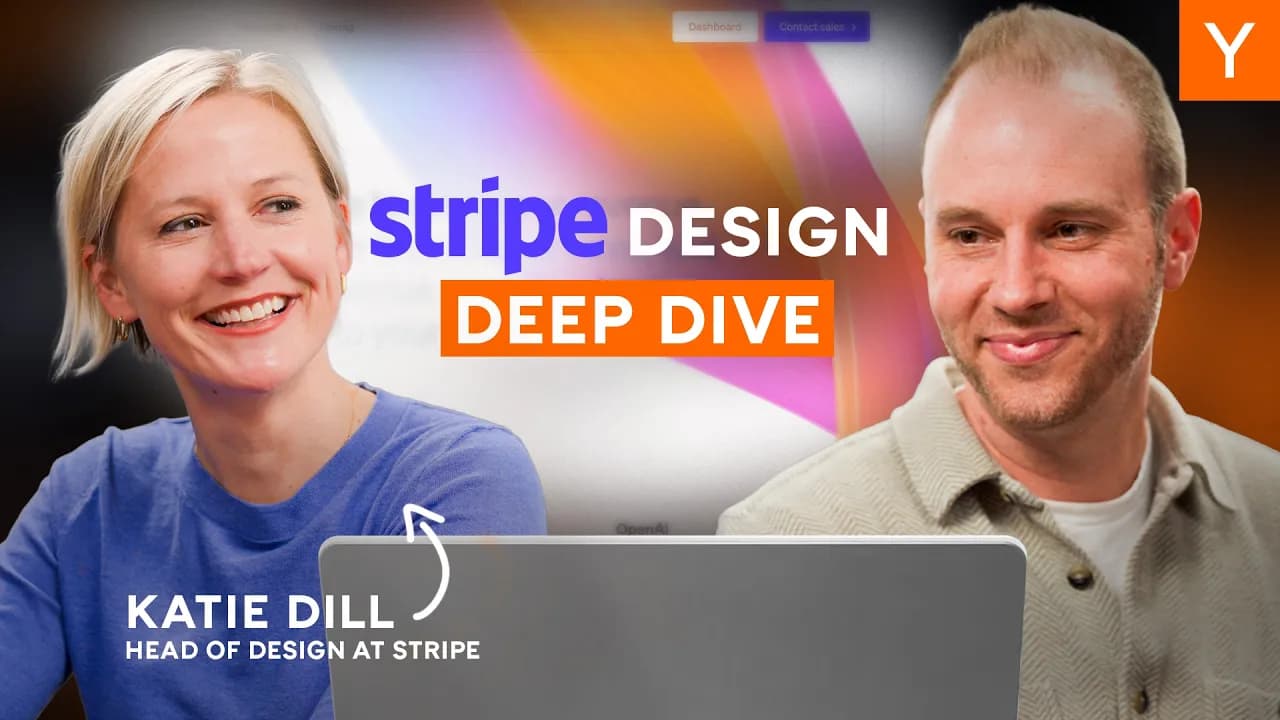
Raise the ceiling: how to scale intent, quality, and artistry with Al | Katie Dill (Stripe)
In a Nutshell
Katie Dill warns that AI's speed and accessibility risk creating generic "zombie" interfaces, mirroring the soulless post-war building boom. To avoid this, teams must maintain a clear point of view, encode quality standards into design systems, rigorously edit outputs for coherence and craft, and push AI toward genuine creativity rather than mere efficiency. The goal is deliberate, context-aware work that conveys care—producing interfaces with personality and distinction instead of polished mediocrity.
These notes were generated by AI and may contain inaccuracies.
Immediately after World War II, the United States experienced the largest construction boom in history. People returned from the war, new building techniques emerged, and buildings rose at a breakneck speed. The builders were inspired by the modernist style that prevailed in the 1920s, based on simple geometric shapes, clean unadorned surfaces, monochromatic color palettes, and the absence of any decorations.
The founders of the modernist movement had clear objectives and philosophical visions, such as the design principles behind Villa Savoy and the well-established principles of the Bauhaus school. However, after World War II, with the urgent desire to build and the emergence of new styles, the style was copied repeatedly without any intention. Thinking became more superficial, and only general models remained that did not suit the context at hand.
Banks that once suggested trust, reliability, and security gave way to generic designs. This reality has continued for decades, resulting in dead (zombie) buildings everywhere. Nothing distinguishes one from another. Nothing says "This is an intentional act" or "This design is fit for purpose." These buildings show no interest in the user, the surrounding environment, the context, or the brand.
We are surrounded by these buildings and are experiencing another construction boom right now—the artificial intelligence boom. Everyone can now build easily. Teams of three people can accomplish what previously required teams of 30 people.
There are echoes of the post-war boom that serve as warning signs. Large language models are adept at giving the most likely answer, meaning they tell you what was popular or what is popular now. They are less efficient at telling you what is authentic or unique to you, your brand, or your user context.
An example given is a Korean barbecue restaurant website that looks like software—very good but lacking personality and not taking into account the user's context or the nature of the use.
Artificial intelligence makes things look ready very quickly, often ahead of schedule. The speaker admits to often having a microwave burrito for lunch, taking a cold solid piece from the freezer, putting it on a plate in the microwave, and within 90 seconds going from hungry to having lunch. Despite serious flaws, the speed of execution is fascinating.
The same happens with AI: write a sentence, click a button, get an interface with nice corners and falling shadows that looks complete. But a polished appearance can be misleading. Does it really solve the problem? Does it add real distinction?
The work is so easy and quick that it seems consumable, and it is treated as such. Responsibility for decisions is sometimes ignored, and the long term is not really considered—such as who is going to maintain this anyway.
These three points can come together to form a world like a real place in Türkiye. If not careful, the result could be a construction boom similar to the post-war boom, with patterns inappropriate for the current context—essentially "zombie" user interfaces.
"Zombie" interfaces are monotonous, empty, or neglected. People spend half their lives awake looking at screens and want programs that make them feel like someone really cares about them. This means having a little bit of personality—something as simple as the Grok robot and the vitality and movement it brings.
Small details matter, like actually setting the date in the tab on the calendar. You might click on it all day, but it shows the developer cared about you. Understanding context, such as the associated agent's portfolio, anticipating problems an agent might encounter while buying online, and building in problem-solving tools demonstrates care for the user's context.
These examples show developers who care about their users and put that care into their work. It showcases the brand's personality and gives it a soul.
Artificial intelligence can be used to build products with care and soul. There are four recommendations:
If you don't have a point of view, artificial intelligence will provide one for you, and it is very likely to be generic and retrospective. You need to define your brand—what it means to you and what it means for your users. Who do you want to be to them and what do they care about? This forms the basis of your standards.
This is more important now because construction has become distributed and ownership is fragmented. Everyone contributes to products in more ways than in the past. It is very easy to delegate responsibility to artificial intelligence.
At Stripe, there is a strong emphasis on optimism, which is put into every detail—colors chosen, the way things are written, what is written about, and products offered to support entrepreneurs. These details are important to agree on because everyone contributes and a lot changes.
During a design critique session looking at an advertisement featuring the Stripe brand parallelogram with images of users, the team noted that while it looked good, some things were not accurate. A multi-functional partner looking to move quickly and launch something asked: "What is the quality standard for something produced by artificial intelligence?"
The response was that users don't care how it was made—what matters is whether it is good or not. This is the basis of standards. What matters in the end is the final result. Through that discussion, consensus was reached on what really matters, resulting in 17 points for improvement—slight adjustments like softer edges and slightly smaller bubbles.
The term "popping Pepsi" is now used as a verb meaning meticulous craftsmanship in the office. The goal is not perfection but going to a deeper level than the client can see. That meticulous craftsmanship will be clearly evident to them.
This vision drives standards and pushes work forward, especially when there are involved agents and so much happens daily. It is all about becoming very observant—paying attention to what users need and want, not just what they say. Notice what in the world around you points to as good, great, and ordinary. Pay close attention to these things in the products used, as well as in similar cases, to draw inspiration from art, science, and a broader vision.
Developing taste and understanding of the world around you and what is good and great can raise personal standards.
The world would be wonderful if everyone had a common understanding and could make the same decision, but humans will not be involved in all decisions in the future. Facades are being built without a designer in the room. AI agents detect and fix problems while people sleep. Generative user interfaces are built for users in real time.
This is why design systems are receiving renewed attention. Yesterday's system is different from today's system. Previously, everything didn't have to be written down because there was always a designer in the room to fill in the gaps. Now, distributed construction and automated building must be enabled, and decisions must be easier to define. The design objective is no longer the screen—it is the system itself.
Gutenberg invented the first printing press, but the lesser-known part of the story is the system he built around it. He did not stop at creating 26 lowercase letters and 26 uppercase letters. He created 290 unique letters, with different presentations, abbreviations, and links between letters. The reason was that when adjusting the text to be perfectly even, he wanted to make sure there were no strange white gaps that would spoil the beauty of the final product.
He made it expandable and specific enough that one could feel it had the quality of handcrafted work, even though it was machine-made. Previously, the old system expanded the scope of consistency. The new system needs to broaden the scope of intent.
At Stripe, work is being done to enable developers to move from just an idea to a finished product almost instantly. An MCP model was started that understood the design documentation, but results were not great—it was not accurate enough and did not achieve desired results. Three different people could enter the same command and get three different results.
Since then, a command-line interface (CLI) built on the design system has been created. It provides a framework that makes artificial intelligence much more obedient. Documentation is consumed at the right time and place to avoid contextual distractions. The big difference is that it is not limited to basic components and parts but includes complete templates and workflows. The system knows how the product is supposed to work and how its elements integrate together.
The system has become more rigid in its approach. Standards are incorporated into production methods, enabling a more consistent product. However, as Christopher Alexander said: "The system can meet all the rules and yet remain dead."
The filter has disappeared. Previously, the quality filter was integrated into every stage of product development, even before the project began. There were 20 ideas and resources could only be allocated to one. Then testing, examining, and refining would happen along the way, so products grew systematically.
Now 20 ideas can be built in one week. This is great in many ways, as theoretical meetings about virtual products can be moved beyond and something real can be interacted with. But the filtering that used to take place throughout the entire process now has to happen after the building, when saying "no" is much harder.
This is where the editor's role comes in—a role of paramount importance. Who performs this role in your organization? Who looks at the process from beginning to end and realizes whether a cohesive entity is truly being built? It's a new behavior.
The idea that "built" means "completed," and that "completed" means "good" must be gotten rid of. The most important thing for developing editing skills is to try it like the user does. Does it actually solve the problem? Does it really align with the way the user thinks about things? Is it actually cohesive?
Many things look good individually, but when put together in a user journey, they seem a bit disjointed. It's not simply a matter of saying yes or no, or whether this is good or should not be pursued. The question is whether the work is actually complete—how can it be pushed towards completion. Achievement should not be the enemy of quality.
Nabil Kureishi's article is insightful and talks about what makes art great. It is about unexpected details—those little surprises that make you say "Wow, I can't believe they thought of that." Then there is the deeper meaning that lies behind the surface, or the ongoing themes that connect the whole work into an integrated whole.
These are the things that artificial intelligence is not good at. Knowing the gaps in artificial intelligence helps deal with them better and fill those gaps. One of the things that bothers the most about the poor quality of artificial intelligence is the feeling that details don't matter—the cup is green, but it could have been blue.
The editor is responsible for every decision and in many ways is every pixel.
The team had the honor of designing this event. Stefan worked on a wonderful opening animation. Starting with a 3D model of the scene, it was fed into artificial intelligence to help with various animations. The first version was wonderful and fun to see its different little parts, and the way it moved was cute. But looking closely, pixel by pixel, there was something uncomfortable about it—it was not the way it should move, a bit choppy, and more of the scenery would be preferred.
It was done again and again, 56 times. After 56 attempts, something truly beautiful was arrived at—more realistic, with a little bit of life in it. These are subtle differences, but the interest can be felt.
If artificial intelligence hadn't been used, such a complex scene probably wouldn't have been built, or so many different viewpoints probably wouldn't have been tried. Although it wasn't finished the first time and required a lot of effort and scrutiny, artificial intelligence opened up a field of possibilities.
Artificial intelligence can help produce monotony, but it is also the greatest creative stimulus ever had. This is gaining even greater importance now because when everyone starts building something, standing out becomes harder and more important.
Today's interfaces—from chats and charts to command interfaces—are by no means the pinnacle of modern-day interactions. There is a lot that can and must be done to make things look generative, alive, responsive, and dynamic. Computers can literally be talked to, so ideas should be expanded upon. It is time to create new interfaces and new aesthetics. Best practices have not yet been written down—those using it now will do it, and the tools are available.
It is just like when multi-touch technology enabled entirely new interactions, or when the synthesizer enabled entirely new sounds. Artificial intelligence allows for all kinds of new creativity. People are outperforming the Stripe design team with more interesting data visualizations. Restaurant websites with distinctive character and personality are seen, and people are using artificial intelligence to draw and create art themselves.
At Stripe, artificial intelligence is primarily used to enhance the capabilities of the creative team. The latest cover for "Built to Grow" magazine was created by a human coloring artist who worked on amazing iterations. Artificial intelligence was used to further refine the details to ensure colors and lines were in exactly the right places. It was like taking sound human judgment and helping expand upon it to create something truly amazing.
To make artificial intelligence a stronger creative partner, improve input with more specificity regarding what's geared towards the brand and unique interests. Use specific prompts. Don't just say "Hi, I need a website for my Korean barbecue restaurant"—add what is believed in, the concept of quality, and what is cared about. Add source materials used to build standards. Help it think in different ways.
Test outputs rigorously. Don't give in to the temptation of the "burrito dilemma." Always push one step ahead. Use opposing agents to help critique and slightly modify the work, but always strive for the best.
These are just tactics. The most difficult aspect is the cultural one. It is easy to follow ready-made traditional patterns—it is safe and comfortable, but finding something unique that improves upon the status quo is far more impressive and much more difficult.
If leading a team, don't just tell them to use artificial intelligence—give them space to explore. Protect the stranger and the unfamiliar. Artificial intelligence reduces the cost of construction. Some of these savings should be spent on creating something truly special.
If artificial intelligence is only used to make the things already made faster, the most exciting part is definitely being missed. Artificial intelligence can help raise the bar for ambition, not just the minimum. The most important thing is to be extremely deliberate in the work—point of view, system, standard of quality, and ambition that will be brought to life using artificial intelligence.
In stark contrast to the post-war construction boom and modernist designs is Gothic architecture. In 1850, John Ruskin wrote extensively about quality and craftsmanship, highlighting Gothic architecture as a model of magnificence. He noticed that no two Gothic buildings were alike—not one column was alike to the other. Every detail was uniquely designed, showcasing the unique touch and mind of its maker. It looked like the product of genuine care.
This is what users want. They are not impressed if something is stirred using 3js and Blender in 30 minutes. They are impressed by solutions to their problems and by the clever touches in the details that show needs were anticipated and the brand has special character.
In this construction boom, there is the option of not creating the digital equivalent of zombie buildings. This can be made into a creative renaissance. More robust products that show the touch and care of their maker should be made.
Keep Lenny's Podcast in your library
Save the videos and channels worth coming back to, and find them again in one place.