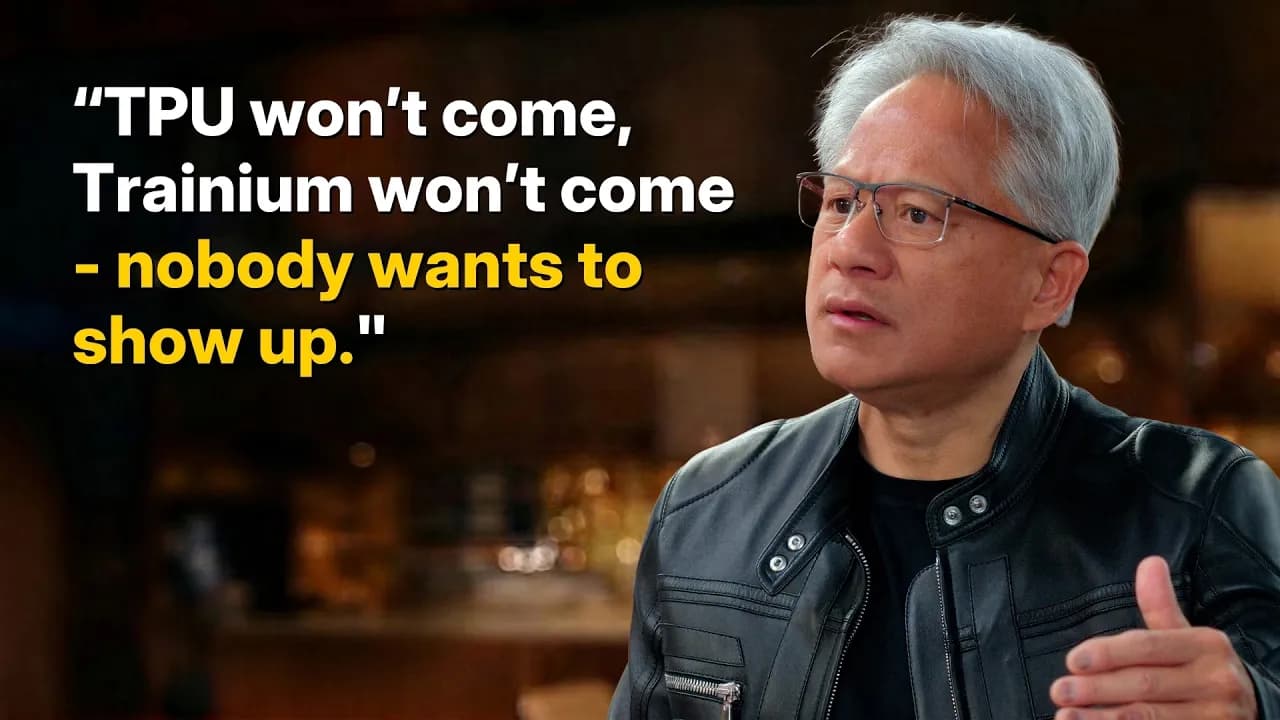
Redefining Chip Architecture with Arm CEO Rene Haas
In a Nutshell
Arm CEO Rene Haas argues that AI has made CPUs more essential than ever, as they handle the orchestration, arbitration, and movement of tokens that accelerators generate, and that AI tools are already slashing verification and validation time in chip design. ARM has evolved from pure IP licensing to selling physical chips, starting with Meta as its first customer, and is now building the supply-chain muscle to compete directly with TSMC and memory vendors. Robotics will be the next massive ARM-driven market, but the industry faces 3–5 years of constrained capacity, export controls, and local backlash that could slow data-center and fab buildouts.
These notes were generated by AI and may contain inaccuracies.
There's no computing problem that's ever been invented that doesn't utilize and can't utilize the microprocessor. It is the heart of everything. All roads lead through it, around it, past it. Something has to do the orchestration, arbitration, decision around where those tokens go. That's what CPUs do.
Chip design can take anywhere from 24 to 36 months depending on the complexity of the chip. The actual design is not the largest amount of time. The largest amount of time is in the verification, the validation, the debug. AI is really good at that. And if we were to shut it off, it's like being in the 1990s. You've got internet and you're now saying, you know, only internet between the hours of two and four. After that, go to the library that we have down the hall. It'd be anarchy. The genie's out of the bottle and there's no stopping that.
Rene Haas is the CEO of ARM and SoftBank Group International. The discussion covers ARM's position within the chip industry, the resurgence of interest in chip innovation, the challenges of the supply chain, the future of robotics, energy, his place in the SoftBank group, and how workloads are changing in the future for ARM.
ARM has two positions in the chip supply chain. The primary business is licensing IP. The CPU core that finds its way into smartphones, data centers, automobiles, and other applications. ARM's customers either build the chips themselves, like Samsung who has their own fab, or the vast majority of companies that take their chip designs and go to TSMC to get them taped out. Because ARM is so broad in terms of the markets served, ARM sees everything and has a very good sense of what's going on in automotive, data center, and smartphones.
ARM introduced their first product last March at Hot Chips, the ARM AGI CPU. Now ARM is in the supply chain themselves from the standpoint of having to figure out how to buy substrates, buy wafers, and buy memory.
The move from IP licensing to physical products was an evolution from the early days of supplying simply the IP components. A few years ago, product cycle times weren't slowing down while chip manufacturing times were extending. The ability to get solutions out faster was becoming more important. ARM moved from individual components into what they called compute subsystems, providing the blueprint for how to stitch everything together.
Demand for compute subsystems was insane. Initially, people thought customers wouldn't want these subsystems because that's what a chip designer does. However, it saved time to market and saved a whole lot in terms of cost and speed. The physical product was the next leap. There are certain sets of customers that license IP and have all the capability to build chips based on ARM. But there are a lot of companies who want to have product based on ARM. Not all of ARM's customers build products that serve those markets.
Meta was the first example. They wanted a general purpose agentic CPU. There wasn't anybody out who could give it to them. They came to ARM and said they should do this together, and that's how ARM got into physical products.
ARM was very careful about making sure the ecosystem was on board because CPU IP is only as good as the ecosystem. ARM talked to just about everybody who were customers about this direction. Surprisingly, there was a lot less push back than expected. The reason was that more software available in the wild, whether proprietary and/or open-source, benefits the broader ecosystem and the customers themselves. Nvidia, Amazon, Microsoft, and Google, all people who build ARM-based server chips, were all on board.
To deliver a physical product, ARM needs supply chain operations people. ARM needs to work with TSMC and Samsungs of the world, and with Samsungs, Microns, and SK Hynix to get memory allocation. On the engineering side, ARM needs back-end people, layout people, implementation people, bring up labs, and physical stuff. ARM didn't have a lot of physical stuff, which was kind of the beauty of the original business.
ARM had a 98.5% gross margin. There was no inventory, no RMA, no scrap. ARM had to add a lot of capabilities for physical products. ARM has a lot of people on the leadership team who've come from that world. ARM has execs from Broadcom, Qualcomm, and Nvidia. The leadership has done this before at other companies, so ARM has been able to build up that muscle pretty quickly.
Rene Haas is a huge believer in AI as a utility that's going to help productivity for every single industry. It is going to be the great leveler in terms of companies that can get started super quickly. Since being such a believer, ARM uses AI very heavily inside the company. On the non-engineering side, ARM uses it all over the place. On the engineering side, ARM has seen huge benefit. Verification, validation, debug, and documentation are where AI excels. ARM probably has 80 to 90% of engineers today inside ARM who use AI on a daily basis.
Certain things the tools are still not that mature at, one of them is really around RTL generation and then physical design and implementation in best of class. This is simply because the models are trained on what's available publicly and a lot of that information is quite proprietary. There's massive opportunity between the ecosystems and everyone in the industry to make that better.
ARM has been working with model makers around fine-tuning models to address the proprietary information gap. ARM probably has the richest IP portfolio both in terms of the IP and the documentation, the test benches, and how to build the IP. ARM has some built-in advantages based on the business model that will allow ARM to really take advantage of the tools as they get better.
In five plus years, it could be possible to go from idea to a GDS2 file for certain designs. This takes the whole design piece out of the way relative to verification. For more straightforward designs, this is quite possible. If you go into the tool and say design something that's 10% faster than Ver Rubin, 20% cheaper, and 30% more efficient on this model, you're not going to be able to press a button and have it happen right away. But in 5 to 10 years, the industry will see some amazing differences relative to how chips are designed.
What's going to matter is understanding the supply chain impacts and how all of that gets built and put into ultimate end products. This is going to become a much more important muscle. There are a lot of really great young companies today doing AI chips, well-known companies getting tons of funding, innovative designs, selling into an industry where the capital requirements are just massive and the relationships with memory vendors is incredibly critical. Companies are going to have to be much more access to a 3 nanometer line, a 16 line, advanced packaging line, all of it.
This constrained environment will last for 3 to 5 years at least. As long as the transformer is the unit of energy relative to how AI training and AI inference are generated, by design, it is very compute intensive and very memory intensive. This will drive a lot of demand on having supply chain acumen.
Two years ago, packaging and packaging related items were the bottleneck. Now people talk about memory as limiting certain systems being built at sufficient scale. Building out data centers is going to be a bottleneck. Not a lot of data center projects today are ahead of schedule and needing less labor than they thought. When you layer on top of that a lot of buzz from different parts of the United States relative to slowing down data center development or putting restrictions around it, infrastructure buildout could be a headwind.
Setting aside valuation bubbles, the bubble in terms of over supply to demand is not even close. The demand is insatiable just given the way these models work. Infrastructure buildout, access to wafers, access to memory, all of that's combining.
Strategic partnerships incredibly early, whether with people inside the supply chain, people in private equity, or the banks themselves. It's a different game now. Semis are back because there's a wave of semiconductor startups. Investment in the industry is happening, but access to capital is going to be the gate for how they get through that. Getting much more creative in terms of how they work with the ecosystem is going to be super key.
At SoftBank, they look at companies they can bring into the portfolio that they can help, that they can provide a combination of either the backstop and/or if you think about SoftBank, they just announced SoftBank Neo, which is their intent to become a neo cloud. In that world, they could become a home for young companies who have chip technology that in other worlds they'd have to go up and figure out how to get a design win at Microsoft or Google. SoftBank can provide a lot of interesting avenues for that.
SoftBank Group is headed in Japan by Masa and has a lot of different operating companies underneath them. One of the largest ones is SoftBank KK which is essentially SoftBank mobile. Inside the US, there's a lot of investment activity going on with SoftBank Group International. There's SoftBank Vision Fund, but increasingly a lot of the strategies that we're trying to do around SoftBank is helping the strategies that Masa talked about publicly at his shareholder meeting in Japan which is around robotics, open AI, infrastructure, and ARM.
Rene Haas is leading the direction of Ampere and Graphcore and another company called Stack AV that's doing things around autonomous. But a better way to think about it is that Rene is kind of in the room on a lot of discussions that Masa is having and helping him sort of formulate that strategy and more importantly help execute it.
Being part of the SoftBank group gives ARM a huge bird's eye view relative to where the broader industry is going, whether it's around infrastructure, capital, or energy. It could provide a home for ARM products, which doesn't need to be the home, but it certainly can be a home. When looking at the verticals that SoftBank's involved with, robotics, energy, data center infrastructure, and then the products that ARM has, the only one announced so far is the ARM AGI CPU, you can start to connect the dots and say there could be some very interesting opportunities that could be an opportunity for ARM.
Whether it's humanoids or dedicated machines to do certain level of tasks that can be retrained, the robotics market is going to be enormous. Robotics 1.0 was a purpose-built industry. You had piece of mechanics designed to do a certain task and the software that was optimized for that task. If you had a brand new automobile line come up or some different piece of equipment, if the robots weren't well suited for that, rip up the line. The barrier was pretty high. Getting to a world where the robots can learn just based upon either being trained or what they see, and then when you combine that with designing something mechanically general purpose enough that can take advantage of being reprogrammed, and then when you layer on top of that the cost coming down, you look at and say what will it not be able to do. It's almost like something out of the Jetsons where a lot of things will ultimately be done by robots: construction, infrastructure, service, security.
There are a lot of jobs and work tasks that are optimized around a person being six feet tall and having arms of a certain length. But it will be both humanoid and specialized task specific form factors. ARM is going to be everywhere in robotics. ARM has a tremendous amount of technology from a real-time sensing standpoint around microprocessors that will be out at the fingers. They can do perception and sensing. That's all going to be ARM based. Today, whether it's Nvidia or some of the work that Qualcomm does, most of the brains that you see in the humanoids are all running on ARM today.
Rene Haas states that going forward, the robotic industry will be powered by ARM. When asked about early adoption signals given ARM's ubiquity across devices, Haas notes it remains early because business models have not been figured out. The cost of robots is so high that people buying the robots themselves creates a tough model to get people's heads around. Costs need to come down and business models need to be vetted.
Current robotic footprints tend to be things like automotive, certain surgical robots, and distribution centers. These are mostly bespoke applications driving robotic sales today.
Haas identifies factory automation, delivery, and distribution as the first areas to be automated. He describes an autonomous truck as a robot of sorts, noting that around factory automation and delivery and distribution will be among the very first to be automated.
The discussion turns to increasing debate and policy around supply chain controls, usage controls around robotics, chips, and data centers, including export controls. These four types of controls are all relevant for ARM from either an end customer perspective or as a relatively new entrant owning the end product with their own supply chain organization.
Haas puts on his American citizen hat, noting ARM is not an American company with headquarters in the UK, but has significant US footprint with approximately 30% of employees in the US, 40% in the UK, and 30% in Asia.
Haas recalls the 1980s when the US was the leader in semiconductors and Japan started getting very aggressive in memory pricing and taking market share. The US started Semitech back in the day to refortify the American semiconductor industry, which he thought at the time was the right move.
Internet hit and SAS companies were all the rage, and people kind of forgot about semis being a strategically important asset. Haas believes it is critically important for the United States to have as much of that technology inside on US soil.
Haas is a big believer that the US needs more US fabs because it's critical for national security and critical for diversification of supply chain. He notes the same applies to the UK, but to a lesser extent because of the scale of the UK market.
Regarding export controls to limit chips because we don't want China to win the race, Haas's personal view is that it's an infinite game. He believes first that there's not going to be a winner, the race is going to be over. But you could get to a situation where a lot of the critical technologies are not US-based, which is not going to be a good thing.
Haas believes that for both national security reasons and economic reasons, you want to be at the forefront of technology because it drives innovation and drives ecosystems. He uses the example of the US auto industry in the 1950s post World War II where Detroit was the center of the universe, with companies across Wisconsin, Ohio, Illinois feeding into that ecosystem.
Data centers are the same way. People look at data centers and say it's a big Costco box with two cars in the parking lot being driven automatically, so there's no jobs. Haas calls BS on that because whether it's around energy, liquid cooling, all of the things that make the data center better, those are all jobs that can be created and done here.
Haas notes that actions being taken to try and prevent future data centers feel more coordinated than not, with phrases like grassroots efforts but appearing to have some coordinated function. His hypothesis is there's a fear that AI means job loss, and job loss means implications for all these things.
When asked if that fear is well grounded, Haas states he doesn't think it's well grounded at all. The electricians labor union specifically said please don't ban the data centers, we need these jobs very recently.
Haas points out that electrician is a highly skilled job that requires a lot of training and certification, and you need tons of them to do this kind of work. He notes there may have been a stigma to being an electrician, viewed as not maybe a highly educated job or not needing a PhD.
The backlash is just from fear that jobs are going to go away. The AI boom has benefited a lot of people, but there's a lot of people who have no benefit from it. There's a lot of America where it's tough to make the mortgage, their paychecks haven't gone up, and now they've got this AI thing that just looks going to be even harder.
Data centers become a bullseye for all the things that could be bad about AI, with people holding up fake tainted water and claiming that it's ruining the water supply. There are other things being made up about data centers as a way to try and create fear.
The discussion acknowledges organized media influence around these issues. However, there are benefits from the construction of a rapidly growing new industry that can create new technology, new jobs, and external wealth for communities around them. It's on the industry to go communicate that.
Haas states that on first principles, whether it was smartphones, the internet, personal computers, fill in your favorite technology, there is no downside from being the leader. There are second and third order effects that you may not like, but to be the laggard, you are having the entire script dictated to you and everything that kind of comes with it.
Look at other parts of the world that are just not the leaders in this space economically and socially, they're left behind and governments carry the large tax burden of it. If you're on the wave of some technology innovation, and AI is a little bit of the final frontier of what can be done with essentially intelligence, of course you want to be in the lead, of course you want to be driving that because the benefits for society are going to be enormous.
Haas is most excited about being in the center of all that. He feels fortunate every day that ARM is in the heart of all of this and can be a participant in that ecosystem. ARM can help drive the innovation and be involved with leadership companies developing leadership products.
ARM is right in the middle of it all because all the AI needs some level of compute, and that compute needs to be power efficient, which is what ARM does really well. Those roads all lead through ARM.
Haas notes he's been in this industry his entire career and had a lot of times thinking about what's the next product we're going to need, do people really need another tablet and does it need to be 8.9 inch or 9.2 inch. Now there's no question the abundance of opportunity innovation is so great with AI, and he's super excited and feels blessed to be leading a company that's in the center of it all.
The need for chips is driven by massive change in workload, and there is continual massive change in workload. From the CPU standpoint, when ChatGPT had the explosion and everything was all about the accelerators, there was so much focus that no matter what the question is, the answer is the accelerator.
There's no computing problem that's ever been invented that doesn't utilize and can't utilize the microprocessor. It is the heart of everything. All roads lead through it, around it, past it. You look at fundamental system design and you have to have CPUs. They just don't kind of go away.
CPUs were a little bit forgotten as this accelerator thing kind of took off. But what then became very obvious was as more and more of the data was moving away from training, training is obviously very important to recursive learning, reinforcement learning, to inference, the use of the tokens, the use of the information.
In a system problem, something has to do the orchestration, arbitration, decision around where those tokens go. The token factory just generates all these tokens. It's like literally where are the trucks that are going to take the tokens away and give them to the users. That's what CPUs do.
Until something's invented that says the CPU has gone away and we're now doing it through some other mechanism which has yet been defined or invented, the CPU is going to be doing just fine. There's going to be a lot of demand for it, a ton of demand in addition to the accelerators that generate the tokens.
The way to think about it is it's a system which applies whether talking about a data center, an automobile, a robot, a phone, wearables. As you get to the smaller footprints where more and more AI is going to take place, that's going to be a sweet spot for ARM because the CPU is table stakes anyway. You have to have it to do all the things that are required in the edge device.
ARM has an opportunity with their instruction set architecture to do a lot of things where you just can't put a 50 watt GPU on your head. You're going to have to do that AI processing somewhere locally.
Keep No Priors: AI, Machine Learning, Tech, & Startups in your library
Save the videos and channels worth coming back to, and find them again in one place.