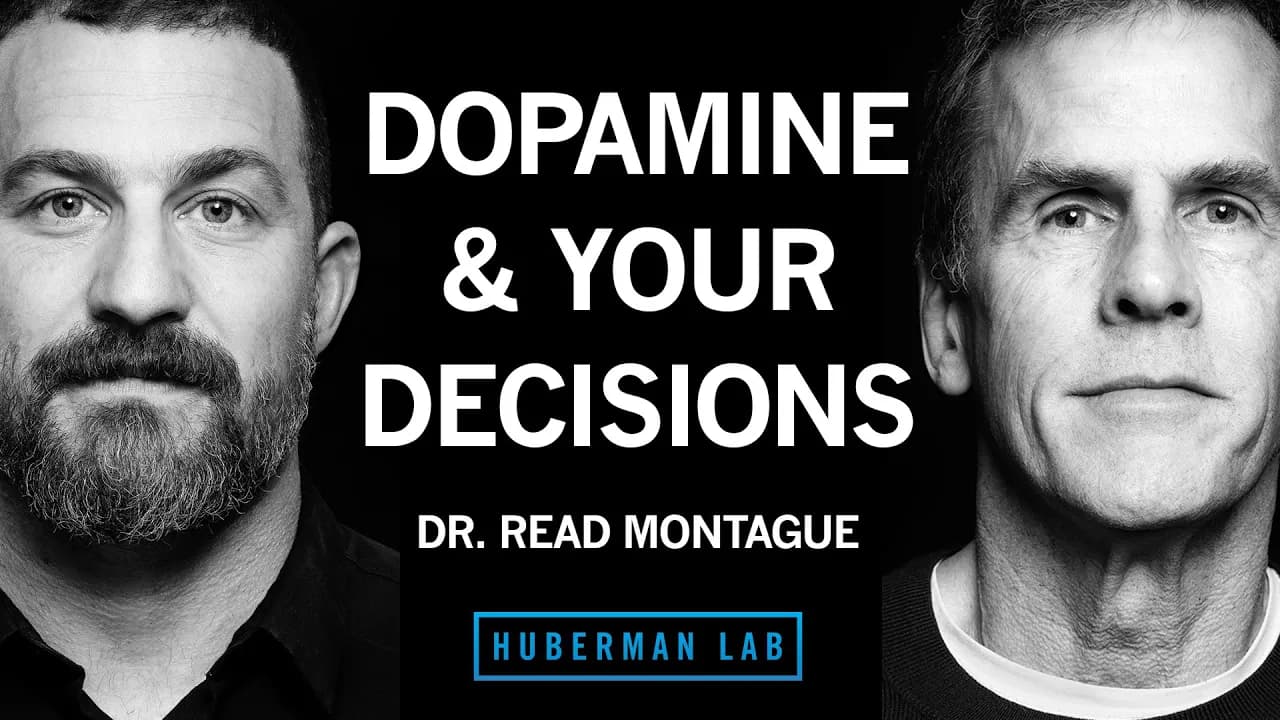
Science & Tools of Learning & Memory | Dr. David Eagleman
These notes were generated by AI and may contain inaccuracies.
Oftentimes older people ask if doing crossword puzzles is good. It is good until you get good at it, then stop and do something you're not good at—constantly find the next real challenge. That's the key to plasticity. The brain is locked in silence and darkness, trying to make a model of the outside world. Constantly pushing and challenging it with things it doesn't understand keeps it changing.
Welcome to the Huberman Lab podcast discussing science and science-based tools for everyday life. Andrew Huberman is a professor of neurobiology and ophthalmology at Stanford School of Medicine. Guest is Dr. David Eagleman, neuroscientist, best-selling author, and science public educator.
Discussion covers brain science features impacting everyday life, enabling better decisions and rewiring for effective learning. Start with neuroplasticity—brain's ability to change in response to experience or deliberate learning. Mechanisms for getting better at learning and unlearning skills/information. Memory formation, relationship between stress and time perception (traumatic events feel slow motion), usefulness for undoing traumatic memories. Neuroscience of cultural/political polarization, false memories, déjà vu, dreams and dream meaning.
David is an absolutely legendary science communicator... able to embed factual information about the brain into real life stories... true virtuoso of neuroscience and science education... will change the way you think about thinking and your own mind and... the way that you view the world.
Podcast separate from Huberman's Stanford teaching/research; brings zero-cost science info/tools to public. Episode includes sponsors.
Dr. David Eagleman welcomed. Huberman notes Eagleman's early public science education and lab career.
Most fascinating aspect of human brain: its ability to change itself—plasticity.
Human Brain as Half-Baked at Birth
Mother nature's trick: drop humans into world with half-baked brain, let world wire the rest. In 1953, Crick and Watson (Eagleman worked with Crick at Salk Institute) discovered DNA structure at Eagle and Child pub—"secret to life." But other half is experience: culture, language, neighborhood wiring the brain.
If born 30,000 years ago with same DNA: wouldn't be "you"—different culture/language/stories.
Brain Plasticity Mechanics
Brain plasticity: constantly reconfiguring every second. 86 billion neurons, each contacting ~10,000 neighbors—plugging/unplugging, changing connection strength. Like little creatures slithering around, absorbing world. Humans have more than other creatures—taken over earth, left planet, build skyscrapers/composes symphonies. Each generation absorbs prior discoveries, springboards to new.
Alligator born 30,000 years ago: same. Humans dominant due to flexibility.
Human Cortex Expansion
Human brain like macaque monkey brain with added supercomputer (prefrontal cortex, actually more cortex generally). Humans have four times as much cortex as nearest animal neighbors. Cortex: outer 3 millimeters, wrinkly—magic stuff.
Cortex as One-Trick Pony
Cortex same everywhere: same circuitry, six layers, same algorithms—defined by inputs. Visual inputs → visual cortex (line orientation, motion). Auditory → auditory cortex.
Textbooks oversimplify; highly flexible. 2000 study by Mriganka Sur at MIT: in ferrets, rerouted optic nerve to auditory cortex → became visually responsive.
More cortex: (1) Computational real estate between input/output (e.g., monkey eats food immediately; humans can diet/plan). (2) Prefrontal cortex: simulate what-ifs, possible futures without risk.
Cross-Modal Plasticity in Sensory Loss
Blind from birth: "visual cortex" (back of head) taken over by hearing/touch/memory—better at discriminating sounds/touch (e.g., Braille). Deaf: auditory cortex → lip reading (detect accent/origin).
No unused real estate. More real estate to one task → extraordinary ability (hypothesis for savantism in autism: devote real estate to Rubik's cube/piano/visual scenes → superhuman, at cost of social skills).
Matina Yerba Mate (Huberman helped create): smooth caffeine, regulates blood sugar, improves digestion, mild appetite suppression. Huberman drinks 3 cans/day. Available at Sprouts Market nationwide. Free can with receipt photo: drinkmatina.com/offer.
Tap water contaminants: 2020 Environmental Working Group study—200 million Americans exposed to PFAS (forever chemicals) linked to hormone/gut/fertility issues; 122 million with cancer-causing chemicals.
Rora countertop filter: removes endocrine disruptors/dis-infection byproducts, preserves magnesium/calcium. No install, medical-grade stainless steel. roora.com/huberman for discount.
Recent Science study: early sport/creative specialization vs. diversification—early specialization worse for peak success (exceptions like Tiger Woods, Williams sisters). Diversification better into early teens+.
US notion: early specialization key to excellence. For everyday person (Eagleman has kids): genetic leanings? Early experience sets funnel width for later opportunities.
Practice for Mastery
Williams sisters, chess/golf champions (Polgár sisters—best female chess players, father taught from day one): drilled from start → champions.
Cognition understands forehand/backhand; mastery burns to circuitry (software to hardware). Eagleman vs. Serena Williams: she burns less brain calories (efficient hardware); he simulates.
Plasticity for efficiency—brain saves energy (mobile battery-run creatures).
Diversification Tradeoffs
Diversification useful (e.g., snowboarding/skiing mutually improve). But trilingual/bilingual kids: lower vocabulary per language vs. monolingual (practice amount).
Learn musical instrument/second language: enriching/useful (e.g., California: English/Spanish). Kids resist (Google Translate/Meta glasses), but not same as relating.
Face-to-face struggle enriches—forces brain work. Eagleman's father: 8 languages fluently (medical school Europe, clinical rotations, girlfriends as incentive).
Reward systems key for plasticity change.
Internet's Positive Impact on Learning
Internet terrific for kids: learn when curious (bicycle tire/space physics). Plasticity needs curiosity/engagement neurotransmitter cocktail.
Pre-internet: teacher dumps info (e.g., Battle of Hastings 1066)—may not stick. Now: context of curiosity → sticks. Impressed by young people's knowledge (TED, Alexa, ChatGPT).
Huberman: pre-internet effort (bike to library) vs. instant access → more implementation time.
Dinner arguments resolved instantly via phones—dissolves social dominance (e.g., father's word final).
Building a Healthy Nervous System
Control over inputs (adolescents/teens/20s/adults, though harder). Core elements for well-rounded nervous system? Howler monkey learns monkey needs; humans leverage prior plasticity.
Essentials: communicate, move. Check core 10 boxes of neuroplasticity?
I mean, I would say two things. One is
Maximize along every axis: be an athlete, scholar, good at social life with many friends. Avoid wasting time, e.g., playing Candy Crush on airplanes; instead read books, listen to podcasts.
For children in schools, focus on critical thinking and creativity since future careers are unpredictable in 20-30 years.
Ways to Cultivate Critical Thinking and Creativity
- AI Debate: Debate hot-button issues like abortion or gun control with AI; graded on argument quality, then switch sides. Provides 360-degree view, avoids ideological capture. Scalable beyond teachers' capacity.
- Creativity: Compress foundational learning, add one extra week per semester for remixing: bend, break, blend elements into new versions. Creativity is remixing storehouse of knowledge.
We should be teaching that.
German philosopher Goethe: two bequests to a child are roots (critical thinking) and wings (creativity).
Managing Social Media
- Use separate old phone for X and Instagram; transfer texts manually. Increases productivity, happiness, attention; treats social media as purposeful activity like watching a show.
- Supermax prison lockbox: Locks phone with timer (e.g., 4-9 hours), 15-second countdown. Enjoyment in adding time, feeling freedom as a gift to self. Careful of dopamine pull when resuming.
Seek novelty: Continually challenge brain with new things between frustrating but achievable. Examples: new instrument, language, technology/software.
Religious Orders Study (Chicago)
- Decades-long study of nuns/priests donating brains post-mortem.
- Some had Alzheimer's pathology but no cognitive deficits while alive (died in 90s).
- Reason: convent life with social responsibilities, chores, conflicts, games, singing kept brains active, building new neural roadways/bridges around degeneration.
- Contrast: retirees at 65 sitting on couch watching TV have worse outcomes due to lack of challenge.
Nothing as hard that the brain does than other people.
- Crossword puzzles good until mastered; then switch to new challenges.
Brain's Goal: Predictive Modeling
- Brain locked in silence/darkness, builds model of world; stops changing when predictions succeed.
- Push with novel, unpredictable input to maintain plasticity.
- Agitation/frustration from catecholamines (adrenaline, norepinephrine) signals novelty, triggers plasticity.
Boosting dopamine, acetylcholine, norepinephrine, epinephrine, serotonin enables adult brain plasticity.
- Psychedelics (serotonergic, e.g., psilocybin) and SSRIs both tools for plasticity via serotonin.
- Acetylcholine key: floods during prediction mismatch (youth); local dabs in adulthood for targeted changes.
Risks of Tweaking
- Parkinson's meds crank dopamine → hypercompulsive gambling (risk aversion changes; now contraindication).
- Neuromodulators interact as combination locks, not isolated.
Brain Areas Differ in Plasticity
- Primary visual cortex locks down early (e.g., Logothetis lab: adult monkey retinal changes, no V1 plasticity).
- Downstream areas (face recognition, new brands) remain plastic lifelong due to new data.
Software Analogy
- Primary sensory cortices = software kernel (untouched basics like adding numbers).
- Higher layers = applications (continually updated).
Plasticity not goal; directed plasticity. Total plasticity (infant-like) undesirable—erases identity (memories, skills).
Caution on psychedelics/Ayahuasca: some "one-shotted" negatively, forever altered unhelpfully.
Humans unique in future simulation via expanded prefrontal cortex (unhooks from now, unlike animal cousins).
- Mind as movie theater: reminisce past, simulate futures.
- Internal rivalry: short-term drives (eat cupcake) vs. long-term (stay fit, promises).
Ulysses Contract
- Pre-commit to bind future self from bad behavior.
- Origin: Odysseus (Ulysses) lashed to ship's mast, crew wax ears to pass Sirens safely—he hears song but can't crash.
- Present sound-mind self contracts for tempted future self.
Examples
- Phone lockbox prevents reflexive checking.
- Freeze cash in ice to delay spending.
- Pleasure in total control over temptations trying to control you.
- Social pressure: gym buddy; boot camp where no-shows get group jumping jacks/screaming on lawn.
- Money on line: Woman quitting smoking wrote $10,000 check to friend—donate to KKK if caught smoking (most aversive outcome).
There are a million ways to do these Ulysses contracts... how do you lash yourself to the mast so you'll keep the good behavior you want?
The example of the woman writing a check to the KKK illustrates the Ulysses contract. She strongly opposes the KKK and would never support them, yet needed potential punishment to enforce her stance. Even when knowing and feeling something strongly in the present, accessing best choices is hard. We fear our future self more than present discomfort, so we use Ulysses contracts as wisdom to predict behavior outside sober, rational moments.
Temptation Removal for Addictions
- Alcoholics Anonymous advises clearing all alcohol from the house, as future self might succumb on festive or lonely nights.
- For drug addictions, never carry more than $20 cash to avoid buying drugs when tempted.
- Cannot trust future self; set up walls during reflection to become who we want to be.
Ulysses contracts apply to both avoiding bad behaviors and building toward a better future self through dos and don'ts. People are terrible at both. New Year's resolutions rarely last a week or two due to busyness or fatigue.
Strategies for Positive Goals
- Use websites to put money on the line, e.g., $50 bet to bench 250 lbs by a date; money returned only if achieved.
- Hook positives to routines; reference James Clear's ideas like placing running shoes near the door to reduce friction.
- Prepare for future lazy/tired self, e.g., put shoes by door before sleep.
Some friends are neurotic: if running at 8 a.m. but it's 8:02, they delay to 9:00, needing to start on the hour. Others just do things, suppressing the inner chatter voice. Everyone has the neurosis but some ignore it better. Never trained as kids on when to deliberate vs just do it. People fall into camps: some need to think/analyze less and do more; others reflect more. Ability to suppress inner voices or versions of self varies.
Neuroscience shows spectrums along any measure. Inner voice: some always hear it (like host's wife, an inner radio); Eagleman has none.
Aphantasia to Hyperphantasia
- Aphantasia: no mental images; hyperphantasia: vivid movie-like visuals.
- Everyone on spectrum.
- Visualize: ant crawling on tablecloth toward jar of purple jelly.
- Experiment: picture sun over mountain, rays poking through clouds, then rain. Scale 1-5: 5=movie-like, 1=no image, 3=in between.
- Host: sees silhouette, pale yellow rays, opaque (like phone screen for hyperphantasics).
- Eagleman: aphantasic; studied it for years, interviewed hundreds.
Ed Catmull (Pixar founder, ray tracing patents) discovered he's aphantasic; surveyed Pixar staff—best directors/animators are aphantasic. Hypothesis: aphantasic kids, asked to draw a horse, study it closely (unlike hyperphantasics who recall image), gaining drawing practice and skill.
Bowfinger Reference and Creative Process
- Movie Bowfinger (Steve Martin, Eddie Murphy, Heather Graham): hilarious Hollywood satire; Bowfinger envisions shots everywhere.
- Movie makers may not visualize fully; dialogue with page/script leads to more practice materializing ideas.
Everyone has unique hardware/software with commonalities. Evolution and tech progress reflect siloing into tracks (hunters, builders, AI experts), advancing species. Detrimental if all got core neuroplasticity training to do everything? Specialization, plus prefrontal cortex/extended plasticity window, makes humans earth's curators.
Genetic Predispositions and Trajectories
- Cannot be Michael Phelps-level swimmer without his 7-foot wingspan.
- Space-time cone analogy: start at cone base, trajectories within cone limits defined by genetics, unchosen childhood/culture/language/era.
- Specialization healthy (lumberjacks, lawyers, accountants).
- Modern era: broad kid educations (karate, soccer, piano) wonderful; parents open doors, child chooses path.
Kierkegaard: "Every man starts as a thousand men and dies as one." Potential narrows; choosing doors closes others.
Nervous system starts hyperwired; learning prunes connections, strengthens others. Brain: fixed neurons (debate on few new ones); hyperconnects by age 2, then prunes overgrown garden based on world experiences.
Practice: shift awareness—interosception (skin, breathing), present meditation; focus distant object; imagine pale blue dot. Each spatial realm alters time association. Spend 2-5 minutes in each for perspective: exit moment's time domain, realize events won't last forever. Perceptual exercise for stimulus-response gap (Victor Frankl), stress flexibility.
Attention, Time Perception, and Horizons
- Relationship: where attention placed affects time perception.
- Evolve exercise for space-time representations (get outside/within self).
- Horizons vs close walls alter time (claustrophobia confounds; VR could test).
Eagleman: brilliant practice. Time perception: no single brain area; different mechanisms for long eras, seconds, subseconds. Studied since grad school; papers in Science, Nature.
Development of Long-Scale Time
- Cognitive: children poor (e.g., 7th grader can't grasp Roman Empire 2200 years ago); improves with age/experience (historians feel centuries).
- Infants: space/time is crib; expands to highways.
- No data on switching scales, but like literature zooming in/out (taught in Stanford's Brain and Literature class).
Always late? Ulysses contract: commit to 5 minutes early, wait in car.
People terrible at perceiving time; illusory. Some better than others.
Childhood: fell off roof, push-up landing, busted nose (cribriform plate, poor smell); fall felt long, calm, thought of Alice in Wonderland rabbit hole. Typical in life-threats: calm, bizarre thoughts, slow time (car accidents: watch hood crumple, mirror fall; gunfights).
Tower Drop Experiment
- Tested: time slow-motion during fear, or memory trick?
- 23 volunteers dropped backward 150ft from tower (70 mph into net); Eagleman did 3x.
- Wrist device flashes info to measure information intake speed. Essentially, we're taking
Essentially, taking advantage of flicker fusion frequency by flashing lights quickly: at a certain rate, you see what's going on; faster, you can't. Drew people to read numbers on a wristband during freefall to test if people see in slow motion during life-threatening situations. Tested on 23 people; results very clear: people do not see any faster.
However, retrospectively with a stopwatch, their own fall felt much longer than watching someone else fall. This is a trick of memory: in life-threatening situations, recruit not just hippocampus for memory but a secondary memory track mediated by the amygdala (emergency control center), writing down memories in high density. Reading it back feels longer because all we're conscious of is memory of the event.
Memory Density Explains Time Perception
- Childhood summers feel endless due to novel experiences (first waterfall, hiking), writing lots of new memories.
- As adults, patterns are familiar, less new footage; time flies (e.g., winter to fall feels quick).
Time speeds up as we grow older because of less novel memory formation.
Glucose is major fuel for cells, especially brain; impacts brain function, mood, energy, tenacity, willpower. Use Lingo continuous glucose monitor to track real-time glucose response to foods/actions. Spikes/crashes cause brain fog, fatigue, irritability, hunger. Individual responses vary; helps build habits for metabolic health, mental clarity, sustained energy (e.g., walk after meal stabilizes glucose). Huberman podcast listeners in US get 10% off 4-week plan at hellingo.com/huberman (18+, not on insulin, not for diagnosis).
Perceptual frame rate not different in stress (not higher frame rate movie like slow motion via strobe). Amygdala tracks more information unconsciously, leading to higher-density memory, but real-time experience unchanged.
Under normal circumstances, write down almost nothing; in emergency, amygdala commands attention to every detail. Brain uses Bayesian logic: more memory detail = more time elapsed.
Collected hundreds of subjective reports from accidents. Example: motorcycle accident victim rolling over, composing a ditty/song to helmet hitting road; felt like 6 seconds, but footage showed 1-2 seconds.
Counterargument: people claim "I know it's not true from my car accident—it took long." Response: passenger screaming "no"—did it sound stretched out? No sound distortion confirms no slow motion; it's higher memory density.
Novelty in Happy Events and Time Perception
In purely happy novel events (terrific wedding, great party, blissful vacation), clock more experiences/memories via novelty.
- Parasailing over sharks: weekend feels eternal.
- Routine weekend (Instagram): feels like no time passed.
- Marijuana: hard to anchor timeline, feels like "forever" in kitchen.
Rejects proportional life-fraction theory (summer bigger for child); it's memory footage from novelty/attention.
Advice for Longer-Perceived Life
- Seek novelty to write more memories (controls perceived longevity).
- Brush teeth with other hand.
- Take different route home from Stanford (see new neighborhood details).
- Rearrange office (swap desk/paintings).
Enhances brain plasticity: challenges internal world model, notices new things.
Huberman: Addiction = progressive narrowing of pleasure sources + continued use despite negatives. Enlightenment = progressive expansion of pleasure sources (e.g., monks present via meditation; get pleasure from sip of water when thirsty).
Paying attention = being present. But all-present eliminates Ulysses contracts (precommitments for future self, e.g., no cookies at home, gym buddy). Balance: contracts free present moments.
Examine extremes (freefall) for insights. Beauty/tragedy at every spatial/temporal scale (fractals). Homeless/mental illness: hyperfocus on trivial (sidewalk dirt)—tragic misallocation.
Anecdote: Las Vegas CES, homeless woman rubbing Chinese lion statue for luck (false brain association).
Mental health = ability to switch time/spatial domains (avoid tunnel vision or head-in-clouds). Example: Shane MacGowan (Pogues singer, severe alcohol issues); shuffled into traffic (handlers intervened), yet gave legendary show.
Ultra-creatives drift spatially/temporally but harness moments. Albert Einstein enjoyed fixing doorknobs (crossing scales).
Addiction: brain upregulates receptors for drug (expects more in world); withdrawal when stopped. Analogy: heartbreak = brain readjusts to world without loved one/pet (physiological pain).
Social media (TikTok): upregulates expectation circuits? Like past TV fears ("boob tube" rots brain; moms locked kids out till dark). Now, well-produced/matched content; addictive but draining, diminishing highs.
Positive: YouTube/social for learning (architecture history during workout; rabbit holes of new topics). Kids smarter via access + AI (debate, explain flying buttress). Neosensory (sold 6 months ago): combined senses.
Neosensory: Novel Sensory Channels
Bracelets turn sound into skin vibrations (deaf learn to "hear" via skin). Pushing info via unusual channels.
Anyone can use (not just deficient). Interested in non-traditional sensory inputs. Example: wristband captures sound, patterns of vibration on skin; deaf learn to hear that way.
Why? Because this is the same thing that your inner ear, your cochlea
This is the same thing that your inner ear, your cochlea, does. It's just capturing vibrations on the eardrum and translating that into different frequencies, shipping that off to the brain in terms of spikes, voltage spikes along nerves. We're doing the same thing except we're pushing it in through the skin. It goes up the spinal cord to a different part of the brain. But the brain can figure that out. How? Because it's doing correlations. It sees somebody's mouth move. It's feeling the sound and it figures out how to hear that way.
History of Sensory Substitution
Sensory substitution has a long history going back to the 1800s, when people first started asking if you can push information into the brain in a weird way. The very first one was in the 1880s: a little camera lens that detected light and dark, translated into buzzing on your forehead. For blind people, they could tell there's a wall over here and an opening over here.
The first major paper was in 1969 in Nature by Paul Bach-y-Rita. He took blind people, put them in a dental chair with a grid of 40x40 solenoids poking them in the back. A video camera fed whatever it saw to the back: triangle felt as triangle poked, face felt as face. Blind people got pretty good, especially once they controlled the camera.
So it was following them around as they move through the world.
No, they were sitting in the dental chair. In 1969, technology was clunky, heavy, got hot, not portable. Paul Bach-y-Rita's research continued with the BrainPort for blind people: camera on glasses, electrical grid on tongue feels like pop rocks. Looking at coffee cup, feel outline. Blind people throw ball into basket, navigate obstacle course.
Your eyeballs capture photons turning into spikes racing into brain's darkness—electrical signals. Tongue feeling turns into spikes racing into brain's darkness. Brain figures it out via correlation: feel with fingers, hear something, brain says visual thing out there.
People who lost sight report it feels like sight, even through tongue. With NeoSensory wristband, after 6 months, user hears dog bark out there, not feels buzzing then thinks dog.
Function provides over 100 advanced lab tests for heart health, hormone health, immune functioning, nutrient levels, toxins like BPA, PFAS (forever chemicals). Analyzes results with insights from top doctors.
Example: elevated mercury—reduce tuna, eat leafy greens, supplement NAC and N-acetylcysteine for glutathione/detox. Second test showed it worked.
Comprehensive blood testing detects mental/physical health issues affordably. functionhealth.com/huberman for early access (waitlist 250,000).
Ed Yong's book An Immense World (science writer): don't value senses hierarchically (e.g., eagle vs. human vision). Better: how much does organism/person rely on sense determines abilities.
I can't echolocate like a bat.
If needed to navigate, humans could learn. Term echolocation coined 1930 in Science paper "Echolocation in bats and blind men". Blind people use tongue clicks/cane taps to echolocate. Sighted can too if motivated.
Mr. Potato Head theory: whatever senses plugged into brain, it figures out. Animal kingdom: snakes infrared vision, fish electroreception, star-nosed mole 22-finger nose, birds/cows/insects magnetoreception.
Evolution: mother nature invented brain once, then tweaked genetics for peripheral devices—plug-and-play.
Sensory Addition
Colleagues at Oxford Brookes built belt with vibratory motors + digital compass: buzzes where north is (e.g., left hip, shifts with turn). People detect north easily—added magnetoreception.
Everything perceived out there is electrical/chemical in brain. Dreams: eyes closed, paralyzed in REM, yet visual.
Aphantasics/hyperphantasics: unclear on dreams. Dreams blast activity into visual cortex like vision.
Theory: Dreams Defend Visual Cortex
2013 Harvard experiment: blindfold tightly 1 hour, visual cortex shows activity from touch/sounds (60-90 minutes). Cross-modal wiring: auditory/touch neurons reach visual cortex—silent sentinels take over if unused.
Planet rotates into darkness nightly: visual disadvantaged (pre-lights). Other senses active, visual not—risk takeover. Dreams defend visual cortex.
Circuitry: midbrain → lateral geniculate nucleus → primary visual cortex. Every 90 minutes, volley slams only there. Visual creatures see as dream story with plot/emotion.
Examined 25 primate species brain plasticity (proxies: walk/reproduction age). Grey mouse lemur: pre-programmed, quick. Homo sapiens: slow, extended infancy, half-baked, plastic.
REM sleep correlates: humans tons (infants 50%), drops with age/less plasticity. Animals with extended infancy (need learning) have 8x more REM than precocial (cows/giraffes/zebras walk in 40 minutes).
Only hypothesis with quantitative predictions across species.
REM vs. Other Sleep Dreams
REM dreams visually elaborate. Wake during REM: "riding meadow on camel". Deep sleep: less visual/rich.
Blind people dream non-visual (feel living room rearranged, jaguar chase via sound/touch)—occipital lobe repurposed.
Brazilian mentalist does auditory magic for blind; blindfold yourself, experience tricks (not just sound illusions).
Counselors at blind schools blindfold 7 days: different experiences, brain changes.
Stressful circumstances: frame rate not increased, but memory density higher.
High-stress traumatic interaction (e.g., victim more stressed): higher memory density/accuracy? Or threshold where stress limits memory (calmer better)?
Weapon focus: victims fixate on weapon, not face.
Amygdala memories not accurate. Elizabeth Phelps post-9/11/2001: interviewed NYC re 9/11 & 9/10 breakfast. Follow-ups: 3 months, 1 year, 10 years. Traumatic 9/11 memories drifted like mundane ones.
Memories drift: each recall changes them (operator game).
Legal system smarter last 30 years:
- Avoid police suggestibility (e.g., lineup confirmation boosts false confidence).
- Separate witnesses (influences memory, e.g., hair length).
Classroom Eyewitness Demo
Woman (actor) bursts in screaming at Dr. Eagleman about emails. He defuses, teaches 20min, calls security, asks class describe her (he plants: mole on left cheek). Descriptions vary wildly, but many include mole (planted). Eyewitness ID terrible.
Legal system deals with recollections up to Supreme Court.
Eyewitness testimony case went to the Supreme Court: a man was jailed based on a woman's testimony from the dark second floor. Defendant argued it was unreliable, but Supreme Court ruled they cannot guarantee reliability as most cases rely on it. Legal system educates jurors on limitations, but jurors are swayed by eyewitnesses saying "I know what I saw" despite scientific testimony. People believe their memory is like a video camera.
Kids are more susceptible to memory manipulation than adults. Elizabeth Loftus at Irvine conducted studies: told people she spoke to their parents about a false childhood event (lost in mall, found by woman in red hat). A week later, subjects incorporated it into their life memories.
Huge implications for therapy uncovering repressed memories.
Suggestion to use unbiased dogs to evaluate claims.
Previous generations have few childhood photos; now devices like Alexa cycle through kids' photos daily, providing spaced repetition, tying kids more tightly to accurate memories. Unuseful (can't escape childhood) but potentially more accurate.
Previous guest hypothesized: at concerts, people photograph more than experience, remembering photo-taking over event. Possibly social: proving presence to friends/followers. Example: Louvre Mona Lisa, everyone photographing instead of looking.
Eagleman suspects slightly less present experience but longer-lasting via photo reminders; area under curve same.
World seems more polarized; Eagleman: not more than before (20th century examples: Nazism Germany, fascism Italy, Pol Pot Cambodia, Rwanda, Chinese/Russian communist revolutions—people killed neighbors pre-social media). Social media exposes echo chambers that always existed.
fMRI experiment: 6 similar hands, one stabbed with needle—activates pain matrix (empathy basis). Add labels: Christian, Jewish, Muslim, Scientologist, Hindu, atheist. Empathic response enhanced for in-group, diminished for out-groups (same for atheists). Low-level response, not necessarily action.
Similar with sports teams. Arbitrary groups: toss coin for Justinian/Augustinian, give wristband; enhanced empathy for "team" hand.
Host theory: natural empathy for in/out-groups except despised ones; stronger indicator when good happens to them. Reverse experiment (reward instead of harm) not done to knowledge.
Continuum of liked to disliked people: bad news evokes empathy; good news for disliked evokes less joy, twist if undeserved.
Empathy for strangers' harm (e.g., old man attacked); labels (Democrat/Republican rally) modulate. Schadenfreude: reward system activates for out-group harm (Tania Singer Nature paper). Movies: cheer villain's death, empathize with hero's graze.
Media filter: recent debated shooting event—same videos, polarized interpretations based on protagonist/antagonist.
Reward subtler than harm (zero-sum: others' gain as loss). Some hate rich/famous/beautiful; wired differently on zero-sum vs. infinite resources.
Capuchin monkeys: equal banana rewards fine; unequal (other gets grape) causes anger—deep evolutionary fairness sense.
20th century: neighbors murdered over religion/atheist communism (Hutu/Tutsi Rwanda: intermarried friends, Hutu slaughtered Tutsi faster than Nazi gas chambers).
Propaganda: governments dehumanize out-groups (animals, virus, rats, cockroaches, robots)—turns off prefrontal human-care networks. Rwanda: Tutsi as cockroaches on radio. Goal: educate next generation to recognize propaganda tricks.
Colleague argued against calling lab animals "animal models" (mice, cats, non-human primates)—dehumanizes real beings. Relieved to work with consenting humans ("work with," not "on").
Psychologists/psychiatrists: clients vs. patients. Words matter—turn circuits on/off. Political: society calling groups nonhuman dangerous (Tutsi cockroaches, Jews pestilence). 1934 Reichstag: far-right Nazis or far-left communists elected; extreme polarization enables one side to devour other (Hitler declared Fuhrer, jailed communists).
Society needs: meaningful debates, assume good faith, understand others' reasons; recognize own model limits (book: Empire of the Invisible—thin trajectories through space/time, think we know truth).
Education (high/junior high): model limits, understand others', blind biases (orchestras: blind auditions behind curtain decades).
Complexification of relationships: shared commonalities first build rapport before political differences (e.g., surfing pals, same team). Iroquois (northern Wisconsin, 5 tribes killing each other): new leader Deganawidah (Great Peacemaker) assigned crosscutting clan memberships (e.g., Beaver/Eagle clans across tribes)—reduces invasion willingness.
fMRI: 2029 scenario, 3 religions ally vs. 3 others—in-group empathy shifts arbitrarily.
Eagleman patented social media algorithm: surfaces commonalities first, reveals differences later—increases willingness to engage.
Host: interbreeding (genetic, geographic, racial, cultural, ethnic) mixes identities, prevents harm; deep evolutionary drive.
Because I do think that the one thing that runs very deep in our species is this evolutionary
Eagleman emphasizes the deep evolutionary drive in humans to make more of ourselves and protect our young, even across races, religions, etc., limiting grounds for violence. He notes that 50 years ago (born in 1975), interracial marriage was rare but happens far more frequently now, as does intermarriage across religions and cultures, though polarization continues.
Yeah, I wish I shared that optimism on that front but the fact is in Rwanda Hutu and Tutsi had been intermarrying for a long time. In Germany, Jews and Christians had been intermarrying there for a long time. But when stuff hits the fan, none of that matters. And people will still make dividing lines and say, "Hey, if you've got some of this in you, you're on the other side."
Huberman acknowledges the importance and promise of Eagleman's projects to reduce polarization.
Wrapping Up and Eagleman's Current Projects
Huberman notes they could talk another six hours and invites Eagleman back. Eagleman has his own podcast, is writing 10 books, involved in movie scripts, teaches three classes at Stanford.
Eagleman's podcast Inner Cosmos allows him to tackle big philosophical questions about time, polarization, etc. Mostly monologue but includes guests.
Upcoming Books and Film Projects
- Signed next two books: The Ulysses Contract and Empire of the Invisible.
- Movie production: Documentary film with comedian Craig Ferguson asking "can AI be funny?" They've built a robot that Craig will take on the road for comedy shows in the middle of the country to draw people in and explore deeper AI implications for our lives, avoiding a doomy gloomy approach.
Eagleman also fixes doorknobs at home and raises a family.
Huberman praises Eagleman as a world-class educator, storyteller, and scientist who ran experiments, providing deep insight into data. Calls him a virtuoso for sharing pearls of wisdom and practical takeaways.
Huberman thanks listeners for joining the discussion with Dr. David Eagleman; links to his work and books in show notes/captions.
- Subscribe to YouTube channel (zero-cost support).
- Follow on Spotify and Apple; leave up to five-star reviews and comments.
- Check sponsors from beginning and throughout episode (best support).
- Questions/comments/topics for Huberman Lab podcast: YouTube comments (he reads all).
Huberman announces his first book: Protocols: An Operating Manual for the Human Body (worked on >5 years, based on >30 years research/experience). Covers protocols for sleep, exercise, stress control, focus, motivation with scientific substantiation. Available by pre-sale at protocolsbook.com (links to vendors).
- Follow Huberman Lab on Instagram, X, Threads, Facebook, LinkedIn for science/tools (some overlap with podcast, much distinct).
- Subscribe to Neural Network Newsletter (zero-cost monthly): podcast summaries, 1-3 page PDFs/protocols (sleep optimization, dopamine, deliberate cold exposure, foundational fitness for cardio/resistance training). Sign up at hubermanlab.com (menu > newsletter); email not shared.
Final thanks for interest in science.
Keep Andrew Huberman in your library
Save the videos and channels worth coming back to, and find them again in one place.