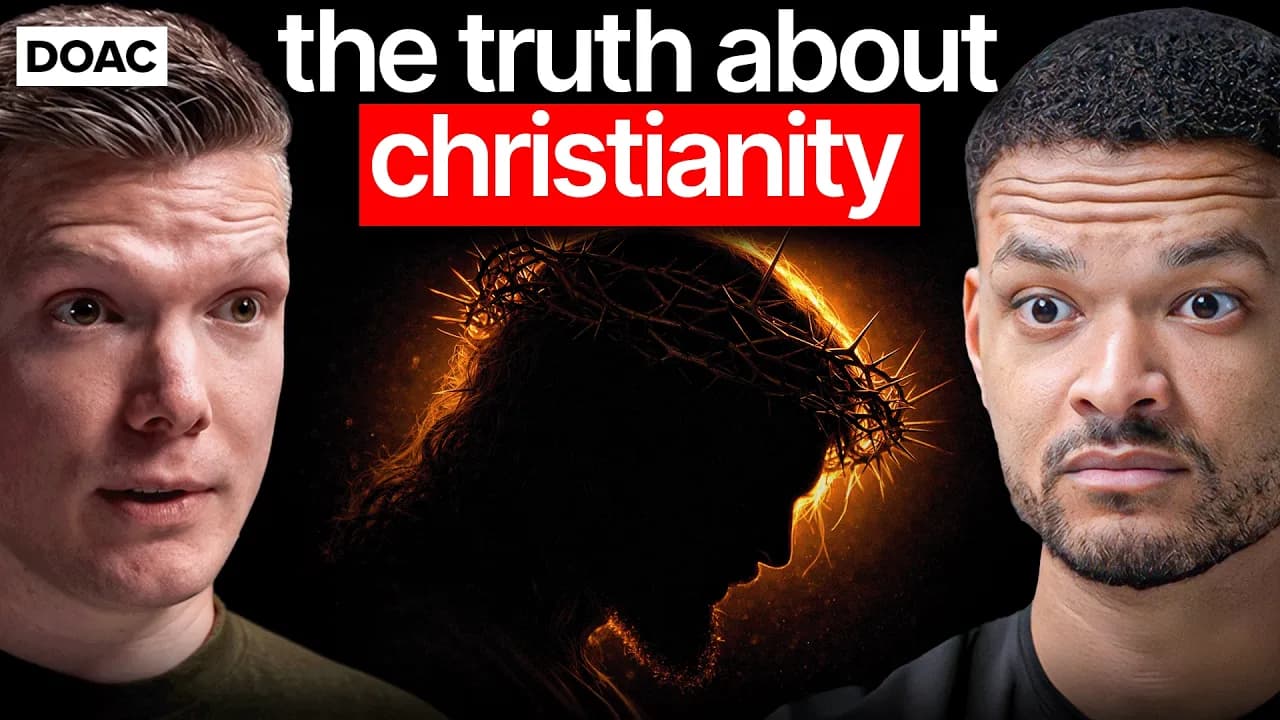
Shawn Ryan: There's A Battle For Your Soul, It's Happening Right Now
In a Nutshell
Shawn Ryan describes visiting hell during a five-MeO-DMT experience after ibogaine treatment, experiencing intense spiritual oppression that led him to undergo multiple Catholic exorcisms and strengthened his faith in Christ. He reveals how intelligence operatives plant guests on podcasts to insert geopolitical narratives, while warning that psychedelics open dangerous spiritual realms humans were never meant to access. Ryan's transformation from adrenaline-addicted CIA contractor to sober family man now includes supernatural encounters that have drawn him closer to biblical study and away from political content.
These notes were generated by AI and may contain inaccuracies.
Shawn Ryan stated that he visited hell and that it was more real than anything he has ever experienced. He described it as the most amount of fear he had ever felt in his life. His body was contorted and doing things that the human body should not do. When asked if he thought he was possessed, he confirmed this and mentioned that he has subsequently had several exorcisms. He stated that the things that are happening are undeniable.
Shawn Ryan joined the US Navy and enlisted at age 17. He went straight into the Navy SEAL program, completed BUDS, and spent 5 and a half years in the Navy. After leaving the Navy, he became a real estate agent after reading Donald Trump's book on how to get rich, but failed miserably. He then moved into government contracting, starting with a small State Department gig before being picked up for a CIA contract through Blackwater, then jumped to a company called Socked, and eventually became a direct contractor for the agency with no middleman.
A Navy SEAL stands for sea, air, and land, operating in all three environments as special operations. The training pipeline takes a couple of years. BUDS, if completed without getting hurt or rolled back, takes 6 months. Ryan spent about 9 months in BUDS due to being rolled back. The pipeline includes jump school and SEAL Qualification Training (SQT), which is the final school where trainees receive their SEAL trident. After receiving the trident, trainees spend another year to a year and a half training at their SEAL team before deploying. Training includes diving, jumping, land warfare, demolition, small unit tactics, time in kill houses, and experience in all operational environments including desert, winter, and jungle.
Ryan's first deployment was to Haiti in 2004 when Aristide got pulled out of power. This was his first experience with true poverty and warfare conditions. He witnessed sewage going into the streets, prisoners who had broken out, dead bodies floating in water, bullet holes everywhere, and cars on fire. He described it as vast chaos, though it was minor compared to what he would see later.
After Operation Red Wings in Afghanistan, which was the biggest loss in SEAL team history at the time with a sniper element compromised by a goat herder leading to an ambush and helicopters going down, Ryan's platoon was deployed in late September or early October. They hit targets that were mostly dry holes and grabbed a couple of prisoners before going home early.
Ryan then went to Iraq. His platoon went home, but he decided he wanted to get out because the deployment was not what he thought it would be. He had expected more combat and direct action every night, but they were not getting that in Afghanistan during the 2005-2006 timeframe.
During his last deployment, Ryan's OIC found a way to farm out the SEAL platoon to conventional units that were getting hit on supply routes with roadside bombs and suicide bombers. The SEALs would attach to these units and train them on surveillance, mission planning, setting up sniper hides, shooting, inserting, extracting, and positioning different teams. They would then go out with the conventional units and hunt the people killing American forces, successfully killing terrorists within 24 hours of being deployed.
Ryan confirmed that he was a different man after returning from the SEAL teams. He learned critical life lessons and his personal drive went through the roof. He realized that humans can accomplish far more than most people think. His ability to work under extreme stress increased dramatically. However, there was another side - he became addicted to adrenaline and those types of environments. He succumbed to the culture that comes with that, which included a lot of drinking and fighting.
Ryan built one of the biggest podcasts on the planet. He believes podcasters are being compromised by guests being planted on their shows. He stated there are people inside all platforms being used, including YouTube, Meta, and TikTok, who function as moles. He mentioned that his show will not appear in popular podcasts despite getting 150 to 200 million views a month and being number three on Spotify, because of topics he was discussing early on regarding terrorism.
Ryan discussed how the Trump administration utilized podcasts effectively during the election cycle. He believes that after the election, many podcasters and influencers felt powerful being close to the administration, but this led to their capture. He referenced the first Epstein file release where people were photographed holding binders, which he believes captured them. He mentioned receiving several invites to the White House, football games, and public events where he would be photographed, but always turned them down because he recognized the attempt to capture him and put him into a group.
Ryan believes there are guests that come out of nowhere who get unfathomable traction and numbers, not because of good life stories or miraculous achievements, but because they are talking about current events. He described how these guests can do 2-5 hour interviews where only one sentence about geopolitical events might be the mission, hoping it gets clipped and goes viral. He mentioned receiving texts from guests saying they predicted events in Ukraine, Israel, or Iran, and when he checks, they did mention it, which makes him think they got him.
Ryan stated that as an ordinary civilian, he would not have believed these things existed until learning about spy organizations. He grew up thinking the world is as it seems, but realized that spy agencies and networks use operations to compromise people and put them in certain situations. He mentioned that there are people living in New York City with families, jobs, and businesses who are actually planted from other countries with money funneled to support fake lives.
Ryan believes intelligence operatives have people inside all platforms, with their primary job being intelligence work while their cover is being an employee at YouTube, Meta, or TikTok. He referenced Annie Jacobson's term speculative narratives instead of conspiracy theories.
Ryan was supportive of Trump and wanted him to win, though he did not give official endorsements. He offered the Democratic Party an opportunity to have Kamala Harris on his show and was in discussions with her team about an outline, but they backed out at the last minute. When Trump came on the show, there were no guidelines about what could be discussed. When Kamala Harris came on after the election, there were also no guidelines.
Ryan has changed his opinion on Trump for a multitude of reasons and is not happy about anything happening currently. He believes Trump has totally gone against what he said he was going to do. Regarding the situation in Iran, Ryan sees no positive outcome for America and does not know what is going on there anymore. When talking to former military colleagues, they believe they are involved for another country's interests, specifically Israel.
Ryan does not believe the narrative that Trump got involved in Iran for reasons related to nuclear weapons. He believes these situations are not for American interests. He thinks America may no longer be the superpower or will not be shortly, citing China's nuclear power structure and America's issues with its power grid and the petrodollar.
Ryan referenced Professor Chung's breakdown on the petrodollar. He mentioned how America has destroyed relationships with countries like Canada over the Keystone pipeline, where Biden initially rejected it, Canada started making deals with China, and now Trump is penalizing them with tariffs that went from 25% to 50% to 100%. He believes the world sees America as dealing with a schizophrenic and that as a business owner, you cannot do business with an entity like that.
The speaker wants to investigate what happened when the US took superpower status from the UK during World War II, noting that current discussions focus on doom and gloom scenarios about currency collapse and lawlessness. The speaker questions whether losing superpower status would necessarily be negative and plans to bring on historians to examine the actual historical transition.
If the US loses its superpower position, it could remove foreign influence money from US politics, potentially forcing politicians to focus on domestic issues rather than foreign entanglements. The speaker emphasizes the need to examine poverty conditions across all 50 states.
The speaker plans to visit the poorest areas of each state to document poverty conditions and highlight the disparity between foreign aid spending and domestic neglect. The project would visit every state including New York, New Jersey, Wisconsin, California, Alabama, Mississippi, and Florida to show politicians the conditions in areas they represent.
The US historically maintained superpower status through perceived strength without overt displays of aggression. When the US begins acting like a bully through tariffs and insults toward allies, it signals insecurity rather than strength, causing other nations to question whether this represents genuine strength or weakness.
When the US insults countries and their leaders, it prompts other nations to form alternative alliances rather than continuing to align with the United States. European leaders are currently reassessing their security dependence on US leadership, particularly regarding Iran, and considering new leadership structures.
China demonstrates calm strength by avoiding conflicts with other nations while observing the US self-destruct in real time.
The speaker currently has no plans to get involved in the 2028 election unless a third party emerges with strong candidates.
Blair Skoro appeared on the podcast and discussed his recruitment from prison to infiltrate Islamic terrorist cells and the Muslim Brotherhood as a CIA asset. He described intercepting massive weapons caches that were redirected to CIA control. During the interview, he suddenly shifted to discussing Russians bringing nuclear warheads into the US, which seemed out of context and raised suspicions about whether this was an attempt to insert a narrative.
The speaker notes that gut instinct can identify when interviewees are still working on behalf of agencies. The pattern involves someone providing authentic background information followed by insertion of a single narrative-driving statement that doesn't fit the conversation flow.
The speaker has withheld several episodes that didn't meet factual standards. One involved a COVID vaccine discussion where the guest claimed the vaccine was patented before COVID-19 existed but kept switching terminology between "COVID vaccine" and "SARS vaccine," raising concerns about factual accuracy. The speaker decided against releasing the episode to avoid influencing medical decisions based on potentially false information.
An interview with a supposed World Economic Forum expert was terminated when the guest couldn't define what the organization actually was, instead discussing conspiracy theories without foundational knowledge.
A recent interview with a woman claiming agency experience was ended when she could only discuss polygraph tests rather than substantive classified information, suggesting she might be researching methods to defeat polygraphs rather than having genuine insider knowledge.
After leaving CIA contracting at age 34, the speaker moved to Medellín, Colombia for two years of sobriety from alcohol. The period was characterized by addiction to adrenaline that couldn't be satisfied through normal civilian activities. The speaker found everyday American conversations about war meaningless since participants lacked direct experience.
The speaker became involved in drug dealing networks in Colombia, though the primary motivation was setting up networks and infiltrating existing operations rather than the dealing itself. The activity provided the adrenaline rush previously experienced in military and contracting work. The speaker described having no value for their own life during this period, stating they would probably die in Colombia if the activity became boring.
During a multi-day cocaine bender, the speaker visited Barrio Antioquia to purchase drugs and threw money in the air at Puente de los Locos, a homeless area. Upon returning to their penthouse, the doorman informed them that police had visited seeking passport copies and information. The police had photographs of the money-throwing incident and had allegedly planted surveillance equipment.
After confirming the police surveillance through the doorman's information, the speaker conducted a surveillance detection route through internet cafes, purchased multiple tickets to different destinations, and left Colombia within 12 hours.
Upon returning to the United States, the speaker had not fully changed their behavior. They made additional trips to Panama, Costa Rica, and Honduras specifically to visit dangerous locations like San Pedro Sula, which was considered the most dangerous place on the planet at the time.
A major turning point occurred when the speaker's best friend developed a severe opiate addiction after leaving contracting work. The speaker made helping this friend their purpose, which required them to clean up their own behavior first. During this period, the speaker began therapy to set an example for their friend.
While in Colombia, the speaker experienced physical symptoms including swollen ankles from poor circulation during cocaine use. On Mother's Day, they called their mother believing it might be their last day alive due to overdose concerns.
Therapy proved beneficial despite initial ego concerns. The process allowed the speaker to work through problems by verbalizing them to an unbiased listener, similar to how podcast interviews help guests process their own thoughts. The accountability aspect of therapy was also valuable.
The speaker underwent Ibogaine treatment twice for addiction. The first treatment occurred after starting the podcast. Ibogaine is described as an intense, long-duration treatment that some claim can cure addiction with a single therapeutic dose.
After having a six-month-old son, the speaker realized he was not present with his family because his mind was always focused on business. He traveled to receive ibogaine treatment specifically to slow his mind down and be present with his wife and son. At the time, he had already stopped drinking hard alcohol and using cocaine, though he was still using sleeping medications and Adderall. After the ibogaine experience, he quit drinking entirely, stopped all sleep medications, and discontinued Adderall, describing the process as effortless. He has now been sober for over four years with no vices remaining.
The speaker's second ibogaine journey occurred approximately three months ago. This journey included five-MeO-DMT the day after the ibogaine session. He describes this experience as visiting hell. The experience was characterized by total emptiness rather than fire or traditional hell imagery. During the five-MeO-DMT portion, he encountered the most intense fear and anxiety he had ever felt, with a complete absence of God or Christ, feeling like an eternity that lasted approximately an hour and a half.
The experience felt like the most intense exorcism imaginable, with sensations of things trying to leave or being expelled but unable to exit. He described overwhelming feelings of abandonment and the most horrific feeling imaginable, more real than anything experienced in actual life. His body became contorted in ways a human body should not move, according to a Marine Corps veteran friend who witnessed the experience.
The speaker believes that while psychedelics can provide benefits, they open individuals to a spiritual realm that humans were never supposed to access. He describes being spiritually naked in an unknown world where one becomes vulnerable to spiritual access in both directions. Since this experience, his life has been markedly different with numerous supernatural occurrences including nightmares, odd coincidences, and synchronicities. He describes this period as dark but notes it has drawn him much closer to Christ.
The speaker shared specific supernatural experiences including recurring nightmares about his family being destroyed. In one dream, a Catholic bishop he was planning to interview sent cryptic homosexual messages, causing him to wake up hating the Catholic Church. When he began his prescribed prayer regimen called the Libra Cristo method at 6:00 a.m., 12:00 p.m., and 6:00 p.m., a picture frame flew off the wall during the St. Michael's prayer.
Later that same morning at mass with his spiritual mentor Hendo, he experienced an immediate allergic reaction upon taking communion, with his face feeling like it was on fire and veins popping out in his forehead within seconds. These experiences have been occurring in sequences for three months since the ibogaine journey.
The speaker notes that when people in the psychedelic community hear negative experiences, they become upset and don't want such experiences discussed. He believes he may be the only prominent voice willing to discuss both the benefits and dangers of psychedelics. He suggests the veil that psychedelics lift may exist for a protective reason, and that accessing spiritual realms carries real consequences.
The speaker has undergone multiple exorcisms with two different Catholic priests who serve as spiritual mentors. He clarifies these are not possession but rather oppression, where external spiritual forces affect circumstances around a person without controlling their mind or body. The exorcisms involve series of prayers in both Latin and English, with reactions to specific prayers helping identify what spiritual forces may be involved.
He describes the difficulty of explaining to his wife and children that he has undergone another exorcism, noting the fear and uncertainty this creates. Other military veterans from SEALs, Special Forces, and Delta Force have privately contacted him sharing similar experiences after psychedelic use, indicating he is not alone in these encounters.
The host describes himself as agnostic but curious, having been raised Christian, gone through a new atheist phase with authors like Richard Dawkins, and now finding himself unable to define spiritual experiences definitively. The speaker notes that his supernatural experiences have strengthened both his and his wife's faith in Christ, making the events undeniable. He plans to create a multi-year series breaking down every book of the Bible on his podcast, viewing recent supernatural events as confirmation he should pursue this direction rather than political content.
The discussion explores supernatural experiences and the ongoing spiritual battle over one's soul. The experience three months prior marked a significant shift in understanding the spiritual realm operating in real time. Prayer several times daily serves to release oppression during this battle. There is no predetermined timeline for how long this spiritual struggle will continue, and the resolution will become very apparent when it occurs.
The recognition of this spiritual battle has led to concrete consequences in business relationships. A life insurance company that had been an advertiser for years cancelled their relationship specifically because they do not advertise on faith-based content. This creates tension between maintaining financial partnerships and speaking openly about faith and spiritual matters. The decision appears designed to discourage discussion of these topics, similar to events that occurred the night before Cardinal Burke appeared on the show.
The ability to reach large audiences through podcasting carries significant influence that attracts opposition from various entities. The platform's power to lead people toward biblical content generates resistance. This creates a clear choice between continuing faith-based discussions despite financial consequences or compromising for advertiser retention. The reality that money cannot be taken into the afterlife factors into this decision-making process.
Analysis of numerous guest interviews reveals a consistent pattern among high-achieving individuals: they made decisions against their near-term incentives. Examples include Jimmy Carr leaving a stable job to perform comedy in pubs for minimal pay over 5-10 years, and Darren Brown abandoning a secure position to work card tables in Bristol for a decade. These choices appeared irrational at the time but consistently led to better long-term outcomes. Living out of alignment with one's values creates worse long-term consequences than temporary turbulence from making aligned decisions.
The primary goal in podcasting centers on encouraging people to ask questions without fear and reducing tribal thinking. The approach involves maintaining an open mind by interviewing diverse guests including Brolin, Jank, and Tucker Carlson. This openness extends to admitting mistakes publicly and correcting misinformation when discovered. The emphasis on personal integrity and accountability distinguishes this approach from common practices where few people hold themselves responsible for their statements.
The goal includes showing that asking difficult questions and taking stands for beliefs does not result in consequences as severe as anticipated. Courage is described as contagious, and the country needs more people willing to engage with controversial topics. The host's experience covering highly controversial subjects while maintaining the platform demonstrates that such discussions can occur without catastrophic outcomes.
A good life centers on creating memories with family rather than accumulating wealth. Financial security provides some stress relief but introduces different forms of pressure. Peace and happiness cannot be purchased and must be created through personal effort. The approach involves doing meaningful work while living in the moment and prioritizing time with loved ones. Business decisions should focus on power plays rather than pursuing every opportunity.
The period before having children represents optimal time for business building, as family responsibilities will eventually compete for attention and energy. Children grow quickly, making time irreplaceable once they arrive. However, business pursuits must balance against the risk of destroying family relationships through overcommitment.
Being everything to one's children requires physical and emotional presence that business demands can compromise. When parents are absent, others fill that role in their children's lives. The struggle involves constant phone calls, business deals, and urgent matters that seem critical for advancement but compete with children's desire for parental attention. Children can detect when parents are mentally absent even during physical presence.
Some of the most valuable lessons come from observing parents' behavior rather than direct instruction. Examples include a mother working constantly without complaint, even sleeping on a bag of rice in her shop to support her family. These demonstrations of hard work and sacrifice teach fundamental life lessons that shape later success and perspective on hardship. The nature of parental absence matters significantly - working for children's benefit differs from absence due to other priorities.
The conclusion emphasizes looking for power plays and holding out for the right opportunities rather than accepting quick money. The Glacier privacy app emerged from this approach after declining numerous opportunities that did not align with personal values. The app addresses phone privacy by blocking data collection from apps and data brokers through secure DNS, while also providing VPN functionality and burner numbers that can be discarded when compromised.
Podcast frequency will eventually reduce from two episodes weekly to one due to family considerations and travel demands. Business creation should focus on solving real problems rather than pursuing every opportunity. The creative aspects of business and finding alternative paths to success provide fulfillment beyond financial returns. Persistence and creativity in finding multiple avenues to goals represent key lessons from military and contracting experience.
The question left for the next guest asks "What is love?" The immediate response defines love as what one is willing to die for, with family identified as that ultimate priority. The conversation concludes with recognition of the host's integrity, alignment between beliefs and actions, and the demonstration of putting family at the center despite professional demands.
Keep The Diary Of A CEO in your library
Save the videos and channels worth coming back to, and find them again in one place.