SpaceX’ $75B+ Historic IPO, GPT5.5 Outperforms Polymarket, AI Solves 80yr old math problem | EP #257
In a Nutshell
SpaceX filed for a record $75B+ IPO at a $1.75T+ valuation, positioning itself as an AI infrastructure and software company (via Macrohard) while ceding foundation models to Anthropic. OpenAI's unreleased model solved an 80-year-old Erdos math conjecture with genuine creative insight, while Chinese labs lead in video generation and AI is already outperforming prediction markets. The episode's core thesis: AI-native organizations will collapse traditional firm structures into intelligence loops, creating existential pressure for every company to rewrite itself around agents or face replacement by two-person teams with open-source tools.
These notes were generated by AI and may contain inaccuracies.
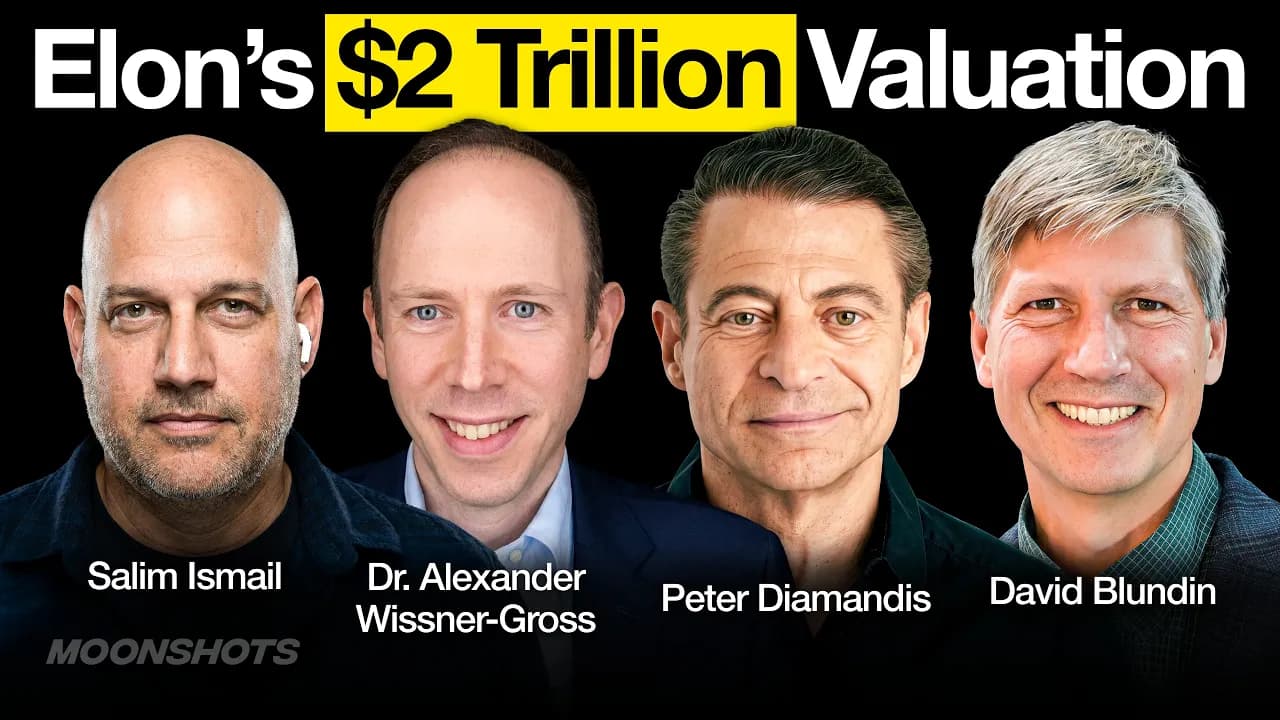
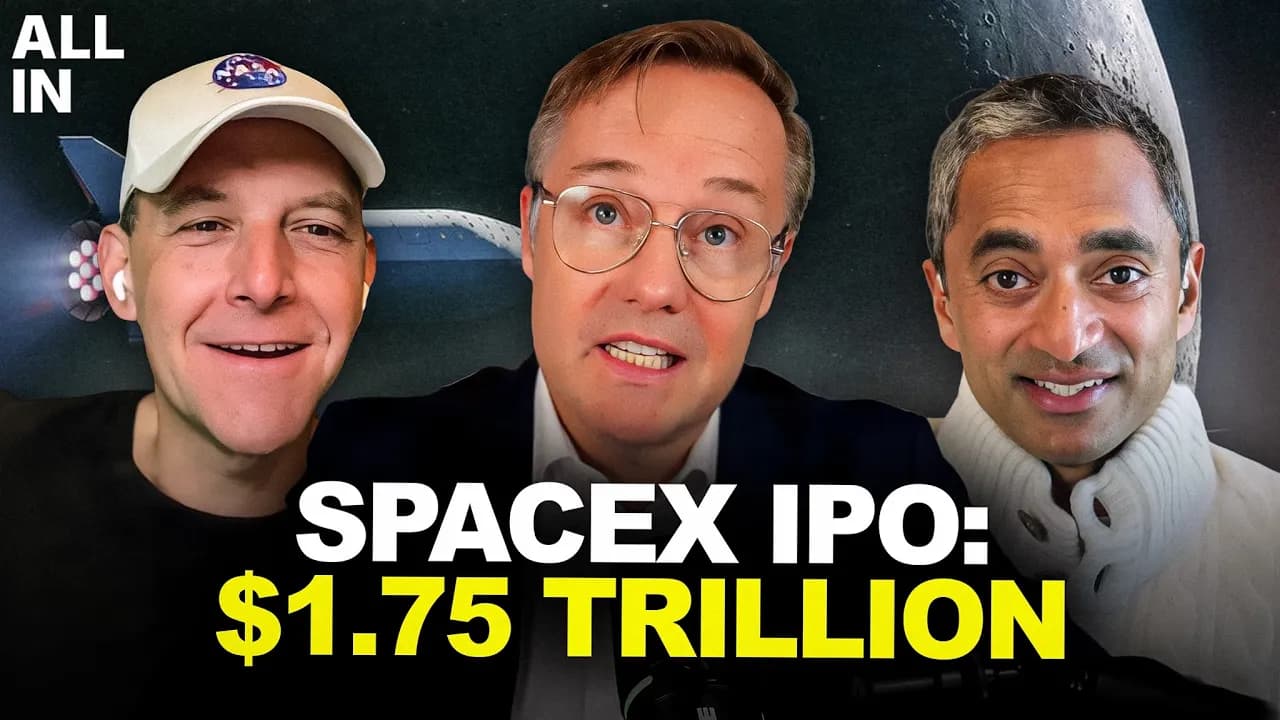
SpaceX filed for what is expected to be the largest IPO ever, raising $75 billion at a valuation north of $1.75 trillion. This is over 2.5 times the size of Saudi Aramco's IPO. Elon Musk is maintaining super voting rights with insiders controlling 86% of the voting power. The SpaceX IPO prospectus states an expected addressable market of $28.5 trillion.
The $28.5 trillion TAM breakdown includes $870 billion for Starlink, $740 billion for Starlink mobile, $600 billion for digital advertising via X, $2.4 trillion for AI infrastructure, and $22.7 trillion from Macrohard. Macrohard is the partnership with Tesla to emulate all digital work and create an AI-run software company. The TAM is just under the size of the entire US GDP. Elon's core thesis is that the global economy can be 10xed in 10 years.
In the past 48 hours, Anthropic is paying SpaceX $15 billion per year for data center access, covering both Colossus 1 and Colossus 2. The great talent has left xAI by the droves and is going to Anthropic, including Karpathy and Shane Longpre from MIT. This creates a duopoly between Anthropic and SpaceX AI.
SpaceX is seemingly abandoning the foundation model space and handing it over to Anthropic, focusing on the infrastructure layer (Dyson swarm) and the layer above (Macrohard). SpaceX is acquiring Cursor 30 days after the planned IPO, with Cursor now based on Kimmy (Chinese openweight models) with fine-tuning based on American reasoning traces. SpaceX wants to own the infrastructure layer below and the Macrohard layer above.
SpaceX is trying to transform itself into a Dyson swarm version of Microsoft, similar to Microsoft's strategy of enveloping OpenAI. The prospectus focuses on what investors understand: Starlink revenue, launch revenue, and enterprise applications rather than the full space colonization vision.
Once public, these companies can easily do a thousand acquisitions or more of a billion dollars or more. Anyone doing a startup has capacity for a thousand unicorn transactions. A unicorn is called a unicorn because it's supposed to be extremely rare. Elon will have a currency to go on a shopping spree.
This will be the first time Elon has a public entity that can raise many billions of dollars overnight where he is the controlling shareholder. He does not control Tesla, which is why he is constantly going to Delaware court over his compensation package.
Polymarket predicts a 20% probability by the end of this year of SpaceX and Tesla merging. Within a year, the ability to value and merge the two publicly traded markets becomes easier.
Starship V3 is scheduled to launch with 100 ton payload capability to orbit and 18 million pounds of thrust using the Raptor 3 engine. This is flight 12. On this flight, they will demonstrate docking ports that enable orbital refueling, which is required for lunar missions and going to Mars. Both stages will splash down, with Super Heavy in the Gulf of Mexico and Starship in the Indian Ocean.
NASA Artemis 3 is a docking test in 2027. Artemis 4 to the lunar surface, particularly the south pole, is taking place in 2028.
Orbital refueling is expected later this year. Being able to do orbital docking and refueling between Starships is a key moment. The Starship architecture is launch intensive, involving dozens of independent launches and refueling steps. This is analogous to packet-switched networks versus circuit-switched systems, decoupling cargo from transport.
New Glenn, Relativity Space, and Rocket Lab's Neptune do not come close to Starship's planned hourly launch rate. Falcon 9 currently launches every 2.5 days. The design space of aerospace lift is vast and competitors will come out of the woodwork once the market for heavy lift is demonstrated through the Dyson swarm buildout. China is busy copying everything it can out of SpaceX.
Starship was the last great thing built without AI assistance. Future designs will use mechanical design AI, accelerating development. Eric Schmidt's rocket company ( Relativity Space) will benefit from fast follower effects and AI design tools.
OpenAI built Future Sim that replays the internet day by day starting from January 1, 2026, giving AI agents access to real news. GPT 5.5 running Codecs scored 25% accuracy, leading across all frontier models. It beat Polymarket crowd predictions for the Super Bowl.
Future Sim benchmarks the ability of models to predict events beyond their knowledge cutoff date without web access. The state-of-the-art is already at 25% accuracy. This is the worst psychohistory models will ever be. This enables Monte Carlo research of policy decisions and the ability to predict planetary scale interventions.
Disease will likely get solved through a perfect digital twin of the system allowing exhaustive testing of all possible interventions. This is the planetary analog of what a virtual cell can do for curing all disease.
The architecture from the referenced paper has been integrated into the organizational singularity framework. New York currently hosts numerous specialized hedge funds across sectors like semiconductors and retail, all supported by prime brokerages handling trading and accounting. This entire industry structure could consolidate into just one or two AI models, creating extreme wealth concentration effects. If AI demonstrates fundamental superiority in market selection, it will rapidly expand across all markets rather than remaining confined to single sectors. This trajectory points toward collapse into a small number of mega funds with massive AI budgets, described as the financial singularity.
Leopold's predictions on energy infrastructure and reduced chip interest continue to materialize. Token demand is exceeding supply, with energy and infrastructure remaining the primary limiting factors.
OpenAI launched a personal finance mode within ChatGPT accessible to 12,000 financial institutions. ChatGPT Pro users can now ask personalized questions about spending, debt, taxes, and long-term planning. This represents OpenAI entering the $12 billion personal finance app market, potentially threatening products like Mint and NerdWallet. Approximately 200 million people already use AI for financial questions.
Foundation model companies are rolling out legal and finance capabilities through APIs that enable vertical disintermediation of existing companies including lawyers and financial accountants. This creates an ecosystem of new startups that adopt these APIs early and can disrupt markets while foundation model companies also prosper. A parallel AI economy is growing independently of traditional New York financial institutions. After upcoming IPOs, capital will flow into this new economy through public markets including SpaceX, Anthropic, and OpenAI, establishing a parallel banking and finance system independent of legacy infrastructure.
This development aligns with the solve everything thesis involving large models, transitioning from traditional models to an inner loop of intelligence with everything else wrapped around it. The same architecture exists in the organizational singularity work. Banks face significant risk as the interface to money shifts from traditional institutions to AI, causing them to lose control. Financial devices will layer around AI rather than individuals. The strategy involves building a completely new architecture rather than attempting to disrupt legacy systems, allowing the new system to become the gravity center. This pattern will repeat across legal, healthcare, insurance, and education sectors.
The conduit for moving money from the old economy to the new economy has become clear. Examples include Alex serving as an adviser and securities that can be deployed into AI through platforms like Robinhood or exchanges. Once capital enters the new economy, it operates independently of the legacy banking system. Trillions of dollars will move through upcoming IPOs. The situation parallels Bitcoin ETFs, where once assets move to the new system, participants no longer concern themselves with legacy infrastructure.
OpenAI is preparing to file for IPO as early as this Friday, following their legal victory against Elon Musk. The company previously indicated through CFO Sarah that filing would occur in 2027, but timing has accelerated ahead of Anthropic to secure available capital. SpaceX's IPO will consume significant market attention. OpenAI requires substantial capital for compute infrastructure expansion.
OpenAI's pivot from consumer to enterprise requires justification of high productivity per token. The personal finance launch raises questions about monetization strategy. Rather than becoming a financial institution, OpenAI appears to be following Google's playbook by entering financial verticals for advertising revenue. Financial queries generate substantial advertising value. The integrations enable targeted advertising within personalized conversations. Anthropic announced no advertising, a position consistent with their enterprise focus.
An unreleased OpenAI model disproved a central conjecture in discrete geometry from Paul Erdos, one of history's most prolific mathematicians. This represents the first clear example of AI solving a well-known unsolved math problem rather than just any unsolved problem. The problem concerns the maximum number of pairs of points in a plane that can be separated by a fixed unit distance. Erdos conjectured it was impossible to achieve materially better than linear scaling proportional to the number of points.
The solution demonstrates superlinear scaling for the first time. The problem involves deep tools from algebraic number theory despite being elementary in geometric presentation. The original construction was believed to be optimal, but the model showed substantial improvement was possible. Unlike the four color problem, which involves exhaustive brute force solutions, this problem required genuine creative insight. Professional mathematicians examining the reasoning traces noted the model pursued exotic possibilities that humans would abandon due to exhaustion.
The successful reasoning chain began with language about optimistically pursuing a possibility, which ultimately yielded the solution. This mirrors AlphaGo's move 37, where clever learned policy search enabled effective exploration of the game tree. The same pattern will emerge in physics, chemistry, biology, materials science, and engineering. The optimal solutions generated by AI are not necessarily human-legible and may appear exotic, inhuman, or even biological. This moment is more significant than simply solving a math problem, as it demonstrates AI's capability for non-intuitive optimization problems like magnetic bottle design, protein folding, and chip layout.
A Chinese AI group has pulled ahead of US rivals in video generation. ByteDance's SeaArt 2.0 and Kling now rank first and second on independent video model leaderboards. The advantage stems from superior data rather than superior models. TikTok has generated billions of hours of video data unmatched by any US company. Chinese frontier labs have access to both Western and Chinese video training data. A notable example shows a person inserting themselves into key moments in the Harry Potter cinematic universe, demonstrating how video generation dissolves the boundary between fanfiction and visual media.
China benefits from greater data access through civilian surveillance capabilities and potentially pirated video sources. Despite algorithmic and chip disadvantages, Chinese models lead in consumer video generation relative to Gemini Omni. Google remains the only major American lab pursuing multimodal approaches, while Chinese open-weight models emphasize multimodal capabilities. Video generation uses the same transformer architecture from 2017, with innovation occurring in latent space compression and decompression.
Domains including chemistry, biology, and physics also operate with latent spaces. Leadership in video generation serves as a leading indicator for startups competing in specialized domains like chemical reactions or robotics. A company can maintain competitive advantage within specific latent spaces, such as company management knowledge, without competing directly with Anthropic or OpenAI. China possesses TikTok and short-form content while Google has YouTube, yet the Chinese advantage appears driven by focused effort rather than insurmountable data superiority.
Interactive video generation and real-time world models already exist in systems like Genie. Liquid AI demonstrated generating images as quickly as speech one year ago, though current implementations require minutes due to compute limitations. The holiday experience of generating video on demand is technically possible but unavailable due to insufficient compute allocation. TikTok and Douyin function as training loops disguised as entertainment platforms, suggesting China may maintain video generation lead temporarily until Western models catch up.
Speakers at recent graduation events mentioning AI faced significant pushback from students. Gloria Feld, VP at Tavistock, encountered similar hostile reactions. The incoming workforce generation expresses anger and fear over AI's potential to disrupt their careers. The sentiment reflects uncertainty about the precise contours of the AI-driven transformation ahead.
The rise of artificial intelligence is framed as the next industrial revolution. Panelists noted that students sense companies and institutions are rapidly adopting AI without a redesigned social contract. The backlash is characterized not as anti-technology but as anti-extraction. A new narrative around agency rather than replacement is needed, along with addressing the legitimacy gap between AI elites and young people.
This issue is identified as priority one for XPRIZE. One hundred billion dollars of charitable money has been directed toward OpenAI, yet the speed of AI advancement caught many institutions off guard. Eric Schmidt, described as one of the greatest business executives of all time, faced boos despite delivering non-inflammatory remarks about AI as the next industrial revolution. With the job market effectively zero for many college graduates, such reactions are viewed as predictable.
The Build with Gemini XPRIZE was launched to address these concerns. Google contributed $3 million as prize funding. The challenge invites teams worldwide to become entrepreneurs by selecting a problem affecting 100,000 people and building a revenue-generating, scalable solution in public over three months. Within 24 hours of launch, over 2,000 participants registered, with expectations of reaching tens of thousands. Dan Martell and Dick Mackin are among the donors. Interest is particularly strong among individuals aged 13 to 25. The recommendation is to use AI tools to build businesses and employ others rather than seeking traditional employment.
Universities are criticized for selling an outdated credentialing system. Students spend approximately $200,000 on degrees that may be obsolete by graduation. The suggestion is made that universities should become launch pads for agency and entrepreneurship instead of defending legacy systems. Historical context is provided that even 30 years ago, very little university education translated directly into workplace application, and this disconnect has only worsened.
The booing incidents did not occur at Harvard, MIT, or Stanford. The majority of the graduating class of 2026 is described as anchoring expectations in stagnation. Selection bias is noted: students who reach graduation ceremonies have already accepted the traditional path, while those rejecting the system may skip college entirely. The argument is made that starting businesses is preferable to protesting at graduation.
Parents with children in high school or college, and recent graduates without jobs, are advised to pursue entrepreneurship education. The Build with Gemini XPRIZE at geminisexprize.com is recommended as a practical starting point. The two most important mindsets identified are purpose and curiosity.
Massive Transformative Purpose (MTP) was coined in 2012. At a 2017 conference keynote attended by 700 business school deans, only two had read Exponential Organizations. This is characterized as criminal negligence. Universities have known about these structural problems for decades but possess a strong immune system preventing adaptation, necessitating entirely new systems that bypass legacy institutions.
A Stanford survey of 849 computer science majors found that 49% would rather cheat than fail. AI tools are used in nearly every class for homework, coding, and essays. Stanford reinstated proctored in-person exams for the first time to address the issue. The historically respected Stanford honor code is described as effectively dead. Similar dynamics are presumed to exist at other institutions worldwide.
The situation indicates an overhang where taught skills are being automated by AI. Honor codes are critiqued as enabling faculty laziness; direct supervision of exams is recommended instead. If higher education is to remain relevant, far more supervision and proctoring may be required. Alternative models suggested include wilderness camp-style experiences where students build actual businesses or solve real computer science problems without access to AI tools.
Dave teaches Foundations of AI Ventures at MIT, where students must build business plans. If the plan gets funded, the student receives an A. The recommendation is to teach students to use AI and grade based on their prompt streams rather than traditional tests. Graduation speakers are questioned in an era of podcasts, with tradition cited as the only remaining justification. The point is raised that students should be trained for the AI-enabled world they will actually enter, not for compliance with outdated restrictions.
Universities face a binary choice: become credentialing museums or AI-native talent accelerators. The bifurcation must happen quickly. This transition represents the largest entrepreneurial opportunity in education history, with new companies selling lifelong capability acceleration rather than four-year courses.
Meta installed software on employee computers to track mouse movements, clicks, and screen activity. The stated purpose is training AI agents to understand human computer usage. The practical effect is recording all employee actions so AI can learn to replace them. Protests occurred at multiple U.S. offices, and an internal post received 20,000 views. This occurred the same week Meta cut 10% of its global workforce.
Elon Musk's plan with xAI is referenced as seeking to upload employee capabilities and replace them with a percentage of a GPU. Amazon is equipping delivery workers with glasses to track movements for future robot replacement. Currently, 44% of Gen Z workers are deliberately sabotaging AI systems they are supposed to train. The distinction is drawn between an AI coach and an AI cop using the same data but producing different outcomes.
Meta's history of privacy statements is cited, including repeated claims that user data would never be sold, followed by inability to opt out. WhatsApp encryption was promised and later removed. The same pattern of data extraction is now occurring internally. The decision to track employees is questioned given that frontier labs are primarily using synthetic data for computer-use training. Meta is not currently considered a frontier lab.
Google has gathered extensive data for decades. Eric Schmidt noted that Google could monetize search and purchase data around earnings reports but refrains due to legal risks. Gmail contains board reports and sensitive documents that algorithms scan. The principle is that data gathering will continue, but misusing it creates unnecessary backlash. Fighting the existence of data collection is viewed as unproductive.
Mark Cuban proposed a federal token tax at the provider level of less than 50 cents per million tokens. The stated goals are incentivizing optimization of tokenization, reducing energy usage, and generating $10 billion annually, potentially growing 30x or 100x, to help pay down federal debt. For 300 million Americans, this equates to roughly $33 per person per year. The proposal is characterized as interesting but unlikely to meaningfully address job displacement concerns.
Taxing tokens creates incentives to abandon token-based architectures entirely. Diffusion models and alternative transformer approaches without tokenization exist. Taxing FLOPs (floating-point operations) would encounter similar workarounds. Any input resource tax risks creating severe perverse incentives. The most liquid resource is compute usage, which would migrate to untaxed jurisdictions. Such a tax could inadvertently favor established players like Meta and OpenAI while slowing startup innovation.
Sam Altman has discussed the public owning a portion of national compute, analogous to Alaska's permanent fund or sovereign wealth models in Saudi Arabia and the Emirates. OpenAI recently offered $2 million in tokens to all Y Combinator companies as a potential preview of universal basic compute distribution. The mechanics of wealth distribution from the agentic ecosystem to average citizens remain under exploration.
Token usage is not a fixed, taxable commodity. Byte-pair encoding, single-byte encoding, four-byte encoding, or no encoding at all can be used. Cost-per-token discussions are meaningless without context window specifications. Any tax on tokens would rapidly drive the industry toward untaxed alternatives. The intent of taxing AI as an economic activity is acknowledged, but the mechanics risk creating compute tax havens and seasteads.
Colossal Biosciences announced the development of an artificial egg for hatching chicks. The company created a rigid outer shell for protection and rigidity, paired with a permeable membrane that allows oxygen to diffuse into the system at ambient temperatures. A large window on top provides real-time visibility into every stage of embryonic development.
This represents ex utero gestation technology. Colossal Biosciences is known for de-extinction efforts, including the woolly mammoth, direwolf, and dodo bird, with 15 species currently in process. The MOA bird presents significant egg-related challenges for their work.
Global egg production stands at 1.9 trillion eggs per year from approximately 33 billion chickens. The technology has been tested with several dozen birds. Late-stage gestation requires large amounts of oxygen that are difficult to supply through artificial means, making the oxygen-permeable artificial egg a meaningful breakthrough for supporting late-gestation metabolism.
Colossal Biosciences works on three artificial womb programs. Two-thirds of the 15 species in the pipeline are mammals. The dodo bird, native to Mauritius and featured on the country's money, stamps, and flag, is a target for resurrection to drive tourism revenue. The blue buck is another extinct species targeted for de-extinction.
The company does not recreate exact historical species. Instead, they make targeted genome edits—such as 300 specific edits—to produce organisms with desired traits like longer tusks, woolly hair, cold tolerance, or longer snouts. This approach allows designed species characteristics. Ben Lamm confirmed it would be possible to create a dragon-like organism with wings, though not fire-breathing.
The work involves genotype-to-phenotype mapping, where a desired final outcome is visualized and DNA is engineered to match that picture. A key question remains whether the resulting organism is a completely different animal that merely resembles the original, or whether recreating the original requires DNA within the historical reproducing lineage of that species.
Ben Lamm will appear at the Moonshot Gathering in September. Biology is becoming programmable, extending beyond animals to plants capable of drought resistance, disease resistance, and faster or larger growth through the intersection of AI and synthetic biology.
Dr. Don Malem, Chief Medical Officer of Fountain Life, discussed dementia prevention. Conservative estimates indicate 45% of dementia cases are preventable. Advanced testing at Fountain Life revealed that one quarter of members had advanced brain age.
Through interventions including healthier eating, physical activity, and optimized sleep, participants improved brain age by 26%. Fountain Life searches globally for the best therapeutics and approaches. Members concerned about maintaining brain function to ages 100-120 can visit fountainlife.com/pater.
A Gallup poll found that 70% of Americans oppose data center construction in their communities, with nearly half strongly opposed. Some residents stated they would rather live near a nuclear plant than a data center. Primary concerns include rising electricity costs, water usage, and environmental damage. Seven gigawatts of proposed data centers have been stopped or delayed.
Nevada Energy is redirecting 75% of Lake Tahoe's electricity supply to data centers by 2027. The story reflects a cultural divide: California voters will decide in November on a one-time 5% tax on wealth accumulated by 200 billionaires, prompting migration to Incline Village, Nevada. Nevada views data centers as an economic opportunity, while California emphasizes environmental protection.
Kilowatts flow to the highest dollar-per-kilowatt productivity applications, similar to how tokens flow to highest productivity uses. The Lake Tahoe electricity reallocation, planned since 2009, now favors data centers as more productive consumers than residential use. The U.S. must build the Dyson swarm or radically expand energy supply, likely pursuing both simultaneously.
Texas has surpassed California in utility-scale solar, doubling solar capacity over the last five years. Texas has also nearly doubled storage capacity and achieved approximately 8x wind capacity growth. Every U.S. state possesses renewable energy resources. China leads globally in renewable deployment.
Texas benefits from abundant oil and gas resources alongside renewables. The state functions as the closest equivalent to a special economic zone in the United States. Data centers locate where energy flows, including geothermal hotspots and desert solar sites.
Coase's theory held that transaction and coordination costs are lower inside firms than outside. Christensen's innovator's dilemma, lean startup methodology, platform business models, and ExO 1.0 extended the firm boundary using community, crowd, and AI. AI renders these frameworks obsolete because external transactions now cost less than internal ones, and company metabolism is slower than the external world.
A new architecture is required. The core consists of an MTP (Massive Transformative Purpose) functioning as a protocol, an intelligence engine, and an organizational form built around that engine. The intelligence stack includes a sensing layer and orientation layer forming an OODA loop: sense, organize, react, with feedback.
Rather than organizing around hierarchy, organizations should organize around intelligence. The firm boundary shifts from a legal entity focused on execution and coordination to a purpose container, fiduciary container, legal container, and liability container—essentially a glorified SPV. AI agents will handle API calls and execution across systems.
Required governance components include trusted evaluation suites for every agent, searchable logs, rollback capability, and human review queues. AI agents function like junior employees that can go rogue without oversight. Over 80% of current AI projects fail because existing AI is forced into human-centric workflows, automating human-to-human bottlenecks.
Disruptive innovation must occur at the organizational edge rather than the core. The recommended approach is to rewrite the organization by creating an AI-native digital twin at the edge, then migrate workflows incrementally. Each workflow undergoes red-teaming before integration. Once recursive self-improvement is achieved at the workflow level, legacy processes are deprecated. Humans shift to oversight, dashboard monitoring, exception handling, and problem solving.
An example workflow involves a trucking company responding to a competitor's refrigerated truck announcement. Sensing agents detect the development. Strategy agents evaluate market size and strategic relevance. An analytical layer assesses options such as acquisition, internal launch, or leasing. A decision layer selects the path. Execution agents implement the choice. Human approval occurs at key points, compressing decision cycles from weeks or months to days.
AI-native organizations achieve 100x or greater performance compared to legacy structures. A company achieved 73x ARR growth in one year through AI-native operations. Call centers transitioned from human to chatbot-assisted to AI-native. Marketing content evolved from agency-driven to AI-assisted to AI-driven.
The methodology called "rewrite" helps companies build the digital twin at the edge. Batches of CEOs will be guided through the process. An organizational singularity venture fund will provide funding for companies building in this modality or transitioning existing operations.
Additional information is available at organizationalsingularity.com. Initial cohort applications have filled 4 of 15 slots. The largest education group in Brazil will run universities through the process. A full book on the framework is being released as an AI, updated every two to three days (current version 15.643). A dedicated chapter addresses organizational design for domain collapse and modeling the future.
There's a chapter being written on governments and nonprofits because most government processes are very prescriptive and lend themselves well to AI native architecture. The team has written this all out and will keep evolving it as things change, as models change, and as agent architectures change.
When the first EXO book was written, they were probably seven to eight years ahead of the market. The second one was maybe three years ahead. This one is maybe a year ahead, making it much more timely than the previous books which were way further in the future.
The simplest way to talk about this is that organizations don't have a choice. The question every CEO and every board member needs to be asking is: can two guys with open source AI replicate a major line of business, a high margin line of business, in 60 to 90 days? If that's the case, there is an existential threat right now, so organizations have to move to this model.
A question was raised about falsifiability from the perspective of Coasean economics. The intercontinental railroad pushed firm size to be larger because continent-spanning companies were needed. The argument is that AI pushes firm size smaller, potentially enabling one-person conglomerates.
The response was that it can go either way. An economics technical paper is being written about how to measure the size of firms because size is not that relevant—it's the amount of economic throughput that can be put through the organization. This will depend on the domain and the kind of moat an organization has.
Regulated companies will be able to defend themselves more. Proprietary data provides strong defense. The best defense is an inner intelligence loop. Once that exists, it becomes very defensible and creates a flywheel that keeps building.
A falsifiable model is not yet known. For entities doing very customizable work like a sports kit car business that is manual and labor intensive, it won't fit the model very much, at least early on, though it will eventually apply over time.
Overall, the shift will occur as human-centric hierarchical coordination is replaced with an AI native loop that keeps flywheeling.
The framework being laid out is a theory of the future of organizations with both descriptive and normative components—what should happen versus what will happen.
The question is how an organization should judge whether this is an accurate description of the future of the firm. How should it be quantified? What are the benchmarks? How do we know whether this is accurate?
Early signals from the market include the rise of AI native companies. Klarna has done an amazing job of turning their customer service environment into a profitable center. Companies like Pulsia are creating entire scaffolding and launching companies without blinking.
It is not so much the number of people but how much economic throughput can be put into the organization.
When the EXO model was launched, all the Fortune 100 were measured against it. Seven years later, the top 10 of the Fortune 100 that followed the EXO characteristics the most delivered 40 times the shareholder returns of the ones that followed it the least.
The reason is that as the external world becomes more volatile, the ability to adapt drives market value. An index fund should have been set up—it would have been the highest performing index fund ever.
Given how accurate the predictions were last time, the current thesis is being advanced on that reputation. The architecture was nailed. The MTP purpose-driven organizations were nailed. Companies are now hiring based on alignment of a personal MTP with the organizational MTP—otherwise there is no point.
The broad thesis that intelligence is at the heart of it is very defensible. Some attributes may need adaptation, but a trust architecture is needed, along with proper scaffolding around the agentic harness to track what agents are doing and maintain audit trails.
An insurance company is using 2500 agents that are doing the work of about 500 people. These examples will be documented with teardown analysis.
A YouTube channel called The Shift is being launched to go through this in detail, interview people doing this work, and bring out signal from noise as quickly as possible on the overall architecture.
An hour-long conversation with Salim was one of the best on this topic, walking through what it means and how to implement it. It is being sent to the CEO of every company involved with.
The channel is at 499,000 subscribers. Two podcasts a week are now being put out on a regular basis. The host feels completely out of the loop if not having these conversations with the moonshot mates.
Rather than inevitably leading to dystopia, AI could catalyze spiritual growth and global harmony. As machines replicate aspects of human cognition, we are compelled to reconsider what it means to be aware, to feel, and to exist. AI exposes biases, flaws, and inequalities in human institutions, revealing patterns that are often hidden. This reflection can be uncomfortable, but creates opportunities for collective self-correction.
It is the best time ever to build. Everyone should go and build and be an entrepreneur. Jump in with an LLM, tell it who you are, what you love doing, your purpose in life if known, and ask what some business ideas are and how to go for them. Programming can be done in English today.
Join at the gemineenterprise.com website and register.
If you made it to the end of the episode, you are considered a moonshot mate. The Metatrends newsletter is a two-minute read every week covering meta trends impacting family, company, industry, and nation. Access is available at diamandis.com/metatrends.
Keep Peter H. Diamandis in your library
Save the videos and channels worth coming back to, and find them again in one place.