Stories About Dogs | 60 Minutes Full Episodes
In a Nutshell
Dogs evolved from wolves around 20,000 years ago through "survival of the friendliest," with genetic mutations on chromosome 6 enabling human bonding, as shown by Duke's Brian Hare comparing dog and wolf pups, and parallels to human Williams syndrome. Comparative oncology leverages dogs' shared cancers (e.g., osteosarcoma, glioblastoma) for faster treatments via NIH DNA studies and trials like Listeria immunotherapy, benefiting both species under Cancer Moonshot. Chaser, a border collie knowing 1,000+ toy names and sentences, proves dogs' advanced cognition; Emory fMRI scans confirm genuine love via reward-center activation to owners' scents and oxytocin from eye contact.
These notes were generated by AI and may contain inaccuracies.
Many viewers have a dog nearby. Dogs evolved from wolves, but how and when remains a mystery. DNA of dogs and wolves provides intriguing clues about their and human evolution. Survival of the friendliest best describes dogs' evolutionary success, according to Duke University scientist Brian Hare. There are an estimated billion dogs on the planet. They live with us, work with us, and love us.
What is it you're trying to understand about dogs? I'm really interested in where dogs come from. I think it teaches us a lot about where humans came from.
Brian Hare, evolutionary biologist and author at Duke University, has studied animal evolution for 25 years.
I think what really summarizes the link between dog and human evolution is survival of the friendliest.
What about survival of the fittest? Survival of the fittest is a misconceived idea in the public mind of what evolution is. It's the idea that the biggest, the strongest always win. Might makes right. But not at all. Dogs are exhibit A of this.
Sweet dogs started as wild predatory wolves. Their evolutionary story began at least 20,000 years ago when humans were hunter-gatherers. Wolves chose humans; a population became attracted to humans, gaining advantage by eating garbage around homes. Wolves that gave up hunting and were friendliest toward humans had a huge advantage. Some wolves fed off scraps, weren't aggressive, and over time became domesticated.
Brian Hare visits Wildlife Science Center in Minnesota, run by director Peggy Callahan and her 23-year-old daughter Meg, skilled at navigating cages full of hungry wolves. There are 110 gray wolves there; some rescued from the wild, most hand-raised by Peggy and Meg. They're divided into packs separated by chain link fences. One pack named after the 80s horror movie Children of the Corn attacked and killed their father, then tried to kill their mother due to opportunity.
Peggy is viewed as the dominant pack member, essential for safety given wolves' enormous jaw pressure and opportunistic nature. Wolves constantly assess dominance.
Can you show me your howl? Absolutely.
Howls mark territory and deter intruders. Dominance starts early; Meg hand-raises pups like one-month-old Pho, correcting him by pinching and growling like his mother, then rewarding.
MJ is the dominant female, hand-raised, tolerates belly rubs until she doesn't.
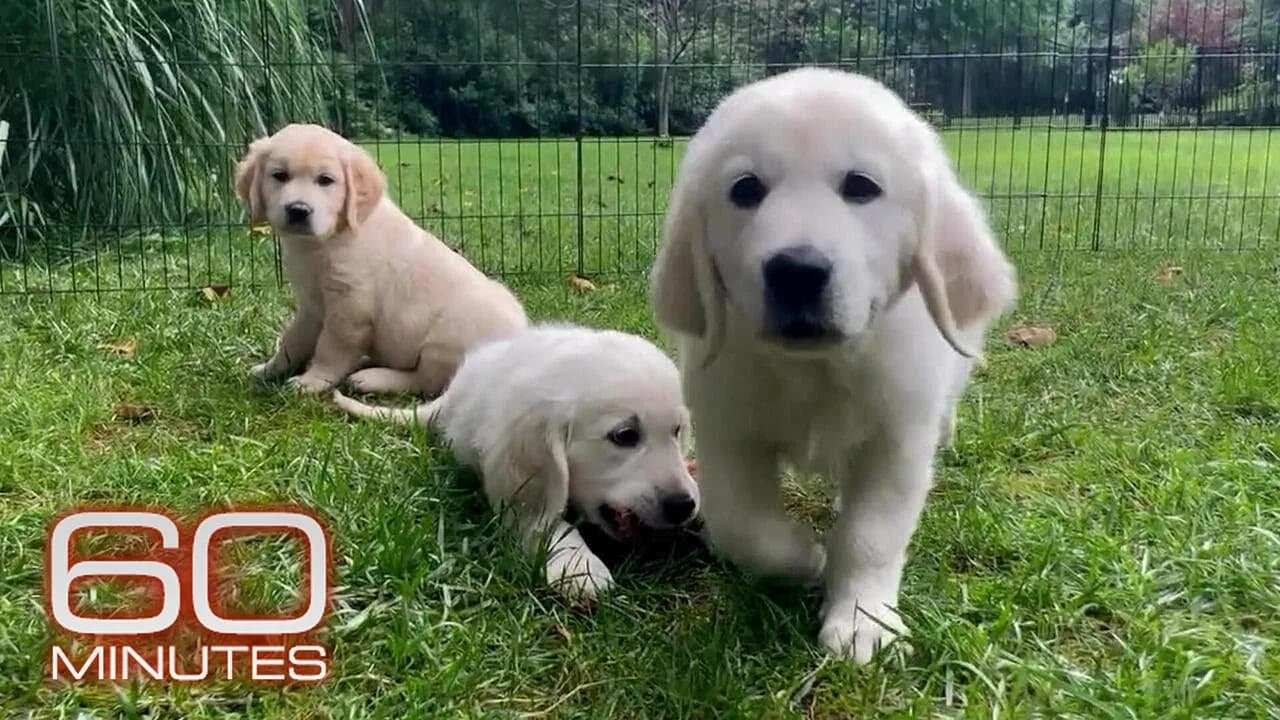
At Duke, Brian Hare runs puppy kindergarten raising Labrador puppies, who tag along everywhere, including basketball practice and track team photo shoots. Program trains service dogs for K9 Companions and conducts behavioral research comparing dog puppies to hand-raised wolf pups.
Dog puppies follow human pointing gestures immediately, looking back and forth from researcher to bowl. Wolf pup Pho does not. Dog puppies are prepared to understand humans due to domestication; wolf puppies are not. Even after months of 24-hour care, wolf puppies prefer wolves over people. Dogs are xenophilic, attracted to new things and people.
In 2010, geneticist Bridgett von Holdt at Princeton compared dog and wolf DNA, finding mutations only in dogs on chromosome 6, pinpointing friendliness mutations making dogs friendly to humans.
You've located specific genes that lead to friendly behavior. That's right.
These evolved over time; wolves near human settlements likely carried some mutations.
So does my dog really love me or is my dog just acting out on its genetic code? She absolutely loves you. She has the genetic predisposition to wholeheartedly love you more than she probably can handle.
Williams syndrome in humans involves deletion of genes corresponding to dogs' friendliness mutations on chromosome 7, causing outgoing, friendly cocktail party personality. Ben Monahan, 36, featured on 60 Minutes in 1997 at age 11, has Williams syndrome, missing 25 genes (one-tenth of 1% of genetic makeup), leading to friendliness, kindness, but also medical problems and intellectual disabilities.
What makes me unique is my way of giving happiness to people, my friendliness, my kindness. When people are happy, it makes me feel like I've achieved something.
Ben's mom Terry Monahan, former head of Williams Syndrome Association, notes extreme trustfulness.
Ben, what do you think about that? About there might be a link friendliness in dogs and friendliness in humans. It just makes me feel so happy and proud that dogs and people have similarities.
One parent said, "Are you kidding? If a tail was put on my son, it would be wagging all the time."
Dog evolution shows evolving friendliness leads to cooperation. Humans 100,000 years ago were not alone; 4-5 other human species existed. Homo sapiens survived as the friendliest species.
Survival of the friendliest, the successful evolutionary strategy many humans today would be wise to remember.
4 million dogs in the US diagnosed with cancer yearly, often same kinds as humans. Dogs share many genes with humans. Comparative oncology, funded by White House's Cancer Moonshot Initiative, studies naturally developing cancers in dogs to speed treatments for both.
NIH scientists, led by senior geneticist Elaine Ostrander, collect DNA samples at dog shows, gathering 40,000 samples over nearly 30 years. Dogs get same diseases as humans (diabetes, cancer, neuromuscular) due to shared genes, environment, food.
Dogs bred last 200 years for traits, creating variety (Great Danes to Chihuahuas). Most variation post-Victorian era from small number of genes. One gene determines cream vs. black hair; others long vs. short hair.
MSRB3 gene mutation causes floppy vs. prick ears in dogs; more dramatic mutations cause deafness in humans.
Certain breeds prone to cancers: Scottish terriers 20 times more likely to get bladder cancer than mixed breeds, simplifying gene identification vs. complex human cases.
Dogs get same cancers: lymphoma, melanoma, brain, breast, osteosarcoma (bone cancer).
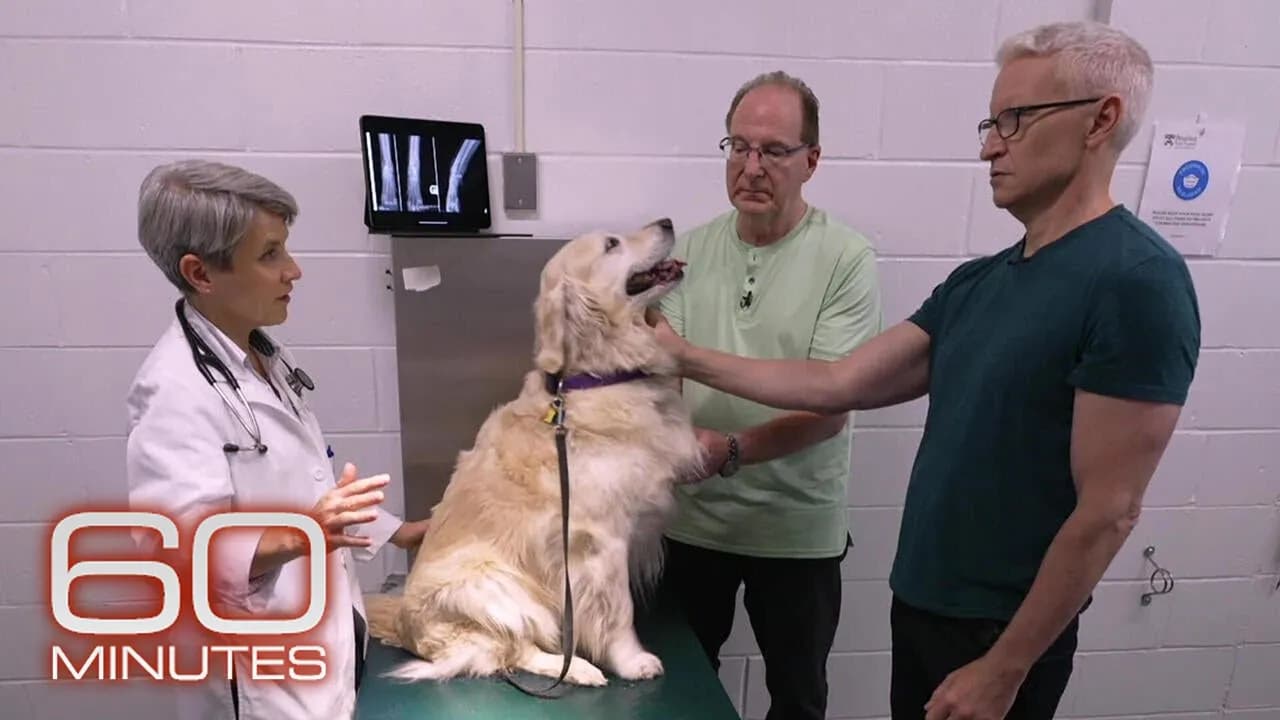
Univ. of Pennsylvania vet Nicola Mason oversees Cancer Moonshot-funded trials. Osteosarcoma looks identical in dogs and humans under microscope.
10,000+ dogs vs. ~1,000 people (mostly children/young adults) get osteosarcoma yearly in US.
Christy Gomes, diagnosed 2020 at age 11, had thigh pain mistaken for soccer injury. White mass eroded most femur bone; replaced with 9-inch metal rod. Chemo reduced her to 72 lbs; cancer recurred in lungs.
Patients once their tumor comes back are really high risk. Probably 80% of the time we'll get new tumors.
Osteosarcoma treatments unchanged for 60 years due to rarity, low funding.
Since 2012, Dr. Mason's trials used genetically modified Listeria bacteria (less virulent, contains HER2 protein from osteosarcoma cells) to awaken immune systems. Injected, it causes fever, triggers killer cells.
Sandy, 9-year-old golden retriever, amputated front leg 2018, joined trial. Life expectancy 1 year with standard care; now 4 years cancer-free.
First trial results: dogs tolerated it, increased survival; FDA approved phase 2 human trial for recurrent osteosarcoma in lungs (young adults/children).
Christy Gomes received third infusion August at Children's Hospital of Orange County; sedated, experienced headache/nausea like truck hitting, but immune response activated, recovered quickly. No cancer on last scan; continues every 3 weeks.
National Cancer Institute spends $20+ million analyzing dog cancer samples, overseeing trials.
Otto, 7-year-old boxer, diagnosed 2021 with glioblastoma brain tumor. Julie Hinsch, 59, diagnosed 2020 with similar. Both in Univ. of Minnesota trials with shared data between human and vet surgeons on safety/dosing.
Julie met Otto with family; both fought same cancer/treatment.
I never thought I would be having a conversation with a person and a dog who were having the same treatment. Incredible.
Otto's cancer returned; euthanized after final swim. Julie's worsened; stopped trial, grateful.
I helped fight cancer.
Dogs may hold the key.
Christy, now high school freshman, with Yorkie Penny:
We have to have more common things than we think. It's not just that they need us for food. We have to have like more connection than that.
Human beings have lived with dogs for thousands of years. You'd think that after all that time, we'd have
Scientists didn't pay much attention to dogs until recently, despite sharing lives with them. Dolphins and apes/chimps studied for decades, but dogs overlooked. Little known about dogs' brains: Do they love us or lick for food? How much language do they understand?
Meet Chaser, called the smartest dog in the world, with 86-year-old retired psychology professor John Pilley (corrected from Pilly) in Windford Hoop. They are inseparable. Pilley views Chaser as their child, a family member who comes first.
Pilley taught Chaser by assigning names to toys, up to 5 hours a day, 5 days a week for 9 years. Compares her to a 2-year-old toddler with capabilities of one. Most 2-year-olds know ~300 words; Chaser knows 3x that.
Chaser's Toy Vocabulary
Chaser learned names of >1,000 toys: 800 cloth animals, 116 balls, >100 plastic toys (1,022 total), each with unique name. Cataloged toys; over 3 years, hundreds of tests where Chaser correctly identified 95%+ by name (e.g., "find circle"). Results published in peer-reviewed journal; Chaser got book deal.
Taught nouns and verbs differ (e.g., "take wheel" vs. "paw" on something, "nose" on something). Commands combined in variety of ways. Breakthrough as puppy: realized objects have names (insight at 5th month, after ~40 names, learning accelerated). Closest to young children learning words.
Brian Hare's View
Brian Hare, evolutionary anthropologist at Duke University, calls Chaser most important dog in modern scientific research. Not stupid pet tricks; learns thousands of new things via social inference (same as kids). Demonstrates with son Luke (~age 1): hides ball under cup, points; Luke infers. Bonobos (closest relatives) fail test; dogs succeed (e.g., 2-year-old Labrador Cisu follows pointing).
Dogs show inferential reasoning, key for human culture/language development. No evidence until last decade. Evolved alongside humans >15,000 years; 80 million dogs in US (more than children).
Dr. Gregory Berns (corrected from Burns/Emery), Emory University neuroscientist, studied human brains 20+ years. Inspired by own dog: Do they reciprocate love or scam for food?
Conducts fMRI scans on awake, unsedated dogs (trained 3-4 months to stay still). Protects sensitive hearing with earplugs/muffs. Scans show brain slices; analyze activation.
Scent Experiments
Dogs smell cotton swabs: stranger's underarm sweat vs. owner's. Smell area (behind nose) activates either. Owner's sweat activates caudate nucleus (reward center), like human favorite song or loved one. Proves positive association beyond food; not scamming.
Videos of dogs welcoming service members show bond. Eye contact releases oxytocin (love hormone) in both dogs/humans, like mother-baby bonding. Dogs "hug with eyes"; enjoyable, not just manipulative.
Hare created Dognition website: owners play games to test dog's brain power. Measures communication, empathy, cunning, abstract reasoning. Different intelligences like humans (e.g., good at English vs. math). Hare's dog Tassy (mixed breed): poor working memory (forgets "sit/stay"), great communicator.
Chaser (border collie) off charts on reasoning/memory. Border collies bred for understanding sheep herding. Pilley randomly chose her from litter. Many potential Chasers; spend time playing games to teach. Advice: Work more with your dog to help reach potential.
Keep 60 Minutes in your library
Save the videos and channels worth coming back to, and find them again in one place.