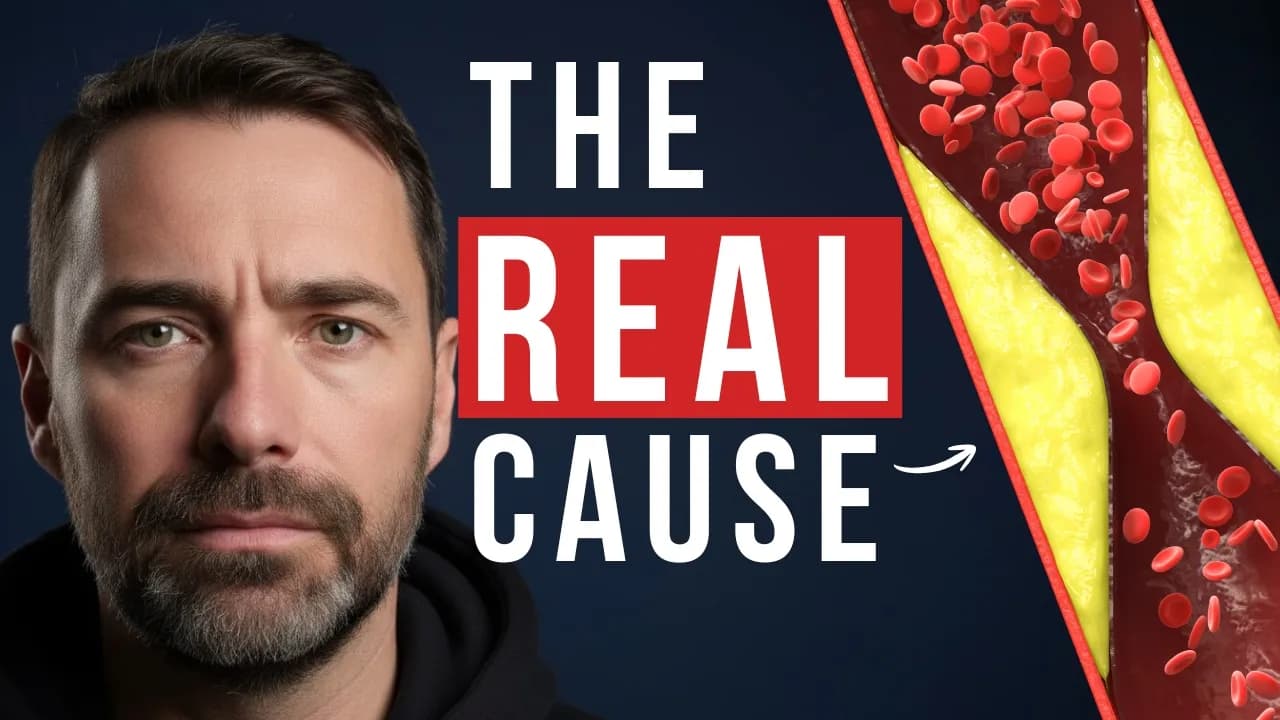
The Cholesterol "Glitch" Your Doctor Has Never Explained
In a Nutshell
The video argues that rising CAC scores on statins are being reframed as "success" even though the scan only detects calcified plaque and ignores dangerous soft plaque. It claims statins fail to address root drivers like chronic inflammation and insulin resistance, yet the system interprets every CAC result—high, low, or rising—as justification for more statin use. The core message is that this creates a closed loop where the most profitable drug is prescribed regardless of actual cardiovascular risk or patient outcomes.
These notes were generated by AI and may contain inaccuracies.
Somewhere right now, someone is sitting in their doctor's office after getting a heart scan with a CAC score that came back a little high. The doctor said they need to start a statin immediately. That person took the statin every day for a year, then got another CAC scan showing the score was even higher. The doctor responded by increasing the dosage. Nobody explained that this outcome was expected and documented in the literature.
The basic lipid panel simply counts cholesterol quantity, similar to standing on a highway overpass counting cars. More cars means more chances of an accident according to this logic. The test does not assess quality or whether particles are the dangerous small, dense type that penetrate artery walls. The guidelines keep lowering the threshold for statin eligibility, making more people eligible for prescriptions while heart disease remains the number one killer.
In 2026, new guidelines suggested starting statins at 30 years of age. The speaker questions why not start at 20, in teenagers, in children, or even babies in utero. The speaker advocates addressing the root cause rather than masking it with medication that allows continuation of the behaviors causing the problem.
The CAC scan is a CT image showing actual calcification in arteries, providing real imaging evidence rather than a proxy measurement. This test was celebrated in the low carb and carnivore community as a tool to see what is actually happening instead of relying on a precursor to a precursor. A CAC scan showing no calcification could serve as an off-ramp from statins backed by hard imaging data.
The video is brought to you by Bolton Electric Bikes. The speaker describes the bikes' features including beefy tires, disc brakes, heavy-duty frame, rack, mineral oil brake system, adjustable suspension, five speeds, temperature display, speed in miles per hour, brake lights, and pedal assist modes. The speaker mentions they are the power carnivore couple and finished putting together their dual ebikes.
When CAC scores increase after starting statins, the official position is that this should not prompt alarm. The claim is that statins convert dangerous soft plaque into calcified plaque, which is stable and less likely to rupture. A rising CAC score is presented as proof the drug is working.
Researchers at Intermountain Medical Center working with Johns Hopkins and the NIH followed patients for nearly seven years, measuring plaque composition including soft plaque, calcified plaque, and fibrous plaque, then tracking cardiac events. The lead researcher stated that previously lipid-laden soft plaque was thought more likely to rupture, but the new research indicates calcified plaque appears more associated with adverse cardiovascular events. The defense that rising CAC scores are beneficial may rest on a foundation now being questioned by researchers themselves.
A CAC scan only measures calcified plaque and does not measure soft plaque at all. A person could have a perfect CAC score of zero while still having significant soft plaque that does not show up on the test and that can rupture.
The pattern forms a closed loop: if not on a statin and CAC score is high, a statin is prescribed. If already on a statin and CAC score goes up, that is interpreted as the drug working. If the score keeps rising, the dose may be increased. Statin users are now officially interpreted differently. No result on the CAC test leads away from statins. Low score before statins means take them to keep it low. High score before statins means take them now. Score rising on statins is called stabilization and success. The test that could get people off statins has been turned into a reason to prescribe more statins. All roads lead to statins, the most profitable drug of all time.
Heart disease remains the number one killer despite decades of statin use and multiple lowering of prescribing thresholds, with tens of millions of people now on these medications. The research points toward chronic inflammation and insulin resistance as the actual drivers of cardiovascular disease. These damage the arterial wall and create the environment where plaque forms. Cholesterol goes to the site to address the problem, but the firemen are being blamed instead of the fire.
A statin does not address inflammation and insulin resistance. At best it adjusts one number while the underlying fire continues burning. The question is whether behaviors causing the problem are being changed or whether a chemical shortcut is being sought that allows continuation of the wrong behaviors. Insulin resistance and inflammation cannot be addressed by medication while continuing to eat foods that cause these conditions. The body is not broken but responding to what is being put into it and how one is living.
The CAC scan does not lie. A rising number is a signal. The question is whether to listen to the signal or take a drug that changes the instrument reading while the underlying problem continues. This approach is like putting a band-aid over the check engine light. The right conversation is about identifying the actual root cause of heart disease and whether anything is being done about it rather than applying a band-aid.
Keep HomeSteadHow in your library
Save the videos and channels worth coming back to, and find them again in one place.