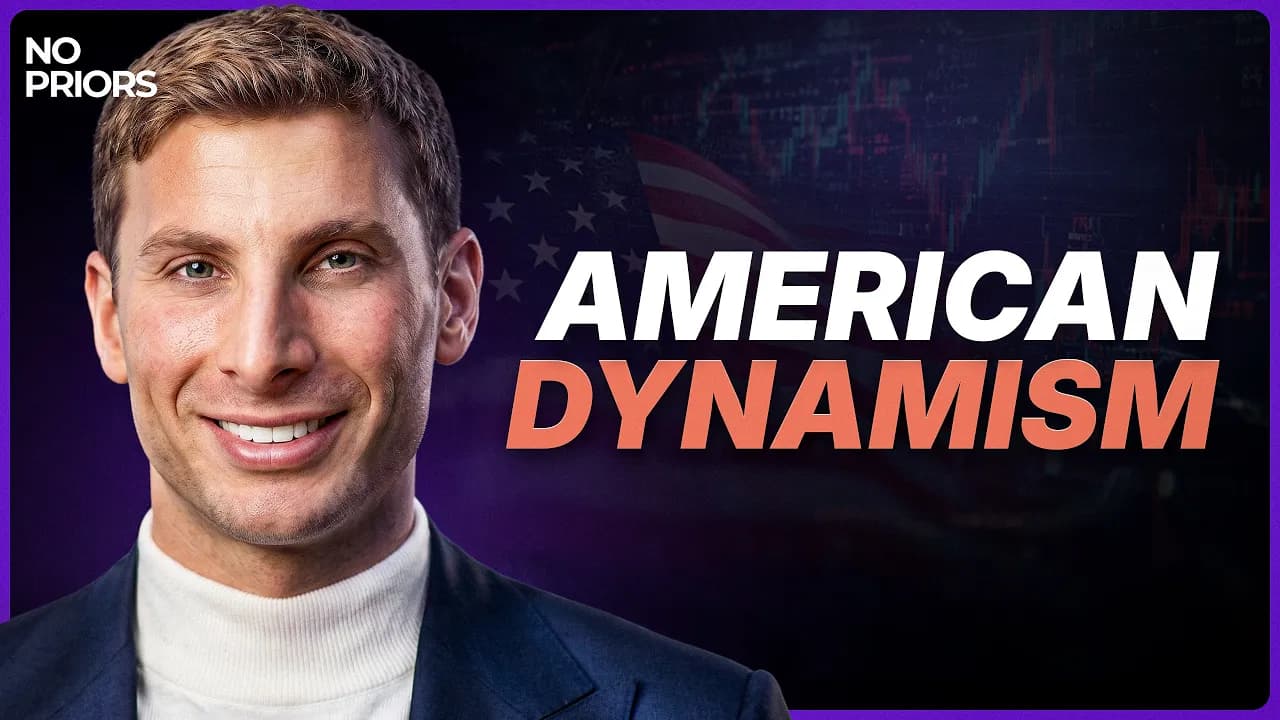
The Largest Untapped Market Inside U.S. Defense | Emil Michael
In a Nutshell
Emil Michael, DoD Under Secretary for Research and Engineering and chief AI officer, drives urgency to counter China's historic military buildup by prioritizing 6 critical tech areas—applied AI, scaled hypersonics, directed energy, autonomous drones/robots, and more—while launching genai.dod.mil for 1M+ users and unifying innovation units like DARPA and DIU to accelerate deployment. New defense entrants like SpaceX and Anduril are welcomed via streamlined front-door contracts, tackling the "valley of death" with $1B DIU funding, AFIT scaling, and $200B Office of Strategic Capital loans for dual-use tech in hypersonics, drones, AI, and brittle supply chains (e.g., germanium, brushless motors). Rebuilding the U.S. defense industrial base demands scaled manufacturing, domestic self-sufficiency in critical minerals/semiconductors/pharma, and entrepreneur investment, fueled by Arsenal of Freedom tours and a shift to cheaper, mass-producible autonomous systems for 20-30% of future budgets.
These notes were generated by AI and may contain inaccuracies.
The military buildup in China is the biggest military buildup in world history. There's real urgency to ensure the U.S. stays ahead, requiring a different level of investment and thinking than the last 20 years. In the 80s, there were 50 defense contractors that merged down to about five. There's room for new entrants. SpaceX, Anduril, and Palantir all had to sue the Department of Defense for their first contract. The new approach is to come through the front door because people are excited about lower cost, faster, more sophisticated options.
Emil Michael is former chief business officer of Uber, White House fellow, and currently Under Secretary for Research and Engineering at the Department of Defense (DoD). He also took over as chief AI officer recently.
For a long time, DoD had one organization called acquisition, technology, and logistics. About 8 years ago, they split acquisition from research and engineering due to tech moving faster on new weaponry and defense systems. As Under Secretary for Research and Engineering, Emil works with entrepreneurs and new companies, like in Silicon Valley.
He is responsible for:
- DARPA (most advanced research in the country/world; invented the internet—gift shop sells napkin with internet architecture sketch).
- Defense Innovation Unit (DIU) (based in Mountain View; links defense industry and startup community building commercial dual-use products).
- Strategic Capabilities Office (modifies existing systems for strategic surprise).
Goal: Unify these across DoD, which spends $150 billion/year on tech, to avoid duplication and bring things to market faster. Big announcement yesterday by the Secretary at Starbase.
DIU has success with Anduril and others, providing early funding to promising defense tech/hardware companies. Now focusing on doing more.
Emil's high-speed, aggressive dealmaker reputation from tech companies. DoD has massive impact, scale, but not strongest reputation for speed. He aims to inject urgency, speed, imperviousness to barriers. Leadership/culture creation is transferable. Progress slower in bureaucracy but with more resources and important mission. People want to join his team and across DoD. Harder but more impactful; just as motivated.
Entrepreneurs gathering in DC; impressive talent recruitment.
14 priorities mean no priorities. Cut from 14 critical technology areas to 6 action-oriented ones with sprints (like engineering teams). Too many distract and spread resources thin.
Key areas (off the top):
- Applied AI (not building foundation models—private sector spends hundreds of billions; adapt/apply to DoD use cases).
- Scaled hypersonics (newest threat: Mach 5+, maneuverable; few countries build them—China, Russia, US; focus on scale, reasonable price, less exquisite, more mass/producible like Anduril thinks).
- Scaled directed energy (high-powered microwave/lasers to take down missiles like Israel's Iron Beam; cheaper for drones—$5M missile vs. $50K drone).
Russia-Ukraine war sparked renaissance in drones/robots as new front line. In territorial battles, robots fight first, reducing human casualties.
Shift mix toward robots/drones faster on land. Carriers/sea projection/power protection continue, but mix shifts to autonomous submarines, boats, big drones, airplanes as AI enables control/sensing/autonomy.
In 10 years, 20-30% of budget on these cheaper systems for way more firepower than human-involved systems.
As rep for Secretary, look across Army, Navy, Air Force, Space Force for common needs/tech enablers useful broadly for economies of scale. Service-specific handled by their labs/R&D/procurement.
Took months to study 14 areas and scale to 6 with common threads across enterprise.
Surprise speed of genai.dod.mil. DoD networks are secure (even unclassified); can't just use chatgpt.com (prohibited). Architected policies/data flow so nothing goes back to public models (no U.S. data leakage).
Tiger team of ex-Databricks, Meta, AWS engineers + Google Gemini team (familiar with DoD). Launched to 3 million employees in 60 days. Over 1 million unique users in last 30 days (1/3 of enterprise). On Gemini 2.5 (3.0 soon), then Grok with xAI, others TBD, across classification levels.
Fundamentally changes work; done fast with fast people.
Deploy AI in 3 categories (pace-setting pathfinder projects to break barriers, demonstrate value across DoD):
- Enterprise (efficiencies like any company).
- Intelligence (leverage human analysts: flag 10 things to check; fuse intel types for efficiency; aggregate sources—best collection in world, great deterrent).
- Warfighting (war gaming, planning, scenario simulation, order execution).
Autonomous systems clearest (drones → Ceribotics/animals; AI for sensing/behavior). Boston Dynamics lagged vs. Optimus (later, more AI-infused robotics work better).
Good moment for DoD to leverage. Enterprise: reduce drudgery (20-page PowerPoints, 100-page reports); attract better talent.
DOGE brought technically sophisticated fixers/builders (not all engineers). Borrowed them for AI action plan/GenAI. US Tech Force (Scott Kupor, Andreessen Horowitz): thousands of college grads for 2-year technologist service to country (badge of honor, industry cred).
Dialing for dollars: calls recent job-leavers, friends for bench talent. Recruiting Tuesdays; picks off a few/month.
Secretary's transformations:
- Restore warrior ethos (objective gender/race-neutral standards; fitness for warfighters).
- Fitness of defense industrial base (DIB) for threat environment (Iran, Venezuela, Houthis in one year; not postured enough).
Tour: Tell industry we need them to produce; have their backs, cut bureaucracy, open front door for new entrants. Change RFPs: from 300-page requirements to "here's the problem—propose solutions." Primes excel at forms; startups at novel ideas.
Visited 20 companies in 6 road days (Southern California, Texas, North Carolina). Inspiring motivation in workers/tech (hardware/software systems).
More open for business than ever. Adversaries started from cleaner sheet 10-15 years ago. China's military buildup is biggest in world history; real urgency to stay ahead.
There's real urgency to stay ahead, requiring a different level of investment and thinking than the last 20 years. In the 1980s, there were 50 defense contractors that merged down to about five now, leaving room for new entrants. SpaceX, Anduril, and Palantir all had to sue the Department of Defense for their first contracts. The goal is to enable companies to come through the front door without fighting, as there's excitement for lower cost, faster, more technologically sophisticated options.
Caution to entrepreneurs: it's still not like selling to another business. This is government, and systems must work because lives are at stake—not just money. Uber or MX deals are easy by comparison; selling to DoD is several tiers up in the hierarchy of pain.
For combined hardware-software products, manufacturing at scale and flawlessly is required—hardware is hard in Silicon Valley and defense. Elon has mastered it with satellites, but few startups have. Startups must prove competence in scaled production. Advice: come with a tech pitch and prototype, but also a plan to produce 10,000 units.
Congressional budgets have line items for specific programs, differing from rapid innovation needs. The valley of death—where startups struggle post-prototype—is a major problem.
Solutions:
- Defense Innovation Unit (DIU): rapid contracting with $1 billion to get startups off the ground.
- AFIT: helps companies scale manufacturing.
- Office of Strategic Capital: $200 billion in lending authority for low-cost loans (treasuries + 100 bps). Sends demand signal, crowds in private equity. In the last 4-5 months, closed five critical minerals deals quickly.
Reserving budget for in-year decisions counters Congress passing funding bills halfway into the execution year—planning must be 1.5 years ahead. These mechanisms minimize the valley of death. Equity capital from investors helps when seeing promising companies with DIU deals.
Advocates for dual-use companies serving defense and broader markets. Sparse landscapes:
- Hypersonic weapons: few startups, but former SpaceX people innovating due to physics understanding—wish for more.
- Drones: bigger drones resembling long-range missiles; tech for GPS-denied environments for precision.
- Golden Dome: taking out threats from space—complex but compelling.
- AI: well-funded with foundation models and derivatives for specific apps.
As CTO of a 3 million-person organization, adoption spans large timelines, but genai.mill hit a million users recently. Approach with Uber entrepreneur mentality: move fast, deploy tools until told to stop. Doesn't work as fast as private industry, but human desire to improve exists.
Bureaucracies deserve bad rap for rules and culture, but individuals are mission-oriented at DoD—working for something bigger, not to make a buck. Provide tools, leadership, and people are receptive.
Rebuilding is national survival. Free market advocate, but outsourcing pharmaceuticals, critical minerals, semiconductors, nuclear power plant capabilities was a mistake—adversaries controlling them means losing destiny control.
Worth the cost to bring back with American ingenuity, entrepreneurship, capital markets. Prioritize like Maslow's hierarchy: critical minerals export controls from China deal require self-sufficiency in a year.
Enthusiasm widespread, attributed to President Trump, Secretary Hegseth, smart people recognizing needs. 200 pharmaceuticals on critical shortage list due to foreign dependence—not viable for children. Create viable market conditions; relies on investors and their portfolio companies.
Optimism from recognized demand to make things domestically, driven by automation, AI, better processes—not competing on cost globally but making superior products. American workers with automation produce best-in-class cost-effectively.
People still needed: digging, welding, electrifying data centers; building housing. Welding jobs for shipbuilding pay six figures in low-cost areas—need training. Robots for farms (e.g., picking strawberries) fill gaps; U.S. best positioned.
Adversary subsidies (e.g., earth minerals) distort markets—not free markets. China dumped to crush industries. Tariffs balance dumping for fairer competition.
Targets brittle supply chains where technology exists but production needs 10x scaling. Exhaustive supply chain reviews identified needs like:
- Germanium (few knew three years ago).
- Brushless motors for drones (China-dependent).
- Semiconductors beyond TSMC for data centers.
Expand existing companies to meet national needs, reducing adversary dependency. Used to have robust base; now single suppliers for critical parts like nozzles—want 2-3 for innovation.
Distributed supply chain: e.g., Lattice Materials in Bozeman, Montana for germanium and silicon crystals for defense optics. Fiber optic cable not made domestically—critical for jamming-resistant drones (Ukraine-Russia war), telecom.
Create lists, communicate broadly, ensure market conditions avoid dumping. Research/engineering needs strategic capital arm.
DIU publishes 4-5 categories publicly. Office of Strategic Capital proactive for existing companies via loans. Need forum to proactively share needs for investors/entrepreneurs—expand via new companies too. A to-do list for founders.
First stint: White House Fellow 2009-2010 during global war on terror—insurgents with crude weapons like IEDs.
Now: near-peer adversary with space capabilities, long-range strikes, drones, AI—battlefield shifted to tech superiority.
Surprise: visceral understanding of adversary advances in markets like germanium, fiberglass, brushless motors, Taiwan importance—known theoretically outside, but hit hard inside.
Thanks for support; will return with to-do list.
Keep No Priors: AI, Machine Learning, Tech, & Startups in your library
Save the videos and channels worth coming back to, and find them again in one place.