The Muscle Building Myth Everyone Fell For (NEW Study)
These notes were generated by AI and may contain inaccuracies.
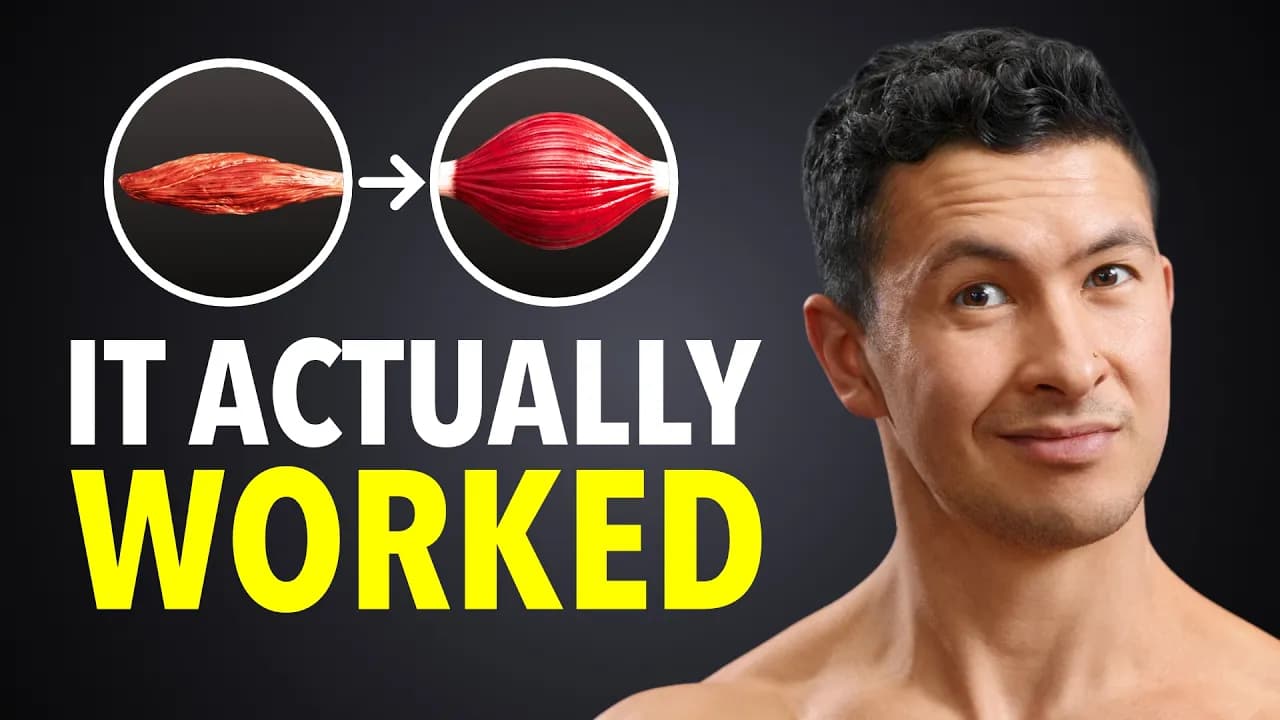
Spent over $40,000 on a study to prove everyone wrong. Fitness community obsessed with stretch-focused training: modifying exercises to stretch muscles more or challenge them in the stretch makes them S-tier for growth. Speaker previously supported this based on dozens of studies, but evidence has massive holes. Assembled elite research team, custom machines, year-long comprehensive study to answer: Is the stretch really the key to building more muscle? Results shocked the speaker.
Do these findings change your thoughts on some of the exercises that you may have thought better for growth. >> Kind of. Yeah, I think
Benefits of stretching muscles for growth known since 1970s. Researchers hung weights from chicken wings to stretch lat muscles; lats grew 170% from stretch alone. In humans, extreme loaded stretching on chest and calves (Dr. Eric Helms wore intense stretching calf boot for 1 hour/day) produced nearly as much growth as normal strength training. Indicated stretching is a powerful growth signal.
Compared tricep pushdowns to overhead tricep extensions (deeper stretch on long head); deep stretch led to 1.4x growth. Remember this exercise—explains later why it works well for triceps.
Researchers tested holding max contraction with legs fixed at different angles: more bent (quads more stretched) led to up to 2x growth vs. straighter position. Tested real reps: bottom half of leg extension (stretch-focused) vs. top half; stretch version led to more growth. Trend exploded: stretch-focus training for faster gains, S-tier results, optimized exercises.
- Studies only on biceps, quads, calves (easy/cheap to test). Other muscles don't stretch same way; some built differently. One muscle gets crazy growth from stretch not seen in others (revealed later).
- Studies compare totally different exercises (e.g., preacher curls vs. incline curls). Preacher curls (hardest in stretch) showed more biceps growth but lock arm, making it harder to cheat—extra growth from stretch challenge, stability, or both?
- Most studies use ultrasound (fast, cheap, but limited): only snapshots thickness at one point; muscles don't grow evenly top-to-bottom. Stretch research especially affected.
Collaborated with university, Brett Contreras, Kassem Hansen. Tested rarely studied muscles (chest, glutes, side delts, rear delts) using MRI (gold standard, full 3D model, precise but $1,000/hour; needed 20+ hours). Brett Contreras funded MRI portion.
Tested exercise hardest in stretch vs. hardest in squeeze. Used custom machines from Prime Fitness USA for lateral raises, hip extensions, pec flies, reverse flies. Knob-adjusted resistance profile: make hardest in stretch (beginning) or squeeze (end), same exercise/range of motion. Cleanest stretch vs. squeeze test ever.
Recruited 20 subjects (men/women). Within-subjects design: one side body stretch-focus, other squeeze-focus; controls genetics/diet. Makes 20-subject study stronger than 40+ regular subjects. Hypothesis: stretch side outperforms.
Test subjects predicted squeeze side better (e.g., harder near end). Blinded MRI analyst, statistician; speaker saw results post-stats. Head researcher Adam Jones spent 200+ hours manually outlining/measuring MRIs. 97% adherence (388/400 workouts). Muscles grew ~20% in 10 weeks (excellent, increases detection power).
Pressure on the heel, nice and tall, and then we're sweeping that leg down and back. Good. Controlling up.
I think my left leg, which is the one that gets harder near the end, is going to more just cuz it's harder.
JJ's my friend and I enrolled him in the study. And uh I mean like I ever since like two weeks ago, I just kind of noticed he was getting some wicked gains on his shoulders. >> Is one shoulder noticeably bigger than the other? >> That I don't know that I don't know. But um >> definitely there's been some size growth. We'll see. We'll see if the MRI is done.
Guess: stretch or squeeze? Results: chest same growth, side delts same, rear delts same, glutes same. No trends; checked 3 points along each muscle + total volume. Shocked speaker; deeper data explains prior misleading research.
Stretch hype mashes three ideas:
- Degree of stretch: Biarticular muscles (hamstrings, quads, calves, triceps) cross two joints, stretch further. Exercises stretching them more grow faster (why many studies found stretch effective—easy to test).
- Range of motion: Bottom (stretch position) most important for growth. Not going deep limits gains. Study used full ROM both groups.
- Resistance profile: Hardest in stretch vs. squeeze? Study says no—as long as full ROM + some stretch tension, doesn't matter if hardest at bottom/top. Aligns with new study: cable vs. dumbbell lateral raises (one hardest stretch, other squeeze) similar shoulder growth.
Some muscles respond differently to stretch (details later). Limitations:
- Untrained subjects (beginners grow from anything; most prior research also untrained but found differences).
- For trained lifters, novelty sparks growth (speaker: after years dumbbell laterals [squeeze-hard], cable laterals [stretch-hard] grew shoulders faster—new stimulus or enjoyment?). Can do both.
- Didn't test all muscles (e.g., calves respond extremely to stretch; one study: half-reps bottom > full ROM).
Encouraging: Wide range effective exercises if hard training + full ROM (e.g., hip thrust = squats for glutes; reverse dumbbell flies = cables; chest flies = bench press). Good for injuries/equipment/recovery.
Exceptions: Biarticular muscles benefit from extra stretch—include best exercises (specified later). Lats maybe exception (no data yet, speaker's opinion).
Yo yo. >> Okay. So, now that you have actually had a chance to read the results, I'm really curious to hear like what you think. >> Yeah, it looks it looks amazing, by the way. Like I Oh, man. I didn't I didn't realize you were using MRI for it. I think it's a really really important um uh area that you've helped kind of fill fill in. Do these findings change your thoughts on some of the exercises that you may have thought are like better for growth >> kind of. Um yeah, I mean I think with the pecs that's probably the one that like I'm like ah okay well now you know what uh you don't get a little bit of extra range of motion uh by doing the bench press like nah as long as you're training hard and you know doing enough sets maybe it doesn't matter so much. So that's that's a cool finding. I think like my takeaway based on this new study is that like there there's just flexibility, right? I think this is like h it's like kind of gets to like a deeper point about what science-based training should be and how it should be communicated. I don't think there's anyone in the evidence-based field who would be like, "No, no, no." Like the stretch is literally number one. Like more important than training hard, more important than how much volume you do, more important than like controlling the weight and progressive overload and consistency and all this stuff. Like that's not a take. We kind of have like a lot of the puzzle pieces in place when it comes to those like fundamental variables. And these are just like the final few pieces that were like trying to fit in. >> Yeah. Yeah. And that was one of the goals with our study, too.
Study doesn't disprove past research—adds clarity on where stretch matters. Science builds on prior work, refines stances.
Next study: first MRI on back growth (rows vs. pulldowns). Funded by Built with Science app profits. App: science-based pocket coach (builds workouts, tracks progress, smarter training/diet). New AI version uses speaker's knowledge, dietitians, latest science for personalized coaching. Users report insane transformations. Free 2-week trial; Black Friday 20% off until Dec 1 (code in description after). Preprint link in description.
Keep Jeremy Ethier in your library
Save the videos and channels worth coming back to, and find them again in one place.